
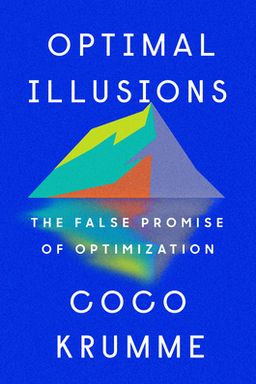
Optimal Illusions cover

Optimal Illusions

by Coco Krumme

Optimal Illusions unveils the hidden costs of a world fixated on optimization. Coco Krumme explores how this obsession leads to social and environmental issues, while offering a fresh perspective that balances efficiency with resilience and inclusion. Discover how to move beyond rigid systems towards a more harmonious future.

The Illusion of the Optimized Life

How can you know if your life is genuinely thriving—or just endlessly optimized? In Optimal Illusions, Coco Krumme argues that modern society has mistaken efficiency for meaning. We’ve built a world run on algorithms, spreadsheets, and endless improvements, yet those very mechanisms have left us disconnected, lonely, and anxious. Krumme contends that optimization was never simply a set of mathematical principles—it evolved into a cultural lens, shaping how we see time, productivity, even morality.

Krumme begins by asking how we came to worship efficiency as the highest virtue. From Amazon’s vast logistics systems to the quantified self movement, optimization promises that every problem can be solved by tuning parameters and analyzing data. Yet, she discovers that this faith in perfect systems mirrors the rise of Protestant individualism, industrial capitalism, and the mathematical revolution that began with figures like Isaac Newton. The result is what she calls an epistemic land grab—a worldview so pervasive that it crowds out all alternatives.

From Ruins to Algorithms

The introduction’s vivid image of a bulldozer carving up the Kentucky landscape symbolizes this transformation. Beneath the dirt lies history; above it, humanity builds the $1.5-billion Amazon Air Hub. Efficiency drives everything—from the movement of lobsters across the country to the way “one-day shipping” reshapes civilization’s arteries. Beneath this logistical choreography, Krumme finds a hidden language: optimization.

She traces her own journey from mathematical modeler at MIT and Silicon Valley to disillusioned observer wandering through America’s agricultural and industrial heartlands. Her story becomes both personal and cultural, mirroring the nation’s obsession with the “best possible” outcomes—whether in farming, technology, or individual success.

Optimization as a Belief System

For Krumme, optimization isn’t only a scientific technique—it’s a religion. Rooted in the Enlightenment and refined by industrialists like Henry Ford and efficiency apostles like Frederick Taylor, it preaches salvation through precision. You can see its gospel everywhere: the tech entrepreneur’s dashboard, the calorie counter’s app, the MBA spreadsheet calculating cost-benefit ratios. Every critique is reabsorbed as another optimization problem. If your model fails, you just “improve the model.” No one asks whether we should be modeling at all.

This belief system, she argues, is peculiarly American. Our folk heroes—Eli Whitney, Ford, and even startup founders—translated the dream of efficiency into moral virtue. Productivity became righteousness; waste became sin. Optimization thus seeped into our speech and our values, colonizing even ethics and art with its logic of progress.

When the Best Isn’t Enough

But Krumme warns that every optimized system eventually collapses under its own perfection. The more tightly we engineer, the more fragile we become. We see this in the mental-health crisis of the overworked elite, in the ecological devastation wrought by industrial efficiency, and in the social collapse that follows our obsession with growth. The very logic that promised abundance now leaves communities hollowed out—farmers replaced by algorithms, workers by spreadsheets, and culture by metrics.

Through examples like North Dakota beet farmer Bob—who resists genetically modified crops and ultimately yields to the corporate grind—Krumme shows how individuals lose autonomy inside over-optimized systems. These stories are not isolated but emblematic: the end of agency amid the illusion of perfect control.

Beyond the Metaphor of Efficiency

Krumme’s central question—what is the alternative to optimizing?—drives the book’s structure. She doesn’t call for rebellion or regression but for reframing: seeing the world not through the lens of “best” but through one of place, slack, and scale. Her narrative closes by urging readers to rediscover the inefficiencies that make life humane. The world, she suggests, doesn’t need more algorithms—it needs perspective. As with her own move to an island cabin, salvation lies not in abandoning the system but in learning to look past its seductive, treacherous clarity.

In short: Optimal Illusions asks you to question whether optimizing—your time, your career, even your happiness—has improved life or merely made it measurable. Krumme’s exploration spans centuries, connecting Enlightenment science, Protestant ethics, Silicon Valley startups, and personal longing. Her conclusion is quietly revolutionary: To live well, stop seeking the “best.” Start seeking what’s real.


The Origins of Optimization

Krumme begins her historical excavation in Flatland Revisited, exploring how the modern idea of “optimization” grew from Enlightenment philosophy and industrial engineering. She links Gottfried Leibniz’s claim that we live in the “best of all possible worlds” with Voltaire’s ironic rebuttal in Candide. The eighteenth-century argument over the meaning of “the best” didn’t just launch satire—it seeded the mathematics of optimization. We’ve been chasing “the best lemonade,” Krumme says, ever since.

From Lemonade Stands to Industrial Empires

Her metaphor of the lemonade stand captures optimization in its simplest form: define your ideal outcome (the sweetest or most cost-effective lemonade), measure your parameters (lemons, sugar, water), and solve under constraints. What began as playful arithmetic evolved into software models controlling cargo schedules and advertising algorithms. The same logic drives global supply chains and agricultural consolidation. Through the story of North Dakota farmer Bob, she illustrates how optimization reshaped farming—from local rotations and communal knowledge to mono-cultured beets and chemical precision.

Norman Borlaug and the Green Revolution

Krumme recounts Norman Borlaug’s twentieth-century crusade to breed higher-yield wheat—a project that saved lives but also defined humanity’s new obsession with productivity. Borlaug’s “Green Revolution” optimized biology itself, creating dwarf crops tailored for mechanized harvesters. Yet this mechanical progress led to invisible trade-offs: polluted water, eroded soil, diminished community. Optimization’s triumph came at the cost of its soul.

The Tragic Trade-off

In modern America, Krumme writes, we exchanged three vital qualities for efficiency: slack, place, and scale. Slack is redundancy, the cushion that absorbs shock. Place is knowledge grounded in local experience. Scale links part to whole, helping us feel connected to what our work serves. In chasing yield, we’ve lost all three. The beet farmers of North Dakota, like the global economy itself, operate on razor-thin margins, unable to adapt when the market shifts. The more we optimize, the narrower our vision becomes—and the less resilient our world.

Optimization, Krumme concludes, is not real improvement but an emotional illusion—the feeling of control achieved by making variables behave. Yet behind every model lies fragility, excessive precision, and the human longing to simplify complexity.


The Age of Atomization and Abstraction

Traveling to Las Vegas, Krumme studies the modern city as an altar to optimization. The Strip’s automated spectacle mirrors the logic of algorithms: every slot machine is tuned to keep you losing just long enough to stay hooked. She calls Vegas “a paean to optimization”—a place where the math of probability becomes theology. To understand how we got here, she turns to Isaac Newton and Claude Shannon, two thinkers who changed how humans conceptualize the world.

Newton’s Magic and Shannon’s Code

Isaac Newton’s transition from alchemy to physics, Krumme argues, marks the moment when mystical pursuit became mathematical discipline. Newton divided the world into predictable parts—the foundation of calculus and reductionist science. Centuries later, Claude Shannon performed a similar revolution in information theory: turning human speech and uncertainty into bits and entropy equations. Both men reshaped reality into data, inviting others to “engineer” society itself.

Atomization, Abstraction, and Automation

Krumme identifies three conceptual shifts that cemented optimization’s worldview:

  • Atomization – Breaking reality into parts, like factory components or data bits.
  • Abstraction – Replacing experience with models, maps, and algorithms.
  • Automation – Handing decision-making from humans to machines.

These shifts made possible everything from Ford’s assembly lines to Zappos’s call-center metrics and Amazon’s warehouses. Each phase removed friction—but also empathy. Vegas and online commerce thrive on atomized probabilities, detached from the tactile, moral web that once governed human interaction.

The Flattening of Reality

Through Newton’s formulas, Shannon’s information entropy, and poker’s regret-minimization algorithms, Krumme shows how precision flattens life. We gain predictive control but lose surprise, texture, and moral pluralism. Her metaphor of mapping Nevada’s deserts parallels flattening truth itself—trading awe for certainty, art for quantification. When the “best strategy” is known, as in poker or corporate forecasting, the game dies. The triumph of efficiency is its own extinction.

Optimization’s beauty, Krumme writes, is seductive; its treachery lies in how it makes every surprise look like an error to be fixed, rather than a mystery to be lived.


The Gospel of Efficiency

In one of her most striking chapters, “High Desert Church,” Krumme connects optimization to spiritual history. She compares Marie Kondo’s tidy rituals to Benjamin Franklin’s moral bookkeeping and John Stuart Mill’s utilitarian calculus. Efficiency, she writes, began as a way to organize virtue. The Puritans sought salvation through hard work; the modern West seeks salvation through productivity dashboards. The lineage is surprisingly direct.

From Frugality to Utility

Krumme explores how early American thinkers treated discipline as a moral act. Franklin’s virtue of frugality—“Waste nothing”—became the prototype for modern efficiency metrics. As society industrialized, British philosophers like Mill and Bentham added social calculus to moral calculus: maximize “the greatest good for the greatest number.” Utilitarianism turned ethics into math, mapping virtue onto equations of pleasure and pain. The result was a new religion grounded not in grace but optimization.

The Modern Saints of Tidying

Enter Marie Kondo. Krumme sees her Netflix fame not as quirky minimalism but as an iteration of the Puritan gospel—the idea that controlling physical space brings moral clarity. Kondo’s “spark joy” mantra is a spiritualized optimization algorithm: sort, categorize, quantify delight. Her success mirrors Silicon Valley’s impulse to engineer not just productivity but happiness itself.

The Moral Anxiety of Modernity

By tracing this lineage, Krumme shows how technological efficiency inherited Protestant anxiety: Are we good enough? Are we doing the right thing? The moral questions of salvation became questions of optimization, and vice versa. Stan Ulam’s Monte Carlo simulation, developed to predict nuclear reactions, embodies this same human urge—to transform uncertainty into control. Our machines now simulate morality itself, evaluating “best” outcomes for human welfare.

Optimization, Krumme writes, was born as a moral language and matured into a technical one. We stopped asking whether the system was good and began asking only whether it worked.


When the Model Breaks Down

In “Metaphoric Breakdown,” Krumme captures the moment when optimization collapses—graphically illustrated by the 2021 Texas power grid failure. The state’s independent energy system, designed for peak efficiency, buckled under stress. The weather froze machinery, electricity prices soared, and five million homes went dark. The grid had done exactly what it was designed to do: optimize price signals. The problem was the metaphor itself.

Gradually, Then Suddenly

Borrowing Hemingway’s line from The Sun Also Rises, Krumme shows how breakdowns occur “gradually, then suddenly.” Systems optimized for perfection lose resilience. Once slack and redundancy are gone, any shock cascades. Like Hemingway’s bankrupt character, our culture collapses from too much control.

Optimization’s Fragile Script

Through the story of Allen Gilmer—the Texas oil executive who built mapping algorithms for drilling—Krumme illustrates how models detach from reality. Gilmer’s software optimized exploration, yet his success drained mystery from discovery itself. The explorer became the mapmaker. When every frontier is charted, curiosity dies. Gilmer’s nostalgia for the “cowboy age” echoes a national psyche yearning for imperfection.

Cultural Collapse as Code Failure

From power grids to financial systems, Krumme links technical collapse to moral exhaustion. Every metaphor eventually breaks. Texas wasn’t just a weather event—it was the failure of the efficiency creed. A model optimized inside closed parameters ignores what lies beyond: people shivering, unpredictable storms, meaning that can’t be coded. In her view, civilization’s “metaphoric breakdown” is underway, signaling a cultural shift toward something slower, more embodied, and less measurable.

When the math stops explaining, Krumme warns, the metaphor remains—and it’s the metaphor that must change. We can’t debug meaning with more code.


The Treachery of Reversing Progress

In “The Treachery of Optimals,” Krumme questions whether optimization can ever be undone. Her metaphor comes from René Magritte’s painting of a pipe captioned, “Ceci n’est pas une pipe.” Like the painting, optimization deceives by presenting models as reality. Even when we reject it, we’re still trapped inside its frame. Can we deoptimize without recreating optimization itself?

The Bison as Metaphor

Krumme travels to Wyoming to meet Jason Baldes, a Shoshone ecologist restoring bison herds as part of a “decolonization of land.” His project shows how hard it is to undo industrial logic. You can’t simply release buffalo into landscapes engineered for cattle and highways. Unwinding an optimization, she writes, is asymmetrical: easy to scale up, nearly impossible to reverse.

Restoration’s Paradox

Attempts to restore nature risk repeating the same mechanistic mindset—replacing one system with another “optimized” version of balance. The American Prairie Reserve’s high-tech conservation plan and billionaire-funded land purchases evoke the same gospel they claim to renounce. As Krumme shows through Baldes and others, authentic renewal demands spiritual humility, not managerial expertise.

Path Dependence and Human Memory

Optimization creates a one-way path. We know how to engineer complexity forward but not how to retreat gracefully. In ecosystems and in culture alike, history accumulates like sediment. The “treachery” isn’t evil intent—it’s blindness to what’s real beneath the models. Whether restoring buffalo or reclaiming lost community, Krumme urges patience, partiality, and acceptance of mess over mastery.

Every optimization, she writes, is a painting mistaken for the world. The cure isn’t another masterpiece—it’s stepping outside the gallery.


Life After the Algorithm

In her final chapters—“After the Gold Rush” and “Babylon”—Krumme offers a vision of what comes after the reign of efficiency. The frontier has closed; the algorithmic empire has plateaued. What remains, she suggests, is learning to inhabit the ruins. The future lies not in rejecting systems but in reclaiming human scale within them.

Finding Slack and Place Again

On her island home near Seattle, Krumme experiences inefficiency as grace. Ferries are late, groceries arrive slowly, and neighbors chat during long waits. Each “delay” rebuilds lost slack, reconnecting individuals and restoring proportion. She contrasts this with the hyper-optimized machine of Silicon Valley, where success feels hollow, like the empty mansions of San Francisco’s tech elite. True meaning comes from rhythm, not speed.

Myths of Progress and Collapse

Through figures like railroad baron James Jerome Hill and the faded ethos of American expansion, Krumme argues that optimization was our national myth—the belief that endless growth equaled redemption. But like all empires, it hits limits. The bulldozer driver at Amazon’s Air Hub becomes an archetype of this turning point: still building, yet haunted by ruins beneath his feet. Krumme invokes Borges’s “Lottery in Babylon” as a parable for our era: a system so pervasive it replaces meaning itself.

A New Lens for Choice

Her proposed way forward rejects both control and escape. You can’t fix optimization by optimizing or flee it entirely. Instead, she calls for a new faith—a renewed choice of perception. Live on islands within systems; build human-scale “third places” to restore connection. The answer isn’t to quit Amazon but to step beyond its metaphorical bulldozer. Where optimization made us spectators, this new lens asks us to become storytellers again, crafting meaning beyond utility.

Krumme’s closing insight: We can’t optimize our way to humanity. But we can choose how to see—all over again.

Dig Deeper

Get personalized prompts to apply these lessons to your life and deepen your understanding.

Go Deeper

Get the Full Experience

Download Insight Books for AI-powered reflections, quizzes, and more.