
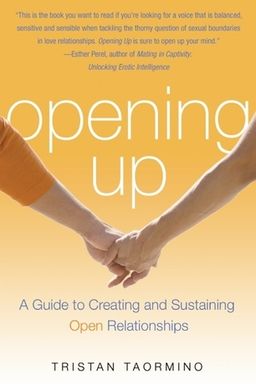
Opening Up cover

Opening Up

by Tristan Taormino

Explore the world of nonmonogamous relationships with ''Opening Up'' by Tristan Taormino. This insightful guide challenges traditional views on love, offering practical advice on communication and self-awareness. Discover how opening your relationship can enhance intimacy, trust, and personal growth, all while exploring new desires.

Reimagining Love and Commitment in Modern Relationships

What does it mean to love in a culture where monogamy is no longer the only measure of fidelity? In Opening Up, sex educator and writer Tristan Taormino argues that monogamy’s decline reflects deeper social transformations: gender equality, sexual liberation, queer visibility, and the ongoing democratization of intimacy. Rather than moral decay, this shift reveals a cultural expansion—an opportunity to reimagine commitment through honesty, consent, and customization.

From Historical Roots to Cultural Evolution

Taormino begins by tracing how monogamy evolved from an economic institution to an emotional ideal. In the 1950s, nearly 96% of adults were married, but social changes—the sexual revolution, the feminist movement, divorce reform, and queer activism—fractured that model. By the early 2000s, half as many people married, and infidelity had become widespread. Studies like Kinsey’s and the Janus Report showed high rates of extramarital affairs, revealing a double standard: people practiced nonmonogamy but refused to admit it publicly.

That contradiction, Taormino argues, explains the rise of consensual nonmonogamy. The “shadow institution” of cheating made transparent, deliberate, ethical alternatives necessary. Movements from the 1972 Open Marriage book to 1990s polyamory communities built language and frameworks to support choice and truth.

The Core Philosophy of Ethical Nonmonogamy

At its center, the book teaches that love and sex thrive through consent, communication, and trust. Taormino distinguishes ethical nonmonogamy from infidelity by making one rule explicit: everyone must agree knowingly and willingly. Consent replaces secrecy with transparency; honesty replaces lying with dialogue. Communication methods like Nonviolent Communication (Marshall Rosenberg) and Radical Honesty are examined and refined into compassionate truth-telling.

Fidelity, in this model, means keeping promises rather than restricting sexuality. Partners can have outside connections while still honoring agreements and protecting emotional safety. This principle reframes commitment from ownership to integrity—maintaining one’s word rather than denying one’s desires.

Navigating Styles and Structures

Taormino’s taxonomy spans swinging, partnered nonmonogamy, hierarchical polyamory, nonhierarchical poly networks, solo poly, and polyfidelity. Each offers distinct logistics and emotional landscapes. Married couples like Shari and Eli thrive in partnered nonmonogamy, choosing sex outside marriage while remaining emotionally devoted. Others, like Lewis, Turner, and Ivan, live in “trilationships” built on equality across three partners. Solo polys like Nicole and Hailey resist hierarchy altogether, building love networks without a single “primary.”

Through these examples, you learn nonmonogamy is not one-size-fits-all—it’s relational design. The goal is not freedom for its own sake but alignment between desire, values, and practicality.

Emotions and the Inner Work of Openness

Opening a relationship demands emotional growth. Jealousy, Taormino insists, is inevitable but instructive. You learn to trace its roots—envy, insecurity, or fear—and to use structured coping tools like self-soothing, naming emotions, and requesting reassurance. Participants report growing from reactive jealousy to transformative awareness, sometimes reaching compersion: joy at a partner’s pleasure with another. This emotional maturity reframes love from zero-sum competition to abundance.

Taormino depicts jealousy and compersion as parts of the same spectrum—signals of attachment. By treating emotions as data rather than threats, you develop resilience and empathy. Emotional literacy becomes the skill underpinning all ethical nonmonogamy.

Design, Boundaries, and Change

Practical agreements define how relationships operate—who can do what, under what conditions, and with what boundaries. Partners craft contracts about sexual conduct, safer-sex protocols, emotional disclosure, and veto or permission rights. Taormino emphasizes flexibility: renegotiate as desires evolve. She warns that change—new partners, orientations, or life stages—is inevitable. Stability comes from adaptation, not rigidity.

In practice, relationships often cycle through openings and closures. Andi and Josh’s temporary return to monogamy exemplifies that transitions can heal rather than fail. The method is intentional communication, not moral judgment.

Community, Family, and Real-World Living

Finally, Taormino covers the sociological side: coming out, parenting, and legal safety. Disclosure can liberate but also endanger—custody battles, workplace risk, and stigma mean you must weigh openness carefully. Poly parents and chosen families offer living proof of success: multiple adults share caregiving, emotional labor, and household tasks. However, legal ambiguity persists, requiring creative use of wills, health proxies, and co-parenting contracts.

Key insight

Modern love’s challenge isn’t monogamy versus nonmonogamy—it’s how to practice trust, communication, and consent amid constant change. Taormino’s vision of nonmonogamy is both moral and practical: an ethics of transparency built to sustain desire without deceit.


Principles and Emotional Skills for Ethical Love

You learn that ethical nonmonogamy depends less on sexual freedom and more on emotional competence. Taormino sets seven pillars of ethical openness: consent, honesty, communication, boundaries, trust, self-awareness, and fidelity redefined as promise-keeping. Each functions as a moral compass when navigating multiple relationships.

Consent and Honesty

Consent must be explicit and informed—no guessing or pressure allowed. Agree because you want to, not because you fear abandonment. Dishonesty turns polyamory into infidelity; honesty makes it a shared creation. Communication isn’t just talking; it’s listening, validating, and checking in. Healthy couples debrief after dates, use scheduled talks, and process hurt without defensiveness.

Boundaries, Trust, and Fidelity

Boundaries define safe space: physical (condoms, safer sex rules), emotional (sharing feelings appropriately), and logistical (e.g., not having sex in shared bedrooms). Trust builds slowly; consistency and honesty sustain it. Fidelity becomes about integrity: keep your word even when permissions change.

Building Emotional Literacy

The emotional labor of openness involves self-knowledge. Recognize triggers and jealousy patterns early. Compersion, or joy at your partner’s pleasure, emerges through empathy and practice—proof that love can expand without scarcity. As Mark Michaels and Patricia Johnson note, honesty without compassion is cruelty; love requires both truth and kindness.

Key insight

Ethical nonmonogamy is emotional craftsmanship: you build structures of consent and compassion strong enough to hold freedom without chaos.


Mapping the Many Forms of Open Relationships

Instead of a single template, nonmonogamy offers multiple structures—from swinging to solo polyamory. Taormino invites you to analyze what kind of emotional and logistical balance suits you.

Swinging and Partnered Nonmonogamy

Swingers often maintain one central relationship while engaging others for sexual variety. Clubs, conventions, and online networks define etiquette and safer-sex protocols. Examples like Agnes and Raymond show couples evolving from monogamy to organized play. Partnered nonmonogamy goes further: partners explore sexually outside their marriage while keeping emotional intimacy at home.

Polyamory and Its Variants

Polyamory involves multiple emotional bonds. Hierarchical models designate a primary and secondaries (common among couples managing home or legal ties). Nonhierarchical systems remove hierarchy entirely, prioritizing equality (Lewis, Turner, and Ivan’s triad being a classic example). Polyfidelity closes networks so members commit exclusively within a group (Sandra’s five-person family shows this model in motion).

Solo Polyamory

Solo polys like Nicole reject social pressure to form a “couple.” They sustain autonomy, often maintaining multiple intimate ties but separate households. Society’s bias toward pair-bonding means these individuals create custom support networks for belonging and safety.

Choosing and Customizing Your Structure

You choose a form not by ideology but by compatibility: emotional bandwidth, time, and goals. Successful open relationships come from intentional design. As Taormino notes, “build what fits, not what’s fashionable.”

Key insight

Relationship diversity shows love is not limited by structure—it’s expanded by choice and respect.


Designing Agreements and Handling Violations

Agreements anchor open relationships. They define expectations and prevent emotional collisions. Taormino treats them like living contracts: written or verbal understandings covering sex, emotion, and logistics.

Crafting Specific Rules

You learn to ask: who, what, when, where. Set boundaries on partners, sex acts, safer sex, and time. Couples often decide whether outside play happens together or separately, if bedrooms are shared or off-limits, and how to handle disclosure. Written agreements build clarity and trust—like Ignacio and Khane’s ritual “Alone Month” to reaffirm their primary bond.

Dealing With Gray Areas and Violations

Not every situation fits written rules. Gray areas appear when intent is unclear—does lunch count as romantic? Is club play allowed if marks remain visible? The book outlines repair steps: clarify facts, assess intent, apologize sincerely, and renegotiate. Major violations (unprotected sex or secret affairs) require accountability and rebuilding trust.

Balancing Fairness and Flexibility

Strict equality often fails; balance succeeds. Each partner’s needs differ—time, libido, emotional tolerance—so flexibility protects harmony. Agreements evolve; renegotiation is not weakness but maintenance.

Key insight

Clarity and adaptability protect relationships more effectively than rigid rules; agreements are living tools, not traps.


Understanding Jealousy and Cultivating Compersion

Jealousy is not the enemy—it’s information. Taormino and poly educators like Owen and Raven Kaldera frame jealousy as a dashboard warning light: pause, inspect, and understand before reacting.

Dissecting Jealousy

Jealousy contains envy, insecurity, possessiveness, and exclusion. You may crave what another has, fear replacement, or feel left out. Naming each part helps address it. Practical steps—self-soothing, journaling, “I” statements, reality-checking fantasies—turn jealousy from chaos to clarity.

The Art of Compersion

Compersion, born at the Kerista Commune, flips the script: feel joy in your partner’s pleasure. Erotic compersion transforms jealousy into arousal, as Claire and Dahlia discovered when they found joy watching their partners with others. Emotional compersion is deeper—Marcus and Fiona’s examples show love amplified by shared joy, not diminished.

Learning Both Skills

To cultivate compersion, unlearn possessiveness, meet partners’ lovers to humanize them, and reframe fear as growth fuel. Taormino insists compersion is optional yet rewarding—it reveals abundance rather than scarcity.

Key insight

Jealousy and compersion are emotional mirrors—both demand courage, but only awareness transforms them into connection.


Navigating NRE and Relationship Change

New Relationship Energy (NRE) refers to the thrill of new love—the chemical rush that can blind judgment. Taormino shows how to enjoy it safely by balancing excitement with accountability.

Recognizing the Pattern

NRE resembles limerence—obsessive thinking, euphoria, tunnel vision. People in it neglect old relationships, overcommit, and dismiss warnings. Ron and Violet’s story reveals both dangers and recovery: his NRE burned out, but their marriage survived through patience and communication.

Balancing Passion with Stability

Enjoy the high but keep perspective. Delay major life decisions, schedule time with existing partners, and ask for feedback when you feel infatuated. If you chase NRE repeatedly, examine whether it’s emotional escapism. Used well, NRE can renew old love, not destroy it.

Embracing Transitions

Change never stops in open relationships: new partners, orientations, or priorities require adaptation. When monogamous couples open up—or when poly people close temporarily—Taormino reminds you to treat transitions as growth. Amity Buxton’s research on mixed-orientation marriages supports this: upheaval can evolve into self-discovery for all involved.

Key insight

Emotional maturity is measured not by how you open relationships, but by how gracefully you navigate change.


Community, Parenting, and Legal Safety in Poly Life

Nonmonogamy extends beyond personal choice—it’s social living. Taormino closes by exploring public life: coming out, building community, parenting, and legal protection.

Coming Out and Authenticity

Disclosure can bring liberation and belonging. Dillon’s decision to bring partners to Thanksgiving made his family see all of him. But risk remains—custody loss, career backlash, and stigma. Many (like Dani the minister) choose discretion for survival. You learn to tailor disclosure: decide who needs to know and prepare resources.

Community and Chosen Families

Chosen families like Sandra’s five-person polyfidelitous household or Jimmy’s leather clan offer practical support—shared childcare, emotional labor, and companionship. These networks replace judgmental environments and embody cooperative love.

Parenting and Legal Protection

Multipartner parenting enriches children with diverse adults and stability, but courts still privilege dyads. Valerie White urges written custody and guardianship agreements. Safer-sex protocols and fluid-bond chains safeguard health. Legal tools—tenancy contracts, health-care proxies, wills—replicate protections denied to poly families by default law.

Key insight

Love beyond pairs requires not only personal integrity but social strategy—community and law become acts of care.

Dig Deeper

Get personalized prompts to apply these lessons to your life and deepen your understanding.

Go Deeper

Get the Full Experience

Download Insight Books for AI-powered reflections, quizzes, and more.