
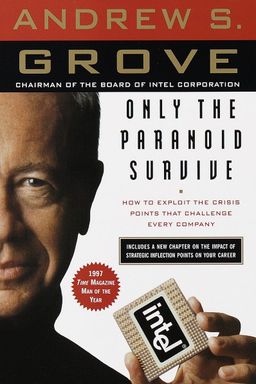
Only the Paranoid Survive cover

Only the Paranoid Survive

by Andrew S Grove

In ''Only the Paranoid Survive,'' Andrew S. Grove shares his experiences as a highly successful CEO, offering strategies to leverage Strategic Inflection Points. Learn how to navigate pivotal changes, foster innovation, and lead your company to new heights.

Thriving Through Strategic Inflection Points

Have you ever felt like the rules that made you successful suddenly stopped working? That moment of confusion—when past strategies fail and new ones aren't clear yet—is exactly what Andrew S. Grove calls a strategic inflection point. In Only the Paranoid Survive, Grove, the legendary former CEO of Intel, argues that enduring success comes from recognizing when your business or career hits this pivotal point—and adapting faster and more decisively than competitors.

Throughout the book, Grove expands on his famous motto, “Only the paranoid survive.” He doesn’t mean destructive anxiety, but rather a productive vigilance—the constant scanning of the horizon for signs that the environment is shifting beneath you. Every company and every career, he contends, will inevitably face moments when its fundamentals are about to change. These transformations can be deadly if ignored or harnessed as opportunities for reinvention if confronted head-on.

From Intel’s Crisis to Universal Lessons

Grove opens with the now-famous story of Intel’s Pentium processor crisis in 1994—a minor technical flaw that exploded into a public relations disaster, costing nearly half a billion dollars. Facing overwhelming media scrutiny and customer outrage, Grove realized that Intel was no longer a supplier to engineers and manufacturers—it had become a consumer brand. The old rules of B2B commerce had vanished overnight. This realization marked one of Intel’s defining strategic inflection points, forcing Grove to reimagine how the company operated, communicated, and engaged customers.

But Grove goes deeper. He rewinds to an earlier crisis when Japanese semiconductor firms overtook Intel in memory chip manufacturing. In what would become one of the most studied business pivots in history, Grove and Chairman Gordon Moore decided to abandon their original business—the very one their company was founded on—and bet everything on microprocessors. That choice not only saved Intel but redefined computing for decades.

Understanding “10X Changes”

What triggers an inflection point? Grove uses what he calls a “10X change”—a shift in one of the six forces that shape competition (derived from Michael Porter’s model): competitors, suppliers, customers, potential entrants, substitutes, complementors, and regulators. When any of these forces intensifies tenfold—say a new technology emerges, global competition surges, or regulation suddenly disappears—the old logic of the business collapses. Grove’s skill lies in helping readers recognize when such a 10X change is happening and how to respond before it becomes fatal.

Navigating the Valley of Death

Between the old equilibrium and the new order lies what Grove evocatively calls the “valley of death.” It’s the most perilous phase of transformation, when confusion reigns and leaders question their instincts. He compares it to crossing treacherous terrain without a map—you can’t turn back, but you also don’t yet see the other side. The only way through, Grove insists, is ruthless clarity of direction and experimentation. “Let chaos reign,” he writes, “and then rein it in.” Change cannot be planned in neat spreadsheets—it must be lived, felt, and tested.

Paranoia as a Mindset for Survival

Grove’s “paranoia” is not fear for fear’s sake—it is an alertness to signals that others ignore. He recommends cultivating a network of “Cassandras”—people in the organization who sense change first but are often dismissed. For Intel, these Cassandras were middle managers and engineers who noticed that Japanese competitors were offering higher-quality DRAM chips at lower prices. Grove’s insight is that the periphery usually sees what the center doesn’t; executives must listen to uncomfortable truths before it’s too late.

From Companies to Careers

In the final chapters, Grove extends his model to individuals. He argues that your career is your business. Just like corporations, people face inflection points that redefine what skills and industries matter. When the environment shifts—whether through technology, globalization, or mergers—you can’t count on loyalty or stability. The key is to think like an entrepreneur of one: anticipate changes, run mental fire drills, and constantly “get in shape” for future transitions.

Why This Matters

In essence, Only the Paranoid Survive is both a survival guide and a leadership manifesto for the modern era. Grove blends engineering precision with psychological insight, showing that business transformation is as much about emotion and courage as analysis. His lessons echo thinkers like Peter Drucker on adaptation and Clayton Christensen on disruption—but Grove adds the gritty realism of someone who lived through the chaos. Whether you’re leading a company or steering your own career, Grove’s message is simple yet profound: paranoia isn’t the enemy—it’s your most reliable early warning system in a world where something fundamental will always, eventually, change.


Recognizing When Something Has Changed

Grove begins by showing how difficult it is to realize that your environment has already shifted. During the Pentium chip crisis, Intel was blindsided—not by a technological failure, but by a shift in perception. In the past, Intel’s customers were computer manufacturers. Suddenly, ordinary consumers were demanding new chips and questioning Intel’s integrity. “Where do you get off telling us what’s good for us?” became the new refrain. The company hadn’t just misread the problem; it had missed that the rules of its world had changed.

The Hidden Signs of Rule Changes

Every business operates by an unstated set of rules—how products are sold, who defines quality, and what competition looks like. Grove warns that these rules rarely announce their own expiration date. They creep up gradually, and leaders often notice only when performance slumps or when customer complaints multiply. He compares it to sailing a boat when the wind suddenly changes direction: if you don’t adjust the sails quickly enough, the boat heels over. By the time you realize it, the old techniques no longer work.

The “Last to Know” Phenomenon

Grove confesses that CEOs are often the last to understand what’s happening. Those closest to customers—salespeople, technical support, and middle managers—sense trouble first. He recounts talking with an IT manager who struggled with a new software product while the CEO of the vendor remained oblivious. “That guy is always the last to know,” the manager sighed. Grove took this as a warning to all leaders: the periphery feels strategic tremors long before headquarters does. Staying insulated behind layers of hierarchy leads to blindness.

Exposing Yourself to the Winds of Change

To stay alert, Grove urges managers to “expose themselves to the winds of change.” Engage directly with customers—especially those you’re losing. Invite discussions with journalists, analysts, and even critics. These external voices act like early sensors for shifts in technology, taste, or regulation. Intel used customer hotlines and direct phone responses during the Pentium crisis not only to handle complaints but to learn the new psychology of consumer expectations. This openness, though painful, became a catalyst for adapting how Intel communicated.

Lessons for Individuals

Just as companies can be blindsided, so can careers. When you feel that your skills or methods suddenly seem less relevant—or when colleagues begin talking about new tools and trends you’ve never heard of—that’s a personal version of Grove’s “something changed.” The key is humility and curiosity. Ask questions early, before the wave overwhelms you. The paranoid mindset isn’t about fear—it’s about readiness to act when what used to work stops working. The earlier you feel the wind shifting, the better your chances of staying upright.


Managing 10X Forces and Strategic Inflection Points

When markets shift, they rarely do so gently. Grove calls the overwhelming pressures that transform industries “10X forces.” These are changes that multiply one factor of business—like technology, regulation, or customer power—tenfold. They’re not just big; they’re exponential, and they upend entire ecosystems. Understanding these forces is the first step toward mastering strategic inflection points.

The Six Forces Framework

Adapting Michael Porter’s famous “five forces” model, Grove adds a sixth: complementors. The complete list becomes competitors, suppliers, customers, potential entrants, substitutes, complementors, and regulators. Each represents a source of pressure. When one changes dramatically—say, suppliers consolidate or new substitutes emerge—the balance of power shifts across the industry. For example, airlines changing their commission structure forced thousands of travel agencies to rewrite their business models overnight.

The 10X Effect

A “10X” event multiplies power tenfold. Japanese semiconductor makers offered chips that were drastically cheaper and better, triggering Intel’s early crisis. Wal-Mart’s massive logistics network created a “10X” competitive force for small-town retailers. Digital technology replaced silent films. Each example underscores Grove’s point: when a force becomes ten times more powerful, the existing rules no longer apply. You can’t simply do more of the same harder—you must do something entirely different.

Spotting an Inflection Point

Most companies don’t recognize inflection points until they’re halfway through. Grove likens it to getting lost on a hike: it takes a long time for the leader to admit, “We’re lost.” Awareness comes in waves—first confusion, then denial, then realization. The challenge is to act decisively before the data becomes obvious, because by then, it’s often too late. “Timing is everything,” he writes. Ideally, you act while your company still has financial health—your protective “bubble” that allows experimentation without total collapse.

The Human Cost

Inflection points are painful. They produce “holy wars” within companies—engineers arguing over old vs. new technologies, managers clinging to legacy markets. Grove’s Intel saw fierce internal debate between advocates of the old memory business and those backing microprocessors. Those who can balance analysis with instinct—acting before certainty arrives—are the ones who survive. Strategic inflection is not just a business phenomenon but a test of leadership psychology. It asks whether you can let go of your identity before the world forces you to.


Adapting to Industry Transformation

Few stories illustrate the drama of transformation like the evolution of the computer industry itself. Grove details how computing shifted from a vertical structure—where companies like IBM built everything from chips to software—to a horizontal one composed of specialized players. This transition didn’t just change who made money; it changed what it meant to compete.

From Vertical to Horizontal

Before the 1980s, computing was vertical: companies made their own hardware, software, and sales channels. Customers bought “systems” rather than parts. When microprocessors made computing 10X cheaper, the ecosystem flattened. Now, you could buy an Intel processor, a Compaq computer, a Microsoft operating system, and third-party applications—all working together. This horizontal model rewarded specialization and scale rather than ownership of an entire stack.

Winners and Losers

The new system created winners like Intel, Microsoft, and Compaq—companies that focused tightly on their layer of the value chain. It also created casualties like IBM, which struggled to adapt its vertical mindset. Grove describes IBM’s failed attempt to link its OS/2 software to its own PS/2 computers, missing that customers wanted compatibility across brands. Meanwhile, startups like Dell thrived precisely because they exploited the new logic—customizing and selling direct, without expensive distribution channels.

The New Rules

In horizontal industries, Grove distills three rules for survival:

  • Don’t differentiate without a difference—innovations must matter to the customer, not just to engineers.
  • When a fundamental shift comes—like a new chip or interface—grab it immediately. First movers gain time advantage.
  • Price for volume, not cost. Then drive costs down relentlessly to sustain profit.

These lessons extend beyond computers. Retailing, media, and logistics have all trended toward specialization and global scale. The message: focus, partner, and move fast.

The Emotional Toll of Change

For Grove, the hardest part about transformation wasn’t building new strategies—it was shedding old beliefs. He saw executives trying to use vertical-era instincts in a horizontal world, clinging to notions of proprietary control. “The more successful the players were in the earlier industry, the harder a time they had to change,” he observes. Success breeds inertia—a theme later echoed by Clayton Christensen in The Innovator’s Dilemma. The true challenge isn’t knowing that the rules have changed—it’s accepting that your best skills may no longer be relevant.


Let Chaos Reign – Then Rein It In

When old strategies collapse, order becomes a liability. Grove argues that organizations in transition must go through a period of deliberate disorder—a phase he calls “letting chaos reign.” It’s the messy middle between denial and clarity where experimentation leads the way out. Success here depends less on control and more on tolerance for uncertainty.

The Emotional Arc of Managers

Managers experiencing inflection points go through phases similar to grief: denial, escape, and acceptance. Grove recounts how Intel executives tried to distract themselves with side projects while the memory business collapsed—classic avoidance. He warns that such diversions, like acquisitions or “pet initiatives,” often mask deeper inaction. To lead through chaos, managers must confront the hard truths directly.

Strategic Dissonance

A critical signal that a company is stuck is “strategic dissonance”—when words and actions diverge. Grove saw Intel announcing its future as a memory company even while sales teams quietly prioritized microprocessors. This contradiction is common during transitions. Frontline employees often act according to new realities before senior executives admit them. Recognizing dissonance is vital—it shows that the ground has already shifted beneath your feet.

The Power of Experimentation

To find the new order, Grove advocates experimentation—try new products, channels, or technologies. Intel nurtured its microprocessor team for years before betting the company on that business. When chaos reigns, such experiments act as lifeboats, keeping innovation alive until a new direction becomes clear. But experimentation is not unlimited freedom; it’s structured curiosity guided by purpose.

Timing and the Business Bubble

Chaos is safest when cushioned by what Grove calls the “business bubble”—a period when the old business still generates resources. Acting early allows leaders to experiment under protection. Waiting too long, as Grove warns, means experimenting without oxygen. He admits that every major shift at Intel came “a year later than it should have.”

Renewing Mental Maps

During chaos, managers also need to redraw their “mental map” of the industry—who matters, what’s possible, and how power flows. This table-top exercise becomes vital for survival. Grove teaches that industrial maps should evolve like cartography—lines blur, new territories appear, old kingdoms fade. Reinvention starts by redrawing your world on paper and then in action.


Paranoia as a Leadership Discipline

At the center of Grove’s philosophy lies one deceptively simple axiom: fear can be useful. “Only the paranoid survive” encapsulates not just business vigilance but a discipline of continuous awareness. Grove redefines paranoia as attention, not panic—a state where leaders constantly anticipate threats and opportunities rather than react to them.

Constructive Fear

To Grove, fear fuels achievement. It keeps teams sharp, prevents complacency, and ensures early detection of change. A healthy organization is one where employees worry aloud—about competition, performance, and customers. The dangerous opposite of paranoia is comfort. Companies that feel too secure after long success—like IBM before the PC era or Digital Equipment before microcomputers—become blindsided. Fear is the antidote.

Cassandras and Communication

Grove urges leaders to listen to “Cassandras”—those unpopular truth-tellers who warn of impending change. Their insights come from the periphery, where new realities first appear. Managers must create cultures where bad news travels quickly and is never punished. At Intel, Grove prioritized open debate and feedback via email, believing that electronic communication democratized knowledge. Fear without transparency, he warns, becomes toxic; fear combined with open channels becomes strength.

Balancing Data and Instinct

Grove’s paradox is that good management demands both analytics and intuition. Data tells you about the past—instinct guides you through the unknown. During turbulent times, leaders must argue with data, rely on anecdotal evidence, and trust their gut to detect early signals. His advice mirrors Peter Drucker’s call to lead “by judgment” rather than by spreadsheet—a recognition that numbers alone can’t see around corners.

Fear as Focus

Used properly, fear becomes focus. It drives teams to prioritize what matters and keep scanning their environment. For individuals, paranoia means career vigilance: asking regularly “What might make my job obsolete?” For corporations, it means embedding habits of monitoring signals, debating openly, and rewarding adaptation. Grove’s leadership style—data-driven but viscerally cautious—became Intel’s enduring DNA and a lesson in how focus born from fear creates resilience.


Career Inflection Points – Your Life as a Business

In the final chapter, Grove turns his lens from corporations to individuals. His premise is bold: your career is your business, and you are its CEO. Every professional faces their own strategic inflection points—moments when industry shifts, technologies emerge, or personal values change. Those who act decisively, like great companies, survive and grow; those who cling to old skills fade into irrelevance.

The Parallels Between Companies and Careers

Just as organizations encounter “10X” changes, individuals do too. Grove tells the story of a banker who lost his job after a merger, retrained as a broker, and was displaced again by online trading—until he reinvented himself as a financial journalist. His adaptability, Grove says, exemplifies career paranoia: anticipating change and acting before it strikes. Like Intel’s pivot from memory chips to microprocessors, he adjusted his focus before complete disaster.

Running a Mental Fire Drill

Grove encourages you to rehearse mental fire drills: imagine your job or industry disappearing and ask what you’d do next. Stay attuned to signs of change—new technologies, emerging competitors, or shifts in consumer behavior. Talk with people outside your field to see what’s coming. Fear, again, becomes an alert system, helping you prepare for tomorrow’s disruptions instead of dread them.

Overcoming Denial and Getting in Shape

Like companies, individuals often suffer the “inertia of success.” You assume your skills will always be valuable because they worked in the past. Grove warns that denial can cost years of opportunity. When you sense decline—whether in your firm, your role, or your passion—act early while your “career bubble” still protects you. Use that time to retrain, experiment, and build new networks before the old ones collapse.

Clarity and Conviction

Like a CEO guiding a company through the valley of death, you must balance clarity and conviction. Clarity means defining what you want your career to become—and what you refuse to do. Conviction is the will to cross uncomfortable terrain to reach it. Grove’s metaphor is poignant: a career change is like emigration. You leave familiar land behind, with language and customs you once mastered, and begin again as a foreigner. But if you embrace learning and keep moving forward, the new land will soon become home—and your paranoia will keep you thriving there, too.

Dig Deeper

Get personalized prompts to apply these lessons to your life and deepen your understanding.

Go Deeper

Get the Full Experience

Download Insight Books for AI-powered reflections, quizzes, and more.