
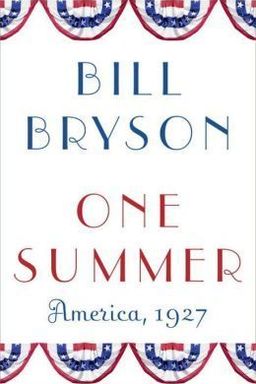
One Summer cover

One Summer

by Bill Bryson

One Summer: America, 1927 by Bill Bryson delves into a transformative period in U.S. history. Discover how events like Lindbergh''s flight, Hollywood''s rise, and Babe Ruth''s fame shaped the nation, while economic policies sowed the seeds of the Great Depression. This engaging narrative uncovers the complexities of a pivotal summer that defined modern America.

1927: The American Year the Modern World Was Born

Imagine standing at the midpoint of the twentieth century’s transformation—the moment when technology, celebrity, industry, and politics converged to reinvent modern life. The year 1927 was that fulcrum. America that year was a laboratory where aviation met mass media, where movies began to speak, sports became national theater, and social policies exposed both ambition and cruelty. Every story—from Lindbergh’s Atlantic crossing to Ford’s failed Amazon utopia—reveals a society balancing innovation with hubris, optimism with moral blindness.

Technological leaps and cultural shocks

In 1927, you see technology breaking barriers. Charles Lindbergh’s solo flight across the Atlantic transformed aviation from spectacle to serious transport, proving that disciplined engineering could scale global distance. That same spirit of possibility animated Hollywood, where The Jazz Singer made the cinema talk and sound reshaped every industry practice. Radio became a unifying voice, knitting rural and urban America into one listening audience, while early television experiments by Philo Farnsworth foreshadowed a new era of mass visual communication.

These inventions didn’t just change machines—they rewired perception. You were no longer isolated by geography: the same broadcast reached millions, the same image flickered in countless theaters. America began to think and dream collectively. Yet such progress also birthed new hierarchies: corporate monopolies, patent wars, and celebrity culture that consumed its own heroes.

Celebrity, media, and the modern myth

The speed of mass communication turned human achievements into instant myth. Lindbergh’s 3,600-mile flight made him a global icon overnight—fetishized in newspaper campaigns and radio extravaganzas that invented modern celebrity. Babe Ruth’s 1927 Yankees likewise made sport synonymous with stardom and spectacle, transforming athletes into commercial personalities. At the same time, tabloids sensationalized crime—the Snyder–Gray murder case and the Bath school massacre—to feed a growing appetite for drama and voyeurism.

These cycles of exposure created the culture we now inhabit: headlines that glorify, audiences that idolize, and the constant friction between privacy and publicity. Lindbergh’s later torment, from overexposure to political backlash, foreshadowed the celebrity paradox of modern fame—a lesson as relevant to the digital age as to the age of ticker tape.

Economic and industrial power

Behind the pageantry, 1927 was also a pivotal financial and industrial year. The Federal Reserve’s decision to cut rates at a secret Long Island meeting, meant to help Europe, flooded American markets with credit and seeded the stock bubble that would burst in 1929. Meanwhile, Henry Ford—symbol of industrial mastery—revealed both genius and blindness. He shut down his vast Model T production without a replacement ready, costing millions in idle capacity. Simultaneously, his ill-fated Fordlandia experiment in the Amazon showed how mechanical thinking failed when transplanted into living ecosystems. Both episodes exposed an industrial age learning painfully that control has limits.

These economic moves intertwined with culture: cheap credit fueled consumer exuberance—installment buying for cars, radios, and shares—while the idea of relentless progress lulled the nation into complacency. The seeds of the Great Depression were being quietly sown beneath the roar of prosperity.

Social fault lines and the politics of fear

If 1927 was a triumph of imagination, it was also a mirror of cruelty and inequality. The Supreme Court’s decision in Buck v. Bell legalized sterilization of people labeled “unfit,” embedding eugenic ideology into law. The Sacco and Vanzetti executions exposed how fear of radicals and immigrants could warp justice. The Mississippi Flood displaced hundreds of thousands—mostly poor and Black—revealing how class and race determined who survived disaster. In each case, technological or bureaucratic power was wielded with moral arrogance, a pattern hauntingly familiar today.

Equally bitter ironies unfolded under Prohibition: a policy meant to uplift morality instead spread corruption, poisoned thousands through tainted alcohol, and enriched organized crime. Enforcement vacuums, underpaid agents, and systemic hypocrisy showed how moral crusades, once codified as law, can unravel civic trust.

A culture of performance and risk

Across aviation, sport, industry, and entertainment, Americans in 1927 embraced performance as proof of virtue. Lindbergh’s solitude in the cockpit, Ruth’s swing, Dempsey’s long count, Ford’s self-reliant empire—all honored the individual’s defiance of limits. But each pointed to new kinds of dependency: on machines, markets, and media systems too vast to control. The modern hero was no longer the frontier pioneer but the skilled operator within an industrial spectacle—the person who commanded complex tools while risking being consumed by them.

The lasting inheritance

By year’s end, America had become recognizably modern. The airplane and radio abolished distance, the movies merged sound and image, corporate power intertwined with creative invention, and ordinary citizens experienced the world as audience and participant at once. Yet the moral crosscurrents—eugenics, inequality, moral panic—warned that technological advance alone does not guarantee progress. The year encapsulated the twentieth century’s dual promise: mastery over nature and machinery, and vulnerability to our own excesses.

Core insight

1927 stands as the year America rehearsed the future—when innovation met spectacle, idealism met inequality, and the machinery of progress began to define the modern condition.


Aviation’s Breakthrough and the Age of Daring

Aviation in the 1920s was an arena where technology met raw courage. The decade began with leftover wartime hardware and ended with transatlantic triumph. The Orteig Prize catalyzed the leap—$25,000 for the first nonstop New York–Paris flight drew engineers, adventurers, and dreamers into open competition. Amid crashed prototypes, vanished crews, and frantic redesigns, one insight emerged: simplicity and reliability would outlast extravagance.

From war technology to peacetime obsession

World War I left behind production lines, trained pilots, and mechanical know-how but no clear civilian purpose. Prizes and nationalism filled the gap. René Fonck’s overloaded Sikorsky crash, Nungesser and Coli’s disappearance, and Byrd’s multi-engine failures taught fatal lessons. Only Lindbergh—a meticulous 25-year-old air mail pilot—applied those lessons completely: one engine, minimal instruments, maximum fuel efficiency.

Design thinking in flight

Lindbergh’s Spirit of St. Louis embodied elegance through restraint. Built by Ryan Airlines in sixty days, it sacrificed comfort for endurance. The forward fuel tank blocked visibility but improved safety; the Wright J-5 Whirlwind engine balanced power and reliability over 3,600 miles without failure. Navigation relied on arithmetic and nerve—dead reckoning over vast darkness, using only a clock and compass.

His 33½-hour flight from Roosevelt Field to Le Bourget proved that range, not risk, defined the future. The single-engine strategy outperformed massive multi-engine fantasies. In engineering terms, Lindbergh’s decisions foreshadowed modern systems thinking: identify core objectives, minimize variables, and accept discomfort to maximize design integrity.

Technological and cultural ripple

Lindbergh’s success validated commercial aviation. Within months, airlines multiplied, airports were funded, and investors poured millions into new ventures. The airplane’s image shifted from daredevil’s tool to public infrastructure. (Pan Am’s transoceanic networks and Douglas’s later aircraft owed much to this psychological swing.) Aviation became the technological metaphor for modernity: speed, autonomy, and mastery of invisible routes.

Enduring insight

Progress often rewards disciplined simplifiers more than flamboyant innovators; success depends as much on knowing what to exclude as on what to invent.


Lindbergh and the Making of Mass Celebrity

After Paris, Lindbergh’s image escaped his control. Newspapers printed millions of words; radio amplified his voice nationwide; parades suffocated cities under confetti rain. The quiet pilot became the world’s first truly modern celebrity—achieved, packaged, and consumed through synchronized mass media.

The mechanics of fame

You can trace the process almost scientifically. Journalists constructed narrative arcs of pure heroism, editors competed for sensational angles, and radio synchronized emotion across time zones. NBC’s coast-to-coast broadcast of his Washington Monument reception reached perhaps thirty million listeners—the first truly national live event. The nation’s technological networks created unity through shared awe.

This machinery birthed a new economy: endorsements, songs, and souvenirs. Hollywood courted him; cities declared holidays. Yet for Lindbergh himself, the public appetite quickly became burden. Endless appearances reduced privacy to anecdote. The pilot who valued solitude found himself imprisoned by devotion.

From triumph to fatigue

Lindbergh’s later trajectory mapped the dangers of mythic identity. His son’s kidnapping in 1932 and his own political misjudgments—accepting a medal from Nazi Germany, supporting isolationism—demonstrated how moral nuance evaporates under symbolic light. His wartime isolation turned glory to controversy. In hindsight, the same mass media that exalted him consumed him.

Cultural lesson

The Lindbergh saga introduced the feedback loop between media, celebrity, and moral scrutiny—the process by which technological connectivity creates both heroes and scapegoats.


Mass Culture: Movies, Radio, and Spectacle

In 1927 entertainment became industry and art turned into networked commerce. Hollywood, Broadway, and broadcasting simultaneously crossed thresholds that made them global forces. The shift from silent to sound cinema with The Jazz Singer and the rise of national radio networks fused technology and performance into a single mass experience.

The film revolution

Warner Bros.’ gamble on Vitaphone synchronized discs and Al Jolson’s partial dialogue transformed audiences’ expectations overnight. Once people heard speech from the screen, silence felt archaic. Theaters scrambled for costly upgrades; actors with poor diction faded; and the musical genre emerged. Simultaneously, Broadway’s Show Boat introduced the integrated musical—songs and plot unified to tackle racial and emotional depth—signaling a maturing art form.

Radio and the collective ear

Radio, orchestrated by David Sarnoff’s RCA empire, became the soundtrack of national life. Live events—the Dempsey fights, presidential speeches, Lindbergh’s return—welded local and national into one emotional field. Advertising converted this intimacy into revenue, birthing a new commercial culture. Even television’s infant experiments by Farnsworth hinted at visual broadcasting’s eventual takeover of attention.

Meanwhile tabloids and publicity stunts turned everyday crime and scandal into serialized theater. Newspapers printed composograph photos to dramatize courtrooms; morality tales doubled as entertainment. Together, these mediums built the media ecosystem of our age: simultaneous, commercialized, and personality-driven.

Essential takeaway

Modern mass media was born from the fusion of technology and spectacle—uniting audiences through shared emotion while commodifying attention as the new currency.


Industry, Innovation, and the Limits of Control

1927 revealed both the power and peril of industrial ambition. On factory floors and in boardrooms, the same managerial logic that had built Ford’s assembly line reshaped nations—but also exposed the limits of control when human complexity, nature, or expertise was ignored.

Ford’s dual gambles

When Henry Ford halted Model T production, he upended the global auto economy. His insistence on internal secrecy and rejection of external experts left dealers idle and workers unemployed for months. Meanwhile, across the equator, his Fordlandia experiment tried to impose the same precision on the Brazilian jungle—an ecological and cultural fiasco that exposed the arrogance of industrial universalism. Rubber trees succumbed to pests; managers misunderstood local customs; disease spread.

Both cases illustrate the paradox of genius untempered by humility. Ford’s empire could conquer repeatable processes but collapsed when confronted with living systems—whether biological, economic, or social. In this you glimpse the early warning that scale can magnify error as easily as efficiency.

Economic euphoria and hidden fragility

That same year, Federal Reserve policy—cutting interest rates to aid Europe—unintentionally inflated America’s market bubble. Brokers’ loans soared, stock speculation became a civic pastime, and easy credit fueled consumerism. People bought goods and shares on installments, mistaking liquidity for wealth. The optimism that celebrated Ford’s factories and Lindbergh’s flight masked financial instability ready to snap.

Industrial lesson

Efficiency without adaptability breeds fragility; systems that ignore ecology—human or environmental—eventually collapse under their own rigidity.


Crisis, Policy, and the Politics of Inequality

Technological triumphs shared the stage with moral failures. In 1927 the United States confronted the dark side of modern governance: the capacity to mobilize resources and knowledge for exclusion as well as prosperity.

The Mississippi Flood and the birth of federal responsibility

The Great Mississippi Flood covered sixteen million acres, displacing hundreds of thousands. Herbert Hoover’s efficient command rescued many but also staged him as national savior—a preview of how media-managed bureaucracy could elevate political careers. Yet relief was biased: Black refugees were conscripted into forced labor and medical neglect. The disaster catalyzed the 1928 Flood Control Act, embedding federal responsibility for infrastructure and setting precedent for later New Deal institutions.

Eugenics and legal injustice

In the same year, the Supreme Court’s Buck v. Bell decision authorized sterilizing citizens deemed “unfit.” Justice Holmes’s phrase—“Three generations of imbeciles are enough”—enshrined pseudo-science as law. Combined with Harry Laughlin’s lobbying and the Sacco–Vanzetti executions, 1927 exposed how fear and prejudice could masquerade as rational policy. These episodes display how modern governance, empowered by data and expertise, can still commit moral atrocities when unchecked by empathy.

Prohibition’s unintended empire

Even attempts at moral improvement misfired spectacularly. The federal mandate to denature industrial alcohol turned drinking toxic; thousands died from poisoning in the name of deterrence. Corruption flourished as underfunded agents sold protection and judges took bribes. Yet within that chaos, creative enforcement strategies emerged—Mabel Walker Willebrandt’s use of tax law against bootleggers anticipated later prosecutions of organized crime. Prohibition thus forged both criminal empires and modern federal enforcement tactics.

Ethical takeaway

1927’s politics reveal that competence without conscience—whether bureaucratic, judicial, or scientific—can institutionalize injustice as efficiently as progress.


Sports, Spectacle, and the Shared Imagination

When Americans debated heroes in 1927, they looked not to generals but to athletes and performers. Sports became a national theater where industrial efficiency met individual flair. Boxing, baseball, and spectacle synchronized with radio and newsreels to create communal emotion on an unprecedented scale.

Dempsey, Tunney, and the power of drama

Jack Dempsey’s rematch with Gene Tunney in Chicago, the “long count” fight, drew 150,000 fans and fifty million radio listeners. Its controversy—seconds of delay determining legacy—illustrated how rules, media, and money turned sport into narrative. The crowd’s roar became a national soundscape. Boxing redefined masculinity and spectacle, even as racial exclusion lingered beneath the surface.

Ruth’s 60 and mythic proportions

Meanwhile Babe Ruth’s sixty home runs embodied both physical power and entertainment theater. He and Lou Gehrig turned the Yankees into a corporate brand, merging sport with celebrity marketing. Stadiums swelled, concessionaires thrived, and radio narrators unified fans from Harlem to Houston. Ruth’s performance closed the gap between working-class exuberance and modern show business.

The meaning beneath the spectacle

Sports in 1927 mirrored national identity: self-reliant, risk-loving, but craving shared triumphs. The same culture that idolized Lindbergh and Ruth also thirsted for instant stories—proof that greatness could be seen, heard, and collectively owned. In this, the United States discovered its enduring grammar of celebrity: performance, publicity, and profit intertwined.

Cultural insight

Spectacle turned achievement into national ritual, teaching Americans to experience unity through shared attention rather than shared struggle.

Dig Deeper

Get personalized prompts to apply these lessons to your life and deepen your understanding.

Go Deeper

Get the Full Experience

Download Insight Books for AI-powered reflections, quizzes, and more.