
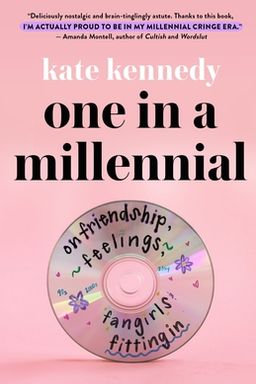
One In A Millennial cover

One In A Millennial

by Kate Kennedy

A pop culture podcaster grapples with the agony and ecstasy of the cultural touchstones of her generation.

The Millennial Tightrope

How can you make sense of a generation that grew up unplugged and came of age online, was promised limitless possibility but met serial recessions, and was schooled by Britney and church as much as by teachers and parents? In One in a Millennial, Kate Kennedy argues that being a millennial is less a birth-year box and more an ongoing negotiation between stereotype and lived experience. She contends that identity in this cohort emerges at the intersection of pop culture’s informal curriculum, institutions that taught contradictory scripts (schools, churches, sororities), and a volatile economy that tested those scripts in real life.

Kennedy writes from inside the story—part memoir, part cultural analysis—so you can recognize your own memories as historical data. The book’s core promise is simple: if you read your life alongside the cultural and structural forces that shaped it, your contradictions make sense. But to do so, you must understand the generational timing that made performance, belonging, and agency unusually fraught for millennials.

Touchstone

“From the outside looking in, you can’t understand it. From the inside looking out, you can’t explain it.” (a sorority koozie Kennedy cites, reframed here as a generational koan)

Generational timing: offline childhood, online adolescence

If you were born into the 80s/90s window, you likely learned to perform identity in two theaters at once: the mall, sleepovers, and youth group offline; AIM, MySpace, and early Facebook online. That straddle matters. You practiced presence and presentation long before “personal brand” became jargon, toggling between Limited Too status markers and AIM away messages as micro billboards for who you hoped to be. Kennedy treats these rituals as training grounds for modern social signaling.

Structures that shaped you: economy, policy, and norms

Millennials entered adulthood amid the Great Recession, rising student debt, and precarious work. Pew Research’s timelines frame delayed milestones—marriage, kids, homeownership—not as moral drift but as macroeconomic consequence. Meanwhile, public policy (like abstinence-only sex-ed funding tracked by SIECUS) filtered into school and church messages that policed bodies and desire. You inherited a sophisticated performance toolkit, then discovered the stage directions didn’t map neatly onto a shrinking job market and contradictory moral rules.

Stereotypes vs. inside view

Media headlines (Time’s 2013 “The Me Me Me Generation”) caricatured millennials as lazy narcissists. Kennedy counters with the inside view: the internet taught constant evaluation, not just self-absorption; two recessions taught hustle and side gigs, not sloth. Pop culture and purity culture both sold you scripts that promised control—get the right outfit, keep the ring on—while the real economy and messy human relationships refused to cooperate. The result is what she calls a millennial paradox: you internalize responsibility for outcomes that were never entirely yours to control.

Pop culture as curriculum, not fluff

Kennedy makes the case that Britney lyrics, Saved by the Bell plotlines, and American Girl catalogs functioned like textbooks for girlhood. They taught how to want, how to dress, and how to belong. AIM turned you into a copywriter of self—screen names (xx, LiL, 143), away messages, idling strategies—where you learned to manage ambiguity and desire. These weren’t trivialities; they were early rehearsals for the emotional labor of modern relationships and jobs. (Note: This echoes cultural studies approaches by scholars like Raymond Williams and Stuart Hall, but Kennedy delivers it through accessible, lived detail.)

Institutional contradictions and their costs

Religious camps and worship concerts offered transcendent belonging alongside purity pledges, shame analogies (chewed gum, used tape), and a rebranding of female worth as “guard the commodity.” Sororities offered sisterhood, leadership, and philanthropy coupled with secrecy, standards meetings, and conformity pressures that policed bodies and schedules. Diet culture sold SnackWell’s, SlimFast, and tanning beds as self-mastery while peers turned validation into currency. That stew often left you anxious, perfectionistic, and convinced that thinness, niceness, or silence was the toll to stay in the group.

Reframing mental health and agency

Kennedy moves from guilt (“Why am I sad when I have so much?”) to language (“This is depression”) and from self-help platitudes to clinical care (SSRIs like Zoloft). She also processes collective trauma (the Virginia Tech shootings) to show how public grief complicates private healing. The big reframe: not every burden is a branding problem you can optimize away; some are medical and structural, and they merit treatment and policy, not just pep talks.

Work, reinvention, and rights

Her career arc—from corporate to viral Etsy doormats (TURN OFF YOUR STRAIGHTENER) to the Be There in Five podcast—demystifies entrepreneurship. Time or money are the real prerequisites; virality brings pressure and trade-offs; community makes the journey sustainable. The same candor powers her chapter on infertility, miscarriage, an ectopic pregnancy treated with methotrexate, and IVF. Post-Roe legal ambiguity can delay lifesaving care; reproductive medicine is not a culture-war abstraction but a clinical necessity for many.

What you take with you

Across pop culture, faith, bodies, work, and parenthood, Kennedy offers a method: take your memories seriously, map them to the forces around you, and audit which scripts you still obey out of fear. You can keep the sisterhood and question the standards; love the music and rewrite the romance; admire hustle and still ask for healthcare and humane policy. The tightrope remains, but with context, you regain balance—and choose where to step next.


Pop Culture School

Kennedy treats the pop-cultural detritus of girlhood as a rigorous syllabus. You didn’t just consume Britney Spears, Saved by the Bell, American Girl catalogs, and Radio Disney; you studied them to survive school cafeterias, youth groups, and early internet chat windows. The lesson: what adults call “frivolous” often functions as your first laboratory for identity, taste, and power.

Mall as campus, brands as badges

If you came of age in the 90s, the mall was your third place. Limited Too, Bath & Body Works barrels, and Sam Goody weren’t just stores; they were classrooms for taste and status. A Cucumber Melon sanitizer became “the most affordable way to own status at school,” a micro-upgrade that translated into social safety. American Girl catalogs doubled as aspirational history and a subtle race/class mirror: did you get a doll that looked like you?

Games that taught the game

Mall Madness, Dream Phone, and Girl Talk gamified shopping, dating, and gossip etiquette. You learned that information about boys was currency, that credit cards and outfits moved plots forward, and that the right combination of signs could unlock belonging. Kennedy doesn’t just mock these relics; she decodes them as training modules in consumerized social life. (Note: This aligns with feminist critiques about the commercialization of girlhood, but Kennedy’s strength is the affectionate specificity of the recall.)

AIM and the art of subtlety

AOL Instant Messenger turned you into a copy editor of self. Screen names (xx, LiL, vowel drops), idle/away tactics, and cryptic lyrics were a masterclass in scarcity and ambiguity. You learned to time replies, to “idle” as a power move, to post a Savage Garden line for one person and let a dozen think it was for them. When you printed chat logs to autopsy heartbreak, you were already doing qualitative research on your own life. Those lessons echo in today’s dating apps and Slack culture—bios, response latency, and mood signaling remain modern fluency.

Sleepovers as secret seminars

Daybeds and trundles housed a pre-digital network of folklore—hand-slapping chants, “Light as a Feather, Stiff as a Board,” Quack Diddly Oso, Concentrate—that transmitted rituals and coping skills. Slumber parties taught confession, boundary-setting, and a kind of informal group therapy before anyone had the language. Kennedy’s Up All Night Club™ wasn’t just a childhood bit; it was a social contract to keep each other company through anxiety and insomnia. You rehearsed identity where authority didn’t watch, and that privacy both nurtured you and normalized secrecy’s edge cases.

Culture as an editable script

Kennedy invites you to treat pop culture as a toolkit, not a dictator. You can wear Baby Spice platforms and still be a serious person; you can love PSLs and still demand policy change. The trick is triage: keep the imagination and community, discard the conformity. If you notice a lyric or logo directing your choices, pause. Are you emulating empowerment or rehearsing compliance? (Parenthetical: Compare Naomi Wolf’s and Jean Kilbourne’s critiques; Kennedy translates those frameworks into first-person practice.)

Key Idea

Pop culture will teach you whether you consent or not; the only question is whether you choose the lessons.

Once you see the mall, AIM, and daybeds as classrooms, your nostalgia stops being sugar water and becomes data. The point isn’t to dunk on your younger self—it’s to honor her ingenuity and renegotiate which scripts still deserve space in your adult life.


Faith and Romance Scripts

Kennedy shows how worship music and boy-band ballads taught the same emotional shape of devotion—and how purity culture and rom-coms conspired to make love feel both transcendent and unapproachable. If you expected NSYNC’s “This I Promise You” to materialize in a frat basement, or The Holiday’s meet-cute to override mixed signals, you learned the hard way that sacred and secular scripts can be equally unrealistic.

Camp highs and purity pledges

Southern Baptist camps offered waterskiing by day and concert-like worship at night. The emotional crescendo made belief feel obvious—what sociologists call “collective effervescence.” Then came purity mechanisms: rings, vows, and object lessons (chewed gum, used tape) that turned sexuality into a public commodity to guard. Miley Cyrus and the Jonas Brothers made rings cool; abstinence-only sex ed (backed by 1990s federal dollars, as SIECUS charts) made it policy. You internalized a new math: your worth equaled your restraint.

Rom-com catechism

In parallel, Love Actually and The Holiday storyboarded grand gestures and rescues, while Savage Garden and Backstreet Boys promised you were already “the one.” These scripts trained your attention outward—wait to be chosen, pursued, saved. Kennedy names her pattern “Kate Expectations”: standards set by soundtracks and sermons that make ordinary kindness feel like underperformance.

Hookup culture vs. purity culture: a no-win binary

On campus, the pendulum swung from sanctified withholding to casual availability. In one arena, you were shamed for wanting; in the other, you were shamed for wanting more. Kennedy’s anecdotes—being a secret, consoling a crying frat boy, chasing self-improvement via grapefruit and South Beach diets—show the inevitable self-blame when reality never matches the score. The male gaze becomes the de facto metric either way.

Opting out of pedestal love

The exit ramp looked refreshingly ordinary: she met her husband walking past a mechanical bull in New York. Real love, it turns out, is less about crescendos and more about reciprocity, steadiness, and shared values. You don’t need to be “on a pedestal” or star in a montage; you need someone who shows up without a soundtrack. (Note: bell hooks’s writing on love as an action, not a feeling, is a helpful companion here.)

Reframe

If a script tells you your worth hinges on withholding or on being endlessly available, it isn’t love—it’s control dressed as romance or piety.

Practical edits to your script

Audit your inputs: if your playlists and feeds only reward grand gestures, seed in stories that prize repair, negotiation, and consent. Translate purity’s binary into agency: your values are valid, but so are your needs, and a good partner honors both. And if you still conflate longing with love, write down what kindness looks like on a random Tuesday; that checklist will outlast any bridge or chorus.


Bodies, Belonging, Conformity

Kennedy maps the ecosystem where diet culture, peer validation, and Greek-life groupthink turned bodies into social currency. You weren’t just counting calories; you were buying security—sometimes with SnackWell’s and SlimFast, sometimes with a T-shirt in an XS to “fit the letters.” The price of admission to belonging was often your peace.

The 2000s food morality play

SnackWell’s nonfat cookies sold permission, Lean Cuisine made dinner into a ritual of restraint, and tanning beds plus Sun In completed the early-aughts aesthetic. Dining halls became performance spaces: dabbing pizza grease, narrating “good” choices, trading Weight Watchers points in whispers. The default belief—thinness equals effort, size equals laziness—converted health into virtue signaling and camaraderie into surveillance.

Validation as tender

Compliments—“You look great!” “You’ll get there.”—worked like microtransactions of approval. Kennedy admits complicity: she both chased the look and leveraged it for attention, because the system rewarded her when she did. That candor matters. People harmed by an economy of appearance often perpetuate it, not from malice, but from survival. Naming the loop is how you stop feeding it. (Parenthetical: See Jean Kilbourne and Naomi Wolf for broader ad-culture critiques; Kennedy’s value is lived specificity.)

Sororities: sisterhood with a standards spreadsheet

Greek life offers fast intimacy—rituals, chants, a promise of “it’s not four years, it’s forever.” It also uses mutual selection, secrecy, and standards enforcement to reward sameness. Kennedy’s chapter on T-shirt orders—mostly S/XS—hits like a quiet indictment: even philanthropy tees police who fits the brand. Miss an event, fall short on grades, or struggle to pay dues, and loyalty thins. The warmth is real, and so is the conditionality.

The emotional toll

Uniformity masquerading as unity breeds anxiety. You learn to be agreeable, trim appetite (for food, rest, attention), and swallow dissent to keep the machine humming. Even well-meaning members get drafted into protecting the image over people. Kennedy’s advice is pragmatic: keep the friendships and question the rules. Ask who benefits from opacity, mandate inclusive sizing and transparent dues, and build grievance processes that don’t punish honesty.

Key Line

“If you cooperate, it’s forever; if you falter, you’re dead to them.” The cost of belonging should not be your selfhood.

New rules for your body and your group

Retire food talk as moral talk. Compliment strength, style, and presence, not shrinking. In groups, measure belonging by behavior—care, reliability, repair—rather than by waistlines or attendance tallies. If a space insists on sameness, it’s not community; it’s curation. You deserve better.


Naming the Numbness

For years, Kennedy framed sadness as ingratitude. Rainy-day poems and a sensitivity to the “Dow Jones” of her dad’s moods felt like personal flaws, not clinical flags. Without language, you self-blame. With language—depression, trauma, treatment—you gain levers. This chapter is a permission slip to replace shame with specificity.

Media myths and high-functioning lows

If your mental-health template is Girl, Interrupted extremes or headlines that reduce women to “basket cases,” it’s easy to miss high-functioning depression. You attend class, crack jokes, and still feel like your internal power flickers off unpredictably. Kennedy’s pivotal line—“I wasn’t completely in power when the power went off”—reframes mood not as morality but as physiology and circumstance.

Diagnosis and the right help

A psychiatrist names her symptoms and prescribes an SSRI (Zoloft). The fog lifts. It’s not a personality transplant or a cop-out; it’s treatment. She simultaneously demotes one-size-fits-all self-help. Motivational slogans that imply success is a mindset can deepen shame when neurochemistry and trauma are in play. Qualified care—therapy, medication, structured support—beats algorithmic pep talks every time.

Collective trauma, private grief

Being on campus during the Virginia Tech shootings (4/16) imprinted a communal wound that institutions rushed to normalize. Group memorials coexist with class resumes; people “move on,” but bodies keep the score. Kennedy describes dissociation and delayed processing—common in mass-trauma contexts—compounded by a cultural script that overvalues resilience optics.

Language that liberates

Words matter. Naming high-functioning depression, differentiating sadness from anhedonia, and separating “grateful for” from “feels good” frees you to act. You can love your life and still need help living it. Share stories, too: hearing others normalize meds and therapy reduces your load and someone else’s.

Practice

If you feel persistently numb or sad despite “good reasons” for gratitude, treat that as data, not defiance. Book a clinician. Relief is not weakness; it’s information.

The millennial toolkit—optimize, rebrand, hustle—can’t fix everything. Sometimes the bravest optimization is outsourcing to medicine and letting community hold what mindset cannot.


From Fangirl to Founder

Kennedy refuses the reflex that trivializes feminine taste. Spice Girls fandom, pumpkin spice lattes, early lifestyle blogs—these aren’t guilty pleasures; they’re cultural labor and economic engines. That stance links directly to her work arc: she leveraged pop fluency into entrepreneurship and later a podcast that professionalized her curiosity.

In defense of the “basic”

As a Baby Spice devotee, she learned how quickly boys weaponize shame against mainstream feminine joy. The “basic” joke persists—PSLs, pashminas, Housewives fandom. Kennedy flips it: when we trivialize women’s interests, we trivialize their contributions and the industries they propel. Bloggers pioneered flat-lay aesthetics, coined “chambray” for the masses, negotiated sponsorships, and built loyal audiences—long before media schools taught “creator economy.”

The doormat that opened a door

With $250 in supplies, she hand-lettered TURN OFF YOUR STRAIGHTENER doormats, pinned them on Pinterest, and watched an Australian meme page send orders cascading in. She bootstrapped—mom and local students helped paint mats, manufacturing minimums later complicated margins, and a near-accident while overworked forced a re-evaluation. The key lesson: you need either time or money to start; most of us juggle both deficits and pay with exhaustion.

Pivoting to voice

After scaling pains, she diversified—websites, consulting, party goods—then launched Be There in Five. Slow growth beat virality; a manager (Courtney) helped monetize and protect the creative core. The pod aligned with her actual edge: long-form, well-researched, funny deep dives on pop ephemera that dignify women’s experiences. It also built a community that returned more than any single SKU ever could.

Privilege and transparency

Kennedy names her safety nets—savings, a partner, geographic flexibility—so you don’t confuse luck for blueprint. Romanticizing bootstrapping without context is another form of gatekeeping. Her practical counsel: keep your day job if you can, test the market small, know your unit economics, and don’t mistake audience love for operational readiness.

Operating Principle

Time or money fuels a venture. If you have neither, borrow community—mentors, collaborators, early customers—to bridge the gap.

The throughline is respect—for the so-called fluffy tastes that move markets, for the labor behind “effortless” content, and for your own limits. If you’ve ever been told your fandom disqualifies your seriousness, Kennedy’s career argues the opposite: curiosity plus care is a business model.


Motherhood, Loss, Autonomy

Kennedy handles reproductive life with unusual clarity: motherhood is both a social default and a personal maybe, and when biology falters, culture often adds cruelty. Her path—miscarriage, an ectopic pregnancy treated with methotrexate, and IVF—braids private grief with public stakes in a post-Roe landscape where legal ambiguity can block care.

LMBCP: the pipeline you breathe

From playground rhymes to Instagram bios, the “love-marriage-baby-carriage” pipeline (LMBCP) hums in the background. You’re told there’s time while timed biology quietly disagrees. When loss hits, even benign spaces—HomeGoods aisles—become minefields of triggers. Small gestures (a listener’s Cuppy bunny) can feel like life rafts because they validate that grief without rushing you to silver linings.

Ectopic realities and legal fog

An ectopic pregnancy is not viable and can be fatal; methotrexate or surgery is standard care. Kennedy warns that post-2022 legal changes, plus hospital religious affiliations, sometimes introduce hesitation where urgency should rule. When clinicians fear liability, patients absorb the risk. She insists this isn’t partisan theatrics—it’s triage. Medical decisions must live with patients and providers, not politicians.

IVF: medicine, not vanity

IVF is needles, early-morning blood draws, anesthesia for retrieval, logistics, and money. Kennedy acknowledges privilege—proximity to clinics, insurance, savings—and names the emotional tax of pinning hope to a calendar. She normalizes assisted reproduction as a medical pathway, not a moral referendum, and pushes back on narratives that frame it as elective indulgence.

Civic empathy and practical power

Her ask is twofold: interpersonal and structural. Interpersonally, don’t flatten people’s choices or grief; let their timelines and definitions of family stand. Structurally, support policies that guarantee timely, evidence-based reproductive care and protect IVF and miscarriage management from legal chill. Knowledge is agency: get testing, learn options, and bring an advocate to appointments when you can.

Bottom Line

Parenthood is one worthy path among many. The job of culture and law is to expand safety and dignity across all of them, not to ration care by ideology.

By putting her body on the page, Kennedy turns statistics into stakes. If you ever felt alone navigating fertility or loss, her candor replaces isolation with a map and a megaphone.

Dig Deeper

Get personalized prompts to apply these lessons to your life and deepen your understanding.

Go Deeper

Get the Full Experience

Download Insight Books for AI-powered reflections, quizzes, and more.