
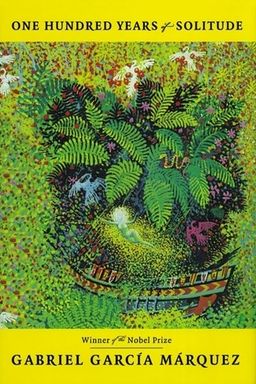
One Hundred Years of Solitude cover

One Hundred Years of Solitude

by Gabriel García Marquez

One Hundred Years of Solitude chronicles the epic tale of the Buendía family, founders of Macondo, blending magical realism with historical narrative. Over generations, the family faces cycles of joy and tragedy, exploring themes of solitude, identity, and destiny. This timeless masterpiece continues to captivate readers with its profound insights into the human experience.

Macondo and the Human Desire to Understand

How can a single town hold the total mirror of human creation and decline? In One Hundred Years of Solitude, Gabriel García Márquez builds Macondo as both laboratory and legend—a place where invention, memory, desire, violence, and modernity intertwine to reveal how knowledge and history are inseparable from human solitude. You enter the story through José Arcadio Buendía’s compulsion to understand and control the world, and you leave with the final Aureliano who reads his own fate in Melquíades’ parchments. The book argues that time and memory are circular: everything once imagined eventually returns, written again in new symbols.

Founding and Experimentation

At its inception, Macondo is pure willpower. José Arcadio Buendía, like an Enlightenment patriarch, uses maps, compasses, and imagination to shape the town. His curiosity and mania for invention—dragging magnets for gold, experimenting with telescopes, and designing impossible ships—reflect humanity's drive to merge knowledge with wonder. You recognize science and magic not as opposites, but as intertwined forms of imagination. Melquíades, the wandering gypsy scientist, amplifies this dialectic: his magnets and manuscripts fuse cosmology and chemistry, turning household life into metaphysical experiment.

Memory and Forgetting

From early enchantment, the narrative moves toward crisis: the insomnia plague erases names, meanings, and shared identity. In response, the town invents material memory—labels on cows, dictionaries spun like prayer wheels—demonstrating the necessity of collective remembrance. These improvised technologies prefigure later archives like Melquíades' parchments, showing that civilizations survive only through external supports of knowledge. When Melquíades restores memory with his elixir, the act foreshadows that salvation lies in the written word, not the dream of perpetual wakefulness.

Desire, Authority, and Repetition

Inside Macondo’s houses, desire and power form recurring loops. The Buendías repeat names and passions across generations: José Arcadio’s excess mirrors Aureliano’s restraint, Amaranta’s virgin vows echo Rebeca’s hunger for earth. Love and violence coexist, and the family’s moral boundaries erode with each generation. Úrsula’s fear of incest—a child with a pig’s tail—becomes the literal mark of the family’s final collapse. Authority too repeats in cycles: Arcadio’s farcical tyranny foreshadows Colonel Aureliano Buendía’s institutional wars. Both reveal how households generate nations and how domestic violence scales into political cruelty.

Modernity and Forgetting

Modernity enters as spectacle—the phonograph, electric light, cinema—and ends in terror. The banana company brings money and trains, then death. The workers’ massacre and its erasure by official decree show how history itself becomes a fiction under power. Institutions produce bureaucratic amnesia; José Arcadio Segundo’s futile testimony exposes the impossibility of truth against organized denial. You recognize in these chapters a critique of progress without conscience, where technology serves exploitation and official archives overwrite real memory.

Solitude, Time, and Fate

In its final movements, the novel transforms from chronicle to prophecy. Aureliano deciphers Melquíades’ parchments and learns that the act of reading equals the fulfillment of destiny. Time is no longer linear: past, present, and future collapse into a single moment of understanding. When the parchments name the family’s extinction, you see how knowledge and destruction coincide—the end of Macondo is not punishment but revelation. The family’s solitary pursuit of meaning has inscribed its own annihilation, proving that complete self-knowledge can only exist when history ends.

Key insight

Macondo is humanity’s mirror: what begins in idealism ends in solitude. García Márquez shows that every system—scientific, social, erotic, or political—eventually transforms into magic, memory, or myth. The novel’s circle closes with the realization that progress and origin are the same dream viewed from opposite ends of time.


Founders and Alchemists

You begin with the two intellectual poles of creation: José Arcadio Buendía and Melquíades. Together they form the town’s metaphysical spine. José Arcadio Buendía builds the town from reason and curiosity, while Melquíades injects it with visionary chaos. Their collaboration demonstrates how enlightenment and mysticism cohabit the same project—the pursuit of understanding.

José Arcadio Buendía’s Rational Madness

José Arcadio Buendía’s logic is an entire world system: maps aligned to the sun, houses planned for equal shade, experiments to transform metals. His will organizes Macondo and his obsessions slowly unravel it. The more he chases absolute knowledge, the more the domestic world dissolves—Úrsula’s coins are burned in alchemical crucibles, nights pass in solitude, and invention becomes confinement. When he encounters the ghost of the galleon trapped in forest roots, he realizes the futility of perpetual exploration: every dream of progress ends at decay’s shore.

Melquíades, the Scientific Prophet

Melquíades arrives with magnets, methologies, and manuscripts, announcing the magical dimension of science. His laboratory of seven metals and daguerreotype plates becomes both archive and oracle. When he dies and returns, his resurrection signifies not mere magic but intellectual immortality—the persistence of knowledge through writing. Melquíades teaches that artifacts outlive their makers and that memory encoded in text becomes its own form of life.

Key insight

Macondo’s founders embody human history itself: rational ambition and mystical renewal. Their experiments forge the book’s core belief that knowledge, even misused, is holy because it represents humanity’s desire to transform reality into meaning.


Memory and Cultural Survival

In Macondo, memory functions as civilization’s heartbeat. When the insomnia plague removes names and identities, the town invents external supports—tags, machines, and slogans—to anchor knowledge. These improvisations reveal a truth still relevant to you: societies survive through collective remembrance, not mere information.

The Insomnia Experiment

At first insomnia looks like liberation—people work tirelessly and talk endlessly—but soon names vanish and objects lose meaning. By labeling cows and anvils, José Arcadio Buendía and Aureliano Buendía try to rebuild cognition through the written word. This act anticipates later archives—from Melquíades’ parchments to Fernanda’s bureaucratic household—and illustrates an enduring human need: writing preserves identity when memory falters.

Melquíades and the Memory Cure

Melquíades returns with his elixir of remembrance, signaling that external wisdom (science, narrative, magic) heals what internal memory cannot. His daguerreotypes suspend time visually just as his manuscripts suspend time linguistically, making the household’s memory inseparable from technology and writing.

Key insight

Macondo’s memory experiments demonstrate that remembrance is collective infrastructure, not nostalgia. Written words, rituals, and artifacts become the prosthetic heart that keeps history alive within communities vulnerable to forgetting.


Desire, Secrecy, and the Weight of Names

Across generations, desire and secrecy drive the Buendías toward repetition. Their loves, rivalries, and taboos create cycles where private impulses turn into public consequences. You witness how sexuality and naming combine into the machinery of destiny.

Erotic Cycles and Hidden Transgressions

From José Arcadio’s primal encounter with Pilar Ternera to Meme’s clandestine affair with Mauricio Babilonia, desire in Macondo remains secretive and fatal. Lovers die, lovers hide, and mothers fear the mythic pig-tailed child. Every passion carries social consequence: Remedios the Beauty’s lethal innocence drives men to madness; Fernanda’s repression turns intimacy into bureaucracy; Amaranta Úrsula’s incest defines the family’s apocalypse.

Names and Repetition

The constant reuse of José Arcadio and Aureliano transforms individuality into prophecy. Úrsula’s vigilance against degeneracy reveals that history in Macondo is hereditary. Each new generation repeats emotional and moral mistakes until the circle closes on extinction.

Key insight

Desire and names are forms of memory. By repeating them, the Buendías sustain their lineage but also trap themselves within its fatal code. Passion and identity together guarantee that the future resembles the past until oblivion intervenes.


Authority, Violence, and Historical Erosion

Power in Macondo shifts between household rule and national warfare. You trace how domestic authority—Úrsula’s moral whip—and political authority—Aureliano’s revolutionary armies—mirror one another. Both intend order; both end in solitude.

Domestic and Political Sovereignty

Úrsula’s governance shows the ethics of restraint. Her battle with Arcadio’s dictatorship reveals how maternal control defends community against tyranny. Yet later, Aureliano Buendía’s transformation into a Colonel scales that domestic conflict into national tragedy—thirty-two failed revolts, seventeen executed sons, and bureaucratic armistices replace moral purpose with numb endurance.

Institutional Power and Forgetting

When modern institutions arrive—magistrates, army, banana company—authority abandons moral content altogether. The massacre’s official erasure proves how power manipulates truth. Lawyers, decrees, and newspapers construct a false history until memory itself becomes rebellion. José Arcadio Segundo’s haunted resistance stands as private archive against public denial.

Key insight

Authority uses spectacle to disguise decay. Whether domestic or political, unchecked rule turns justice into ritual and history into propaganda. García Márquez warns that modern progress without memory renders morality obsolete.


Prosperity, Rain, and Decline

After war and repression come moments of abundance and later ruin. Aureliano Segundo’s lavish wealth and the long rains mark Macondo’s material extremes—feast and flood. You watch ecology and economy intertwine, proving that excess and scarcity are the two faces of the same human pattern.

Prosperity Under Aureliano Segundo

Petra Cotes’ magical fertility brings absurd abundance—animals multiplying without end—and Aureliano Segundo converts wealth into spectacle. The papered house of peso notes symbolizes both triumph and waste. Fernanda’s regimentation turns prosperity into moral imprisonment, replacing generosity with rigid rituals. Their marriage dramatizes modernity’s conflict between excess and prudence.

The Long Rain and Decay

The prolonged storm floods not only streets but meaning. Livestock drown, banana groves rot, and the company departs, leaving economic vacuum. Úrsula gropes through blindness with memory guided by smells. Aureliano Segundo digs futilely for treasure, mirroring his ancestor’s mad experiments. When the rain ends, gold is found and briefly revives life, but the revival only underscores loss—the wealth cannot challenge entropy.

Key insight

Material cycles echo emotional and historical ones: abundance breeds negligence, catastrophe demands rediscovery, and renewal rarely escapes its roots in decline. Macondo’s climate becomes allegory for the human condition—our seasons of creation inevitably dissolve into solitude and silence.


Prophecy and the End of Time

The novel completes itself in Melquíades’ parchments. They are the script that converts family history into cosmic law. When Aureliano reads them, he realizes that interpretation and existence coincide—the act of understanding destroys the world by finishing its story.

Text as Destiny

Melquíades encodes time itself in layers of Sanskrit and military cipher, protecting history from premature revelation. The family’s repetitions serve as living annotations. When Aureliano deciphers the script, he discovers his own conception and the prophecy of absolute erasure: the town’s fate vanishes with its reader. Writing here is not preservation; it is closure.

Circular History and Solitude

Úrsula’s vision of time as a wheel becomes literal—the parchments reveal that every experiment, passion, war, and flood were rehearsed in the same symbolic loop. The “race condemned to one hundred years of solitude” exists within text until the wind of revelation wipes the script clean. You understand that solitude is not isolation but metaphysical destiny: humanity’s endless attempt to reread itself before disappearing.

Key insight

Knowledge completes existence. When you read your history fully, you reach the limit where memory and prediction merge—the point at which understanding equals the end. García Márquez closes the circle to show that meaning itself is finite; once total, it consumes its world.

Dig Deeper

Get personalized prompts to apply these lessons to your life and deepen your understanding.

Go Deeper

Get the Full Experience

Download Insight Books for AI-powered reflections, quizzes, and more.