
Idea 1
The Rise of Chaordic Thinking
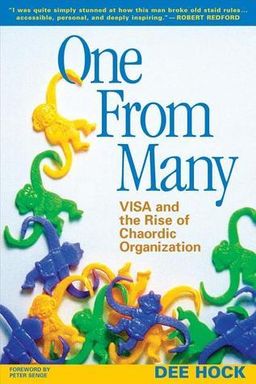
How do you build organizations that thrive amid complexity rather than collapse under it? In his sweeping narrative blending memoir and manifesto, Dee Hock—the founder and first CEO of Visa—argues that our dominant models of organization, rooted in mechanical metaphors and hierarchical control, are obsolete. To adapt to the pace and intricacy of modern life, institutions must evolve to become what he calls chaordic: systems that harmoniously blend chaos and order.
Hock coined the word 'chaordic' after observing nature’s capacity for self-organization and reading scientific work on complexity (particularly insights from the Santa Fe Institute era of complexity theory). He realized that biological and ecological systems sustain coherence not through command, but through distributed intelligence, shared purpose, and adaptive feedback. His insight: organizations could, and must, operate on the same principles if they are to survive the turbulence of a networked, information-driven age.
From Frustration to Insight
Early in his banking career, Hock watched institutions decay under the weight of procedure. The ‘machine metaphor’—the idea that organizations could be engineered like clockwork—produced rigid hierarchies obsessed with measurable output and rule compliance. In practice, it turned enthusiasm into obedience and purpose into proceduralism. Teams like his early NBC card experiment only succeeded when they bent or bypassed these rules, operating instead as dynamic, networked teams improvising in real time.
He tells vivid stories: employees hand-rolling 100,000 promotional mailers using broom-handles as axles, executives joining clerks on the production floor, and data-processing chaos giving birth to mutual trust. These moments weren’t accidental—they exemplified spontaneous order arising when people were freed from micromanagement and united by shared intent. That form of improvisation—bounded yet creative—is the living pattern of the chaordic model.
Money, Information, and the Limits of Machinery
The birth of credit cards exposed another tension: digital technology was transforming money itself. Hock reframed money not as metal or paper, but as guaranteed alphanumeric data—a form of structured, verified information. This insight preceded Internet finance by decades. Once value became data, banking was no longer about safekeeping funds but about guaranteeing the integrity and transmission of trusted information at global scale. This demanded new forms of collaboration across firms and nations that no central authority could command.
In the mid-1960s, however, banks still functioned as slow, siloed bureaucracies with 'manual plumbing'—imprinters, phone authorizations, and keypunch machines. Chaos reigned. Recognizing that traditional command structures couldn’t handle this information explosion, Hock saw an opportunity to build a new institution that was neither purely hierarchical nor completely anarchic—a network of trust bound by purpose and principles rather than ownership and coercion.
From Idea to Institution
The organization that emerged—the National BankAmericard Inc. (later Visa)—embodied the chaordic ideal. It was simultaneously for-profit and nonprofit, global yet locally self-governing, united by shared agreements rather than command chains. Member banks held irrevocable rights of participation, ensuring distributed ownership and voice. Authority existed at the lowest practical level, while overarching governance addressed only collective concerns. This design prevented capture by any one entity, even Bank of America, and allowed thousands of institutions to cooperate in real time across borders.
Hock’s design wove nested committees (regional, national, global) into a living fabric of self-organization. Each unit made its own decisions within common principles. The structure scaled because it mirrored natural systems—fractal, adaptive, self-correcting. In later decades, this model became the invisible infrastructure through which trillions of dollars flowed globally.
Leadership and Human Practice
Hock’s leadership philosophy aligned perfectly with his design principles. True leaders, he said, educe behavior—they draw forth what is already within people—rather than induce, compel, or manipulate them. He insisted that leadership begins with self-management, continues with managing those above and beside you through integrity, and only then extends to managing subordinates. The Visa teams practiced this daily through open meetings, radical transparency, and small cultural rituals (like golden cufflinks with Latin inscriptions) that turned symbolic unity into practical cooperation.
Equally important, Hock insisted that community is sustained by nonmonetary exchanges of value—trust, respect, reciprocity. The tendency to monetize every metric, he warned, destroys the invisible social capital that holds systems together. His own childhood lessons in local generosity—neighbors who shared labor and credit—became templates for designing institutions rooted in participation rather than price.
A Wake-Up Call for the Future
Hock finally turns from history to exhortation. Accelerating technologies—microelectronics, biotechnology, networks—are creating an environment where information doubles faster than institutions can adapt. If we continue to treat organizations as machines, he warns, they will fail catastrophically just when society needs them most. Yet if we learn from chaordic systems—building self-governing networks with distributed intelligence and ethical purpose—we can create institutions tuned to the rhythms of life itself.
Core Message
To thrive amid complexity, stop trying to control what must be self-organizing. Replace mechanical hierarchy with living networks that bind through purpose, trust, and information integrity.
In this sense, Dee Hock’s chaordic vision is far more than a business innovation—it’s a blueprint for reinventing institutions in the information age. It challenges you to design for emergence, cultivate agreement, honor the unmeasurable, and lead by example in the turbulent dance between chaos and order.