
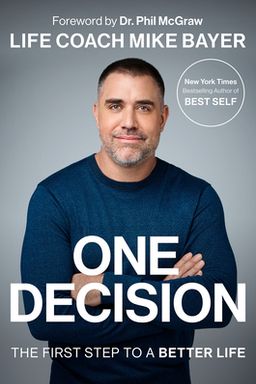
One Decision cover

One Decision

by Mike Bayer

One Decision by Mike Bayer offers a roadmap to shift your mindset from obstacles to opportunities. Learn to make transformative decisions by understanding the forces that shape your perceptions, fostering adaptability, and aligning actions with purpose. This guide provides practical tools to help you navigate life''s challenges with clarity and confidence.

The Power of One Decision to Transform Your Life

What if everything about your life—your happiness, relationships, health, and success—came down to one decision? In One Decision: The First Step to a Better Life, Coach Mike Bayer argues that every meaningful change starts not with a dozen plans or endless self-analysis, but with a single authentic choice. That single choice—what he calls your One Decision—anchors you in your Best Self, helping you shed fear, live truthfully, and take action toward a more fulfilled life.

Bayer, a life coach and mental health expert known for his appearances on Dr. Phil and his earlier bestseller Best Self, believes that the primary struggle people face isn’t lack of talent or opportunity—it’s living inauthentically. Many of us make decisions based on fear, habit, or the expectations of others, rather than the truth of who we are. The antidote, he says, is reconnecting with your inner compass—your Best Self—and learning to make each decision from that space rather than from fear or impulse.

Your Best Self vs. Your Anti-Self

At the heart of Bayer’s philosophy lies a clear-sighted duality between your Best Self (your most authentic, compassionate, and creative mode of being) and your Anti-Self (the fearful, reactive persona rooted in ego, pain, and avoidance). Living well, according to Bayer, means identifying both sides of yourself, then deliberately choosing behaviors and decisions that flow from your Best Self. Only then can you align your outer actions with your inner truth.

He relates his own life trajectory through this lens—coming out as gay, getting sober after meth addiction, and creating a thriving mental health practice—as a testament to how one decision made from the Best Self can transform the entire arc of a life. His message throughout: you are never more than one decision away from a better version of yourself.

The One Decision Paradigm

Bayer distills his framework into what he calls the One Decision Paradigm—a four-step process for thinking and acting authentically:

  • Live as your Best Self.
  • See obstacles as opportunities.
  • Make authentic decisions rooted in that perspective.
  • Let go of outcomes—allow the universe to handle the results.

Each step helps you peel away conditioned fears and bring yourself into honest alignment. This approach is different from traditional self-help that emphasizes goal setting and external success (as seen in books like Stephen Covey’s 7 Habits of Highly Effective People); Bayer focuses instead on internal congruence—cultivating decisions that feel right, not simply seem right.

Why “One Decision” Matters

The book insists that most people’s suffering stems from decision fatigue and fear. We wrestle endlessly with identity (“Who am I?”), conformity (“What will others think?”), and uncertainty about the future. Bayer urges readers to realize that clarity begins when you make one definitive, values-based decision—and then continue to make many small “uniting decisions” that reinforce it daily. Authenticity, he says, isn’t permanent; it’s a daily choice that must be revisited repeatedly.

“You are only one decision away from a better life.”

Bayer’s central mantra frames the entire journey—he wants readers not only to think differently but to act differently, trusting that one authentic choice will set off a cascade of transformation.

Structure and Scope

One Decision unfolds in three parts. The first lays the foundation by introducing the Best Self concept and the Four Os model—Obstacle, Opportunity, One Decision, and Outcome—which teaches readers to transform challenges into growth opportunities. The second part introduces the FORCE model, a five-part system (Fortune-Telling vs. Fact-Finding, Overgeneralizing vs. Objective Thinking, Rigid vs. Relaxed Mindset, Confused vs. Clarified Purpose, and Emotional vs. Evidence-Based Reasoning) that exposes the cognitive distortions sabotaging our decisions. The final section, “Creating Your Better Life,” offers practical tools for action—building a decision-making team, replacing ineffective behaviors, taking authentic steps forward, and releasing control of outcomes to what Bayer calls the “Universe.”

Throughout, Bayer grounds these frameworks in memorable examples, from clients changing careers to addicts reclaiming health to his own journey of recovery and truth-telling. These stories humanize what could otherwise feel abstract, echoing cognitive-behavioral principles and mindfulness teachings found in works like Byron Katie’s Loving What Is or Tara Brach’s Radical Acceptance.

For Bayer, the ultimate goal is not perfection or endless striving but alignment—living in peace with yourself and the decisions you make. Once you’ve made your One Decision to act from your Best Self, he argues, you can stop overplanning and start experiencing life’s opportunities as they appear. It’s a philosophy that merges spirituality with psychology and practical coaching—rooted in faith, recovery, and self-compassion.

In the pages ahead, you’ll explore how to identify distorted thought patterns, regain clarity of purpose, and practice letting go of rigid control. You’ll meet stories of transformation, from people trapped in confusion and addiction to those who rediscovered purpose and peace. Ultimately, Bayer’s message is both hopeful and empowering: you already possess the inner wisdom to create a better life. It starts now—with one decision.


The Four Os: Turning Obstacles into Opportunities

Every moment presents a choice: to see life as happening to you or for you. Mike Bayer’s Four Os Framework—Obstacle, Opportunity, One Decision, Outcome—is his method for turning hardship into transformation. The concept is deceptively simple: if you consciously shift perspective from obstacle to opportunity, the decisions that follow will naturally align with your authentic self.

Obstacle: The Default Lens

An obstacle, as Bayer defines it, is any situation you perceive as blocking your path—whether it’s a bad job, health issue, or failing relationship. Obstacle-thinking makes us blame, complain, and stay stuck. You might hear it in sentences that begin with “I can’t because…” This mindset breeds victimhood and resentment. Bayer contrasts this with his own sobriety story—how years of addiction and fear were driven by staying in the obstacle lens. Living this way means handing power to external forces instead of your own agency.

Opportunity: The Authentic Lens

The pivot begins when you put on what Bayer calls the “opportunity sunglasses.” When you view a setback as an opportunity, you invite new energy and creativity. “Within every obstacle,” he writes, “there are multiple opportunities waiting to be noticed.” He uses examples like losing a job (an obstacle) leading to discovering a more fulfilling career path (an opportunity). This echoes cognitive-behavioral therapy principles—changing thoughts changes emotions and outcomes.

One Decision: The Moment of Choice

After you spot the opportunity, your next step is to make what he calls your One Decision—a conscious choice made from your Best Self rather than fear. For example, if your obstacle is poor health, the opportunity is self-care, and your One Decision might be “I will treat my body with respect.” From there, countless “uniting decisions” (like buying healthy groceries or scheduling a walk) reinforce your core intention. In this way, One Decision becomes a principle, not a one-time act.

Outcome: Release Control to the Universe

The last step is to let go of the Outcome. You can’t control how life responds, but you can control your integrity in making the decision. Bayer labels this act of surrender “letting the universe decide.” It echoes Stoic and mindfulness teachings—detaching from results to find peace. “Rejection,” he writes, “is God’s protection,” a phrase that encourages trusting life’s timing rather than forcing control.

“Instead of asking ‘What should I do?’ ask ‘What would my Best Self do?’ The answer will guide your decision—and the universe will handle the rest.”

This Four Os framework encourages you to replace panic with perspective. Once you reframe problems as potential, you reclaim authorship of your life. And over time, as Bayer puts it, your mind learns a new habit: to look for possibilities rather than limitations. It’s a mindset shift that makes courage habitual—and authenticity inevitable.


Understanding the FORCE: Mastering Your Mindset

If the Four Os are the map, the FORCE is the engine that moves you forward. Bayer uses the acronym to represent five mental patterns—each one a pair of opposites that can either block or empower your decisions:

  • F: Fortune-Telling or Fact-Finding
  • O: Overgeneralizing or Objective Thinking
  • R: Rigid Mindset or Relaxed Mindset
  • C: Confused Purpose or Clarified Purpose
  • E: Emotional Reasoning or Evidence-Based Reasoning

Drawing on psychology and coaching, Bayer shows how these mental forces shape perception and behavior. Most people, he notes, operate under negative FORCEs without realizing it—predicting worst-case scenarios, overgeneralizing failure, or clinging to rigid beliefs. The goal is to shift to the positive side and make decisions from clarity, not distortion.

Fortune-Telling vs. Fact-Finding

Fortune-telling means predicting outcomes based on fear. Bayer recounts a session with a personal trainer named Mike (“Coach Quads”), who refused to raise his rates because he assumed clients would reject him. When he replaced assumptions with facts—acknowledging his twenty-two years of experience—he doubled his income. The exercise teaches that when you replace fear-based guesswork with evidence, possibilities expand.

Overgeneralizing vs. Objective Thinking

Overgeneralizing takes one bad event and applies it to everything (“I always fail”). Bayer helps clients reframe through objectivity. Eva, a single mother scarred by abusive relationships, believed she would “always pick the wrong man.” Once she learned to view her past objectively—as experience, not prophecy—she opened herself to new possibilities and found contentment without a partner. This mirrors the reframing tools found in cognitive behavioral therapy.

Rigid vs. Relaxed Mindset

Rigidity locks you into “my way or the highway” thinking; relaxation fosters openness. Bayer shares how he once approached his podcast with perfectionism, only to realize that flexibility—recording in unplanned locations, improvising—led to creativity and connection. That same principle helps individuals drop control and embrace imperfection.

Confused vs. Clarified Purpose

Confusion arises when you’ve lost touch with why you do what you do. Purpose restores clarity. In one story, a man named Austin spent seven years in a job he never loved, paralyzed by indecision. When he clarified his true purpose—his lifelong fascination with aviation—he left his job to train as a pilot. Purpose dissolved paralysis.

Emotional vs. Evidence-Based Reasoning

Feelings aren’t facts. Bayer illustrates this with Rocco, a man who kept choosing toxic partners because his emotions overrode logic. Once Rocco learned to examine evidence instead—identifying patterns, triggers, and childhood imprinting—he chose therapy and healing over repetition. “You can’t feel your way to wellness,” Bayer reminds. “You have to decide your way there.”

Across all five FORCE pairs, the key idea is awareness. Once you notice whether you’re operating in a negative or positive FORCE, you regain power. As Bayer writes, “When we are being our Best Self, we don’t predict disaster—we create opportunity.”


Clarifying Purpose: Escaping the Confusion Trap

Few things paralyze decision-making like confusion. Bayer calls this the mind’s “tornado”—a swirl of overthinking, second-guessing, and people-pleasing. At its core, confusion thrives where purpose is absent. The way out, he argues, is to identify and reconnect with what truly drives you: your clarified purpose.

Recognizing the Confusion Pattern

When you feel trapped on a mental hamster wheel—seeking endless opinions, analyzing every angle—you’re likely in a confusion mindset. It’s the cognitive version of paralysis by analysis. You might call ten friends for advice or read dozens of articles but end up more conflicted than before. This behavior, Bayer notes, stems from fear of making the wrong decision and losing approval from others. It’s also fueled by forgetting one’s deeper purpose.

The Austin Story: Purpose Clears Paralysis

Bayer’s coaching session with Austin brings this concept to life. Austin spent seven years in an uninspiring furniture job, convincing himself he didn’t know what he wanted. Beneath that “I don’t know” was fear disguised as confusion. Only when he revisited his childhood fascination with airplanes did he realize that aviation—not carpentry—was his true calling. With guidance, he began flight training. When he clarified his purpose, momentum replaced indecision. Later, even being laid off became an opportunity rather than a catastrophe.

Confusion Tornadoes: A Mind in Motion

Bayer likens confusion to a “tornado” of thoughts spinning without progress. His client Amy exemplified this while agonizing over her son's schooling. She had gathered countless opinions that only amplified her anxiety. Bayer had her write down every recurring thought—“money,” “bad mom,” “future,” “regret”—then identify her purpose (“help my son love learning”). Immediately, she shifted from turmoil to clarity. This exercise reframes decisions through your reason for acting, not the noise around you.

“Confusion can only exist where there is no purpose.”

That line captures Bayer’s conviction: purpose is your internal compass. Once you recall why you’re doing something—whether to serve, love, or create—you can make authentic decisions without fear. Confusion dissipates because your motive clarifies direction.

Managing Depression and Gaining Clarity

Many people, Bayer notes, confuse emotional fog for existential confusion. Sometimes depression or anxiety makes purpose hard to access. He urges people to seek therapy, just as Austin did, to remove these mental blockages. Once treated, new clarity emerges naturally. The act of healing becomes itself a purpose-driven decision.

Switching from confused purpose to clarified purpose doesn’t require dramatic epiphanies; it requires curiosity. Ask, “What is my reason for being here, now?” and use that as a filter for choices. The clearer your purpose, the calmer your mind becomes—and decisions transform from burdens to expressions of integrity.


Taking Authentic Action and Letting Go of Outcomes

Making an authentic decision means little unless it’s followed by action. In the final section of One Decision, Bayer helps readers bridge the gap between insight and implementation. He describes authentic action as “behaving your way to success.” Once you decide from your Best Self, you must act in ways that reinforce that self—without obsessing over the outcome.

Identify What Isn’t Working

Bayer recommends beginning with awareness. Write down behaviors that keep you “stuck.” For someone wanting better health, that might include late-night snacking or avoiding exercise. Once listed, you can see patterns clearly—and stop doing what no longer serves you. Honest self-audit, he says, is key to transformation.

Replace Toxic Habits with Supportive Ones

Habits can’t simply be broken; they must be replaced. For instance, swapping binge-eating with meal-prepping, or replacing doom-scrolling with evening walks. Over time, these “uniting decisions” form behavioral momentum until they become automatic. Bayer likens it to reprogramming mental software—consistent small inputs create large cumulative change.

Build Your One Decision Team

No one succeeds alone. Bayer outlines twelve potential roles a supportive team might include—Motivator, Nurturer, Big-Picture Thinker, Wise Counsel, and others. His own teammate Deacon embodies this principle: once an addict who turned his life around after homelessness and trauma, Deacon now serves as Bayer’s grounding force and spiritual mirror. Surround yourself, Bayer advises, with people who remind you of your Best Self rather than your limitations.

Let the Universe Decide

Perhaps the most counterintuitive step in Bayer’s philosophy is surrender. After making your decision and taking action, you must release control. He tells an anecdote about confessing to cheating on a college exam. The professor thanked him for his honesty and still gave him an A—not the expected punishment, but a sign that integrity sometimes yields unforeseen blessings. “Outcomes are out of our control,” he writes. “But honesty always pays off.”

“You’ve made your decision as your Best Self; now let the universe decide the outcome.”

This echoes faith-based recovery models and mindfulness traditions: take right action, then detach from results. The universe—or whatever higher power you believe in—often produces “bonus” outcomes beyond your imagination.

Authentic action, Bayer concludes, is the key to living unapologetically. You can’t predict life, but you can decide who you’ll be as it unfolds. Once you’ve acted from your Best Self, peace follows naturally—not because everything worked out perfectly, but because you stayed true to who you are.


Living Unapologetically as Your Best Self

Bayer closes One Decision with a declaration of freedom: you no longer need permission to be yourself. The final chapter, “Unapologetically Authentic,” celebrates the reader’s completion of the self-coaching journey. You’ve faced your obstacles, understood your FORCEs, clarified your purpose, and acted authentically—now the task is to live from that truth every day.

Authenticity as Daily Practice

Authenticity isn’t a static state; it’s a recurring decision. “To stay authentic,” Bayer writes, “we must revisit our connection with it daily.” Life’s challenges will inevitably nudge you into old patterns or negative FORCEs, but each time you notice misalignment, you can make a new decision. The goal isn’t perfection—it’s continuous reconnection.

The Role of Vulnerability

Authenticity requires vulnerability—the willingness to be seen without masks. Bayer models this through radical self-disclosure, from addiction to insecurity about school and dyslexia. Vulnerability, he shows, doesn’t weaken decisions; it strengthens connection. It’s how we build trust—with ourselves and others.

Mantras for the Best Self

He ends with a simple mirror practice: look into your eyes and repeat a mantra affirming surrender and peace. His version reads, “With an opportunity mindset, I have made my decision as my Best Self. I now choose to let the universe decide.” The practice grounds the intellect in the heart, symbolizing what Bayer calls “the longest journey—from the head to the heart.”

The Ten Commitments of an Authentic Life

Bayer concludes with a list of everyday commitments: never give up on yourself, embrace your uniqueness, silence excuses, judge food not people, love unconditionally, and tell your story. These aren’t abstract affirmations—they’re behavioral anchors to keep you aligned with authenticity, echoing Don Miguel Ruiz’s The Four Agreements updated for modern growth.

Living as your Best Self, Bayer says, is the highest form of peace. You can’t control outcomes or prevent pain, but you can consistently choose honesty, curiosity, and compassion. In doing so, you stop chasing happiness and start embodying it. Each day, each moment, you’re invited to make One Decision again—to be unapologetically, courageously yourself.

Dig Deeper

Get personalized prompts to apply these lessons to your life and deepen your understanding.

Go Deeper

Get the Full Experience

Download Insight Books for AI-powered reflections, quizzes, and more.