
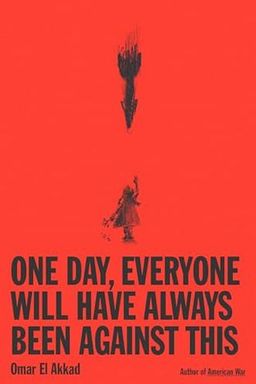
One Day, Everyone Will Have Always Been Against This cover

One Day, Everyone Will Have Always Been Against This

by Omar El Akkad

In his nonfiction debut, El Akkad looks at how the West responds to mass suffering.

Walking Away from Empire’s Story

When do you decide that staying complicit hurts your soul more than leaving costs your life? In One Day, Everyone Will Have Always Been Against This, Omar El Akkad argues that the 2023–25 obliteration of Gaza did more than expose a single horror; it shattered the moral scaffolding of modern Western liberalism. He contends that the empire’s center—political, media, cultural—runs on anesthetic language, selective grief, and a lesser-evils logic that collapses precisely when confronted with a genocide you can watch in real time. To recover any ethical footing, he urges a practice of witness and a politics of refusal: learn to see past euphemism, name violence accurately, and, when necessary, walk away from institutions that can’t stop initialing the side of the bomb.

This is not a think tank’s white paper. It’s a memoir-essay braided from the author’s life as the son of Egyptian emigrants, a Gulf War kid in Doha, a Canadian journalist in Afghanistan and Guantánamo, and a father in Oregon scrolling through images of dismembered children while his daughter draws a city on a roll of paper. The book couples close-up scenes—a nine-year-old pulled from rubble, a father’s torn papers at a Cairo checkpoint, a shower stall ripped by shrapnel at FOB Masum Ghar—with a sustained autopsy of how the empire manufactures moral distance: through euphemism, passive voice, and a polite middle that can live with atrocity so long as the right words appear in the press release.

What the book claims

El Akkad’s core argument has three planks. First, empire speaks a dialect designed to absolve itself. Buildings “collapse,” children “perish,” massacres become “incidents” or “aid-related deaths.” Language is the body armor of power. Second, institutional centrism—especially the liberal kind—demands you judge harm relatively, not absolutely. Vote blue though it harms you, because the other side will harm you more. That arithmetic falls apart at genocide; there is a point beyond which relative harm cannot offset absolute evil. Third, the only antidote is a blend of moral clarity and refusal: witness (name who did what to whom), and negative resistance (the right not to participate, spend, amplify, or adorn the killing).

Where the story takes you

You follow the author across borders and battlefields. In Qatar, schoolchildren write thank-you letters to U.S. troops during the First Gulf War. In British Columbia, American border agents deny his family entry and hand his father to Canadian police for no clear reason—an early lesson in who gets presumed human. In Kandahar, a rocket’s overpressure wave turns night into noon; at Guantánamo, a guard teaches an art class while cells are engineered so coat hooks collapse under a suicide’s weight. In Toronto, a terrorism case branded the “Toronto 18” reveals how teenagers get groomed: first, a grave in the woods; before that, a slow schooling in righteous images of other people’s corpses.

Parallel to this travelogue runs a careful study of language. The word Mashallah can mean joy, awe, submission, or protection depending on context; meanwhile in English, a child is not shot but “hit” by a “stray bullet.” Headlines report “aid-related deaths” after Israeli troops fire on starving people lined up for flour. The empire bans a Palestinian author’s prize ceremony, tells writers to avoid the word “Palestine,” and then funds the museum wing about the importance of free expression (compare George Orwell’s essays on political language; see also Edward Said on narrative power).

Why it matters now

Because this isn’t only about Gaza. It’s about the political muscle memory you build—or atrophy—every day. If you can learn to scroll past a starving infant, you can also learn to accept climate sacrifice zones, displaced billions, and border regimes that let people drown on camera. The author calls this the empire’s economy of negation: growth by taking away—pensions rebranded, jobs “gigified,” forests as fuel, language scraped of agency. In that economy, your refusal—no matter how small—matters. Each time you say, “I won’t platform this, launder that, endorse this line while that child screams,” you throw sand into the gears.

What you’ll learn in this summary

You’ll learn how witness really works—what journalists know but institutions often forget—and why euphemism is policy, not style. You’ll see how “lesser evil” math empties out your conscience, and how both active and negative resistance create consequences that PR can’t tidy away. You’ll watch writers, festivals, and universities choose: cancel a Palestinian award, or cancel your own award show when nominees refuse blood-splattered prize money. You’ll reckon with fear as a currency—who gets to spend it, at what exchange rate—and how, as a parent, your private terror can be honest without becoming policy for someone else’s annihilation.

Finally, you’ll arrive where El Akkad does: keeping two ledgers. One records atrocity. The other records courage—Wael Dahdouh broadcasting after his family is killed, students building encampments, veterans memorializing Aaron Bushnell after he sets himself on fire saying, “Free Palestine.” The book asks you a question only you can answer: how much of your comfort are you willing to surrender so that someone else’s child keeps breathing?


Witness Against Anesthesia

El Akkad treats witness not as voyeurism but as an obligation: to say plainly who did what to whom, and to resist the narcotic pull of passive voice. He learned the stakes the hard way: in a weeklong hazardous-environment training before Afghanistan, he’s hooded, cuffed, marched into the woods, and told to imagine the worst. Later at FOB Masum Ghar, a rocket tears a hole through the shower tent where an Afghan interpreter dies; tracer rounds paint the night red. The next morning he leaves. Locals don’t. That asymmetry—your ability to leave—haunts his definition of witness.

The referee myth

Much of Western journalism, he argues, still clings to a self-image of referee/scorekeeper/announcer: show both sides, keep the game moving, leave judgment to the audience. But that model collapses when one team kneecaps the other in the tunnel. “Listing claim and counterclaim” becomes farce when faced with plain bad faith. That’s how you end up with straight-faced coverage balancing “fewer guns reduce gun deaths” against “more guns reduce gun deaths,” or dutifully reciting Israeli talking points about “precision strikes” while Palestinian reporters crawl through rubble to name the bodies (compare Lewis Raven Wallace’s The View from Somewhere on objectivity myths).

A viral lie travels faster than a lived truth

In the early days after October 7, an Israeli reporter mentions “beheaded babies.” It metastasizes into “forty beheaded babies,” cited at podiums and echoed across outlets. Meanwhile, those same outlets can’t get into Gaza to verify anything. For El Akkad, the lesson reprises the 2003 WMD debacle: when empire chooses a story of what the other side is capable of, it will outrun any story of what it actually did.

Who tells the story—and pays for it

By mid-2024, at least 108 Palestinian journalists are dead (Committee to Protect Journalists). Wael Dahdouh of Al Jazeera buries his family, reports the next day, is wounded, reports again. Western prizes hesitate to name Palestinian reporting plainly for fear of “bias.” El Akkad finds this the industry’s moral nadir: when words get dead kids killed but polite distance gets you a keynote.

Witness, uncompromised

Name the agent of violence. Avoid the passive voice. Refuse to make the afflicted perform condemnations that aren’t germane to their suffering. Treat absence of access as a reporting problem—not a license to launder power’s press releases.

The price of “neutrality”

As a Globe and Mail reporter, El Akkad covers Guantánamo’s courtrooms where hearsay is admissible, names are redacted, and lawyers get threatened for speaking them aloud. He covers the “Toronto 18” and reads a comment: “I don’t trust any story about terrorism written by a guy named Omar.” The neutrality asked of him is never asked of the state. That’s why, when U.S. Secretary of State Antony Blinken laments journalist deaths while funding the war killing them, the words ring like tin spoons on a steel gate.

Why this matters to you

Your information diet trains your conscience. If your feed is built on “accidents,” “clashes,” and “aid-related deaths,” your moral reflex atrophies. If you seek out those who stay when you can log off—the Dahdouhs, the freelancers with no press jacket—you begin to reacquire names for the things happening in your name. Witness is not an identity; it’s a habit: resist anesthesia daily.


How Language Manufactures Distance

El Akkad shows you how power turns grammar into a weapon. Start with the small: a girl in Gaza is told, “You are like the moon.” In Arabic, inti zay el amar carries a century of films and love songs. Translate it flatly and you lose the lineage—and the way people love under siege. Then study the large: headlines that say a journalist was “hit by a bullet” during a “raid on a suspect’s home.” Who fired the gun? Who chose the raid? The passive voice hides the hand.

Euphemism is policy

From Vietnam’s “collateral damage” to the War on Terror’s “enhanced interrogation,” euphemism doesn’t just tidy up prose; it tells you what’s permissible. In Guantánamo, hunger strikes become “asymmetric warfare.” Detainees (not prisoners) can be held indefinitely (not sentenced). An entire legal order is smuggled in through word choice (see also Rebecca Solnit on disaster language; George Lakoff on frames).

When mapping misses the ground

On a trip to Iqaluit with Google’s Street View team, engineers ask elders to point out the most important “roads.” The elders ask: winter or summer? Routes that are highways in December turn to water in July. The lexicon of Silicon Valley has no field for seasonal ice. Likewise, Western coverage of Gaza frequently has no field for checkpoints, color-coded IDs, or famine as policy. What’s unnameable becomes unthinkable.

Two languages of violence

El Akkad notes there are effectively two grammars for atrocity. For victims of empire (those we recognize), killers are “butchers,” acts are “slaughters,” and the dead are named. For victims of empire (those we export), “buildings collapse,” “blasts occur,” and the dead are numbered. The same outlets that covered Russia’s crimes in Ukraine with agent-filled verbs and named perpetrators often shifted to fog and passivity in Gaza (a pattern media scholars have documented repeatedly).

Silence as blank canvas

At Gitmo, censors black out a publicly available New York Times article attached to a legal motion. Why? Because in the theater of state secrecy, even visibility must be re-performed as hidden. The same dynamic governs Gaza: kill the journalists first, then let the silence paint whatever narrative serves. Later, history will “discover” bodies under hospital courtyards and revise its verbs. For now, imperative mood rules: forget.

A reader’s checklist

Who is the agent in this sentence? What verb hides agency? What’s the unsaid context (occupation, checkpoints, siege)? What euphemisms are doing legal work?

Why it matters to you

Language is the distance you grant yourself from another’s pain. If you habitually accept language that erases the perpetrator, you outsource your ethics. Reclaim verbs. Ask the question polite society dodges: who did this?


Values Under Pressure

What do you really believe when someone tears up your papers and says, “Your papers”? El Akkad anchors his political argument in personal humiliations and small theaters of power. In Cairo, soldiers rip his father’s curfew papers in half during the long shadow of Sadat’s assassination. In Abbotsford, border guards deny the family entry to the United States and hand his father to Canadian police; hours later he’s released without explanation. In Doha, a Mercedes driver beats a Southeast Asian worker with his sandal after a fender bender as passersby laugh. The lesson isn’t subtle: many societies require someone’s nonexistence to function. Your self-story depends on whose pain you don’t have to see.

Who gets counted as human

Growing up in Qatar’s stratified economy, he sees Western expats in villas with drivers and housemaids, and third-country laborers with no path to rights. During the First Gulf War, his American school has kids write thank-you letters to soldiers. Gratitude becomes a posture you practice toward whoever can shatter your windows. Later, when Israel bombs Gaza and settlers watch with folding chairs, he sees the same posture—this time turned celebratory. A former U.S. vice president signs messages on bombs, smiling for photos. The performance isn’t fringe; it’s the center revealing itself.

The liberal transaction breaks

Modern liberalism, in El Akkad’s telling, is transactional: empathize with the oppressed over there while benefiting from the systems that oppress them here. It works until the abstraction fails. “Vote for the lesser evil” can be a reasonable short-term tactic. But at genocide, the math fails: relative harm cannot wash absolute evil. The insistence that you must vote for the person bankrolling a live-streamed extermination because their opponent is worse reveals a hollow core (compare Martin Luther King Jr.’s “white moderate” critique in Letter from Birmingham Jail).

What the middle demands

El Akkad targets not only outright fascists but the “easily upset middle” that needs language to protect their self-image. If buildings “collapse,” if deaths are “tragic” but “complicated,” then brunch can resume. That’s why so many leaders frame ceasefires as too messy for diplomacy, even after an international court orders genocide proceedings. To remain the hero of your own story, you must never see what you fund.

What this means for you

Pressure clarifies values. You can prefer the aesthetics of civility, or you can refuse to be counted among the people who looked at a pile of small shoes and chose procedure. If you’re a parent, you know what a pulse-ox number rising from 82 to 90 feels like at a hospital bed. The book asks: can you transfer even 1% of that visceral care to a child you’ll never meet?


The Machinery of Resistance

El Akkad distinguishes between two kinds of resistance you can actually practice: active (show up, disrupt, speak) and negative (refuse to participate in injustice’s laundering). Both matter. Both carry costs. And both have been on open display since October 2023.

Saying no (and meaning it)

At Toronto’s Giller Prize gala, protesters briefly interrupt to call for a ceasefire. The sponsor bank holds a $500 million stake in an Israeli weapons firm. Open letters fly. Writers who once scolded “cancel culture” go quiet; emerging authors risk careers by speaking. PEN America does little; nominees withdraw; PEN cancels its own ceremony. In New York, Jonathan Glazer uses his Oscar speech to reject the hijacking of Judaism for mass murder. In theater, Victor I. Cazares goes on a medication strike, burying their HIV pills until their institution calls for a ceasefire—staking literal health on solidarity.

Institutions on trial

The Frankfurt Book Fair cancels Palestinian novelist Adania Shibli’s award event. The Harvard Law Review pulls Rabea Eghbariah’s essay on the Nakba; when Columbia Law Review plans to publish it, its board takes the whole site down. The Pulitzer Board praises “Journalists and Media Workers Covering the War in Gaza” while avoiding the word “Palestinian.” The message to artists: your courage will often outpace the stage’s courage. Then you must choose—take the stage’s money and mime neutrality, or walk.

The right not to participate

Negative resistance is especially threatening to power. More than thirty-five U.S. states pass laws against boycotting goods linked to Israel. Why outlaw not buying something? Because a system that runs on endless participation cannot survive your refusal at scale. El Akkad urges building this muscle in small acts: choose not to lend your presence, fee, or platform to institutions laundering atrocity. Those habits make bigger refusals possible.

Sand in the gears

“Wherever you are, whatever sand you can throw on the gears of genocide, do it now,” writes Palestinian poet Rasha Abdulhadi. Fingernail-fulls count. So do encampments and port shutdowns. You don’t know which handful will jam the machine.

Why it matters to you

If you’ve been waiting for a “safe” time to dissent, El Akkad’s point is blunt: safety is the prize of those the system was built to protect. For everyone else, safety comes later, if at all. Choose while it still costs mostly comfort.


War, Craft, and the Writer’s Job

What is a writer good for when the ICU runs out of morphine? El Akkad turns the craft talk inside out. He has stood inside Cairo’s mausoleum lowering his father’s shrouded body beside his ancestors, then driven the city at night as Egypt’s short-lived democratic opening curdled. He has filed from Guantánamo by day, then written American War by night—only to watch a speculative novel about the United States absorb the worst truths he meant to bring home from elsewhere.

What work are we good for?

He watches demure writers become the loudest opponents of genocide, while some public scolds of “cancel culture” grow quiet. The paradox exposes a truth: the job is not to be interesting; it’s to be accountable. If your art quotes Baldwin and Morrison but retreats to finches when bodies pile in hospital courtyards, you’ve chosen aesthetics over ethics (contrast Toni Morrison’s Nobel lecture: language as action).

The iceberg only floats if readers can see

“Show, don’t tell” presumes a shared archive. If your readers don’t know the Nakba or Sabra and Shatila, the submerged nine-tenths never registers. In one book club, readers ask why his refugee camp massacre is so “brutal.” An Egyptian reader asks why he “toned it down” so much. Same scene, different archives. The craft problem is political: some worlds are kept offstage by design.

Industry courage vs. artist courage

Frankfurt cancels a Palestinian award; standards editors advise avoiding the word “Palestine”; magazines spike essays; festivals open with land acknowledgments and close with donor tributes to hedge funds underwriting occupation. Yet some institutions refuse to flinch (the National Book Foundation didn’t fold when a donor pulled out; many nominees for PEN awards declined recognition). You, as an artist or reader, can force the choice: literature or laundering.

Sit with the grotesque

El Akkad quotes Noor Hindi’s “Fuck Your Lecture on Craft, My People Are Dying.” Some days caring about the moon is resistance. Other days, beauty without indictment steals oxygen from the dying. His ask is not that every poem become a brief; it’s that your aesthetics never become anesthesia. Sit with what can’t be rationalized—because that’s where the soul is formed.


Fear’s Exchange Rate

Fear circulates like currency. Some people can spend it and move armies. Others can spend it and be told to shut up. El Akkad watches a tree fall across his Oregon deck hours after kids played there. His stomach twists for days. Private fear is honest. But when private fear gets scaled into policy—when your dread of what might happen is used to legitimize what is happening to someone else—it becomes the empire’s favorite tender.

Making monsters

The “Toronto 18” case shows how teenagers get discipled into catastrophe: years of curated images of violated Muslim bodies in Kashmir, Bosnia, Palestine; a grave dug in the woods; an older man saying, “If you don’t do it, this is where you end.” Meanwhile, the state perfects its own monster-making: in court, “terrorism” becomes any violence with a political aim, except the state’s. When a white man massacres worshippers, we get “mental health” and “lone wolf.” When a Brown kid fantasizes in a chatroom, it’s a new legal regime.

Who gets to be afraid

Thomas Friedman compares Iran to a “wasp.” The Wall Street Journal labels Dearborn, Michigan, “America’s Jihad Capital.” These columns don’t inform; they grant permission. If an entire city is a nest, swatting becomes self-defense. By then, “aid-related deaths” will have covered over the bullets in the breadline, and a five-year-old named Hind Rajab—who called for help while trapped among her slaughtered family—will be reported as “missing” before an independent review finds hundreds of bullet holes in her car.

Colonial fear logic

In colonial time, history never starts with land theft; it starts when the wagons are already circled. Everything after that is a response to “barbarism.” That’s how you finish this sentence—“It’s unfortunate tens of thousands of children are dead, but…”—with something about what they would have done to “ours.” Fear becomes a moral solvent: it dissolves the personhood of the other, then hardens into policy.

Your part in the exchange

You can be honest about your fear without volunteering it for empire’s balance sheet. Don’t let a private panic about your child justify a public campaign against someone else’s existence. Ask instead: whose fear buys everything? Whose fear buys nothing? Spend accordingly.


Leavetaking and Arrival

The book closes where it began: with thresholds. Leaving one home for another; leaving one moral order for another. Aaron Bushnell, a U.S. airman, walks to the Israeli embassy and lights himself on fire, saying, “Free Palestine.” Pundits rush to call it mental illness. El Akkad notes the unease: transactional politics can’t metabolize self-sacrifice without a material return. But negative resistance—refusing to feed a machine—always confounds the machine.

The politics of refusal

At the U.N., Ambassador Linda Thomas-Greenfield raises her hand to veto a ceasefire resolution—again. El Akkad imagines the quiet of the town car after, the assistants, the dictated statements. Then he juxtaposes a Palestinian girl asked what she misses most: “Bread.” The empire’s negation—we will not—meets the individual’s: I will not. Laws rush to outlaw boycotts because a system dependent on infinite participation fears your no more than your protest.

Growth by subtraction

Covering business, El Akkad sees how late capitalism wins: not by inventing, but by taking away and renaming the loss a feature. Uber “innovates” work by offloading risk. A CEO of the year guts pensions and calls it transformation. In AI, theft of artists’ labor is rebranded “training.” When wildfires and floods come, governments will depend on your tolerance for suffering and your readiness to criminalize migrants who flee the heat you outsourced.

After the killing ends

One day there’ll be truth commissions, land acknowledgments, and university courses on “our failure to see.” The same leaders who timed their outrage to polling will grieve loudly. That’s how liberalism metabolizes atrocity: grief in arrears becomes virtue. But a generation is keeping receipts. The smirk on the sidelines won’t age well in photographs—or in grandchildren’s questions.

The second ledger

So keep another book. Record the puppet-maker in Gaza who keeps crafting dolls for displaced kids; the doctors who fly into a bombardment; the union dockworkers who refuse to load weapons; the students who risk expulsion; the Jews who block the president’s convoy because love can scale outward. These are blueprints for arrival—not to a perfect world, but to a different one, where you measure your life not by how well you performed civility, but by what you refused when refusal was all that was left.

Dig Deeper

Get personalized prompts to apply these lessons to your life and deepen your understanding.

Go Deeper

Get the Full Experience

Download Insight Books for AI-powered reflections, quizzes, and more.