
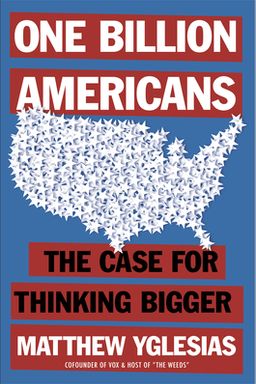
One Billion Americans cover

One Billion Americans

by Matthew Yglesias

In ''One Billion Americans,'' Matthew Yglesias presents a daring vision to bolster America''s global economic standing by increasing its population to one billion. Through innovative policy proposals, he explores how more people could lead to a stronger economy, better consumer options, and revitalized cities, making a compelling case for a brighter, sustainable future.

A Bigger America for a Bigger Future

What if America’s greatest challenge isn’t political division, but the fact that it’s simply too small? In One Billion Americans: The Case for Thinking Bigger, journalist Matthew Yglesias argues that the United States must triple its population to secure its position as the world’s leading power. His proposal is audacious yet surprisingly practical: to remain economically and geopolitically dominant in the face of a rising China and a growing world, America needs more people—more children, more immigrants, and more livable cities.

Yglesias contends that population isn't just a demographic statistic; it’s a strategic asset. The United States became the world’s preeminent superpower not only through its industrial prowess but through its sheer scale—its ability to mobilize more workers, consumers, and innovators than anyone else. But now, with China’s 1.4 billion people and India’s even faster growth, America’s 330 million citizens face a numbers problem. Without radical ambition, the country risks slipping irreversibly from global leadership.

Why Population Size Matters

At its heart, Yglesias’s argument is geopolitical. In the twentieth century, the United States’ victory in World War II and the Cold War stemmed from having both the world’s largest economy and a robust population base. Today, that balance is eroding. China doesn’t need to become richer per person than America to become more powerful overall; it simply needs to become half as rich on a per-capita basis. That alone would make it a larger economy—and with that comes influence, technology, and military reach. To Yglesias, preventing this shift doesn’t require hostility or fear of China’s growth—it requires America to grow, too.

But size, he reminds readers, isn’t just about power. It’s also about prosperity. A larger population means bigger markets, more innovation, more dynamic cities, and richer opportunities for all. From Silicon Valley to Houston, economic clusters thrive on density—the collisions of people and ideas that fuel progress. Just as bigger cities attract better talent, a bigger nation cultivates a deeper bench of scientists, entrepreneurs, and dreamers.

A Blueprint for Growth

Yglesias outlines a three-part path to a billion Americans: encourage larger families, open the doors to more and better immigration, and rebuild America’s cities so they can welcome millions of newcomers. Each lever, he argues, relies on rediscovering a lost sense of national ambition—what he calls a politics of “thinking big.” In the postwar era, America built highways, suburbs, and rockets to the moon. Today’s version, he insists, would be a nation unafraid to invest in affordable housing, modern transit, and generous child care to make growth livable and sustainable.

He recognizes the skepticism such ideas provoke. Isn’t the country already crowded? Don’t cities like San Francisco and New York struggle with sky-high rents? Yglesias flips that thinking on its head. America, he writes, isn’t too crowded—it’s absurdly underpopulated. France, with half the landmass, fits 67 million people comfortably. The United States could triple its population and still be less dense than Germany. What holds America back isn’t space—it’s political fear of change and local resistance to growth.

More Families, More Immigrants, More Possibilities

Central to Yglesias’s plan is tackling America’s historically low birth rate. Many Americans, he notes, say they want two or three children but often stop at one, largely because of financial stress and social expectations. The economics of parenting have become punishing: housing near good schools is expensive, child care costs rival college tuition, and family leave policies lag far behind other wealthy nations. Yglesias calls for sweeping parental leave, universal preschool, and direct child allowances—ideas he supports not out of nostalgia for tradition, but because children are future citizens, innovators, and taxpayers. Supporting families, in his view, isn’t charity—it’s infrastructure.

When it comes to immigration, Yglesias doesn’t merely advocate for compassion; he makes a ruthlessly pragmatic argument. Immigrants fuel growth immediately. They bring skills, fill jobs, start businesses, and offset America’s aging workforce. Rather than restricting entry, the U.S. should recruit foreign doctors, engineers, and workers through systems like “National Renewal Visas,” which would revitalize declining cities by encouraging immigration to places like Buffalo, Toledo, or Youngstown. Each new arrival would help sustain schools, revitalize real estate, and stimulate local economies.

Rebuilding the American Landscape

Population growth requires physical expansion, and here Yglesias dives into America’s urban and infrastructural crisis. Cities like San Francisco and Boston are paralyzed by housing shortages thanks to zoning laws and NIMBY (“Not in My Backyard”) politics. Meanwhile, once-vibrant industrial centers like Detroit and Cleveland sit hollowed out, with aging infrastructure and abandoned neighborhoods. His solution is twofold: remove barriers to building more densely in thriving metros, and relocate federal agencies and industries to struggling cities to create new centers of prosperity. He imagines a country of “comeback cities,” where growth isn’t confined to a few coastal enclaves but spread nationwide.

For transportation, Yglesias argues that congestion isn’t a reason to resist growth—it’s a reason to fix our infrastructure. He advocates for congestion pricing, high-quality mass transit, and European-style rail systems that connect cities efficiently. Growth, he says, doesn’t have to mean chaos; it can mean competence. The same logic extends to climate policy: a bigger America doesn’t doom the planet, since sustainability depends on better technology, not on shrinking populations. More Americans, in fact, could mean more innovators developing solutions to climate change.

Why It Matters

Ultimately, One Billion Americans is a call to reject small thinking. Yglesias reminds readers that America’s historic greatness sprang from an audacious belief in abundance—of land, opportunity, and human potential. If the country can recapture that boldness, it can both restore its middle class and sustain its leadership in a world where power follows population. For readers, the challenge is simple yet profound: will we continue to drift into decline, or will we build a bigger, bolder America worthy of its ideals?


The Economics of Family Growth

Yglesias begins his domestic blueprint with a direct challenge: if most Americans want more children than they’re having, what’s stopping them? For him, the answer lies not in changing personal values but in fixing the economics of parenting. Modern life, he writes, has made raising children a luxury good—and that’s a civilizational mistake.

The fertility rate in the U.S. sits below replacement level. Women say they’d ideally like around 2.6 children; the average is closer to 1.7. The reasons—high child-care costs, unaffordable homes, and student debt—aren’t mysteries. Yglesias argues that it’s time for public policy to bridge the gap between what people want and what they can afford.

The Family Fun Pack

His centerpiece is the “Family Fun Pack,” inspired by Finland’s child-friendly welfare model and popularized by progressive researcher Matt Bruenig. It’s a simple idea: provide parents with what every child needs—universal paid leave, health care, preschool, and child allowances. This “starter kit” of supports, Yglesias notes, would mirror Finland’s famous baby box—a literal box of essentials given to every new parent that symbolizes equality and care. The U.S. version, he argues, should be financial, not cardboard.

Like the Scandinavian models it resembles, it would be universal. That universality matters. When programs cover everyone, they win political support and avoid the stigma of “welfare.” More importantly, children become a shared national priority rather than a private burden. (In similar fashion, France’s generous family supports helped stabilize its birthrate long after other European countries began to shrink.)

From Leave to Learning

Yglesias proposes a chain of continuous support from birth onward: several months of paid parental leave, followed by universal child care and preschool. Education, he notes, begins long before kindergarten, but America’s fragmented system treats early childhood as private terrain. “Nobody tells parents,” he writes, “that every step before kindergarten is on them.” He draws on studies of Head Start and pre-K programs showing lifelong gains in graduation and earnings for kids who start learning early.

Most strikingly, Yglesias calls for rethinking the school calendar itself. Summer vacations, he notes, made sense when children worked on farms; now they make parenting harder and learning loss worse. Year-round schooling or public summer camps would relieve families and improve outcomes. “If we designed schools for modern work,” he quips, “we’d keep them open.”

A Culture of Parenthood

Beyond policy, Yglesias sees the need for a cultural realignment. American society, he writes, has embraced “workism”—the idea that jobs define moral worth. Parents, especially mothers, are shamed for either working too much or too little. He calls for a shift toward valuing family time as much as professional ambition, echoing scholars like Derek Thompson (The Atlantic) who link overwork to declining happiness. Public policy, he insists, must make that shift tangible—shorter workweeks, more holidays, and real family leave.

His underlying message is one of dignity and investment. America can afford to make parenting easier—it’s rich enough to build aircraft carriers and fund tax breaks for billionaires. “Why not fund our future citizens?” Yglesias asks. Raising children, he reminds us, isn’t just a private choice—it’s national infrastructure.


Immigration as National Growth Strategy

Yglesias’s second lever for hitting one billion Americans is immigration—what he calls the fastest and most pragmatic growth strategy available. Immigrants, he argues, bring immediate benefits: they arrive ready to work, contribute taxes, and expand the consumer base. “Every immigrant is a new American success story waiting to happen,” he writes.

He frames the current debate as paradoxical: conservatives view immigration as a threat, while progressives often defend it on humanitarian grounds. Both, he says, miss the core point. Immigration isn’t charity—it’s national strategy. Historically, America’s open-door policy made it the world’s innovation factory. Today, it could be the key to rejuvenating struggling heartland cities and addressing labor shortages in tech, health care, and education.

The Case for “More and Better” Immigrants

In One Billion Americans, Yglesias doesn’t shy away from selectivity. He supports targeting more educated and skilled immigrants while dramatically increasing overall numbers. For inspiration, he revisits the “Mariel boatlift” of 1980, when 125,000 Cubans landed in Florida almost overnight. Despite fears of economic collapse, studies found almost no harm to native workers—proof that even chaotic waves of migration can be absorbed. He contrasts that with the Trump-era RAISE Act, which would halve total immigration, calling it “an exercise in self-sabotage disguised as nationalism.”

Equally innovative is his idea of National Renewal Visas—place-based immigration incentives for declining cities. Borrowing from the “Heartland Visa” concept by economists Adam Ozimek and John Lettieri, these visas would attract immigrants to mid-sized towns like Toledo, Rochester, or Erie, where empty homes and underused infrastructure can welcome new residents. Living there for five years would earn a permanent green card, simultaneously rebuilding local economies and boosting national growth.

Immigrants as Problem Solvers

Immigration also offers solutions to pressing domestic policy challenges. In health care, Yglesias notes, America artificially restricts foreign doctors and nurses, driving up costs for everyone. Welcoming medically trained immigrants would instantly expand access and lower prices. Similarly, immigrants strengthen the fiscal health of programs like Social Security by paying taxes long before drawing benefits. (The National Academy of Sciences confirms that first-generation immigrants are net contributors over their lifetimes.)

Far from draining the welfare state, immigrants make it sustainable—if policy adjusts intelligently. Yglesias even suggests modestly higher payroll tax rates for immigrants to defuse political opposition while preserving fairness. What matters most, he says, is national renewal. “A billion Americans,” he writes, “means more engineers, artists, homebuilders, and caregivers—because every person is a possibility.”

From Fear to Confidence

Yglesias knows the politics of immigration are fraught with racial anxiety and cultural backlash. But he argues that only a confident, forward-looking America can manage diversity—just as it always has. “We’ve done harder things,” he reminds readers, pointing to the integration of European, Asian, and Latin American waves that once seemed impossible. The path forward, he suggests, lies not in shrinkage but in scale: being the place where ambition from around the world comes to live and build. Immigration, for him, isn’t a problem to contain—it’s the engine of greatness to be reignited.


Rebuilding the Hollowed Cities

One of the book’s most vivid arguments unfolds in Yglesias’s chapter “Comeback Cities.” He recalls covering Amazon’s infamous “HQ2” hunt—a spectacle that revealed everything wrong with how America spreads opportunity. Cities like Detroit, Cleveland, and St. Louis, desperate for investment, lost out to prosperous Washington, D.C., and New York, where residents protested the win. “America’s problem isn’t that prosperity is scarce,” Yglesias writes, “it’s that it’s unevenly distributed.”

Rather than subsidizing already-rich coastal metros, he proposes redistributing economic dynamism toward the Rust Belt and declining regions. His vision is rooted in realism: declining cities have infrastructure, housing, and room to grow—they just lack people and opportunity. Filling that gap, he argues, starts with reimagining where government and industry are located and who they serve.

Federal Relocation as Economic Catalyst

Yglesias suggests decentralizing the federal government itself. Agencies that don’t need to be near Congress—such as the Bureau of Engraving and Printing—should move to places like Youngstown or Milwaukee. This isn’t a partisan gimmick; it’s a well-tested economic development tool modeled on postwar “base realignment and closure” (BRAC) programs that smartly redistributed Defense Department jobs. The idea, he writes, isn’t to punish Washington, D.C., but to recognize that “in a country of declining places, it makes no sense for the government to overpay for office space in the nation’s richest metro.”

His colorful example—the botched Trump-era attempt to relocate parts of the USDA—illustrates how not to do it. The administration gave employees no notice or support, driving mass resignations. “It became a culture war instead of an economic project,” Yglesias laments. Real reform would involve gradual transitions, worker incentives, and coordination with receiving cities that align with each agency’s expertise—NIH in Cleveland with the Cleveland Clinic, for instance, or the Patent Office in Detroit to match its engineering heritage.

Crowdsourcing the Private Sector

Government dispersion should be paired with corporate strategy. Yglesias proposes deconcentrating the private sector, especially tech and media, which cluster stubbornly in New York, Silicon Valley, and Los Angeles. He notes how industries thrive through coordination—publishers staying near one another in Manhattan, or tech giants crowding Bay Area suburbs—but argues that this very clustering now harms national balance. “There’s nothing magical about Palo Alto real estate,” he jokes, “except bad zoning laws.” He imagines coordinated industry relocations, possibly incentivized by federal leadership, to cities like Philadelphia (for media) or Austin and Minneapolis (for tech).

For workers, this would mean cheaper housing and higher real wages; for companies, lower operating costs and access to retained talent. Most importantly, it would breathe life into cities that have been losing population for seventy years. The federal government can’t coerce such moves, but it can facilitate conversations and create incentives—a role Yglesias sees as “quietly revolutionary.”

Population as Cure

Ultimately, population is the key to revival. With fewer residents, taxes shrink, services crumble, and blight spreads. Detroit’s cheap houses, he notes, aren’t bargains—they’re symptoms of decay. “A city isn’t a farm,” he writes. “When neighbors leave, value leaves too.” His “National Renewal Visas” complement this logic perfectly: filling empty cities with new residents, immigrants, students, and entrepreneurs who can turn stagnation into renewal. Every additional family isn’t a burden—it’s stability. His lesson is blunt but optimistic: declining America isn’t doomed; it’s just underpopulated.


Curing Housing and Density Myths

Yglesias dedicates a passionate chapter to America’s housing dysfunction, arguing that building a bigger America is impossible without making housing abundant. His verdict is unequivocal: “We don’t have a population problem—we have a zoning problem.”

He dives deep into how restrictive zoning laws, parking mandates, and local veto power strangle growth in cities that most need it. Seventy-five percent of Seattle’s residential land, he notes, is reserved for single-family homes. Even in New York, 15 percent of residential land forbids apartments. The result: astronomically high rents in booming cities and urban decline where growth is blocked.

The Case Against Single-Family Zoning

He likens America’s zoning to banning large airplanes from busy airports—then wondering why flights are scarce. Detached houses are lovely, he concedes, but mandating them everywhere blocks duplexes, townhouses, and small apartments that could make cities affordable again. Minneapolis and Oregon, pioneers in abolishing single-family exclusivity, offer a model. He calls these reforms the backbone of “gentle density”—adding units without destroying neighborhood character.

He also warns against faux-progressive contradictions. Many liberals support immigration and opportunity yet oppose nearby density that makes either possible. “You can’t have immigration without apartments,” he quips. A billion Americans require not just inclusionary values but inclusionary zoning.

Reclaiming Land for People

Yglesias’s critique extends to “historic preservation” rules that ossify neighborhoods and block much-needed construction. He recounts examples like Washington, D.C.’s “historic” strip malls near metro stops that legally can’t be redeveloped, calling them “monuments to misplaced nostalgia.” True history, he argues, lies in growth and renewal, not enforced stagnation.

Beyond zoning, he attacks local politics—the tyranny of the neighborhood meeting. Drawing from researchers Katherine Levine Einstein and David Glick, he shows how older, wealthier homeowners dominate zoning hearings, opposing projects that would benefit the broader public. The result is “a democracy of incumbents, not citizens.” His remedy: shift decisions upward to state and federal levels, where the broader economic stakes can be seen.

From NIMBY to YIMBY

To reverse housing scarcity, Yglesias champions the YIMBY (“Yes In My Backyard”) movement—an ideological coalition that unites libertarian economists, progressive urbanists, and pragmatic developers. States like Oregon, California, and Virginia, he notes, are already experimenting with mandates for “missing middle” housing and accessory dwelling units (ADUs). The goal isn’t high-rises everywhere but flexibility: a housing ecosystem that grows naturally with demand. Behind every permission slip for a new unit, he sees a building block for future Americans—and a defense against national decline.


Infrastructure for a One-Billion Nation

What happens when three times as many Americans hit the road, the rails, or the skies? Yglesias turns to transportation as the biggest logistical hurdle—and one of the greatest opportunities—for a growing nation. Instead of retreating from congestion, he insists, America should innovate through it.

Fixing the Broken Roads

The solution starts with priorities: stop building new highways before fixing the ones we have. Despite years of federal bailouts, nearly 20% of American roads are rated in poor condition. Politicians love ribbon-cuttings, Yglesias notes, but preventive maintenance is what actually saves money. He urges a “fix it first” model, reallocating funds toward upkeep in metro areas where most traffic occurs. Roads, he reminds readers, are not endless frontiers; they’re systems that must be maintained intelligently.

Beyond the Gas Tax

Next, Yglesias dismantles the outdated gasoline tax. Tied to a static 18.4 cents per gallon since 1993, it no longer sustains infrastructure in a world of electric vehicles. He proposes replacing it with distance-based and congestion-based user fees—charging drivers for how much, where, and when they drive. He highlights Stockholm and Singapore, where congestion pricing has slashed traffic and pollution while improving bus reliability.

“The mightiest nation on Earth shouldn’t surrender to traffic jams,” he writes, challenging Americans to treat congestion like any other solvable problem. Revenue from smart pricing could fund better transit or even tax cuts elsewhere—it’s not punishment, but efficiency. Every hour saved from gridlock, he argues, is an hour added to national productivity.

Rethinking Transit and Trains

Yglesias also skewers the high costs and inefficiencies of U.S. transit construction. New York’s Second Avenue Subway cost ten times more per mile than Paris’s Metro expansions. He references urban planner Alon Levy, showing how better labor practices, simpler designs, and in-house expertise can cut costs dramatically. “We don’t need innovation,” he argues, “we need imitation—of Europe.”

His favorite import: the German S-Bahn, a hybrid between commuter rail and subway. By connecting suburban trains through downtown tunnels, cities like Munich and Berlin achieve dense, affordable mobility. Yglesias imagines adapting this model in Boston, New York, and Philadelphia—creating integrated regional rail systems at a fraction of current costs. “If Berlin can manage seven-minute headways,” he jokes, “so can Boston.”

Building Capacity, Not Sprawl

Finally, he reframes infrastructure as population insurance. Highways and subways aren’t luxuries—they’re how a billion people can coexist productively. Airports, often accused of congestion, would actually improve with more traffic, since larger populations justify more direct flights. True scarcity, he concludes, lies not in space or resources but in America’s failure to build. “We sent people to the moon,” he writes. “Surely we can fix our trains.”


Abundance, Growth, and National Confidence

In his closing chapters, Yglesias ties his vision together under one moral lesson: America must rediscover its faith in abundance. A billion Americans would not be a burden but a blessing—proof that democracy, prosperity, and inclusivity can scale together.

He deflates the common myths that more people mean more scarcity or environmental collapse. The real constraint, he argues, is political imagination. America’s land, food, and water resources easily rival or exceed those of denser wealthy nations. “We could triple our population,” he notes, “and still be less crowded than France.” The problem isn’t ecology—it’s pessimism.

Paying for Greatness

Funding such ambition, he insists, is not the issue. America can raise revenue through progressive taxation, higher alcohol and carbon taxes, or even modest military cuts redirected toward families and infrastructure. Low global interest rates, he notes, make public investment cheaper than ever. “Our children aren’t a cost,” he writes, “they’re the returns.”

Population growth would also resolve what economists call “secular stagnation”—a glut of savings and shortage of real investment. More people mean higher demand, more housing construction, and higher interest rates that keep recessions shorter. This “growth dividend” underscores his argument that demographic expansion is not charity but strategy.

A Hopeful Form of Patriotism

Yglesias ends with a challenge to readers and policymakers alike. America’s greatness has never been static; it’s built by people bold enough to expand its promise. He quotes John F. Kennedy’s “we choose to go to the moon” speech—but turns it on its head: one billion Americans, he says, isn’t hard, it’s just untried. “Letting people in, building homes, supporting families—none of that is rocket science.”

His final message revives the civic optimism that once defined the nation. Expansion—of hearts, cities, and possibilities—made the United States great in the first place. To stay number one, it must remember that greatness is not inherited, but built. And it’s built, above all, by people.

Dig Deeper

Get personalized prompts to apply these lessons to your life and deepen your understanding.

Go Deeper

Get the Full Experience

Download Insight Books for AI-powered reflections, quizzes, and more.