
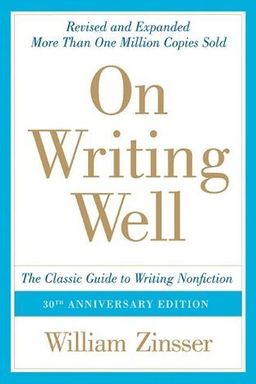
On Writing Well cover

On Writing Well

by William Zinsser

William Zinsser''s ''On Writing Well'' is an essential guide for anyone looking to master nonfiction writing. Packed with valuable insights, it simplifies the writing process, helping you find your authentic voice and refine your style for greater clarity and impact.

The Art of Writing Well: Clear Thinking Made Visible

How can you take the jumble of ideas in your head and turn them into sentences that readers actually want to read? That’s the central question William Zinsser poses in On Writing Well: The Classic Guide to Writing Nonfiction. Zinsser argues that writing well isn’t about using fancy words, complex sentences, or trying to sound intellectual—it’s about clarity, simplicity, and honesty. His book is both a craft manual and a philosophy of writing, built around the idea that good writing is good thinking, expressed in clean prose.

Zinsser, a longtime journalist, editor, and teacher, believes that anyone can learn to write clearly if they’re willing to do the hard, patient work of revising and stripping sentences down to their essence. His tone throughout is that of a mentor—direct, witty, and encouraging. On Writing Well isn’t about technical grammar or strict rules; it’s about discovering your authentic voice and being faithful to your material.

Writing as a Transaction

Zinsser opens the book by calling writing a “transaction” between writer and reader. Every word you choose is part of that exchange. The writer’s job isn’t to dazzle but to respect the reader’s time—to say exactly what they mean, and no more. He reminds you that readers come to writing with their own needs, impatience, and attention limits, so the burden is on you to hold their trust. Writing is personal, and what you put on the page reflects who you are. That’s why the best nonfiction, Zinsser insists, is also the most human.

In essence, clarity in writing mirrors clarity in thinking. If you can’t express your idea simply, you probably don’t understand it well enough yet. This concept echoes Albert Einstein’s famous claim that if you can’t explain something simply, you don’t understand it deeply—one reason Zinsser’s philosophy remains timeless.

The Principles of Simplicity and Clarity

The first part of the book, titled Principles, lays out Zinsser’s foundation: strip your writing of clutter. He describes clutter as the disease of American writing—stuffed phrases, redundant modifiers, and bureaucratic jargon that obscure meaning. To write simply, you must ruthlessly cut out what doesn’t serve the message. Every word must earn its place. This lesson mirrors George Orwell’s advice in “Politics and the English Language,” where Orwell pleads for precision over pretension. Both writers urge us to favor strong, plain words that convey thought with honesty.

Zinsser’s focus on clarity extends beyond grammar and style. It’s a matter of ethics. To clutter your writing is to disrespect your reader and to misrepresent your ideas. He calls writers to moral discipline—to make their prose transparent enough for truth to show through.

Finding Your True Voice

Throughout the book, Zinsser reminds you that style isn’t about adopting someone else’s rhythm or vocabulary—it’s about finding your own. Many writers, he notes, start out mimicking the voices of others. That’s normal, but the goal is to sound like yourself on the page. To achieve that, you need confidence and honesty, not artifice. Zinsser demonstrates this by writing with warmth and wit—proof that you can be conversational without being careless.

In chapters like “The Sound of Your Voice” and “Enjoyment, Fear and Confidence,” he talks about the emotional side of writing: how fear of judgment often makes us hide behind formal, dull language. Zinsser’s antidote is to embrace simplicity and trust that your authentic voice is enough.

Writing as a Craft, Not an Act of Genius

Zinsser argues that good writing isn’t a gift—it’s a craft. You learn it through effort, drafts, and revision. His belief that “writing is rewriting” runs through every section of the book. In this sense, he’s aligned with writers like Anne Lamott (in Bird by Bird) who teaches that messy first drafts are necessary steps to refinement. Zinsser sees revision not as punishment but as the heart of writing: a process of discovering what truly matters and how best to express it.

Forms and Freedom in Nonfiction

The book’s second and third sections—Methods and Forms—cover everything from how to write leads and endings to exploring subjects like travel, memoirs, business, science, and humor. Zinsser views nonfiction as “literature in its own right,” not mere reporting. Good nonfiction, he says, uses the tools of fiction—narrative, character, dialogue—to bring facts alive. Whether you’re profiling a person or exploring a scientific discovery, storytelling principles still apply: unity, voice, and attention to rhythm and structure.

He stresses that unity—of tone, focus, and point of view—is the glue that holds any piece together. You can write about anything, he assures the reader, as long as you bring clarity and curiosity to it. That’s the liberating message: nonfiction doesn’t have to be dry.

The Writer’s Attitude

In the final section, Attitudes, Zinsser explores the mindset writers need: confidence, joy, and humility. Good writing, he says, is born from respect—for language, for readers, and for the truth. He encourages writers to enjoy the process, to let their personality shine through, and to aim not for perfection but for authenticity. Writing well isn’t about a flawless product—it’s about thoughtful process and continual learning.

Zinsser’s message remains powerfully relevant in our digital age, where cluttered writing and short attention spans dominate. On Writing Well endures because it’s not just a manual—it’s a manifesto for clear thinking, honest communication, and timeless craftsmanship. For anyone who writes—whether journalist, student, professional, or blogger—Zinsser’s wisdom is a reminder that good writing is a way of being precise about life itself.


Simplicity: The Courage to Be Clear

Zinsser dedicates one of his earliest and most famous chapters to simplicity, calling it the “essence of good writing.” In his eyes, every cluttered sentence is an act of cowardice—a way to hide weak ideas behind fancy words. To be simple requires courage. It means deciding what truly matters and cutting everything that doesn’t. As Zinsser says, “Clutter is the disease of American writing.”

The Nature of Clutter

Clutter sneaks into your writing when you use long words where short ones would do (“utilize” instead of “use”), or when you pad sentences with qualifiers, euphemisms, or bureaucratic language. Zinsser points to institutions—government, corporations, and academia—as breeding grounds for cluttered prose. People in those systems learn to write defensively, trying to sound impressive or to conceal meaning. The result is writing that’s unreadable and exhausting.

To write clearly, you must first declutter your mind. Before you type a word, ask: what am I really trying to say? Then, after writing, strip away every unnecessary word. Zinsser compares this process to pruning a tree—painful at first, but necessary for growth.

Practical Techniques for Simplicity

Zinsser advises you to prefer strong verbs over weak ones and to avoid unnecessary adjectives and adverbs. A sentence should move forward like an arrow, not meander. He encourages reading your work aloud—clutter often reveals itself in awkward rhythms. This advice aligns with Hemingway’s practice of rewriting until every superfluous word was gone. Zinsser’s rule of thumb: if a word can be cut without changing meaning, cut it.

Simplicity, he reminds us, isn’t about dullness or minimalism—it’s about focus. The goal is not to write less, but to write precisely what matters. When you achieve that balance, your readers feel the clarity as much as they read it.


Finding Your Voice

One of Zinsser’s most empowering lessons is that your voice is your identity on the page. Too often, writers bury their real selves under formality, jargon, or imitation. Zinsser insists that you can’t write well until you stop trying to sound like someone else. The goal is authenticity—words that sound like you talking to a friend, but sharper and more thoughtful.

Authenticity Over Affectation

He warns against false elegance: overdesigned sentences, stiff tone, or inflated vocabulary. Readers can sense when a writer is faking it. Instead, write as you speak—but with care. That doesn’t mean to be sloppy; it means to let your natural rhythms guide your sentences. This echoes E.B. White’s philosophy in The Elements of Style, which also prizes plainness and rhythm as the keys to elegance.

Voice Emerges Through Confidence

Zinsser believes confidence comes from trusting your material and your process. The more you rewrite, the more clearly your voice emerges. That’s why he encourages writing about subjects you care deeply about—your engagement will naturally bring vitality to the prose. He gives examples from students and colleagues whose writing came alive only when they let go of self-consciousness and wrote with passion.

Ultimately, your writing voice grows out of your character. The more you refine your thinking, the more your prose will distinguish itself. As Zinsser puts it, “You are writing primarily to please yourself, and if you go about it with enjoyment you will write something that pleases other people.”


Unity: The Architecture of Nonfiction

Unity, for Zinsser, is the invisible structure that holds any piece of nonfiction together. Before you begin writing, you must decide what kind of person you are (in tone), what angle you bring to the subject (in point of view), and what you’re trying to say (in purpose). Once those decisions are made, everything you write must serve them.

Tone, Purpose, and Focus

Zinsser teaches that a piece must have a single tone—serious, playful, reflective, or analytical—and that tone should remain consistent from start to finish. Likewise, your purpose should be sharply defined. Are you trying to inform, persuade, or entertain? Mixing purposes can dilute clarity. Finally, focus limits your material. Readers trust writers who know where they’re going.

Unity in Practice

He illustrates unity through examples of strong nonfiction: essays that never wander from their thesis and profiles that keep one consistent thread—a theme, question, or perspective—throughout. In travel writing, for instance, he suggests finding one defining impression rather than listing everything seen. In memoirs, unity emerges from choosing which version of yourself the story is about and staying faithful to that self throughout. The message is clear: good writing feels whole because it is whole in the writer’s mind first.

Every powerful piece of nonfiction starts with internal coherence—before the first word lands on the page.


The Craft of Rewriting

Zinsser was relentless about revising. He believed that rewriting is where good writing is truly made. The first draft, he said, is you telling yourself what you think. The second draft is you telling others what you mean. Every revision should push the prose closer to simplicity and strength.

Why Rewriting Matters

Rewriting is not failure but craftsmanship. Zinsser often saw students hesitate to cut their favorite lines, mistaking effort for brilliance. Yet trimming, rearranging, and polishing is what turns a rough idea into art. This process parallels sculpting: you begin with raw material, then carve away everything that’s not essential. He frequently edited magazine pieces down by a third or more, claiming each cut tightened energy and clarity.

Tools for the Rewrite

Zinsser urges you to read aloud, check rhythm, eliminate unnecessary modifiers, and replace passive voice with active verbs. He recommends stepping away after a draft so you can return with fresh eyes—a principle echoed by Stephen King’s “drawer time” method in On Writing. Clarity often emerges only after you’ve had time to forget what you meant to say and instead see what you actually wrote.

The heart of rewriting, then, is humility. You accept that your first effort isn’t sacred—it’s a step toward precision. As Zinsser summarizes, “Rewriting is the essence of writing well: it’s where the game is won or lost.”


Writing About People and Places

Zinsser’s chapters on interviews and travel writing stand out for their practicality. He treats people and places not as topics but as living experiences. The goal is to capture essence rather than chronology—to let detail serve insight.

The Art of the Interview

When writing about people, Zinsser insists on respect. Always let people be themselves, and listen more than you talk. Avoid overquoting; paraphrase to keep flow but keep quotes for authenticity. He notes that true understanding often happens in small moments—a gesture, silence, or unexpected remark. Writing about people is, fundamentally, writing about human nature.

The Craft of Travel Writing

For travel pieces, his lesson is to avoid turning them into itineraries. Focus on one idea or impression—something the reader can feel. In describing a city or landscape, it’s not about listing sights but about capturing what makes that place unique to you. The best travel writing combines personal reflection with observation, transforming geography into narrative. This principle connects with Pico Iyer’s essays, which find meaning in motion itself.

Zinsser’s broader message: writing about anything outside yourself still begins within—through curiosity, empathy, and a clear point of view.


The Joy and Fear of Writing

In his later chapters, Zinsser confronts the emotional side of writing: the fears, insecurities, and pressures that all writers face. He urges you to write with joy rather than dread. Every piece, he reminds us, is an opportunity to discover not only what you think but also who you are.

Enjoyment Fuels Quality

Zinsser argues that if you’re not enjoying what you’re writing, readers will feel it. Enthusiasm is contagious. Even serious or technical topics can benefit from energy and curiosity. He writes, “Writing is enjoyable, and it should be. If you don’t enjoy it, find something else to do.” This conviction echoes Ray Bradbury’s advice that writing should be an act of love, not duty.

Managing Fear and Doubt

Fear, of course, is inevitable—fear of failure, judgment, or not measuring up. Zinsser reminds you that every great writer feels inadequate sometimes. The cure is discipline and trust. Keep writing, rewriting, and trimming until the clarity comes. The confidence follows. Most important, don’t compare yourself to others; every voice is distinct, and yours must reflect your own truth.

Ultimately, his lesson is both practical and philosophical: writing well is an act of self-respect. You give your best to both language and reader, and in doing so, you refine yourself. That’s why, in Zinsser’s world, learning to write well is inseparable from learning to live well.

Dig Deeper

Get personalized prompts to apply these lessons to your life and deepen your understanding.

Go Deeper

Get the Full Experience

Download Insight Books for AI-powered reflections, quizzes, and more.