
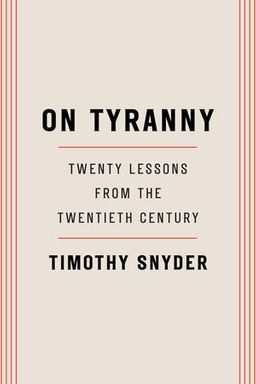
On Tyranny cover

On Tyranny

by Timothy Snyder

On Tyranny by Timothy Snyder offers twenty crucial lessons from the twentieth century, guiding readers on how to recognize and resist tyranny. Through historical insights, it empowers individuals to protect freedoms and maintain democratic vigilance in today’s political climate.

Lessons in Resisting Tyranny

Can tyranny really take root in a democracy like ours? Timothy Snyder’s On Tyranny: Twenty Lessons from the Twentieth Century confronts this uncomfortable question with clarity and urgency. Drawing directly from the collapse of democracies in the twentieth century—what he calls the “bloodlands” of Europe between Hitler and Stalin—Snyder asks modern readers to wake up to the rhythms and warning signs of authoritarianism. His thesis is simple but deeply unsettling: tyranny doesn’t arrive overnight. It seeps in, often through the willing obedience and quiet resignation of ordinary people.

Snyder contends that when citizens surrender their sense of responsibility and truth—when they obey in advance, normalize corruption, or allow private life to dissolve into propaganda—they create the conditions for totalitarianism. Tyranny doesn’t begin with tanks in the streets, he argues, but with choices made in daily life: the words we repeat, the lies we accept, the institutions we fail to defend, and the neighbors we stop greeting.

The Warning from History

Snyder opens by situating American readers within a dangerous illusion—the “politics of inevitability.” This comforting belief assumes democracy naturally strengthens itself over time. But history, as Snyder reminds us, is not linear. Between the 1920s and 1940s, European democracies crumbled into fascism and communism because citizens underestimated how fragile liberty could be. Totalitarian rulers in Germany, Italy, and the Soviet Union exploited fear, manipulated truth, and used crises to consolidate power. Snyder writes that Americans too once believed that such collapse was impossible, but “history does not repeat, it instructs.”

His book distills that instruction into twenty pragmatic lessons—each reflecting a historical pattern of how democracies fail. The first lesson, “Do not obey in advance,” diagnoses the psychological mechanics of tyranny: the voluntary submission of the citizen. When people conform before they are forced to, authoritarian leaders learn what they can get away with. From this insight flows the book’s broader message: freedom requires conscious, daily defense.

Truth as the First Battlefield

In Snyder’s view, truth is always an early casualty of tyranny. Echoing Hannah Arendt’s writings, he notes that when people abandon factuality—whether through lies, cynicism, or “post-truth” relativism—they lose the ability to hold rulers accountable. The Nazis mastered this through incessant repetition and magical thinking: contradictions were tolerated if they served emotion and myth. The “post-truth” world of today, Snyder warns, is not new—it’s pre-fascism. Whenever slogans replace reality and faith is invested in personalities rather than evidence, democracy erodes.

This connects to the importance of language. Propaganda dulls independent thought, especially when citizens recycle the same phrases heard on screens. Snyder urges readers to protect their linguistic independence by reading books and cultivating private reflection—an echo of George Orwell’s “Politics and the English Language” and Viktor Klemperer’s linguistic critiques under Nazi rule.

Institutions, Ethics, and Everyday Resistance

Institutions form the second battlefield. Democracies crumble when their citizens expect courts, legislatures, or journalists to defend themselves. Snyder shows that the Nazis and communists dismantled democratic infrastructure not through sudden coups, but through systematic corrosion—a process that relied on civil servants, lawyers, judges, and doctors relinquishing their professional ethics. For tyranny to advance, it must first capture the consciences of the professional class. Thus, one of Snyder’s central lessons is to “remember professional ethics”—to hold fast to the moral principles of one’s vocation even when state pressure demands otherwise.

Beyond defending formal institutions, Snyder places equal importance on micro-political acts: greeting your neighbors, supporting free media, and volunteering for organizations. These small choices literally shape what he calls “the face of the world.” Symbols of hate, when tolerated, evolve into systemic cruelty. Acts of civility, by contrast, become seeds of resistance.

From Fear to Action

Snyder reminds us that authoritarians thrive on fear, especially during crises. “Modern tyranny is terror management,” he writes, referring to how leaders exploit terrorist attacks or emergencies to justify power grabs. The lesson is clear: don’t surrender freedom for the illusion of safety. Instead, channel fear into preparation. Secure your private life, protect personal data, and resist the normalization of constant surveillance—a twenty-first-century extension of Orwellian warnings.

History, Patriotism, and Courage

The final lessons turn from caution to calling. Snyder distinguishes patriots from nationalists: a patriot loves their country enough to critique it, while a nationalist equates loyalty with blind obedience. True patriotism demands vigilance. Citing figures from Churchill to the Polish resistors of the 1980s, Snyder illustrates how courage, often by ordinary people, becomes the hinge of history. “If none of us is prepared to die for freedom,” he concludes, “then all of us will die under tyranny.”

Ultimately, On Tyranny is not a history book—it’s a manual for civic renewal. It asks what it means to live responsibly in uncertain times and reminds you that democracy’s survival is not inevitable; it depends on moral clarity, daily action, and the courage to stand up when others remain silent.


The Danger of Anticipatory Obedience

Snyder begins his list of lessons with a sobering observation: tyranny often begins when citizens start obeying without being told to. This subtle, voluntary compliance—what he calls anticipatory obedience—was a crucial factor in the rise of both Nazi Germany and communist regimes in Eastern Europe. People didn’t just comply with new orders; they guessed what those in power wanted and acted accordingly. By doing so, they demonstrated that coercive enforcement wasn’t necessary—the system could count on their cooperation.

How Obedience Fuels Tyranny

After Hitler’s appointment as chancellor in 1933, few Germans could see how quickly democracy would unravel. Similarly, in Czechoslovakia in 1946, when the communists won elections, it was anticipatory obedience from bureaucrats, teachers, and soldiers that ensured regime consolidation. Ordinary people rationalized their compliance as harmless adaptation: a way to survive. But this early surrender of independence taught authoritarian leaders two lessons—that they faced little resistance and that they could act faster and more brutally than they had imagined.

The Austrian example of 1938 captures this vividly. After Hitler threatened annexation, Austrian Nazis rounded up Jews and forced them to publicly scrub streets while “neutral” Austrians looked on, even laughing. The cruelty was contagious. Days later, more citizens joined the humiliation. The Nazis learned that they could rely on ordinary people’s participation. Obedience had opened the door to atrocity.

The Psychology of Submission

Snyder connects these historical examples to the Yale psychologist Stanley Milgram’s 1961 experiment on authority. Participants were told to administer electric shocks to another person as part of a learning test. Most complied, even when they thought they were causing severe pain or death. The lesson: people conform more easily to authority than they realize, especially in new situations. Milgram’s conclusion was unsettling: obedience isn’t a foreign trait or a German peculiarity—it’s a human one.

By drawing parallels between Nazi atrocities and everyday psychology, Snyder makes the lesson uncomfortably personal. You, too, may underestimate how easily you conform. Resistance, then, must start before coercion begins—by consciously refusing to act unthinkingly.

“Most of the power of authoritarianism is freely given,” Snyder warns. “A citizen who adapts in this way is teaching power what it can do.”

Breaking the Cycle

The antidote to anticipatory obedience is awareness. You need to stop and ask: am I doing this because it’s right, or because I assume it’s expected? By maintaining personal integrity—whether in classrooms, workplaces, or communities—you shrink the space in which tyranny can grow. Snyder proposes a radical kind of everyday courage: to delay obedience long enough to think. In that pause, democracy has a chance to breathe.

In modern times, this means resisting pressures to self-censor, refuse transparency, or accept violations of rights because “that’s just how things are done now.” It means recognizing when safety and conformity are mere disguises for control. As Snyder reminds readers, democracy depends less on heroic uprisings than on the quiet courage of people who refuse to go along too soon.


Defending Institutions Before It's Too Late

Institutions are the backbone of any democracy—but only if citizens actively defend them. Snyder’s second lesson, “Defend institutions,” reveals how easily democratic structures can dissolve when people treat them as permanent. The mistake, as he shows through history, is assuming that courts, parliaments, and free media will automatically check overreach. In fact, once leaders learn they can break norms without consequence, institutions stop restraining them and start serving them.

The Fallacy of Autopilot Democracy

In 1933, German Jews read newspaper editorials assuring them that Hitler’s government would respect the constitution. They believed the Nazi regime would eventually normalize. Within months, all opposition parties were banned; by the year’s end, Germany had become a one-party dictatorship. What failed first was not law but trust—the assumption that institutions would fix themselves. Snyder warns that Americans share a similar delusion: we refer to “our institutions” as though they were self-healing entities, not fragile human constructs that require stewardship.

This complacency is dangerous. When citizens disengage, opportunistic politicians weaponize bureaucracy—the very machinery meant to protect the people. Snyder counters this with actionable advice: make an institution yours by supporting it actively. Subscribe to a newspaper, volunteer in local government, protect an independent court. Every act of engagement fortifies a small piece of the civic infrastructure.

The Dangers of Gleichschaltung

Snyder invokes the Nazi concept of Gleichschaltung—the “coordination” of all institutions under one ruling ideology. This wasn’t achieved through open destruction but through slow co-option. Universities, unions, and cultural organizations aligned themselves with the regime, thinking it was a temporary adaptation. Within a year, they were assimilated entirely. Similar tactics appeared under communism, where parties turned labor unions and civil society groups into tools of state control rather than opposition.

The reduction of diversity among institutions—political, legal, religious, or journalistic—is a hallmark of creeping totalitarianism. Snyder’s warning is pragmatic: defend pluralism not in principle, but through participation. Choose one institution you trust and make its defense your personal duty. The cumulative effect of millions doing the same can make the difference between freedom and servitude.


The Poison of Post-Truth Politics

Among Snyder’s most haunting phrases is “post-truth is pre-fascism.” In a world where lies spread faster than facts, autocrats thrive. The denial of verifiable reality isn’t just dishonest—it’s the scaffolding of tyranny. The Nazis understood this intimately, as did modern propagandists. Once truth becomes negotiable, power belongs not to those who are right, but to those who shout the loudest.

Four Modes of the Death of Truth

Snyder, drawing from the diarist Victor Klemperer, describes four stages through which truth dies: hostility to factual reality, repetition of lies, magical thinking, and misplaced faith. First comes the open attack on facts—leaders invent their own realities. Second, through “shamanistic incantation,” slogans and chants (“Build that wall!”) create emotional bonds that override logic. Third, magical thinking replaces coherence with contradictions: a politician promises to cut taxes, erase debt, and expand spending simultaneously. Finally, faith descends to earth, as people proclaim their leader as a savior who alone can fix everything.

This descent, Snyder argues, mirrors the trajectory of pre-war Germany. Even as the evidence of defeat mounted in 1945, one amputated soldier told Klemperer, “Hitler has never lied. I believe in him.” The abolition of truth leads to the abolition of individual judgment; people surrender their capacity to discern. The same mechanism now fuels “post-truth” culture—where social media feeds affirm biases and reduce reality to spectacle.

Propaganda, Media, and the Mind

To resist post-truth politics, Snyder calls for a return to “print journalism” and deep reading. The mind needs three-dimensional space—to reason slowly, compare sources, and build context. Online, emotion replaces evidence. Worse, algorithms reward outrage, creating “tribes with distinct worldviews.” When truth fragments, shared society collapses. Snyder offers simple, actionable rules: verify information before sharing, follow journalists who abide by ethics, pay for real reporting, and learn to recognize manipulation.

“The individual who investigates is the citizen who builds,” Snyder writes. Democracy depends on millions choosing truth over convenience.

The antidote to post-truth isn’t cynicism but engagement. Read long articles. Ask questions. Speak carefully. Protect your language as you would your liberty—for both rise and fall together.


Everyday Acts of Resistance

Snyder insists that tyranny doesn’t fall only to heroes—it’s eroded by the small, persistent acts of ordinary people. His midsection lessons—“Stand out,” “Take responsibility for the face of the world,” and “Make eye contact and small talk”—sound deceptively simple, yet they describe a foundational civic truth: free societies rely on trust, and trust is built interaction by interaction.

Symbols and Civic Responsibility

History shows how symbols of hate, left unchallenged, shape the physical and moral landscape. In 1930s Germany, Xs and swastikas scrawled on doors weren’t just graffiti; they were psychological weapons that normalized exclusion. When Americans today overlook similar symbols—racist slogans, online harassment, extremist flags—they also risk numbing moral sensitivity. Removing hate symbols, Snyder suggests, is not merely cosmetic; it’s an assertion that public space belongs to everyone.

Living Politically in Daily Life

Life is political not because government watches every move, but because your daily actions express what kind of society you endorse. Small gestures—introducing yourself to a neighbor, speaking kindly across differences—might seem trivial, but in moments of fear and propaganda, such gestures preserve humanity. Snyder recounts how, under Nazi and communist regimes, even a handshake could save lives by signaling solidarity in times of denunciation.

Czechoslovak dissident Václav Havel, whom Snyder frequently cites, offers the parable of the greengrocer who posts a slogan—“Workers of the world, unite!”—not out of belief but compliance. His act sustains the lie. When people stop performing such empty rituals, tyranny cracks. Every authentic interaction becomes an act of quiet defiance.

Standing Out Together

Resistance begins with the courage to stand out, but succeeds only when others follow. Rosa Parks’s refusal wasn’t just moral—it was contagious. The Polish Solidarity movement of the 1980s blended intellectuals, workers, and clergy into a coalition that toppled communism. Their lesson, Snyder says, is timeless: effective resistance bridges divides and operates in public space. Protest organized online must end on the streets, embodied and visible. Power wants you distracted, safe behind screens; freedom demands presence.

Your body, your speech, your time—they are political resources. Use them well, and even small acts become the architecture of democracy.


Protecting Privacy and the Power of the Private Life

Snyder redefines privacy as a political right. “We are free only insofar as we exercise control over what people know about us,” he writes, echoing Hannah Arendt’s warning that totalitarianism erases the boundary between public and private life. The digital age, with its culture of surveillance and public shaming, recreates this erasure under new disguises: data theft, hacking, and the viral spread of private information.

Totalitarian Temptations in the Digital Age

During the 2016 U.S. election, stolen emails and “timed releases” diverted attention from substantive debate, transforming personal intrusion into political spectacle. Snyder interprets such events as modern rehearsals of totalitarian strategy—weaponizing privacy violations to manipulate emotion. The problem intensified because media played along, seduced by the entertainment value of secrets.

This voyeurism, Snyder argues, primes society for conspiracy thinking. When every revelation feels like a hidden truth, citizens stop distinguishing relevance from distraction. Instead of forming opinions, they follow narratives of exposure crafted by those with power. The result is mob behavior disguised as curiosity.

Reclaiming Your Private Sphere

Protecting privacy means reclaiming both control and consciousness. Snyder’s advice is practical: secure your computer, minimize digital surveillance, and discuss sensitive matters in person. But beneath the technicalities lies a deeper principle: the power to choose silence or disclosure sustains autonomy. Totalitarian systems steal this choice by making everyone visible to authority—and, eventually, to one another as informants. Re-establishing private life restores perspective, empathy, and moral stamina.

By nurturing private relationships and confidential trust, you create safe zones where honesty can survive. In a monitored society, privacy becomes the seedbed of resistance—the space where truth can breathe before returning to the public world.


Emergencies, Fear, and the Politics of Exception

“Be calm when the unthinkable arrives,” Snyder advises, referencing how leaders exploit crises to consolidate power. The tactic is ancient: from the Reichstag Fire of 1933 to modern terrorism laws, emergencies often become pretexts for suspending freedoms. Carl Schmitt, a Nazi jurist Snyder quotes, called sovereignty “the power to decide the exception.” Once fear legitimizes exception as the rule, democracy ends.

The Reichstag Fire as Template

When the Reichstag building burned, Hitler declared it a communist plot. Within twenty-four hours, civil liberties were suspended; opponents were rounded up; and soon he could rule by decree. What mattered wasn’t who set the fire—it was how fear was used. Snyder compares this to modern “terror management,” in which governments amplify fear to justify extraordinary powers. Putin’s Russia, he notes, mastered this through both real and staged terrorist attacks, each followed by the erosion of political freedoms.

Even democratic societies are susceptible. After 9/11, sweeping surveillance powers were normalized. Snyder warns that when leaders equate criticism with treason or label dissenters “extremists,” the vocabulary of emergency becomes the language of tyranny. The shift from temporary security measures to permanent authority is often invisible until it’s too late.

Courage over Panic

The antidote is deliberate calm. Recognize the emotional theater of crisis management: disasters provoke fear, fear demands order, and authoritarian leaders promise safety at any cost. Your task is to resist this psychological bait. “People who assure you that you can only gain security at the price of liberty usually want to deny you both,” Snyder writes. True safety, paradoxically, depends on refusing to surrender freedom in moments when it feels most expendable.

To prepare for “the unthinkable” is to cultivate emotional discipline before crises strike. Remember that panic breeds submission, and that courage doesn’t mean fearlessness—it means principled action in spite of it.


The Meaning of Patriotism and Courage

Snyder concludes with two intertwined lessons: “Be a patriot” and “Be as courageous as you can.” Here he dismantles one of modern politics’ most abused words. Nationalism, he argues, is not patriotism. A nationalist insists that their country is flawless and demands blind loyalty; a patriot loves their nation enough to confront its flaws. Nationalism feeds resentment; patriotism sustains renewal.

Patriotism vs. Nationalism

Snyder quotes Orwell’s insight: the nationalist “endlessly broods on power, victory, defeat, revenge,” whereas the patriot engages the real world, judging their country by universal moral standards. This distinction is more than linguistic—it’s existential. Patriots defend the conditions for self-critique; nationalists dismantle them. In the 1930s, “America First” meant isolation from the fight against fascism. In modern times, similar rhetoric makes tyranny seem virtuous by disguising selfishness as loyalty.

True patriotism, Snyder argues, demands vigilance—daily, not ceremonial. Echoing Wendell Phillips, he reminds us: “Eternal vigilance is the price of liberty.” That vigilance must point inward: toward domestic threats to democracy, not imagined enemies abroad. Otherwise, liberty rots not through invasion but through neglect.

Courage as the Final Line of Defense

All twenty lessons converge here. Institutions, truth, ethics, and solidarity depend on individual courage—the willingness to bear risk. History’s silent warning is that cowards outnumber tyrants. Totalitarian regimes endured not because everyone believed, but because too few resisted. Snyder closes with a blunt truth: “If none of us is prepared to die for freedom, then all of us will die under tyranny.”

Courage rarely appears heroic in the moment. Churchill’s defiance in 1940 and ordinary resisters like Teresa Prekerowa, who smuggled food into the Warsaw Ghetto, both stood alone amid conformity. Yet, as Snyder shows, their isolation became contagious, transforming private conscience into public salvation. For you, courage means standing up early—before it’s safe, before it’s popular, before the choice disappears.

Dig Deeper

Get personalized prompts to apply these lessons to your life and deepen your understanding.

Go Deeper

Get the Full Experience

Download Insight Books for AI-powered reflections, quizzes, and more.