
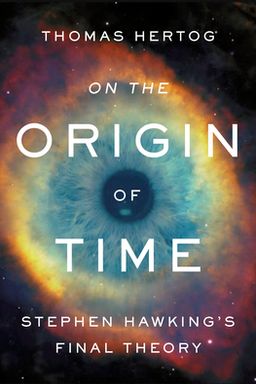
On the Origin of Time cover

On the Origin of Time

by Thomas Hertog

Embark on a journey through Stephen Hawking''s final theories in ''On the Origin of Time.'' Thomas Hertog explores how Hawking fused quantum physics, holography, and evolutionary theory to propose revolutionary ideas about the universe''s origins. Discover the complexities of our cosmos through Hawking''s transformative scientific lens.

The Quantum Origin of the Universe

How can the universe, with its life-permitting precision and apparent design, emerge from a self-contained law of nature? In On the Origin of Time, Thomas Hertog—Stephen Hawking's final collaborator—traces how Hawking’s lifelong struggle with cosmology, from relativity to quantum gravity, leads to a radical rethinking of origins. Hertog argues that the key lies in quantum cosmology: a universe that does not arise from pre-given laws but one where laws themselves evolve, and where the act of observation plays a constitutive role.

The book’s central narrative follows a profound shift in Hawking’s thinking, from classical determinism to a view where the universe’s beginning, laws, and observers are dynamically entangled. You will see how classical physics, with its fixed spacetime and eternal laws, gives way to a quantum, holographic picture in which spacetime and even time itself are emergent phenomena.

Fine-Tuning and the Design Puzzle

Hertog begins by confronting a deep paradox: the universe looks fine-tuned for life. Subtle numerical coincidences—the neutron-proton mass ratio, Hoyle’s carbon resonance, the feeble strength of dark energy—fall within narrow, improbable ranges. You meet two opposing responses. One seeks a unique, mathematical explanation—a timeless Platonic blueprint. The other invokes a multiverse, where physical constants differ randomly and we simply live in one that allows life. Hawking, initially intoxicated by mathematical elegance, comes to see the multiverse idea as a methodological crisis: it seems to replace law-like explanations with anthropic selection, eroding science’s predictive backbone.

Relativity and the Birth of Time

You are then led through the first great transformation: Einstein’s and Lemaître’s discovery that spacetime is dynamic. General relativity turns geometry itself into a physical field, bending and evolving with matter. Lemaître’s insight that this geometry implies an expanding universe—a “primeval atom” beginning—forces you to confront a shocking idea: time may have a beginning. For Einstein, that smelled of metaphysics; for Lemaître, it was a clue that quantum indeterminacy must play a role in creation itself. This conflict between timeless law and temporal genesis becomes the book’s recurring motif.

From Singularities to Quantum Genesis

Hawking’s early work with Roger Penrose showed that under general conditions, spacetime ends in singularities—regions where laws fail. This mathematical fact shifts the question from what happened at the beginning to whether the concept of a beginning makes sense. If the classical equations self-destruct at the origin, then the origin demands quantum rules. Hawking’s next creative leap, shared with James Hartle, was to merge dynamics and initial conditions into one quantum object: the no-boundary wave function. Instead of a sharp edge, the universe’s beginning becomes a smooth transition, where time behaves like a spatial direction. In this picture, asking “what came before” is meaningless—just as you can’t ask what’s south of the South Pole.

Inflation, Observation, and Predictivity

Next, Hertog shows how inflation—an exponential burst of early expansion—links this quantum genesis to modern cosmological data. Quantum fluctuations stretched by inflation become the tiny ripples we see imprinted in the cosmic microwave background (CMB). But when cosmologists extended inflation to a self-replicating process—eternal inflation—they reintroduced an infinity of possible universes and laws. Hawking again balked: such an unbounded picture risks losing predictivity. How can science test hypotheses in a universe it cannot sample? For him, the answer was not to embrace the multiverse but to re-formulate quantum cosmology so that our observations themselves condition which histories count.

Top-Down and Participatory Laws

The later chapters develop Hawking and Hertog’s “top-down cosmology.” Instead of assuming a single, objective history that flows forward from a fixed beginning, top-down reasoning works backward: start with what you observe now and infer the class of quantum histories that could yield that observation. This flips cosmology from a spectator theory to a participatory one. Observation becomes not a passive reception of facts but an active filter that carves one classical history from the quantum mist of many possibilities. John Wheeler’s slogan “No question, no answer; no question, no history” becomes literal: questions shape cosmic history itself.

From Multiverse to Holographic Unity

Hertog then bridges this participatory view with holography—the discovery that everything happening in a volume of space can be encoded on its boundary. The AdS/CFT duality (Maldacena, Witten) reveals that gravity and spacetime emerge from patterns of quantum entanglement. In this light, the universe’s structure and even time itself arise from deeper informational order. If entanglement weaves spacetime, then changing entanglement changes geometry; black holes themselves teach that the cosmos is a holographic information processor. The fine-tunings that once seemed miraculous become reflections of entanglement constraints rather than arbitrary coincidences.

The Evolving Concept of Law

By the end, you realize Hawking’s journey closes the loop opened by Lemaître: the laws of nature are not timeless scaffolds but evolving summaries of what the universe’s quantum state allows you to observe. Rather than multiple universes, there are multiple possible histories, pruned by interaction and observation. Hertog calls this the return of scientific predictivity—not by freezing law, but by recognizing that even laws have histories. The origin of time is thus the origin of law itself: reality becoming self-descriptive through quantum evolution and observational participation.


Relativity and the Birth of the Cosmos

Hertog’s story begins with the revolution of relativity, when Einstein and Lemaître transformed cosmology from metaphysics into science. Special relativity fuses space and time; general relativity makes that fusion dynamical. Gravity is no longer a force acting within spacetime—it’s the curvature of spacetime itself. Matter tells spacetime how to curve, and curvature tells matter how to move.

Einstein’s Static Preference

Einstein originally rejected cosmic evolution, adding the cosmological constant to keep the universe static. He disliked the notion of a beginning—it hinted at supernatural creation. But when Lemaître applied Einstein’s own equations, he found an expanding cosmos that must have a finite past. Observations soon confirmed it: Slipher’s redshifts, Hubble’s distance–velocity relation, and finally the CMB, the afterglow of a hot early universe. (Parenthetical note: the irony that the priest Lemaître advocated a temporal beginning while Einstein resisted it underlines how philosophy often precedes physics.)

Singularities and Limits of Law

Hawking and Penrose then proved that such an expanding universe inevitably traces back to a singularity—a boundary where classical spacetime and its equations fail. At that singular point, density and curvature diverge. This isn’t a bug but a signal that the classical picture collapses. Hertog emphasizes that this breakdown doesn’t imply a supernatural event; it announces the need for new physics. The singularity theorems thus mark a turning point: cosmology’s biggest success becomes the reason to go quantum.

The Quantum Challenge

The pressing question becomes: How do you impose initial conditions on the entire universe when there is no “outside” to supply them? The only consistent answer, Hawking realized, is to let quantum law determine both dynamics and initial condition—giving birth to the no-boundary idea. You begin to see how quantum mechanics, once confined to the micro world, invades the structure of the cosmos itself.


The No-Boundary Universe

Hawking and Jim Hartle’s boldest idea was the no-boundary proposal: the universe could be finite yet unbounded, arising smoothly from a quantum fluctuation without a singular start. Using a “Euclidean path integral,” they described an origin where time turns into a spatial dimension. The imagery is powerful—a rounded bowl instead of a sharp bang. The laws of physics, geometry, and the existence of time all emerge together.

From Imaginary Time to Real Time

In the no-boundary geometry, “imaginary time” allows spacetime to close smoothly, removing infinities. When analytically continued, this geometry unfolds into the expanding universe we inhabit. Hawking’s hospital-floor illustration—drawing a circle to represent time looping into space—makes tangible that the cosmos may have no external start point. Asking what came before the Big Bang is like asking what lies south of the South Pole.

From Philosophy to Prediction

Hertog stresses that the no-boundary model is a scientific, not metaphysical, claim. It leads to quantitative calculations: given certain inflationary potentials, you can compute the probability of different cosmic histories emerging. The no-boundary wave function predicts an ensemble of possible universes weighted by their smoothness and inflationary behavior. However, early versions favored nearly empty universes—an apparent mismatch with our galaxy-rich reality. That puzzle motivates the next idea: that observation itself conditions the manifest universe.

Limitations and Motivation for a New View

The Euclidean approach is mathematically elegant but interpretationally subtle. Which geometries count? How do you extract real predictions? Hawking’s genius lay not in finishing the calculation but in realizing that the theory itself must include the observers doing the measuring. Introducing observership into the universe’s wave function turns no-boundary cosmology from an abstract scheme into a participatory model capable of explaining why this universe appears as it does.


Inflation, Multiverse, and the Limits of Prediction

Inflation solved powerful puzzles: why the universe looks smooth on large scales and flat in geometry, and why quantum ripples grew into galaxies. COBE and Planck data confirmed its fingerprints in the CMB—oscillating acoustic peaks and near-scale-invariant fluctuations. But inflation’s success also created its own paradox: extended to eternal inflation, it predicts an infinite multiverse filled with “bubble” universes obeying different laws.

The Anthropic Detour

Multiverse advocates like Andrei Linde and Leonard Susskind invoked the anthropic principle—arguing that we observe a life-compatible cosmos because observers can exist only in such corners of the multiverse. Yet this move troubled Hawking. With infinitely many regions, any outcome can be assigned nonzero weight if one tweaks the measure. Science risks turning tautological: we explain life-friendly physics by saying only life-friendly physics is observed. Hertog compares this “counsel of despair” to giving up on the empirical method that made cosmology successful.

The Measure and Typicality Problems

Assigning probabilities in an infinite ensemble—the measure problem—remains unresolved. Worse, assuming we are typical observers introduces bias (Darwin wasn’t a “typical” mammal observer either). Rare evolutionary paths—and rare cosmic histories—can produce unique, non-typical outcomes. For Hertog, typicality misleads; observation should be treated as a conditioning fact, not as a sample from a population.

From Multiverse Chaos to Conditional Prediction

Hawking’s response is to rebuild predictivity from a quantum foundation: use top-down cosmology, not typicality, to calculate what histories are consistent with the actual data you observe. This preserves falsifiability and replaces infinite ensembles with an empirically anchored quantum set. In doing so, the multiverse fades from physical hypothesis to mathematical backdrop, replaced by the idea of an evolving, observer-conditioned law.


Top-Down Cosmology and Quantum Observation

Top-down cosmology turns your intuitive logic upside down. Instead of deducing the present from an assumed beginning, you start from the present and retrodict possible pasts consistent with observation. The trick is quantum: the universe’s wave function encodes amplitudes for entire histories, not single chronological lines. Observation, through decoherence, prunes this set into the branch you inhabit.

Everett, Decoherence, and the Role of the Observer

Hertog links this reasoning to Hugh Everett’s many-worlds interpretation: every quantum interaction splits reality into decohered branches, each carrying consistent histories. There is no single past until observations specify one. John Wheeler’s delayed-choice experiments dramatize how later measurements “decide” which version of the past becomes real for a given observer. This is not retrocausality but the logical structure of quantum information: observation completes the definition of history.

Rescuing the No-Boundary Proposal

Earlier, the no-boundary model predicted an empty cosmos. In a top-down framework, however, conditioning on our existing observations—like galaxies—shifts probability toward histories with ample inflation and structure. The theory thus “selects” inflating histories not by anthropic hand-waving but by quantum consistency with the observer’s branch. This restores predictivity and scientific coherence.

Conditional Laws and Predictive Power

Top-down cosmology, Hertog insists, doesn’t relativize truth; it situates it. Predictions become statements of the form: given the present universe, what else should correlate with it? This mirrors biology’s conditional explanations—given current species, trace the histories that could yield them. The approach keeps quantum cosmology empirical, sidestepping the multiverse’s unfalsifiable expanses and embedding observership into the cosmic story from the start.


Holography and the Emergent Universe

Hertog then connects top-down cosmology with the holographic revolution in quantum gravity. The AdS/CFT duality shows that everything happening in a region with gravity can be encoded on its boundary as an ordinary quantum system. Geometry and gravity emerge from entanglement. (Parenthetical note: In modern language, spacetime is a quantum error-correcting code that protects information.)

Entanglement as the Fabric of Spacetime

Entangled quantum states on a boundary correspond to connected regions in the bulk; breaking entanglement can literally tear space. This gives Wheeler’s phrase “it from bit” concrete meaning: spatial proximity and continuity derive from information-theoretic links. The holographic principle also explains Hawking’s black hole entropy: the number of boundary degrees of freedom (Planck-area pixels) determines the information capacity of a region.

Information and the Black Hole Escape

Hawking’s once-paradoxical claim that information vanishes in black holes is reinterpreted. In holography, boundary unitarity forces bulk information conservation. Recent progress involving “replica wormholes” and the Page curve shows that entanglement dynamically reshapes spacetime so that information can reemerge as correlations in late radiation. Entanglement doesn’t just connect places—it opens escape routes for information.

Time as an Emergent Projection

You eventually encounter an even deeper claim: time itself can be holographic. In cosmological holography, the extra dimension maps to emergent time. Looking back in cosmic history corresponds to coarser holographic descriptions; the “beginning” is where the description fails—an epistemic horizon, not a physical explosion. The origin of time becomes a boundary of knowledge, the point where entanglement runs out. From this perspective, the universe’s birth is the moment information begins to organize into spacetime and law.


Evolving Laws and Scientific Predictivity

The book concludes with a striking inversion: the laws of physics, traditionally viewed as immutable, become emergent summaries of a self-organizing cosmos. Through Hartle–Hawking quantum origins, inflationary evidence, holographic encoding, and top-down observation, Hertog paints science itself as a story of evolving law rather than fixed truth.

From Eternal Laws to Evolving Rules

In this framework, constants and parameters—like the Higgs field’s vacuum value or the strength of dark energy—are not eternal givens but historical contingencies. Just as biology’s genetic code evolved, so might physics’ “metacode.” Symmetry breaking in the early universe, a hallmark of the Standard Model and string theory’s landscapes, reflects this evolutionary logic: as the cosmos cools, new patterns of law crystallize. The dream of deriving all constants from Platonic necessity yields to the recognition that necessity itself evolves.

Science Without the Anthropic Crutch

Hertog and Hawking’s critique of the anthropic principle gains its full force here. Rather than appealing to unverifiable typicality across an infinite landscape, you ground prediction in conditional quantum probabilities. Observership isn't an embarrassment but a structural feature of the laws themselves. As in quantum measurement, the universe’s rules become meaningful only within the branches where they are applied.

The Self-Aware Universe

In the end, Hertog’s synthesis returns cosmology to a profoundly human, yet scientifically rigorous stance: we are not accidental spectators but participants in the unfolding of law. The universe gains definition through the questions it allows us to ask; its beginning and its rules coevolve. Science, in this sense, becomes the universe’s way of becoming self-conscious of its own origins.

Dig Deeper

Get personalized prompts to apply these lessons to your life and deepen your understanding.

Go Deeper

Get the Full Experience

Download Insight Books for AI-powered reflections, quizzes, and more.