
Idea 1
Where Science Meets Pseudoscience
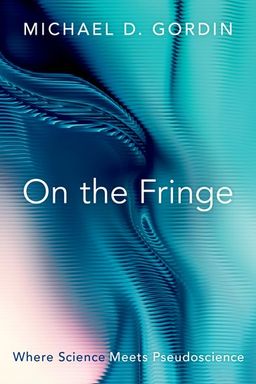
Why do we believe some ideas are science while others are mere quackery? In On the Fringe: Where Science Meets Pseudoscience, Michael D. Gordin tackles this deceptively simple but endlessly controversial question—and shows why there may never be a neat line separating truth from pseudoscience. His primary argument is that “pseudoscience” isn’t really a coherent category of knowledge; rather, it’s a label we apply to ideas we dislike or reject. Every age and culture has drawn the boundaries of legitimate science differently, often motivated by politics, ideology, or power.
Gordin invites you to see pseudoscience not just as error but as a mirror of science itself. Each fringe movement—from astrology and alchemy to creationism and cold fusion—reveals how the scientific community defines credibility, authority, and rationality. His approach is historical and sociological, not merely philosophical. He reverses the traditional question (“How do we separate science from pseudoscience?”) and instead asks: “What happens when some ideas get pushed to the edge?”
The Demarcation Dilemma
At the heart of the book lies what philosophers call the demarcation problem: how to distinguish science from pseudoscience in principle. Gordin explores this through Karl Popper’s famous criterion of falsifiability—the idea that scientific theories must be testable and possibly disproven. Yet falsifiability, he shows, collapses under scrutiny. Many accepted sciences (like evolutionary biology or cosmology) can’t be easily falsified in a lab. And conversely, many pseudosciences (like astrology or Creation Science) gleefully invoke falsifiability to claim legitimacy. Instead of clear rules, science involves social negotiation—peer review, consensus, and credibility among experts.
The Historian’s Lens
Gordin turns from philosophical puzzles to history. By tracing cases across centuries—from Hippocrates’ dismissal of witch-doctors to modern fights over creationism in schools—he demonstrates that fringe doctrines evolve just as science does. Astrology once counted as rigorous science, with mathematical precision equal to astronomy; alchemy shared techniques with modern chemistry. Over time these ideas were demoted to “pseudoscience” not because their methods changed but because the scientific community redefined what counted as reliable evidence.
Why the Fringe Persists
What makes pseudoscience endure? Gordin shows that “being on the fringe” often comes from social positioning rather than sheer wrongness. Fringe scientists frequently replicate the institutional structures of mainstream science—founding their own institutes, journals, and conferences—to fight what they call the “establishment.” Whether it’s creationists demanding “equal time,” UFO researchers seeking peer review, or proponents of cold fusion holding yearly conferences, the fringe mimics and contests the norms of the center.
The Four Families of the Fringe
Gordin categorizes pseudoscience into four historical families: vestigial sciences (once-legitimate fields overwritten by change, like astrology or alchemy), hyperpoliticized sciences (state-sponsored ideologies like Nazi race science or Soviet Lysenkoism), counterestablishment sciences (movements that consciously imitate scientific credibility, like Creation Science or cryptozoology), and mind-over-matter sciences (parapsychology and ESP research that test the limits of human consciousness). These categories reveal not pure fraud but rather distinct reactions to authority, belief, and evidence.
Why It Matters Today
For you as a reader living in an era of misinformation and social media echo chambers, Gordin’s insights feel strikingly relevant. Labels like “fake news,” “conspiracy theory,” or “pseudoscience” function much like their historical predecessors—ways to establish boundaries around truth. Even within professional science, today’s replication crisis and corporate denialism (from climate change to tobacco) echo the same dynamics: contested evidence, political pressure, and public confusion. Pseudoscience survives because it serves human needs—for certainty, identity, and meaning in a complex, uncertain world.
Core Message
Pseudoscience isn’t a disease to cure—it’s the shadow cast by science itself. Whenever there’s a bright center of knowledge, something will fall outside it. Studying the fringe doesn’t just expose deception or error; it teaches you how science continually polices its borders, revises its standards, and defines what counts as truth.
Ultimately, On the Fringe invites you to approach fringe beliefs not with mockery but with curiosity. Understanding why so many people defend these ideas—sometimes passionately, sometimes dangerously—reveals more about the structure of science itself than about Bigfoot or ESP. The moment you scorn the “pseudoscientist,” Gordin suggests, you’ve already become part of the process that keeps science alive.