
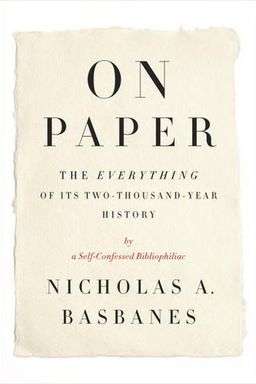
On Paper cover

On Paper

by Nicholas A Basbanes

Explore the rich history and enduring significance of paper in ''On Paper'' by Nicholas A Basbanes. This engaging narrative uncovers paper''s transformative role in society, from ancient innovations to modern applications, revealing its timeless impact.

Paper and the Human Story

How can a material as simple as paper shape civilization? In On Paper, Nicholas Basbanes argues that paper is more than a medium—it is a living technology that enabled everything from written law to artistic expression, revolutions, and everyday communication. His book traces the material’s chemistry, craftsmanship, politics, industry, and survival, revealing paper as both witness and engine of human experience.

From fibers and water to civilization

Basbanes begins with the Chinese discovery that macerated cellulose fibers could form a continuous sheet when drained and dried. This simple chemistry—hydrogen bonding—bound civilizations together through bureaucracy, art, and science. Clean water, fiber, and a screen became constants from Cai Lun in the first century to modern mills. When you grasp that chemistry, you see how paper transformed administrative reach, from Chinese dynasties to the Abbasid libraries and European print culture.

Paper as actor, not backdrop

Basbanes reminds you that paper is never passive. In revolutions, it fueled dissent—the Stamp Act crisis and revolutionary pamphlets; in warfare, cartridges and propaganda leaflets turned pages into weapons; in politics, it became both proof and deception—from forged passports to state propaganda. Paper can incite, regulate, or liberate, depending on whose hands hold it.

Craft and industry intertwine

The book journeys from rural Chinese papermakers in Yunnan to Japanese masters like Ichibei Iwano in Echizen, later to industrial magnates like George Glatfelter reinventing papermaking through engineered fibers. Handcraft and mechanization coexist: the tactile dip and shake of a mold survive in fine-art papermaking, while Fourdrinier machines churn millions of tons daily. You learn that evolution does not mean extinction—revival and adaptation keep papermaking alive.

Paper as identity and power

Paper defines who you are. Passports, licenses, and certificates establish existence; their loss or forgery can alter fate. Basbanes shows identity documents as both freedom and constraint—King Louis XVI’s false papers led to his capture, while Schindler’s forged lists saved lives. Modern security papers (Crane’s currency stock, CIA forgeries) prove that fiber, watermark, and feel remain symbols of authority and truth—even amid digital systems.

Art, invention, and memory

Paper is also where creativity unfolds. Leonardo sketched ideas that led science; Beethoven’s drafts, Edison’s lab notebooks, and architects’ blueprints describe processes, not just results. In origami, Robert Lang and Erik Demaine transform folding into geometry and aerospace engineering, while Michael LaFosse folds tactile instinct into living sculpture. You learn that paper bridges hand and intellect—the mind’s extension through fibers.

Destruction, survival, and witness

Basbanes closes with the paradox of paper’s fragility and endurance. Stasi shreddings resurrected through digital reconstruction, the 9/11 ephemera preserved at the New York State Museum, and Randy Scott’s handwritten note from the 84th floor—all show how paper records human urgency. Even after shredding or burning, traces remain: testimony endures, reminding you that destruction is not disappearance.

Across centuries and continents, Basbanes’s core argument remains steady: paper is not a tool but a relationship—a dialogue between mind, material, and memory. Once you see that bond, you recognize how each sheet you touch connects to makers in mountain springs, printers in revolutions, spies in disguise, and archivists rebuilding history from fragments. Paper, in Basbanes’s vision, is civilization made tangible.


Craft and Chemistry of Making

Paper begins as a chemistry story—water, cellulose, and hydrogen bonds coalescing into a self-adhering mat. Basbanes compares this to papyrus and parchment to show why paper was revolutionary: you don’t need glue or skin, only fiber and patience. Clean mountain water and macerated plant fibers give lasting strength. A fragment from a Shaanxi tomb in 140 B.C. and Cai Lun’s report in A.D. 105 trace process refinement rather than invention out of nothing.

From tradition to living practice

You travel into Yunnan and Sichuan, watching families dip bamboo molds into vats, couch sheets, and press water out by hand. These crafts depend on water quality and touch-memory. Formation aids like prickly pear and pomegranate adjust drainage—the ingenuity of villages preserved in recipes. Duan Win Mao’s spirit paper mill collapsing under modernization illustrates the fragile future of these ancestral practices.

Where craft meets permanence

Washi in Japan embodies the spirit of purity and refinement. Kozo, mitsumata, and gampi define its aesthetic: strength, smoothness, luster. Masters like Ichibei Iwano insist on centuries of discipline—'there are no shortcuts.' Paper becomes sacred: in shrines as 'kami,' in domestic screens, even in wartime balloon bombs. Washi teaches you that paper reflects human virtue as much as technique.

(Note: Anthropologists often cite washi’s dual identity—as both everyday fabric and spiritual medium—echoing Basbanes’s theme of material transcendence.)


Transmission and Transformation

After its birth in China, papermaking followed caravans westward, adapting as it moved. Samarkand’s eighth-century mills bridged chemistry and culture; Arabic papermakers introduced linen rags and starch sizing. The Abbasid’s House of Wisdom depended on paper’s portability and durability. By the time knowledge reached Europe via Muslim Spain and Sicily, it carried centuries of refinement.

Paper’s administrative revolution

Basbanes and Jonathan Bloom argue that Islamic adoption created bureaucracies and libraries—paper allowed governments to record, copy, and circulate thought. From Córdoba’s archives to Istanbul’s court papers, the material became civilization’s infrastructure. When Europe industrialized papermaking—Fourdrinier continuous machines, gelatin sizing, Hollander beaters—it could finally sustain Gutenberg’s press and literacy expansion.

Scale and consequence

This east-to-west transmission shows paper as moving intelligence. Every improvement—fiber choice, sizing chemistry—extended human reach. By the nineteenth century, international newspapers and bureaucratic systems were possible because mills could supply cheap sheets. In Basbanes’s map of transmission, paper doesn’t just migrate—it evolves through contact zones, each layer adding administrative, cultural, and creative power.

(Cultural historians often pair this movement with gunpowder and the compass—the triad of inventions that globalized knowledge.)


Politics, Power, and the Paper Trail

Paper mediates authority—the legal document, the tax stamped sheet, the bureaucratic form, the hidden order. Basbanes’s political chapters show that controlling paper controls the story. When Parliament enforced the Stamp Act, printed resistance birthed revolution. When leaflets fell from aircraft in wars, ideology spread across frontlines. When destroyed or leaked, documents toppled governments.

Paper in revolt and warfare

From gun-wadding Bibles to the Sepoy Mutiny’s greased cartridges, paper intersects faith, violence, and rebellion. In psychological operations, printed leaflets demoralized armies—RAF’s six million 'Notes to the German People' or U.S. leaflets over Italy. Sometimes words on paper turned more minds than bombs. Paper can deliver promises of surrender or poison morale depending on ink choice and message tone.

Paper as evidence and exposure

Basbanes compares archives and cover-ups—from Hitler’s signed racial laws used at Nuremberg to MKULTRA’s shredded records and the Pentagon Papers. Preservation and destruction form twin edges of accountability. When Daniel Ellsberg leaked classified volumes or Chelsea Manning released cables, they revived paper’s role as democratic catalyst, even in digital disguise.

Ultimately you learn that every folded sheet can either bind freedom or conceal tyranny—the outcome depends on who controls the file cabinet.


Industrialization and Consumer Life

Rags once ruled papermaking; scarcity forced innovation. The Hollander beater mechanized pulping, Fourdrinier machines made continuous paper, and chemical wood-pulping gave cheap stock to an emerging literacy market. Basbanes shows how these breakthroughs converted reading from privilege into routine—and later fed disposable culture.

From books to tissues

Kimberly-Clark’s Cellucotton became Kotex and Kleenex—a wartime invention rebranded for domestic use. Commercial paper entered bathrooms, kitchens, and dressing tables. Brands sold comfort and cleanliness, redefining paper as an intimate technology. Advertising, design, and mass-scale recycling shaped modern consumer behavior far beyond the printed word.

Resource and environmental reality

Industrial concentrations built giants like International Paper and P.H. Glatfelter. They controlled forests, water, and pulp, balancing nostalgia for craft with corporate sustainability. You see Marcal’s recycled-fiber mill and Zhang Yin’s Nine Dragons empire turning American waste into Chinese packaging—global paper flows revealing ecology, economics, and ethics.

Basbanes lets you examine both triumph and consequence: paper democratized communication but also created a world of disposable abundance.


Identity, Secrecy, and Security

Paper authenticates lives and nations. The passport, license, or banknote doesn’t just identify—it confers legitimacy. Basbanes takes you from Franklin’s early passports to Crane & Company’s cotton-based currency stock and CIA forgery labs. At each level, fiber and watermark mean trust.

Paper as protection and vulnerability

Tony Mendez’s CIA crafts required 'authentic feel'—paper that smelled, aged, and cracked correctly. Operation Mincemeat’s fake officer fooled Nazis through believable pocket litter. Basbanes’s intelligence stories teach you that paper can both shield and deceive: authentication and validation are arts of survival.

Economic and state trust

Crane’s currency paper embodies national security—the linen-cotton blend, embedded threads, and optical lenses guard against fraud. WWII’s Sachsenhausen forgers attacking British pound stock underline that counterfeiting is warfare. Whether personal ID or national currency, paper’s tactile integrity maintains society’s contract of trust.

In Basbanes’s narrative, every watermark and thread speaks: paper remains the visible texture of invisibility—the proof that power rests not only in ink, but in fiber itself.


Revival, Art, and Continuity

Modern artisans revive lost techniques to rejoin art and material. Dard Hunter’s Mountain House Press, Henry Morris’s improvised Bird & Bull, and Kathryn and Howard Clark’s Twinrocker mills reconstruct papermaking as an aesthetic practice. They prove handmade sheets can coexist with industry—limited runs for artists, sustainable batches for museums.

Learning through making

Hunter built entire books from self-made paper; Morris reinvented Hollander beaters from bathtubs; the Clarks systematized artistry for commercial sale. Their methods remind you that craft knowledge resides in hands and water. Fibers like cotton, abaca, kozo define texture and resilience—the decision of fiber becomes the character of art.

Paper as creative field

Origami bridges craft and science. LaFosse folds tactile emotion; Lang compresses geometry into telescopes; Demaine proves algorithms can shape art. Together they turn paperfolding into computational physics and sculpture. Basbanes positions them as inheritors of craft’s precision: in their work, the physical limitations of fiber yield mathematical freedom.

You come away understanding that renewal in papermaking mirrors renewal in culture—old tools making new ideas tangible again.


Memory, Archives, and Witness

Even when threatened, paper endures as evidence and remembrance. Basbanes’s closing chapters dwell on paper’s role as cultural and emotional witness: from Stasi shredded documents painstakingly reconstructed, to museum archives built from disaster debris, to families finding closure in a handwritten note.

Paper as forensic and emotional voice

The 9/11 archives show how everyday paperwork became sacred—missing-person posters, lost memos, and a plea written on a scrap. Randy Scott’s note from the 84th floor connects abstract tragedy to human presence. DNA from its stain identified him, turning fiber into evidence and memory. Curators must balance family privacy with national testimony: preservation becomes moral stewardship.

Reconstruction and recovery

Fraunhofer’s ePuzzler digitally reassembled millions of shredded Stasi pages—proof that erased history can speak again. At Fort Meade, NSA pulping practices embody another paradox: destruction to protect secrets, recycling to reuse fiber. Each method—shredding, pulping, archiving—demonstrates society’s uneasy dialogue with truth.

Basbanes ends by reminding you that paper is never inert; even torn or burned, it retains presence. The act of saving or shredding a document is an act of judgment—one that decides what civilization remembers.

Dig Deeper

Get personalized prompts to apply these lessons to your life and deepen your understanding.

Go Deeper

Get the Full Experience

Download Insight Books for AI-powered reflections, quizzes, and more.