
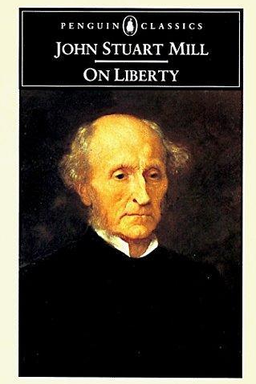
On Liberty cover

On Liberty

by John Stuart Mill

In ''On Liberty,'' John Stuart Mill explores the delicate balance between individual freedom and social responsibility. This seminal work defends personal liberty as essential for societal progress, advocating for the protection of diverse opinions and individuality against the tyranny of the majority.

Liberty, Equality, and the Boundaries of Power

What gives society the right to constrain its members, and how can you live freely without injuring others? In On Liberty and The Subjection of Women, John Stuart Mill outlines a coherent moral and political vision built on a single foundational idea: individual liberty within the limits of harm to others. Across these works Mill develops a unified philosophy of freedom, equality, and human progress — showing how moral, legal, and social institutions must serve the cultivation of self‑directed, thoughtful beings, not obedient subjects.

The Harm Principle and Its Reach

Mill begins with a crisp moral law — society may interfere with you only to prevent harm to others. This means no paternalistic coercion, no moral policing of private life, and no religious imposition disguised as public order. You may be compelled to fulfill obligations or abstain from fraud, assault, or negligence, but not forced to choose abstinence, religiosity, or self‑discipline simply because others value them. Every legitimate restriction must show definite, assignable harm. (In practice this means laws against drunk driving or selling poison unsafely are justified, but bans on drinking or Sunday amusements are not.)

Freedom of Thought and Discussion

Mill’s defence of free speech follows logically from fallibility. You cannot claim truth unless you allow opposition. Every opinion deserves the chance to be tested, since truth itself becomes lifeless when unchallenged. He reminds you of history’s injustices — Socrates condemned, Christians persecuted, modern dissenters jailed — and draws a timeless principle: suppression of error often suppresses truth. Debate, not decree, keeps belief vivid and progress alive.

Individuality and Human Development

Liberty is not only a defensive right; it is the engine of personal growth. Mill celebrates individuality as a moral necessity — the freedom to form your own tastes and plans is what develops character. Societies that stifle variety stagnate, becoming mechanical and conformist. Drawing on Wilhelm von Humboldt, Mill treats diverse ‘experiments of living’ as the best school for improvement. Eccentricity, originality, and difference sustain the vitality of civilization. The individual is the seedbed of genius; uniformity is its death.

Equality and the Subjection of Women

Mill extends the same moral reasoning to gender. The social and legal subordination of women, he argues, rests not on reason but history’s residue of physical force. You cannot infer a ‘natural’ female character from confinement and repression. His hot‑house analogy shows how culture selectively cultivates traits pleasing to men while stifling others. Equality requires experiment: open the professions, the franchise, and education, then judge by outcome, not custom. Legal inferiority — especially within marriage — is both unethical and empirically indefensible. Mill portrays marriage law as a form of domestic despotism that corrupts both sexes: men learn arrogance and command, women submission and concealment. True partnership demands equality of rights and remedies.

Political and Economic Dimensions

Freedom, however, is not anarchy. Mill admits the State must act where private liberty becomes socially injurious or where public goods cannot be left to voluntary means — as in education, sanitation, protection against fraud, or basic safety. Yet he warns that expanding bureaucracy can strangle initiative. Decentralization, competition, and local responsibility keep civic virtue alive. Similarly, his response to socialism acknowledges real injustices of competition — exploitation, waste, adulteration — but he prescribes reform through cooperative experiments, not violent revolution. You must uphold justice without extinguishing individuality.

Moral Progress and the Education of Character

Underlying all Mill’s arguments is a moral psychology: progress depends on the cultivation of conscience and sympathy, not enforced conformity. Despotism, whether in law or domestic life, breeds corruption of character; liberty fosters virtue through choice and self‑direction. Equality in rights enlarges everyone’s moral horizon. Women’s inclusion in public life is thus not only fair but socially educative — it doubles humanity’s moral and intellectual resources.

In sum, Mill’s philosophy unites liberty, toleration, and character under one vision: human beings flourish through freedom of thought, diversity of life, and equality before the law. Coercion justified only by harm protects society from tyranny of both rulers and opinion. It is a moral map for how intelligent freedom becomes the foundation of progress — personal, social, and civic.


The Harm Principle and Social Boundaries

Mill’s Harm Principle is the moral linchpin of modern liberal rights. He states plainly: society can constrain you only to prevent harm to others. The rule draws a line between self‑regarding and other‑regarding actions. You are sovereign over your body, mind, and choices — unless your conduct directly injures someone else.

Drawing the Line

Mill’s test is pragmatic: identify definite harm, not mere offense or moral dislike. Fraud, assault, and neglect are punishable; self‑chosen vices are not. Laws against public intoxication on duty may stand, but prohibition on private drinking cannot. The burden of proof rests with the restrainer, not the restrained.

Examples and Applications

Mill’s own examples clarify the boundary: religious rest laws (forcing Sunday observance) amount to coercive piety; temperance movements that prohibit alcohol enforce taste, not justice; poison regulations should label and record, not ban legitimate use. The moral is simple — regulation is justified only by measurable risk, never by moral view.

The Problem of Indirect Harm

Mill admits modern life complicates the boundary: economic and social interdependence means actions ripple outward. Yet he insists complexity demands caution, not expansion of coercion. Policymakers must prove actual harm, not speculate on offense. His approach remains procedural — deliberate, empirical, and respectful of individual sovereignty.

Practical Guidance

When you propose laws or moral sanctions, ask whether they prevent definite injury or merely impose private judgment. Mill’s maxim guards against tyranny of opinion — a danger more subtle than state persecution. Liberal society survives by defending unpopular choices as long as they harm no one else. It is a call for moral humility in governance.

In short, Mill’s Harm Principle builds a shield around self‑development: protect others from injury, not individuals from themselves. The health of freedom depends on that sharp, disciplined distinction.


Freedom of Thought and the Life of Truth

Freedom of discussion is for Mill the lifeblood of truth. You cannot discover or preserve truth without debate. Every belief — even the most sacred — must face contradiction, because certainty without contest becomes dogma. Mill’s case for free speech flows from three connected ideas: human fallibility, the vitality of clash, and the coexistence of partial truths.

Fallibility and the Right to Err

Suppression assumes infallibility — a claim no person or society can make. History’s tragedies prove it: Socrates condemned for impiety, Christians persecuted under Rome, modern dissenters jailed for heresy. To silence one voice because it disturbs the majority is to act on a false certainty. If all mankind held one view and one person disagreed, Mill says, mankind would still be unjustified in suppressing that single person.

Collision and Vital Energy

Even true opinions need struggle. Without contradiction, they ossify into ritual. Discussion compels defenders of truth to explain, refine, and remember why they believe. That clash keeps knowledge alive. Mill likens enforced consensus to dead faith — memorized but meaningless.

Partial Truths and Synthesis

Opposing doctrines often contain fragments of the truth. Debate gathers these fragments into fuller understanding. Minority views expose neglected facts and broaden perspective. Political and moral progress depends on synthesis, not suppression.

The Moral Culture of Debate

Mill encourages a civility rooted in reason. You may attack ideas with vigor, but not muzzle speakers. Education is the cure for error; censorship only masks ignorance. In both Victorian prosecutions and modern cancelations, Mill’s principle still guides: protect expression not because all opinions are right, but because openness is the only way to discover which ones are.

Freedom of thought is not indulgence — it is the foundation of rational society. Silence, however well‑intentioned, endangers truth more than error ever can.


Individuality and Human Flourishing

To be free is not only to be uncoerced, but to be able to grow into yourself. Mill’s defence of individuality treats personal originality and diversity as social necessities. He contrasts genuine development with mechanical obedience, urging you to cultivate your own nature rather than conform to received patterns.

Why Variety Matters

Drawing on Wilhelm von Humboldt, Mill holds that improvement depends on freedom and variety of conditions. When society values uniformity, it stagnates; when it values difference, it evolves. Experiments of living — unconventional careers, unorthodox beliefs — reveal what ways of life succeed. You benefit when others dare to live differently.

Against Meek Conformity

Mill denounces the moral ideal of restraint and suppression. Protestant asceticism had praised denial as virtue; Mill replies that human vitality, not docility, drives progress. Excessive social pressure and centralized bureaucracy reduce citizens to mediocrity. A democratic age must protect space for non‑conformity or it risks moral uniformity — the social equivalent of intellectual death.

Eccentricity and Genius

Eccentricity, Mill insists, is not mere oddity; it is the mark of originality. Fear of ridicule suppresses talent. When few dare to differ, creativity withers. Encouraging eccentricity keeps society resilient, imaginative, and open to reform. Liberty of growth is therefore a common benefit, not a private indulgence.

To defend individuality is to defend humanity’s power to improve. Mill’s moral arithmetic is simple: every independent character enriches collective life. You cannot have progress without persons willing to be something other than copies.


Equality and Justice for Women

Mill’s The Subjection of Women extends his liberal principles to the domain where law and custom most violate them. He declares that women’s subordination is both morally wrong and empirically harmful. His analysis blends history, psychology, and ethics into a sustained argument that equality of sex is essential to human advancement.

Origins in Force and Habit

Women’s legal disability began in brute strength — the victor’s law. Over centuries, coercion became custom and custom law. Modern acceptance rests not on reasoning but on inertia. Mill treats subordination as a leftover of slavery, a system perpetuated by sentiment and fear.

Nature, Nurture, and False Inference

You cannot know what is “natural” for women when centuries of restriction have shaped their behavior. The hot‑house analogy captures it: society cultivates pleasing traits and stifles others, then declares the result innate. Observation within confinement proves nothing about potential. The proper scientific stance is suspension of judgment until freedom provides conditions for fair comparison.

Marriage as Tyranny

English marriage law, Mill shows, turns wives into dependents. Coverture erases a woman’s legal identity, property, and recourse; her consent at the altar becomes obedience for life. Even love may coexist with oppression, but affection under lawless power only disguises tyranny. Justice demands reform — equal property rights, legal remedies, and mutual consent.

Public Life and Suffrage

Equality means civic equality. Every person affected by laws must have representation. Mill’s appeal for women’s suffrage and office rests on fairness and utility: exclude incompetence but allow competition. Historical examples — Elizabeth, Margaret of Austria, Somerville — suffice to refute claims of universal incapacity. Denying women the chance to prove fitness is waste and injustice combined.

For Mill, emancipation is not gendered benevolence but adherence to principle. Freedom that stops at the household door is no freedom at all.


Domestic Power and Moral Education

Mill’s critique goes beyond legal detail: he exposes how inequality inside the household shapes society’s morals. The family under male supremacy becomes, in his words, a school of despotism. When one sex learns command and the other submission, character itself degenerates.

The School of Despotism

Exclusive domestic authority trains arrogance. A husband obeyed without reason acquires habits of domination, while a wife conditioned to defer loses confidence and spontaneity. These patterns replicate in politics — citizens accustomed to tyranny at home tolerate it in government. Equality within marriage thus serves the public good by educating both sexes in justice.

Affection and Dependence

Mill acknowledges affection often flourishes even within oppression. Devotion among slaves or wives proves emotional strength, not institutional virtue. Subjection intensifies dependence and gratitude, producing apparent harmony that conceals injustice. Genuine love requires equality and the absence of fear.

Women’s Moral Influence

Mill credits women with softening manners and inspiring humane feelings, yet warns that emotional influence cannot substitute for rights. Private virtue may alleviate symptoms of social wrongs, but only legal equality cures their cause. By equalizing domestic power, you foster mutual respect and civic readiness — the moral education of a free people.

Justice in the household is therefore a social reform: it breeds the virtues liberty needs to survive.


State, Policy, and Cooperative Reform

Mill’s later chapters address the State’s role in applying liberty’s principles. He rejects both rigid laissez‑faire and intrusive paternalism. Government should act where harm is real or common interests require joint provision — but never to impose a moral code by force.

Proper Functions of Government

Legitimate state duties include preventing fraud, guarding safety, and ensuring basic education. Compulsory schooling protects children, not opinions. Centralizing information is useful; centralizing initiative is deadly. Efficient bureaucracy may easily become despotic, draining public spirit. Mill’s principle: decentralize practice, keep oversight public.

Economic Freedom and Safeguards

Mill supports free trade and voluntary enterprise where they do not inflict harm. Yet he sanctions proportionate regulation of dangerous goods and fair taxation of stimulants. Preventive police measures must be minimal, targeted, and justified by clear risk, never moral disapproval.

Socialism and Cooperative Experiment

Facing socialist critiques from Louis Blanc and Victor Considérant, Mill concedes exploitation and waste under competition but warns against revolutionary communism. Property and incentive fuel productivity; their abolition may suffocate motivation. The remedy lies in voluntary cooperation — co‑operative workshops, partnerships, and phalanstères — guided by moral education rather than violence. Reform should be tried empirically, not imposed wholesale.

Mill’s balance of liberty and social justice creates a practical ethic: use law to prevent harm and enable opportunity, but always prefer freedom plus experiment to compulsion plus decree.

Dig Deeper

Get personalized prompts to apply these lessons to your life and deepen your understanding.

Go Deeper

Get the Full Experience

Download Insight Books for AI-powered reflections, quizzes, and more.