
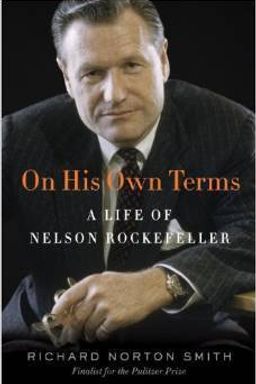
On His Own Terms cover

On His Own Terms

by Richard Norton Smith

Explore the fascinating life of Nelson Rockefeller, a man who used his wealth, influence, and sheer determination to shape American politics and culture. From transforming New York''s infrastructure to strengthening international diplomacy, Rockefeller''s story is one of ambition, controversy, and lasting legacy.

Wealth, Vision, and the American Experiment

How can inherited wealth reinvent itself as public good? In this sweeping biography of Nelson Rockefeller, you see America’s twentieth-century experiment with elite power, managerial optimism, and the belief that money, culture, and politics could together engineer progress. The book argues that Rockefeller’s life—spanning Standard Oil’s fortune, MoMA’s modernism, New York’s transformation, and Washington’s bureaucratic wars—illustrates both the promise and peril of technocratic liberalism. Rockefeller believed that capital and expertise should reshape the public sphere; history tested that conviction against markets, ideology, and moral crisis.

You trace his arc from privileged child in competing dynasties (Aldrich and Rockefeller) to dyslexic student who built competence through teams, then to cultural patron, hemispheric architect, New York builder, and national politician. Each phase shows a man turning private instruments into public institutions: MoMA, Rockefeller Center, the Office of Inter-American Affairs, the SUNY system, and finally the Vice Presidency. His biography becomes a mirror for the American faith that problems yield to design and resources—a faith tested by Attica, debt, scandal, and cultural change.

Two Dynasties, One Mission

Nelson was born into a dual inheritance. From his maternal grandfather, Senator Nelson Aldrich, he absorbed cultural authority—the conviction that taste could civilize a nation. From his paternal line—John D. Rockefeller Sr. and Jr.—he absorbed a Protestant ethic of control, stewardship, and large-scale philanthropy. The combined ethos taught him that elite responsibility meant building systems: foundations, museums, institutions. But it also created an internal division: between aesthetic confidence and managerial conscience. (Note: These tensions echo later liberal reformers such as Daniel Patrick Moynihan who blended social idealism with administrative rigor.)

Dyslexia and the Team Method

Rockefeller’s dyslexia transformed his learning style into an organizational philosophy. Unable to parse lengthy texts easily, he built executive teams who could digest and brief complex material quickly. This habit—first honed in the progressive Lincoln School—later underpinned his managerial model in Albany and Washington: hire bright minds, demand concise memos, act swiftly. His personal handicap yielded a public gift—the culture of expert collaboration. You also see the emotional underside: the drive to compensate through visible achievement and relentless engagement.

Art as Authority and Identity

Following his mother Abby Aldrich Rockefeller, Nelson treated art as both compass and credential. Collecting became a way of making modernity acceptable to America’s elite and public alike. Whether commissioning murals for Rockefeller Center or backing MoMA’s controversial modernists, he used art to define civic values. Yet aesthetic patronage also exposed him to political firestorms—most memorably the Diego Rivera mural crisis, where an image of Lenin on a corporate wall forced Rockefeller to choose between private taste and public outrage. These episodes reveal Rockefeller’s conviction that culture was governance—that shaping what people see is as crucial as shaping what they vote for.

From Builder to Statesman

Rockefeller’s move from the skyline of Rockefeller Center to Latin America’s development programs illustrates his expanding field of action. In both arenas he applied the same formula: institutional design plus managerial execution. His Venezuelan expeditions and wartime coordination work (through the Coordinator of Inter-American Affairs) showed how oil, culture, and diplomacy could intertwine into a program of hemispheric modernization. The same logic extended to his “Basic Economy” projects and IBEC experiments—attempts to fuse private investment and public health in poor regions. He aimed for win-win capitalism, long before the term existed, though uneven execution and local skepticism often blunted the results.

The Paradox of Power

By the time Rockefeller entered elected office, his strengths—speed, confidence, and scale—met the friction of democracy. His tenure as Governor of New York from 1959 to 1973 displayed extraordinary ambition: vast university expansion, moral-obligation bonds, Medicaid, environmental and urban programs. Yet each success carried hidden costs: debt, bureaucratic complexity, and political backlash. His crises—Attica, urban unrest, personal scandal—exposed the limits of executive omnipotence. And when he joined federal office under Ford, his creative energy collided with post-Watergate suspicion: a visionary in a defensive age.

Core argument

Nelson Rockefeller’s life shows that technocratic idealism—belief in planning, expertise, and benevolent capital—can build a modern state but cannot easily survive populist distrust, fiscal limits, or the moral ambiguities of power.

When you finish the story, you stand at a paradox. The physical world you inhabit—universities, mass transit, arts districts—bears his imprint. Yet so do modern fears of overreach, bureaucracy, and elite arrogance. Rockefeller’s creed that leadership meant “doing good, big” remains both an inspiration and a warning. It invites you to ask whether ambition without humility and scale without consent can ever yield the just and lasting order he sought.


Dynasties, Art, and Early Formation

Nelson Rockefeller’s early life unites power and culture. On one side stands Senator Nelson Aldrich, symbol of patrician confidence—the man who shaped tariffs, banking policy, and Rhode Island’s high society. On the other stands John D. Rockefeller Sr., industrial titan wary of publicity and obsessed with philanthropy’s systems. Their marriage in Abby Aldrich Rockefeller fused the cultural joy of patronage with the disciplined sense of stewardship. Nelson inherited both codes: beauty as responsibility and management as duty.

The formative contradiction

Raised among estates like Indian Oaks and Pocantico Hills, Nelson grew up internalizing tension between exhibition and restraint. Abby’s parties and paintings taught him that taste could signify modern leadership. JDR Jr.’s absolutism about order and careful giving instilled respect for structure. This blend produced Nelson’s lifelong impulse to merge art and administration—treating museums like corporations and construction projects as aesthetic gestures. His bedroom filled with model airplanes and blueprints was a rehearsal for later skyscrapers and campuses.

Dyslexia as design principle

Dyslexia profoundly shaped his approach to work. Struggling to read smoothly embarrassed him, but it also forced collaboration and verbal problem-solving. At Dartmouth, he excelled through conversation and visualization, not solitary study. These habits became professional techniques: daily verbal briefings, one-page memos, cross-disciplinary task forces. When Henry Kissinger later remarked that Rockefeller “collects experts like others collect delegates,” he captured the method forged out of necessity. (Note: Similar adaptive intelligence appears in entrepreneurs like Richard Branson who verbalize vision instead of reading data.)

Art as early governance

His taste-making began at home. Abby’s founding of the Museum of Modern Art taught her son that institutional architecture could democratize culture. Nelson’s later purchases—Picasso tapestries, Légers, Giacomettis—weren’t private indulgence but pedagogical showcases. The infamous Rivera mural episode at Rockefeller Center revealed the tension of that approach. He backed artistic freedom until ideology—Lenin’s portrait—threatened corporate neutrality. His choice to destroy the mural signaled a lifelong challenge: how to reconcile avant-garde vision with public acceptability. To him, controversy was the cost of modern leadership.

Rockefeller Center as apprenticeship

By supervising leases, art, and management there, he learned how complex systems could embody a philosophy. The Center’s Prometheus fountain and Radio City ballets announced modern progress; the corporate-financial mechanics behind them taught flexibility amid Depression-era shocks. Internal disputes (with John R. Todd, disputes over design) trained him to mediate art and finance. It became his prototype for all later ventures: use beauty, management, and inclusion to command public imagination—then defend it legally and financially.


From Cultural Patron to Hemispheric Visionary

Rockefeller’s leap from New York’s towers to Latin America’s plains redefined his sense of mission. In 1937 he traveled to Venezuela to inspect Standard Oil operations and returned with a regional conscience. The trip fused three interests—business, anthropology, and philanthropy—into a single pattern: use private means for public modernization. Saving Paracas mummies, founding hotels and clinics, and financing agricultural training became his method of diplomacy. He pioneered what we now call soft power.

Wartime coordination and the CIAA

During World War II, Roosevelt asked him to lead the Coordinator of Inter-American Affairs. The CIAA combined culture (films, art, radio) with economics (commodity control and trade). He sent the Yale Glee Club to Brazil, Orson Welles to film, and Disney to fight malaria. Beneath the showmanship lay strategic logic: win hearts to bar Axis influence. Rockefeller translated his managerial ideal into policy; the hemisphere became his extended project site. Bureaucratic clashes with Wild Bill Donovan over turf introduced him to Washington’s knives, but he proved adept at bureaucratic leverage, using allies like Anna Rosenberg and Sumner Welles to protect autonomy.

Postwar development and private enterprise

After the war, he scaled his experiment through the Basic Economy Program, then AIA and IBEC. These initiatives built wells, sanitation systems, chick hatcheries, and supermarkets across the Americas. They embodied pre–World Bank idealism: blend social uplift with sustainable commerce. Failures were frequent—lost livestock, spoiled butter, graft—but they advanced the idea of corporate social responsibility decades early. At Chapultepec and the UN, Rockefeller converted that regional ethos into diplomacy, emphasizing hemispheric security and collaboration. His advocacy produced Article 51 of the UN Charter—codifying regional self-defense. For him, international architecture mirrored Rockefeller Center’s premise: autonomy balanced with interdependence.

What this era teaches you

The Latin American chapters prove that philanthropy, when strategic, can blur into policy. Rockefeller’s mix of missionary zeal and managerial planning anticipated modern development economics. Yet they also show the trap of paternalism: private goodwill standing in for public accountability. His hemisphere-building provided goodwill but also suspicion. As with the Rivera incident, idealism collided with politics. The lesson is enduring: progress exported without partnership breeds ambivalence.


Governor as Builder and Modernizer

Rockefeller’s move from private patron to elected governor completed his transformation into builder-in-chief. Elected in 1958, he ruled Albany with the same verve he once brought to MoMA. His premise: government could be both efficient and visionary. The challenge: how to finance and manage ambition in a democratic setting.

Administrative choreography

He centralized command through Bill Ronan and program associates—elite troubleshooters who turned plans into projects. Decisions flowed verbally to maintain speed; memos were burned. This model delivered results but eroded transparency. Still, it produced an empire of initiatives: tax reforms, commuter rail support, housing and highway expansion, water programs, and cultural infrastructure. Rockefeller governed as if Albany were an engineering firm with moral purpose.

Financing the dream

When voters rejected bond issues, he invented “moral obligation bonds,” off-budget instruments that circumvented referenda and financed his grand agenda—SUNY campuses, housing, hospitals. Critics accused him of debt alchemy; supporters saw fiscal genius. Projects like the South Mall (Empire State Plaza), SUNY expansion, and mass housing demonstrated his belief that architecture could embody civic virtue. Urban transformation followed: the creation of the MTA, the Taylor Law legalizing collective bargaining, and the Urban Development Corporation for large-scale housing and renewal. Each policy reflected Rockefeller’s bigger pattern: use state power to fix what cities couldn’t.

Crisis and compassion

He wasn’t immune to political shocks. The 1968 garbage strike taught him that moral clarity doesn’t always look decisive on television. Yet his avoidance of using force—choosing negotiation over National Guard mobilization—showed prudence. The 1966 rebound campaign used media brilliance (Jack Tinker’s advertising) and Medicaid’s rollout to reframe him as socially compassionate despite fiscal controversy. The paradox of Rockefeller governance became clear: liberal in spending, conservative in discipline; visionary in design, autocratic in process.

Education and modernization as legacy

His greatest monument was SUNY’s expansion and the Scholar Incentive Program, which legally navigated aid restrictions by funding students. By 1973, New York disbursed the nation’s broadest higher-education scholarships and commanded a university system rivaled only by California’s. For today’s policy reader, Rockefeller’s Albany offers a case study in scaling innovation through finance and design—and a reminder that modernization without democratic rhythm breeds resentment as surely as progress breeds pride.


Ambition, Crisis, and the Limits of Control

Rockefeller’s ascent toward national prominence revealed the strain between technocracy and politics. His presidential bids in 1960, 1964, and 1968 cast him as symbol of a fading establishment liberalism. His management skills inspired admiration; his indecision and elite image alienated a populist party base. The sequence of personal upheaval—divorce, remarriage, family tragedy—compounded that vulnerability. His story from the Fifth Avenue platform fights to the Goldwater convention in San Francisco is a lesson in how policy expertise can lose to ideology.

From personal scandal to renewed governance

The Happy Rockefeller affair exposed his private life to public moralism. Yet grief over his son Michael’s disappearance, followed by steadfast work, showed emotional steadiness that humanized him for some voters. Still, as national politics veered right, Rockefeller’s pragmatic centrism seemed dated. His 1968 hesitation confirmed perception of indecisiveness: too cautious to seize opportunity, too assertive to yield gracefully. Yet these years also produced moral courage moments—his reaction to Martin Luther King Jr.’s assassination transformed empathy into the Urban Development Corporation law, using shock to create structural response.

Attica and its shadow

The 1971 Attica uprising became his ultimate test. Faced with racialized prison anger and media scrutiny, Rockefeller refused personal theatrics. His choice to authorize force ended hostilities but at tragic human cost. The McKay Commission later faulted structural neglect more than malice, yet the moral verdict haunted him. Attica symbolized the dilemma of the liberal technocrat confronted by ungovernable crises: professionalism without empathy appears cruelty; empathy without control breeds chaos. He leaned toward order—earning safety, losing affection.

Late redeployment

After resigning the governorship, Rockefeller’s national relevance revived under Gerald Ford. Revenue sharing had been his policy triumph; fiscal restraint and welfare reform marked his ideological adjustment to conservative times. But inside the Ford White House, he met new opponents: Chief of Staff Don Rumsfeld’s control and an ascendant right wing saw him as liability. His Energy Independence Authority proposal died under bureaucratic crossfire. By 1975, he privately admitted the vice presidency gave recognition without power. His passion for execution had no room in a post-Watergate, downsized government. Ambition met its institutional limits.


Power, Bureaucracy, and Public Accountability

As vice president and later investigator, Rockefeller confronted the bureaucratic and moral reckoning of the 1970s. His chairmanship of the Rockefeller Commission on the CIA sought to restore legitimacy to agencies compromised by illegal domestic spying. The job combined moral purpose and political caution—traits that had always defined his public service.

The CIA inquiry and its half-light

Appointed by President Ford after Seymour Hersh’s revelations, Rockefeller convened a bipartisan team to review the CIA's abuses. He wanted transparency but also stability. When demands arose to probe links to Kennedy assassination plots, he resisted, arguing the nation needed reform, not theatrical retraumatization. The Commission’s final report recommended oversight mechanisms and bans on assassinations yet redacted key evidence—prompting public skepticism. Its real success lay in institutionalizing oversight, not in satisfying conspiracy hunters.

The White House tension

During Ford’s presidency, Rockefeller’s activism—on domestic policy, urban aid, and the New York City bailout—made him an internal rival to conservative staffers. Don Rumsfeld’s maneuver to limit his access effectively cornered him. By 1976 Ford dropped him from the ticket to appease the right. Ironically, Rockefeller’s own strengths—initiative and charisma—made the office unmanageable within a cautious presidency. The lesson: leadership styles optimized for creation clash with systems built for containment.

After Washington

Post-politics, Rockefeller pursued global business schemes (SARABAM) and commercial art ventures, democratizing reproduction of high art. Critics mocked him, but he saw continuity with his lifelong purpose: making culture public and combining art and economics. Family conflicts over the Rockefeller Brothers Fund governance reflected his drive for control versus a younger generation’s push for pluralism. Even in semi-retirement, he fought to shape institutions outlasting him. His sudden death in 1979—amid secrecy and tabloid curiosity—became a final parable: public appetite for transparency devouring privacy itself. It closed a century-long experiment in elite benevolence.


Legacy of Scale and Contradiction

Nelson Rockefeller’s legacy is measurable in steel, marble, and policy architecture, yet interpretive in meaning. He built campuses, museums, plazas, and policy frameworks that defined mid-century liberal governance. He showed that ambition could construct the material and cultural infrastructure of a state, but his career also marks the fading of that very confidence. When fiscal crises and ideological shifts arrived, his model of enlightened technocracy lost legitimacy, even as its creations endured.

Achievements that endure

SUNY’s global-scale expansion, Medicaid’s early adoption, environmental and public-transit systems, and cultural institutions from Lincoln Center to MoMA renewals: these remain living institutions. His reshaping of New York merged finance with design, producing both prosperity and precedent for public-private synergy. His inter-American programs seeded models for global aid. He proved that government and philanthropy could act entrepreneurially.

Costs and cautionary notes

The same qualities that built also endangered: creative finance risking opacity; centralized control dampening trust; humanitarian motives shading into paternalism. His “moral obligation” debt methods later contributed to crises he could no longer manage. Attica, the UDC’s financial collapse, and his opaque death scenes collectively remind you that systems built on speed and hierarchy age poorly in participatory democracies.

Enduring question

Rockefeller’s century asks whether progress requires hierarchy, whether greatness requires command. His answer—and the one you inherit—is mixed. He democratized art even as he ruled aesthetics, expanded education even as he outpaced budgets, and saved cities even as he lost elections. The paradox endures: effectiveness without affection, success shadowed by suspicion. Still, the places, policies, and possibilities he built remain evidence of a life that treated public service as architecture made visible.

Dig Deeper

Get personalized prompts to apply these lessons to your life and deepen your understanding.

Go Deeper

Get the Full Experience

Download Insight Books for AI-powered reflections, quizzes, and more.