
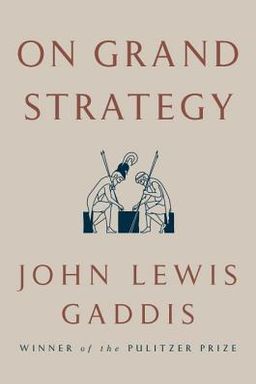
On Grand Strategy cover

On Grand Strategy

by John Lewis Gaddis

On Grand Strategy delves into the strategic minds of history''s most influential leaders, uncovering the delicate balance between ambition and caution. John Lewis Gaddis explores the traits that defined their successes and failures, offering timeless lessons for today''s leaders.

Grand Strategy and the Art of Alignment

How can you balance big ambitions with limited means? In On Grand Strategy, John Lewis Gaddis argues that this ancient question defines leaders from Xerxes to Lincoln to Roosevelt. At its heart, the book proposes a deceptively simple definition: grand strategy is the alignment of potentially unlimited aspirations with necessarily limited capabilities. That alignment—between what you want and what you can achieve—becomes a lifelong exercise in judgment, restraint, and imagination.

The Hedgehog and the Fox: Modes of Thinking

Gaddis begins by contrasting two mental types borrowed from Isaiah Berlin’s essay: the hedgehog, who knows one big thing, and the fox, who knows many things. The hedgehog represents clarity of purpose, while the fox thrives on adaptability and multiple perspectives. Drawing on Philip Tetlock’s research on expert forecasting, Gaddis notes that fox-like thinkers—those who integrate diverse sources, revise beliefs, and accept uncertainty—tend to outperform rigid hedgehogs who fit every fact into a single theory.

The challenge for you, Gaddis suggests, is not to choose but to combine these modes: hold a firm north star (hedgehog) while adapting methods (fox). Without conviction you drift; without flexibility you break. Historical case studies become laboratories in which this duality is tested.

Ends and Means: The Central Equation

From Herodotus to Lincoln, Gaddis reads history as a series of experiments in balancing ends and means. Xerxes’ bridge over the Hellespont displays spectacular ambition but fatal overreach; his empire collapses when logistics, weather, and morale—means—fail to match aspiration. Pericles’ long walls turn Athens into a maritime democracy but also trap it during plague and war, reminding you that every strategic innovation reshapes society and creates vulnerabilities. The constant refrain: every end must be proportioned to the means you possess, and every instrument alters the context in which strategy operates.

Clausewitz formalizes this insight through the concept of *friction*—the unpredictable forces that make the simplest operations difficult. Tolstoy dramatizes it at Borodino: orders go awry, morale collapses, weather intrudes. Together they show that friction cannot be removed; it can only be anticipated and managed through training, temperament, and moral force.

Learning from Teachers and Time

Gaddis argues that good strategists are perpetual students. They learn from teachers—Sun Tzu’s aphorisms, Clausewitz’s abstractions, Thucydides’ narratives—and tether enduring principles to shifting circumstances. Sun Tzu’s compact tethers ('know the enemy, know yourself') link general truths to specific action. Augustus embodies the same method in politics: he stabilizes a republic-turned-empire by combining principle with patient institution-building. Strategy, in this sense, is less about prediction and more about disciplined improvisation anchored in principle.

The Moral and the Political

Grand strategy also tests moral judgment. Augustine defines limits on violence—just cause, legitimate authority, proportionality—while Machiavelli insists on confronting the world as it is, where cruelty may sometimes be necessary for order. Gaddis pairs them to illustrate that strategy is always a moral balancing act: you must act effectively without abandoning conscience. Leaders like Lincoln show how to fuse these traditions—anchoring a moral purpose (ending slavery) while adjusting timing to military and political feasibility.

Temperament and the Strategic Mind

Ultimately, Gaddis argues that what distinguishes success is temperament—the capacity to hold ambition and limitation in dynamic balance. Clausewitz called it coup d'oeil, the painter’s inward eye that grasps essentials amid chaos. Isaiah Berlin later calls it a gyroscope: the inner steadiness that keeps moral and intellectual bearings when the world spins. From Elizabeth I’s performance politics to FDR’s pragmatic juggling, great strategists combine prudence, timing, and empathy for the human texture of events.

By the book’s end, Gaddis has built not just a theory but a pedagogy: grand strategy is best learned through history because history exposes you to the interplay of ideals and realities. You cannot escape friction, overreach, or moral tension—but you can learn to recognize patterns, adjust scale, and choose when to act boldly or hold back.

Core Premise

Grand strategy succeeds when imagination and restraint coexist. Its failures—whether in Xerxes’ canal, Athens’ walls, or Napoleon’s invasion—occur when passion overwhelms proportion. To think strategically, you need both a compass for direction and an artist’s eye for proportion in the real world.

Across time and case studies, Gaddis invites you to train that eye—not just to win wars or govern states, but to design coherent lives where vision and limitation are held in balance. That, for him, is what grand strategy ultimately means.


Friction, Courage, and the Limits of Control

War and politics, Gaddis insists, are driven by friction—the mysterious variable that ruins elegant plans. Clausewitz coined the term to cover everything from fog, fear, and fatigue to bad terrain and human emotion. Tolstoy, in literary form, shows how those forces feel: at Borodino, messengers lose orders, soldiers freeze, and generals cling to illusions. Both remind you that friction is universal, not exceptional, and that resilient strategy designs for its inevitability.

Friction as Teacher

Clausewitz tells you that everything in war is simple, but even the simplest thing is difficult. Napoleon’s 1812 invasion reveals how friction multiplies small errors into catastrophe; campaigns lose coherence as geography, climate, and fatigue accumulate. Kutuzov’s patience becomes strategic genius precisely because he works with time and distance instead of defying them. In modern terms, this teaches you to expect failure, fragment plans, and prepare institutions that can adapt under stress.

The Inward Eye and Coup d'oeil

Clausewitz’s second gift is the concept of coup d'oeil—the ability to see clearly and quickly amid confusion. He compares the strategist to an artist who sketches essentials rather than drowning in detail. Kutuzov, again, exemplifies this quality: intuiting when to retreat or wait without losing the moral core of resistance. You cultivate such vision by study, reflection, and mental rehearsals that make improvisation second nature. (Modern parallels appear in military red-teaming, business simulations, or crisis management exercises.)

Scale and Moral Force

Tolstoy extends Clausewitz’s analysis to highlight the moral dimension. Armies and nations hold together through belief and discipline as much as logistics. When that moral fabric tears, no amount of machinery or orders can restore coherence. For you as a strategist, the lesson is to preserve legitimacy, cohesion, and meaning even when events collapse into chaos. Grand strategy, therefore, begins not with control but with humility in the face of complexity.

Clausewitz’s Warning

“Everything in war is simple,” he wrote, “but the simplest thing is difficult.” The strategist’s courage lies not in eliminating friction but in staying steady when the fog thickens.

Seen broadly, friction reminds you that perfection is the enemy of performance. The best leaders design for breakdown, rely on disciplined improvisation, and cultivate the moral stamina to continue when plans unravel. Gaddis presents this not as pessimism, but as realism—the necessary grounding for any grand strategy worth its name.


Institutions, Culture, and Strategic Design

Institutions, like walls or constitutions, are the architecture of strategy. They turn choices into durable behaviors. Gaddis shows this through Athens’ long walls, Rome’s Augustan reforms, and the American constitutional experiment: each embeds strategy in culture, shaping how societies survive or overextend.

Athens and the Dangers of Technique

Pericles’ long walls exemplify how a brilliant innovation can transform a city—and create its undoing. The walls link Athens to its port, enabling naval dominance and commerce while redefining citizenship and democracy. Yet this same shift erodes agrarian self-sufficiency and invites dependency on sea supply. When the Sicilian expedition bankrupts the state, the walls that once guaranteed safety become a trap. Gaddis’s point: when you redesign the means of security, you also redesign society itself.

Rome’s Durable Framework

Augustus—another of Gaddis’s exemplars—learns from chaos to make stability habitual. He fuses principle with practice: rewarding veterans, reforming governance, and commissioning art that teaches civic virtue. This is “tethered” strategy—anchoring innovation to steady values. Augustus builds institutions that outlast his personality, turning tactical success into structural resilience. (Note: this echoes Machiavelli’s advice that durable states depend more on institutions than princes.)

The American Experiment

Moving forward in time, Gaddis reads American history as a proof of concept for institutional design. The colonial mosaic of self-governing charters becomes the DNA for flexible federalism. When the Founders draft the Constitution, they solve scale through structure: Madison’s large republic and separation of powers act as mechanisms to balance ambition and restraint—the very tension that defines grand strategy.

If you advise institutions today, Gaddis says, treat them like living strategies: every rule and norm stores moral and political choices. Build adaptability in advance, because the means you design will one day outlive your motives. The genius of Athens’ walls or Washington’s federal architecture lies in whether they enable recalibration rather than lock societies into rigidity.


Morality, Realism, and the Strategic Soul

To act strategically is also to choose between conflicting moral worlds. Gaddis reconstructs this tension through Augustine and Machiavelli: one asserts that wars must serve justice and preserve souls; the other argues that preserving the state sometimes requires moral compromise. The best leaders, he suggests, hold both in view.

Augustine’s Moral Guardrails

Augustine begins from theological realism: humans are fallen, so earthly peace must precede perfect justice. His just-war checklist—legitimate authority, just cause, proportionality—becomes a procedural tether that limits excess and sanctifies restraint. For modern strategists, this maps onto humanitarian law and the notion that violence must serve restoration, not vengeance.

Machiavelli’s Pragmatic Ethics

Machiavelli, emerging from a world of shifting alliances and civic collapse, strips politics of illusions. He advises limited, efficient cruelty in defense of order—Cesare Borgia’s decisive strikes as an example. His realism acknowledges that virtue without power courts disaster. Yet by recognizing limits and timing, Machiavelli reintroduces proportion, another moral virtue hidden inside pragmatism.

The Modern Application

For you, the synthesis is practical: let Augustine set your boundaries and Machiavelli guide your methods. Leaders like Lincoln embody this balance. He suppresses rebellion with force but times emancipation to when the Union can sustain it. His example shows how moral goals and political prudence can coexist if tethered by patience and principle.

Moral Strategy in Practice

You preserve legitimacy by enforcing limits within necessity. Moral strategy, Gaddis argues, is not an oxymoron; it’s the only kind that lasts.

Grand strategy thus becomes a moral art: restraining power so that principle survives victory, and expanding conscience enough to serve security. It’s not perfection you seek, but proportion and discipline in pursuit of the achievable good.


Personalities, Power, and Temperament

No institution can compensate for the temperament of its leaders. Through portraits of Philip II, Elizabeth I, Lincoln, Roosevelt, and Wilson, Gaddis explores how character filters strategy into action. Personality expresses itself through style: micromanagement or delegation, rigidity or improvisation, moral vision or pragmatic patience.

Elizabeth and Philip: Two 16th-Century Types

Philip II of Spain embodies the hedgehog in excess. His empire stretches too far, his conscience too forbidding; he manages everything and thus paralyzes decision. Elizabeth I, by contrast, becomes the fox on the throne—playing rival suitors, using spectacle, and delegating execution while preserving plausible innocence. When the Armada sails, her balance of charisma and delegation turns a desperate defense into triumph. The lesson: a ruler’s temperament—improvising or doctrinaire—shapes outcomes more than material resources alone.

Lincoln and FDR: Modern Tempered Leadership

Lincoln embodies what Gaddis calls 'moral timing': setting ultimate ends but pacing their pursuit. He prioritizes the Union before abolition, issuing emancipation only when military and public conditions align. Roosevelt revives that art of timing with his “juggling” in the 1930s–40s—arming Britain by degrees, testing public mood through symbolic gestures, and entering alliances when opportunity converges with necessity. Both prove that temperament—the calm patience to wait and the intuition to act—is the hinge of grand strategy.

Gaddis closes with Isaiah Berlin’s idea that temperament is a gyroscope, not a compass: it keeps you balanced when ideals and realities collide. Without that inward steadiness, even the finest strategy collapses into panic or fanaticism. The ultimate art of grand strategy, therefore, lies as much in self-mastery as in mastery of others.


Pluralism, Freedom, and the Strategic Mindset

Gaddis’s final synthesis flows through Isaiah Berlin’s pluralism. Freedom, he explains, comes in two flavors. Positive liberty seeks collective purpose and reform but courts tyranny when pressed too far; negative liberty safeguards individual choice but risks fragmentation. Strategists, like states, must move between them. You can’t mobilize for survival without coordination, but you can’t sustain legitimacy without personal freedom.

Temperament and Tolerance

Berlin’s fox-hedgehog schema returns here not as a taxonomy but as moral psychology. The best leaders blend conviction with openness: Lincoln’s empathy, FDR’s flexibility, and Kutuzov’s patience mark them as pluralists of temperament. Berlin’s wartime dispatches from Washington—observing Roosevelt’s messy yet effective coalition politics—teach that pluralism is a strategic asset, not a weakness.

Freedom and Restraint in Democratic Strategy

Democracies succeed, Gaddis notes, when they transform dissent into productive feedback loops—fox-like adaptation under a hedgehog compass of shared values. The balance between guided unity and spontaneous pluralism underwrites the success of regimes from Athens’ assembly to America’s federal republic. Freedom, structured by institutions, becomes the ultimate strategic advantage.

The Closing Lesson

Hold principles like a hedgehog, but perceive the world like a fox. Democracy itself thrives on this balance; so does any coherent life of purpose amid flux.

In the end, Gaddis gives you not a manual on war but a manual on proportion—an argument that you can lead others only if you’ve learned to lead yourself through friction, with freedom and firmness entwined. That is the enduring mindset of grand strategy.

Dig Deeper

Get personalized prompts to apply these lessons to your life and deepen your understanding.

Go Deeper

Get the Full Experience

Download Insight Books for AI-powered reflections, quizzes, and more.