
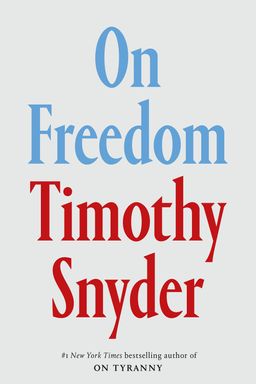
On Freedom cover

On Freedom

by Timothy Snyder

The author of “On Tyranny” articulates practices and attitudes related to the concept of freedom and the ways it can be misunderstood.

Freedom You Can Build

What if freedom were less a hole where oppression used to be and more a house you and your neighbors build? In this book, Timothy Snyder argues that freedom is not just an absence of evil but a presence of good—institutions, capabilities, and virtues that let people actually live. He begins with Mariia, an eighty-five-year-old woman in Posad Pokrovske whose home was wrecked by war. Liberation cleared invaders, but her freedom begins when neighbors bring a generator, rugs, and a drawer salvaged from ruin. De-occupation is necessary; life-giving presence completes freedom.

Snyder calls the habit of confusing liberty with mere removal of barriers “negative freedom.” Its icon is a bell with the padlock lifted. But, he says, real liberty requires addition—schools, clinics, transit, journalism, and laws that widen what people can do. That is why Zelenskyi’s decision to stay in Kyiv in February 2022 mattered: not just resistance to an invader, but an enactment of responsibility that made communal courage possible. Freedom shows up as character, choice, and structures that allow others to act.

The five forms of freedom

To make that presence concrete, Snyder offers five interlocking forms that map across a life course and a republic: sovereignty (the person’s capacity for judgment), unpredictability (the power to surprise and create), mobility (real opportunities to move in space and status), factuality (institutions that generate trustworthy truths), and solidarity (the shared labor and ethos that extend freedom to all). You can use them as a checklist: if a policy shrinks any one of the five, it likely shrinks freedom overall. If it grows them together, liberty becomes lived and lasting.

Threats: lies, oligarchy, and machines

Snyder maps three converging threats. First, big lies replace factuality, making people manipulable and institutions hollow (think Nazi and Stalinist myths, or Trump’s false 2020 claims amplified by Fox and Russian disinformation). Second, oligarchic rhetoric weaponizes negative freedom: fossil magnates and digital barons preach “small government” or “free speech absolutism,” even as they siphon public subsidies and shape rules (Charles Koch’s oil empire; Elon Musk’s platform moves; Citizens United’s money-speech fusion). Third, platforms’ “brain hacks” make you predictable—algorithms monetize outrage and distraction, shrinking your attention and your unpredictability.

Why bodies and climate come first

Sovereignty starts in the body. Drawing on Edith Stein’s distinction between Leib (lived body) and Körper (object body), Snyder shows that empathy—recognizing others as subjects—is how you form judgment. His own near-death sepsis in 2019, with a nurse-friend’s steady presence and the stark racial inequities of U.S. emergency care, reveals how health systems are freedom’s foundations. So is climate: stars fuse hydrogen to make the elements; photosynthesis stored solar energy as fossil fuels; burn them and you unleash greenhouse gases. If you ignore facts and physics, you evacuate the future in which liberty can occur. Fusion research, renewables, and reforestation are not just tech bets—they’re freedom’s timekeepers.

Government as a craftsman’s toolkit

Against the anti-state reflex, Snyder argues that democratic government is how you organize the five forms. Voting—backed by automatic registration, paper ballots, fair maps, and representation for D.C. and Puerto Rico—is applied solidarity. Public finance and law—antitrust action, tax enforcement, carbon pricing—steer mobility, defend factuality, and fund sovereignty (maternal care, childcare, schools). Digital rights—what Snyder calls habeas mentem, a right to your mind—make platforms transparent and privacy-first, so human unpredictability survives.

A guiding claim

“To declare yourself free is to promise to act such that others can be free.” Freedom is not a solitary state; it is a public project.

How to read and use this framework

As you move through Snyder’s stories—from Mariia’s bench and Yahidne’s basement school, to Havel’s defense of the Plastic People of the Universe, to a mastodon tusk in an Ohio newspaper—you see freedom’s presence or absence in concrete details. The lesson for you is practical: ask of every reform and habit whether it nurtures the five forms. Subscribe to investigative reporting; vote to revive rail and schools; support parental leave and public health; insist platforms reveal their algorithms; defend elections. Freedom is vulnerable in abstraction and resilient in construction. Your job is to build.


Freedom You Can Build

What if freedom were less a hole where oppression used to be and more a house you and your neighbors build? In this book, Timothy Snyder argues that freedom is not just an absence of evil but a presence of good—institutions, capabilities, and virtues that let people actually live. He begins with Mariia, an eighty-five-year-old woman in Posad Pokrovske whose home was wrecked by war. Liberation cleared invaders, but her freedom begins when neighbors bring a generator, rugs, and a drawer salvaged from ruin. De-occupation is necessary; life-giving presence completes freedom.

Snyder calls the habit of confusing liberty with mere removal of barriers “negative freedom.” Its icon is a bell with the padlock lifted. But, he says, real liberty requires addition—schools, clinics, transit, journalism, and laws that widen what people can do. That is why Zelenskyi’s decision to stay in Kyiv in February 2022 mattered: not just resistance to an invader, but an enactment of responsibility that made communal courage possible. Freedom shows up as character, choice, and structures that allow others to act.

The five forms of freedom

To make that presence concrete, Snyder offers five interlocking forms that map across a life course and a republic: sovereignty (the person’s capacity for judgment), unpredictability (the power to surprise and create), mobility (real opportunities to move in space and status), factuality (institutions that generate trustworthy truths), and solidarity (the shared labor and ethos that extend freedom to all). You can use them as a checklist: if a policy shrinks any one of the five, it likely shrinks freedom overall. If it grows them together, liberty becomes lived and lasting.

Threats: lies, oligarchy, and machines

Snyder maps three converging threats. First, big lies replace factuality, making people manipulable and institutions hollow (think Nazi and Stalinist myths, or Trump’s false 2020 claims amplified by Fox and Russian disinformation). Second, oligarchic rhetoric weaponizes negative freedom: fossil magnates and digital barons preach “small government” or “free speech absolutism,” even as they siphon public subsidies and shape rules (Charles Koch’s oil empire; Elon Musk’s platform moves; Citizens United’s money-speech fusion). Third, platforms’ “brain hacks” make you predictable—algorithms monetize outrage and distraction, shrinking your attention and your unpredictability.

Why bodies and climate come first

Sovereignty starts in the body. Drawing on Edith Stein’s distinction between Leib (lived body) and Körper (object body), Snyder shows that empathy—recognizing others as subjects—is how you form judgment. His own near-death sepsis in 2019, with a nurse-friend’s steady presence and the stark racial inequities of U.S. emergency care, reveals how health systems are freedom’s foundations. So is climate: stars fuse hydrogen to make the elements; photosynthesis stored solar energy as fossil fuels; burn them and you unleash greenhouse gases. If you ignore facts and physics, you evacuate the future in which liberty can occur. Fusion research, renewables, and reforestation are not just tech bets—they’re freedom’s timekeepers.

Government as a craftsman’s toolkit

Against the anti-state reflex, Snyder argues that democratic government is how you organize the five forms. Voting—backed by automatic registration, paper ballots, fair maps, and representation for D.C. and Puerto Rico—is applied solidarity. Public finance and law—antitrust action, tax enforcement, carbon pricing—steer mobility, defend factuality, and fund sovereignty (maternal care, childcare, schools). Digital rights—what Snyder calls habeas mentem, a right to your mind—make platforms transparent and privacy-first, so human unpredictability survives.

A guiding claim

“To declare yourself free is to promise to act such that others can be free.” Freedom is not a solitary state; it is a public project.

How to read and use this framework

As you move through Snyder’s stories—from Mariia’s bench and Yahidne’s basement school, to Havel’s defense of the Plastic People of the Universe, to a mastodon tusk in an Ohio newspaper—you see freedom’s presence or absence in concrete details. The lesson for you is practical: ask of every reform and habit whether it nurtures the five forms. Subscribe to investigative reporting; vote to revive rail and schools; support parental leave and public health; insist platforms reveal their algorithms; defend elections. Freedom is vulnerable in abstraction and resilient in construction. Your job is to build.


Sovereignty Of The Body

Snyder begins freedom at the skin, with the Leib: your lived body as a subject, not a thing. Borrowing Edith Stein’s phenomenology, he argues that you become capable of judgment—sovereign—because others recognize and care for you. That is why early childhood attention, maternal care, and the ordinary rituals of recognition are political facts. A baby who is held, seen, and answered becomes a person who can think, risk, and decide. A society that undervalues bodies, especially women’s and marginalized people’s bodies, undermines sovereignty at the root.

Leib vs. Körper: empathy as epistemology

Stein distinguishes body-as-object (Körper) from body-as-experience (Leib). When you meet another as a Leib, you register a center of feeling and agency, and in that reflection come to know yourself. Snyder’s prison seminar offers a vivid image: students hug as they enter, reweaving shared bodily space; empathy there generates trust, which generates knowledge. Simone Weil adds the counterpoint: the body is a “mystery” at the hinge of necessity and freedom. Treating bodies like objects—whether in racist triage or transactional medicine—reduces people to obstacles or resources, the political logic of unfreedom.

Health precedes liberty

Snyder’s sepsis in 2019 exposes how fragile sovereignty is without health. A friend who is a nurse places her body and attention between him and death; the U.S. hospital’s racial disparities and the commercialization of care reveal structural unfreedom. If ventilators, antibiotics, and competent staffing are rationed by profit and prejudice, then “freedom from” government rings hollow. Jefferson’s “life, liberty, and the pursuit of happiness” implies an order: life (health) comes first. Women’s reproductive autonomy, paid leave, and a right to health care are not luxuries. They are the conditions for anyone’s responsible choice.

Childhood sovereignty and social scaffolding

Sovereignty is learned. It grows when adults provide safety, time, and attention—parents, teachers, nurses, neighbors. Snyder’s childhood scenes and hospital accounts underline an ethics of presence: you become yourself because others show up. That is as true in Yahidne’s basement, where cramped survivors after Russian occupation had to reassemble schooling and play, as it is in maternity wards where nurses teach breath and touch. Across contexts, the pattern holds: recognition builds judgment; judgment builds freedom.

Policy: protect bodies to protect liberty

If you accept sovereignty as bodily, then public health is constitutional in spirit even if not in text. Snyder’s policy implications are straightforward: fund prenatal and maternal care; guarantee paid parental leave; provide universal health coverage; train and pay nurses well; enforce anti-discrimination in care; and protect reproductive rights. Extend the circle: better air and water standards (climate policy) save lungs and futures. Expand mental health services as part of the right to one’s mind.

Practice: everyday empathy

You can do more than vote. Make recognition a habit: learn names, look up from your phone, listen without rushing to reply. Support caregivers in your orbit—bring meals to new parents, donate to community clinics, show up for friends at the ER. Read Stein and Weil alongside Snyder to deepen the connection between body and freedom (Note: Martha Nussbaum’s capabilities approach offers a parallel argument that bodily integrity grounds justice). In short, to honor sovereignty is to invest attention in others’ lives. That is freedom’s first presence.


Sovereignty Of The Body

Snyder begins freedom at the skin, with the Leib: your lived body as a subject, not a thing. Borrowing Edith Stein’s phenomenology, he argues that you become capable of judgment—sovereign—because others recognize and care for you. That is why early childhood attention, maternal care, and the ordinary rituals of recognition are political facts. A baby who is held, seen, and answered becomes a person who can think, risk, and decide. A society that undervalues bodies, especially women’s and marginalized people’s bodies, undermines sovereignty at the root.

Leib vs. Körper: empathy as epistemology

Stein distinguishes body-as-object (Körper) from body-as-experience (Leib). When you meet another as a Leib, you register a center of feeling and agency, and in that reflection come to know yourself. Snyder’s prison seminar offers a vivid image: students hug as they enter, reweaving shared bodily space; empathy there generates trust, which generates knowledge. Simone Weil adds the counterpoint: the body is a “mystery” at the hinge of necessity and freedom. Treating bodies like objects—whether in racist triage or transactional medicine—reduces people to obstacles or resources, the political logic of unfreedom.

Health precedes liberty

Snyder’s sepsis in 2019 exposes how fragile sovereignty is without health. A friend who is a nurse places her body and attention between him and death; the U.S. hospital’s racial disparities and the commercialization of care reveal structural unfreedom. If ventilators, antibiotics, and competent staffing are rationed by profit and prejudice, then “freedom from” government rings hollow. Jefferson’s “life, liberty, and the pursuit of happiness” implies an order: life (health) comes first. Women’s reproductive autonomy, paid leave, and a right to health care are not luxuries. They are the conditions for anyone’s responsible choice.

Childhood sovereignty and social scaffolding

Sovereignty is learned. It grows when adults provide safety, time, and attention—parents, teachers, nurses, neighbors. Snyder’s childhood scenes and hospital accounts underline an ethics of presence: you become yourself because others show up. That is as true in Yahidne’s basement, where cramped survivors after Russian occupation had to reassemble schooling and play, as it is in maternity wards where nurses teach breath and touch. Across contexts, the pattern holds: recognition builds judgment; judgment builds freedom.

Policy: protect bodies to protect liberty

If you accept sovereignty as bodily, then public health is constitutional in spirit even if not in text. Snyder’s policy implications are straightforward: fund prenatal and maternal care; guarantee paid parental leave; provide universal health coverage; train and pay nurses well; enforce anti-discrimination in care; and protect reproductive rights. Extend the circle: better air and water standards (climate policy) save lungs and futures. Expand mental health services as part of the right to one’s mind.

Practice: everyday empathy

You can do more than vote. Make recognition a habit: learn names, look up from your phone, listen without rushing to reply. Support caregivers in your orbit—bring meals to new parents, donate to community clinics, show up for friends at the ER. Read Stein and Weil alongside Snyder to deepen the connection between body and freedom (Note: Martha Nussbaum’s capabilities approach offers a parallel argument that bodily integrity grounds justice). In short, to honor sovereignty is to invest attention in others’ lives. That is freedom’s first presence.


Unpredictability In Practice

Unpredictability is your power to surprise systems that want you calculable. Snyder treats it as the second form of freedom because creativity and dissent keep politics open. He returns to Václav Havel and the Plastic People of the Universe, a Czech band inspired by the Velvet Underground and Frank Zappa. When the regime tried to normalize culture into docility in the 1970s, the Plastics made noise instead. Havel defended them in court, helped craft Charter 77, and translated artistic risk into political change—seeds that flowered in the 1989 Velvet Revolution. American bands like R.E.M. later echoed the exchange, showing how art circulates unpredictability across borders and decades.

Living in truth: small acts, large shocks

Havel’s phrase “living in truth” means daily noncooperation with lies: refusing to post regime slogans, aiding a friend’s performance, signing a civic petition. Snyder shows how such micro-acts accumulate into macro-surprises. When Zelenskyi stayed in Kyiv at the invasion’s outset, he refused the script that leaders flee. His decision galvanized Ukrainians and allies, turning an improbable defense into a political fact. Unpredictability is not chaos; it is value-driven novelty.

The machine that wants you predictable

Digital platforms erode unpredictability by design. They use intermittent reinforcement, curated outrage, and microstimulation to make you more predictable and profitable. Snyder links screen-saturation (seven hours a day on average) to reduced attention, memory lapses, and the “Reverse Flynn Effect” (declining cognitive scores). If your time is diced into notifications, you become an easy target for disinformation and a poor citizen for deliberation. The algorithm’s goal is not your freedom; it is your repeatability.

Habeas mentem: a right to your mind

To defend unpredictability, Snyder proposes habeas mentem, the right to one’s mind. Like habeas corpus guards your body from unlawful detention, habeas mentem would guard your attention and judgment from involuntary manipulation. He calls for intelligible algorithms, privacy-first defaults (no data retention without opt-in), and traceability for political ads and promoted content. Platforms must surface investigative and challenging reporting, not just the stickiest outrage (Note: This aligns with Shoshana Zuboff’s critique of surveillance capitalism and European moves on platform transparency).

Practices that recover surprise

You can train unpredictability like a muscle. Charge devices out of sight at night. Keep and read physical books. Write letters on paper. Attend local plays, concerts, and lectures—spaces where curation is human, not algorithmic. Teach children to make things (music, code, zines), not just to consume feeds. Support libraries and public schools as studios for novelty. These habits reclaim time for judgment and create the social zones where politics can be reimagined. Unpredictability is freedom’s art form; practice it daily.


Unpredictability In Practice

Unpredictability is your power to surprise systems that want you calculable. Snyder treats it as the second form of freedom because creativity and dissent keep politics open. He returns to Václav Havel and the Plastic People of the Universe, a Czech band inspired by the Velvet Underground and Frank Zappa. When the regime tried to normalize culture into docility in the 1970s, the Plastics made noise instead. Havel defended them in court, helped craft Charter 77, and translated artistic risk into political change—seeds that flowered in the 1989 Velvet Revolution. American bands like R.E.M. later echoed the exchange, showing how art circulates unpredictability across borders and decades.

Living in truth: small acts, large shocks

Havel’s phrase “living in truth” means daily noncooperation with lies: refusing to post regime slogans, aiding a friend’s performance, signing a civic petition. Snyder shows how such micro-acts accumulate into macro-surprises. When Zelenskyi stayed in Kyiv at the invasion’s outset, he refused the script that leaders flee. His decision galvanized Ukrainians and allies, turning an improbable defense into a political fact. Unpredictability is not chaos; it is value-driven novelty.

The machine that wants you predictable

Digital platforms erode unpredictability by design. They use intermittent reinforcement, curated outrage, and microstimulation to make you more predictable and profitable. Snyder links screen-saturation (seven hours a day on average) to reduced attention, memory lapses, and the “Reverse Flynn Effect” (declining cognitive scores). If your time is diced into notifications, you become an easy target for disinformation and a poor citizen for deliberation. The algorithm’s goal is not your freedom; it is your repeatability.

Habeas mentem: a right to your mind

To defend unpredictability, Snyder proposes habeas mentem, the right to one’s mind. Like habeas corpus guards your body from unlawful detention, habeas mentem would guard your attention and judgment from involuntary manipulation. He calls for intelligible algorithms, privacy-first defaults (no data retention without opt-in), and traceability for political ads and promoted content. Platforms must surface investigative and challenging reporting, not just the stickiest outrage (Note: This aligns with Shoshana Zuboff’s critique of surveillance capitalism and European moves on platform transparency).

Practices that recover surprise

You can train unpredictability like a muscle. Charge devices out of sight at night. Keep and read physical books. Write letters on paper. Attend local plays, concerts, and lectures—spaces where curation is human, not algorithmic. Teach children to make things (music, code, zines), not just to consume feeds. Support libraries and public schools as studios for novelty. These habits reclaim time for judgment and create the social zones where politics can be reimagined. Unpredictability is freedom’s art form; practice it daily.


Mobility That Liberates

Mobility is not just moving around; it is the ability to change your life. Snyder distinguishes imperial mobilization (states that move bodies as instruments) from democratic social mobility (institutions that move people upward). The contrast exposes why policy, not slogans, determines whether you feel free. When infrastructure, education, and protections expand your horizon, you can pursue projects. When prisons, monopolies, and precarity lock you in, “freedom” shrinks to rhetoric.

Imperial mobility: movement through violence

Hitler’s Lebensraum envisioned Germans surging east to colonize Ukraine; Stalin’s crash industrialization ripped peasants from land and starved millions (the Holodomor). These are mobilizations without liberty—bodies as means to power. Putin’s wars (2014, 2022) reprise the script: Ukraine is treated as resource and corridor, not as a sovereign society. Imperial mobility destroys futures and converts places into extraction zones.

Social mobility: infrastructure and welfare

Democratic mobility looks different. After 1945, European welfare states built roads, rails, schools, and clinics; the EU added freedom of movement. Poland’s post-accession transformation—more life expectancy, better jobs, revived towns—shows how policy widens paths. Mobility requires time (paid leave), tools (education), and tracks (transit). It also requires insurance against risk: health care and pensions that cushion leaps.

America’s divergence: oligarchy and cages

In the 1980s, the U.S. cut taxes, attacked unions, and privatized public goods. Snyder links this to oligarchy and the carceral turn. Mass incarceration, disproportionately hitting Black communities, halts mobility and steals political voice via felony disenfranchisement and prison gerrymandering (counting inmates where they’re jailed inflates others’ power). He coins “sadopopulism”: leaders relieve supporters’ pain by showing others hurt more, instead of changing structures. It is the politics of immobility.

Policy: open the roads of life

Snyder’s proposals follow the five forms. Build and electrify rail; fund reliable buses; zone for walkability. Make universities affordable; restore vocational tracks. Break monopolies that freeze labor markets; favor human labor in tax policy over capital automation. Reform quarterly-reporting incentives to reward long-term investment. Decarcerate: end prison gerrymandering, restore voting rights, reduce mandatory minimums, and remove profit motives from incarceration. Health care that travels with you and unions that bargain for you turn movement into progress.

Local practice: start where you stand

Support transit referenda; show up for school board budgets; back union drives at employers you know. In Snyder’s Ohio memories (Centerville, Dayton), the loss of rail narrowed lives. Reversing that story begins in county meetings. Mobility is communal: every road, route, and rule that helps a stranger move safely helps you live more freely tomorrow.


Mobility That Liberates

Mobility is not just moving around; it is the ability to change your life. Snyder distinguishes imperial mobilization (states that move bodies as instruments) from democratic social mobility (institutions that move people upward). The contrast exposes why policy, not slogans, determines whether you feel free. When infrastructure, education, and protections expand your horizon, you can pursue projects. When prisons, monopolies, and precarity lock you in, “freedom” shrinks to rhetoric.

Imperial mobility: movement through violence

Hitler’s Lebensraum envisioned Germans surging east to colonize Ukraine; Stalin’s crash industrialization ripped peasants from land and starved millions (the Holodomor). These are mobilizations without liberty—bodies as means to power. Putin’s wars (2014, 2022) reprise the script: Ukraine is treated as resource and corridor, not as a sovereign society. Imperial mobility destroys futures and converts places into extraction zones.

Social mobility: infrastructure and welfare

Democratic mobility looks different. After 1945, European welfare states built roads, rails, schools, and clinics; the EU added freedom of movement. Poland’s post-accession transformation—more life expectancy, better jobs, revived towns—shows how policy widens paths. Mobility requires time (paid leave), tools (education), and tracks (transit). It also requires insurance against risk: health care and pensions that cushion leaps.

America’s divergence: oligarchy and cages

In the 1980s, the U.S. cut taxes, attacked unions, and privatized public goods. Snyder links this to oligarchy and the carceral turn. Mass incarceration, disproportionately hitting Black communities, halts mobility and steals political voice via felony disenfranchisement and prison gerrymandering (counting inmates where they’re jailed inflates others’ power). He coins “sadopopulism”: leaders relieve supporters’ pain by showing others hurt more, instead of changing structures. It is the politics of immobility.

Policy: open the roads of life

Snyder’s proposals follow the five forms. Build and electrify rail; fund reliable buses; zone for walkability. Make universities affordable; restore vocational tracks. Break monopolies that freeze labor markets; favor human labor in tax policy over capital automation. Reform quarterly-reporting incentives to reward long-term investment. Decarcerate: end prison gerrymandering, restore voting rights, reduce mandatory minimums, and remove profit motives from incarceration. Health care that travels with you and unions that bargain for you turn movement into progress.

Local practice: start where you stand

Support transit referenda; show up for school board budgets; back union drives at employers you know. In Snyder’s Ohio memories (Centerville, Dayton), the loss of rail narrowed lives. Reversing that story begins in county meetings. Mobility is communal: every road, route, and rule that helps a stranger move safely helps you live more freely tomorrow.


Factuality And The Future

Factuality—the fourth form—is your grip on reality together. Without it, you cannot deliberate, plan, or hold leaders to account. Snyder makes the case two ways: from physics to planet, and from porches to papers. The planetary story begins in stars fusing hydrogen into helium to make elements. On Earth, photosynthesis stored solar energy in biomass; fossil fuels are that ancient sunlight. Burn them and greenhouse gases trap heat, destabilizing climate. The practical upshot is clear: invest in fusion research, scale renewables, and restore forests. If you deny facts, you forfeit the future where freedom can occur.

Porch facts: the Western Star

The local story centers on a mastodon tusk Snyder’s grandmother kept on her Ohio porch. In 1976, the Western Star ran “Lady Collects Old Tusks of Forgotten Mammoths,” transforming a family oddity into a shared community fact. That is what reporting does: a journalist shows up, verifies, and writes, tying neighbors to a common world. When the Western Star withered into an ad glossy and folded in 2013, a civic organ died. In 2020, communities without local reporters struggled to know whether hospitals were filling or officials were honest. The internet could not replace that work.

The internet cannot report

Snyder’s blunt line is memorable: “The internet cannot report. It can only repeat.” Search engines surface what someone has already found; if no one covers the county jail, no query reveals its conditions. Worse, platforms monetize sensation over verification, making disinformation cheap and sticky. In 2016 and 2020, Russian operations and domestic partisans exploited that bias. Trump’s big lie about 2020, abetted by Fox and platform changes under Musk, turned fiction into attempted power. When narratives outrun facts, coups become thinkable.

Remedies: fund truth like infrastructure

Snyder urges public mechanisms to keep factuality alive. Subsidize investigative and local reporting through grants, tax credits, and public-interest trusts. Tax targeted advertising and use the revenues to support civic journalism (monetize platform externalities). Require platforms to elevate verified local reporting and label paid political content with full traceability. Embed journalism in civic life: student newspaper programs, county ombudspersons, public-service fellowships for young reporters.

Your role: buy the paper, back the science

Subscribe to local and investigative outlets. Donate to nonprofit newsrooms. Share reporting, not rumors. Support public science—labs, climate projects, fusion research—and vote for leaders who defend them. In your daily life, practice verification: seek primary sources, distinguish reporting from commentary, and slow down before you share. Factuality makes all other freedoms possible because it makes tomorrow predictable enough for courage to matter.


Factuality And The Future

Factuality—the fourth form—is your grip on reality together. Without it, you cannot deliberate, plan, or hold leaders to account. Snyder makes the case two ways: from physics to planet, and from porches to papers. The planetary story begins in stars fusing hydrogen into helium to make elements. On Earth, photosynthesis stored solar energy in biomass; fossil fuels are that ancient sunlight. Burn them and greenhouse gases trap heat, destabilizing climate. The practical upshot is clear: invest in fusion research, scale renewables, and restore forests. If you deny facts, you forfeit the future where freedom can occur.

Porch facts: the Western Star

The local story centers on a mastodon tusk Snyder’s grandmother kept on her Ohio porch. In 1976, the Western Star ran “Lady Collects Old Tusks of Forgotten Mammoths,” transforming a family oddity into a shared community fact. That is what reporting does: a journalist shows up, verifies, and writes, tying neighbors to a common world. When the Western Star withered into an ad glossy and folded in 2013, a civic organ died. In 2020, communities without local reporters struggled to know whether hospitals were filling or officials were honest. The internet could not replace that work.

The internet cannot report

Snyder’s blunt line is memorable: “The internet cannot report. It can only repeat.” Search engines surface what someone has already found; if no one covers the county jail, no query reveals its conditions. Worse, platforms monetize sensation over verification, making disinformation cheap and sticky. In 2016 and 2020, Russian operations and domestic partisans exploited that bias. Trump’s big lie about 2020, abetted by Fox and platform changes under Musk, turned fiction into attempted power. When narratives outrun facts, coups become thinkable.

Remedies: fund truth like infrastructure

Snyder urges public mechanisms to keep factuality alive. Subsidize investigative and local reporting through grants, tax credits, and public-interest trusts. Tax targeted advertising and use the revenues to support civic journalism (monetize platform externalities). Require platforms to elevate verified local reporting and label paid political content with full traceability. Embed journalism in civic life: student newspaper programs, county ombudspersons, public-service fellowships for young reporters.

Your role: buy the paper, back the science

Subscribe to local and investigative outlets. Donate to nonprofit newsrooms. Share reporting, not rumors. Support public science—labs, climate projects, fusion research—and vote for leaders who defend them. In your daily life, practice verification: seek primary sources, distinguish reporting from commentary, and slow down before you share. Factuality makes all other freedoms possible because it makes tomorrow predictable enough for courage to matter.


Solidarity Makes Freedom

Solidarity—the fifth form—is freedom made public. It is not charity; it is the social labor that turns individual capacity into a shared world. Snyder takes you to Gdańsk in 1980, where the Polish union Solidarity declared, “No freedom without solidarity,” marrying workers’ demands to civic dignity. He brings you to American buses and bridges, where Freedom Riders and marchers risked bodies to win the 1965 Voting Rights Act. In Ukraine today, he names writers like Victoria Amelina and Volodymyr Vakulenko, who documented crimes and paid with their lives. Solidarity protects such risk-takers and builds the archives, NGOs, and universities that remember their testimony (Snyder helped found Documenting Ukraine).

Freedom is indivisible

If your freedom depends on another’s subordination, you do not have freedom; you have privilege. Solidarity widens the circle. It funds parental leave so new parents become sovereign caretakers; it pays teachers and librarians who cultivate unpredictability; it invests in transit and schools that enable mobility; it supports local journalism that anchors factuality. Solidarity is the budgetary expression of moral seriousness.

Voting as applied solidarity

Democracy operationalizes solidarity. Snyder argues for automatic voter registration, paper ballots, fair maps, and representation for Washington, D.C., and Puerto Rico. He favors public financing of campaigns to dilute oligarchic money, and robust enforcement of voting rights (reversing the erosion after Shelby County v. Holder). Elections are not just choices; they are institutions that must include everyone to mean anything.

Protect those who tell the truth

Journalists, dissidents, and witnesses extend everyone’s horizon. Solidarity funds their work and guards their lives. That means safe harbor visas, legal aid for reporters and whistleblowers, and public archives that preserve documents and bodies of evidence. Where solidarity is thin, oligarchs and autocrats pick off individuals; where it is thick, the community shelters truth-tellers and multiplies their impact.

Practice: build the everyday commons

You can practice solidarity close to home. Read to children at the library; volunteer at schools; support union drives; help a neighbor get to the polls; subscribe to your local paper; back community clinics. These are not side quests; they are the main story of a republic. They make it possible for the next person to stand up and say something new without fear of falling through the floor.


Solidarity Makes Freedom

Solidarity—the fifth form—is freedom made public. It is not charity; it is the social labor that turns individual capacity into a shared world. Snyder takes you to Gdańsk in 1980, where the Polish union Solidarity declared, “No freedom without solidarity,” marrying workers’ demands to civic dignity. He brings you to American buses and bridges, where Freedom Riders and marchers risked bodies to win the 1965 Voting Rights Act. In Ukraine today, he names writers like Victoria Amelina and Volodymyr Vakulenko, who documented crimes and paid with their lives. Solidarity protects such risk-takers and builds the archives, NGOs, and universities that remember their testimony (Snyder helped found Documenting Ukraine).

Freedom is indivisible

If your freedom depends on another’s subordination, you do not have freedom; you have privilege. Solidarity widens the circle. It funds parental leave so new parents become sovereign caretakers; it pays teachers and librarians who cultivate unpredictability; it invests in transit and schools that enable mobility; it supports local journalism that anchors factuality. Solidarity is the budgetary expression of moral seriousness.

Voting as applied solidarity

Democracy operationalizes solidarity. Snyder argues for automatic voter registration, paper ballots, fair maps, and representation for Washington, D.C., and Puerto Rico. He favors public financing of campaigns to dilute oligarchic money, and robust enforcement of voting rights (reversing the erosion after Shelby County v. Holder). Elections are not just choices; they are institutions that must include everyone to mean anything.

Protect those who tell the truth

Journalists, dissidents, and witnesses extend everyone’s horizon. Solidarity funds their work and guards their lives. That means safe harbor visas, legal aid for reporters and whistleblowers, and public archives that preserve documents and bodies of evidence. Where solidarity is thin, oligarchs and autocrats pick off individuals; where it is thick, the community shelters truth-tellers and multiplies their impact.

Practice: build the everyday commons

You can practice solidarity close to home. Read to children at the library; volunteer at schools; support union drives; help a neighbor get to the polls; subscribe to your local paper; back community clinics. These are not side quests; they are the main story of a republic. They make it possible for the next person to stand up and say something new without fear of falling through the floor.


From Rhetoric To Republic

Snyder warns that a narrow fixation on negative freedom—freedom as absence of interference—hands language and law to oligarchs. “Free market” rhetoric can become a cudgel: markets are declared free even as people are made unfree. Digital moguls proclaim “free speech absolutism” while tilting platforms to amplify propaganda and shadow-ban critics. Fossil magnates decry “big government” while living on public leases, subsidies, and taxpayer-funded externalities. Citizens United fuses wealth and speech, letting money drown factual discourse. The result is a politics where the economy is treated as the subject and people as its objects.

The con: privatize gains, socialize losses

Snyder catalogues the hypocrisy. Charles Koch’s network underwrites anti-regulatory campaigns while relying on state-provided infrastructure and protection. Elon Musk narrows platform guardrails in the name of openness, then benefits from the confusion and virality that follow. The language of “freedom from” becomes cover for domination by money or machines. Meanwhile, social supports that create real capacity—childcare, rail, local news—are starved.

Government as freedom’s toolkit

Snyder flips the frame: democratic government is how you assemble the five forms into a durable house. He proposes habeas mentem (the right to your mind), algorithmic transparency, privacy-first defaults, and ad traceability to restore unpredictability and factuality. He backs antitrust enforcement and labor rights to reopen mobility; public funding for local journalism to rebuild factuality; and parental leave and universal health care to secure sovereignty. On climate, he argues for ending fossil subsidies, pricing carbon, and channeling revenues into a public Tercentennial Trust that invests in fusion and renewables—intergenerational freedom as policy.

A practical test: the five-form checklist

Snyder’s checklist helps you evaluate reforms. Ask of any proposal: Does it help children become sovereign (health, care)? Does it protect spaces for unpredictability (arts, academic freedom, digital rights)? Does it expand mobility (transit, schooling, labor markets)? Does it strengthen factuality (local news, science, records)? Does it foster solidarity (inclusive voting, fair taxation, civil society)? If any answer is no, rework the design. If all are yes, you are building freedom’s presence.

The closing promise

From Mariia’s salvaged drawer to a revived newsroom, from a rebuilt rail line to a protected ballot box, freedom appears when you add what life needs. The republic you want is the one you make, together.


From Rhetoric To Republic

Snyder warns that a narrow fixation on negative freedom—freedom as absence of interference—hands language and law to oligarchs. “Free market” rhetoric can become a cudgel: markets are declared free even as people are made unfree. Digital moguls proclaim “free speech absolutism” while tilting platforms to amplify propaganda and shadow-ban critics. Fossil magnates decry “big government” while living on public leases, subsidies, and taxpayer-funded externalities. Citizens United fuses wealth and speech, letting money drown factual discourse. The result is a politics where the economy is treated as the subject and people as its objects.

The con: privatize gains, socialize losses

Snyder catalogues the hypocrisy. Charles Koch’s network underwrites anti-regulatory campaigns while relying on state-provided infrastructure and protection. Elon Musk narrows platform guardrails in the name of openness, then benefits from the confusion and virality that follow. The language of “freedom from” becomes cover for domination by money or machines. Meanwhile, social supports that create real capacity—childcare, rail, local news—are starved.

Government as freedom’s toolkit

Snyder flips the frame: democratic government is how you assemble the five forms into a durable house. He proposes habeas mentem (the right to your mind), algorithmic transparency, privacy-first defaults, and ad traceability to restore unpredictability and factuality. He backs antitrust enforcement and labor rights to reopen mobility; public funding for local journalism to rebuild factuality; and parental leave and universal health care to secure sovereignty. On climate, he argues for ending fossil subsidies, pricing carbon, and channeling revenues into a public Tercentennial Trust that invests in fusion and renewables—intergenerational freedom as policy.

A practical test: the five-form checklist

Snyder’s checklist helps you evaluate reforms. Ask of any proposal: Does it help children become sovereign (health, care)? Does it protect spaces for unpredictability (arts, academic freedom, digital rights)? Does it expand mobility (transit, schooling, labor markets)? Does it strengthen factuality (local news, science, records)? Does it foster solidarity (inclusive voting, fair taxation, civil society)? If any answer is no, rework the design. If all are yes, you are building freedom’s presence.

The closing promise

From Mariia’s salvaged drawer to a revived newsroom, from a rebuilt rail line to a protected ballot box, freedom appears when you add what life needs. The republic you want is the one you make, together.

Dig Deeper

Get personalized prompts to apply these lessons to your life and deepen your understanding.

Go Deeper

Get the Full Experience

Download Insight Books for AI-powered reflections, quizzes, and more.