
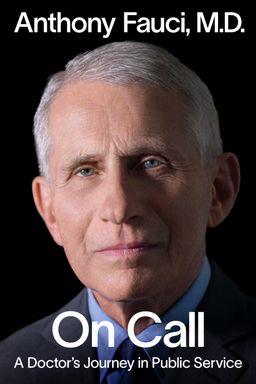
On Call cover

On Call

by Anthony S. Fauci

The physician-scientist and immunologist chronicles his six decades of public service, including his work during the AIDS crisis and the Covid-19 pandemic.

Science, Service, and Leadership

How can you turn science into life-saving action without losing your moral compass? In On Call, Anthony S. Fauci argues that the most effective public-health leadership fuses rigorous science, deep empathy, and institutional savvy. He contends that translational medicine—the tight loop between bedside observation and bench discovery—works only when you also engage activists, persuade politicians, and build systems that last longer than any one crisis.

In this guide, you travel from a Brooklyn pharmacy above which the family lived to the eleventh-floor AIDS ward at NIH, and onward to the White House Situation Room. You’ll see how Jesuit education and mentorship at NIAID shaped a clinician-scientist who could pivot in 1981 to an unknown syndrome, help midwife combination HIV therapy, welcome activists into policy, build the Vaccine Research Center, design PEPFAR, and steady the nation through anthrax, SARS, H1N1, Ebola, and COVID. Along the way, you learn how vaccines are made, why ethical trials matter in outbreaks, and how candid communication earns trust in polarized times.

The Making of a Translator

Fauci roots his worldview in Bensonhurst, Brooklyn: parents Stephen and Eugenia model service at their Thirteenth Avenue drugstore, where compassion outranks profit. Dominican nuns and Jesuit teachers then drill discipline, logic, and “Men for Others” into him at Regis and Holy Cross. At Cornell Medical School he realizes on his physical diagnosis rotation—“this is what I was born to do”—that the clinic is his North Star. The NIH Clinical Center, with labs steps from wards, and mentor Sheldon “Shelly” Wolff teach him to move ideas back and forth between patients and pipettes.

Confronting AIDS, Inventing a Playbook

In 1981, two brief CDC MMWR notices about Pneumocystis pneumonia and Kaposi’s sarcoma in gay men jolt him. He bets his career on the mystery, recruits H. Cliff Lane and Henry Masur, and builds a clinical-immunology engine. As Montagnier and Barré-Sinoussi isolate HIV and Gallo links it to AIDS, Fauci’s lab maps immune derangements (e.g., paradoxical B-cell hyperactivation). Diagnostics in 1985 reveal a vast hidden epidemic, while early AZT flashes hope but also exposes viral resistance—leading to the breakthrough of combination therapy and the ACTG trial network that can test drugs at scale.

Activists as Catalysts, Not Adversaries

Hard-charging activists—Larry Kramer, ACT UP, TAG—begin with fury and end as co-designers of solutions. Fauci invites them to NIH, opens ACTG meetings, and publicly backs parallel track expanded access (1989) so patients outside trials can obtain promising drugs while trials proceed. That shift quickens enrollment, centers patient needs, and accelerates approvals (compare: similar bridges later used in Ebola and COVID through compassionate use and EUAs).

From Lab Chief to Institution Builder

Becoming NIAID director, he studies the institute from the ground up, then aligns budgets, structures, and politics to mission. He champions the Division of AIDS, doubles resources in a single fiscal leap, and persuades President Clinton to seed the Vaccine Research Center (VRC). That platform later undergirds Ebola, Zika, and especially COVID vaccines (Barney Graham, John Mascola, and collaborators like Jason McLellan stabilize spike proteins; Moderna and BioNTech supply mRNA platforms) (Note: a case study in patient capital for basic science paying off years later).

Global Health as Moral Strategy

Field visits to Uganda—Mulago Hospital, JCRC, Rakai—turn statistics into faces. With Mark Dybul and Peter Mugyenyi’s hub-and-spoke model, Fauci drafts a scalable plan that becomes PEPFAR (2003), guided through the White House with Gary Edson, Jay Lefkowitz, and President George W. Bush (with public advocacy from Bono). The result: the largest single-disease global health program, ultimately saving millions. The President’s Malaria Initiative follows, translating known tools (nets, spraying, ACTs, pregnancy prophylaxis) into rapid mortality declines.

Preparing for Man-Made and Natural Threats

After 9/11, anthrax letters force crisis communication and system upgrades (Project BioShield, later BARDA). Smallpox policy pits risk-benefit math against geopolitics, while SARS 2003 proves nature is often the bigger biothreat. Influenza’s drift vs shift shows why egg-based vaccine fragility (e.g., Chiron 2004) is unacceptable; NIAID’s push toward universal flu vaccines and molecular platforms sets the stage for COVID’s speed via Operation Warp Speed.

Core Thread

Empathy without rigor is sentiment; rigor without empathy is sterile. Fauci’s career argues you need both—and the institutional muscle to make good science scale.

Finally, he insists that ethical trials—even amid Ebola—are not luxuries but the shortest path to truth, and that transparent messaging (“what we know, don’t know, and how guidance may change”) is the only durable antidote to panic or politicization. If you lead teams, run trials, or brief the public, this book gives you a playbook: observe closely, test rigorously, partner widely, build platforms, and communicate candidly.


Brooklyn to Benchside

Fauci’s origin story matters because it explains his reflexes under pressure. You meet a kid from Bensonhurst whose father, Stephen, ran a neighborhood pharmacy that doubled as a counseling center; when patients couldn’t pay, the ledger ran tabs instead of turning them away. That ethic—“because we were fortunate, we must help when we can”—becomes his north star. The apartment above the store is not just a setting; it’s a formative clinic in empathy, listening, and follow-through.

Humanities and Science, Not Either–Or

At Regis High School and College of the Holy Cross, Dominican and Jesuit teachers push him to study Latin, Greek, and philosophy alongside chemistry and biology. The Jesuit motto—“Men for Others”—stitches together ethics and analytic rigor. He learns to write clearly and argue logically, skills that later win him cross-partisan trust in Washington briefings (Note: in medicine as in policy, clarity is power).

Athletics and Self-Awareness

Basketball teaches him competition, teamwork, and, crucially, the humility to pivot. Realizing he won’t beat future college stars like Alan Seiden resets his goals. That willingness to drop a dream and re-aim at medicine foreshadows his 1981 pivot from vasculitis research to AIDS—a capacity to change lanes when the facts, and people’s needs, demand it.

Choosing Clinical Medicine—Then Translational Science

At Cornell, during physical diagnosis, he feels the click: direct patient care is his vocation. Yet he also loves mechanism. NIH offers both at once—the ward and the lab on the same floor. Under Dr. Sheldon “Shelly” Wolff at NIAID, he learns a distinctive model: let patients’ problems set the lab’s agenda, and let lab findings circle back to trials. The “soft-shell crab” interview anecdote captures Wolff’s eye for character and fit; he hires people who can think across silos.

Building a Translational Muscle

Fauci’s early research on vasculitis forges habits he later uses in AIDS: define clinical phenotypes precisely, build small high-performing teams, and partner with complementary experts (e.g., Cliff Lane on immunology, Henry Masur on critical care). He internalizes the NIH Clinical Center’s design principle—lab benches within steps of hospital beds—which shortens the distance between a puzzling case and a testable hypothesis.

Mentorship as a Leadership Template

Wolff models three moves Fauci later replicates as NIAID director: (1) spot potential early and give people room; (2) keep patients at the center of research priorities; (3) build structures that outlast individuals. You watch Fauci adopt those moves in creating the AIDS Clinical Trials Group (ACTG), the Division of AIDS, and the Vaccine Research Center—each a system that channels bedside questions into multicenter studies and, eventually, approved therapies or vaccines.

Key Lesson

A hybrid identity—clinician, scientist, communicator—is not a luxury; it’s a force multiplier in crises. The skills you cultivate outside the lab (ethics, writing, persuasion) often determine whether your science matters at scale.

Seen this way, the Brooklyn drugstore and Jesuit classrooms are not mere color. They anchor a through line: service first, evidence always, and institutions as engines. When the AIDS crisis hits, those reflexes—empathy tied to method—mean he can drop prestige projects and sprint toward the fire, then translate that sprint into structures that keep moving even when he steps back.


Facing AIDS Together

AIDS reshapes Fauci’s career and, more broadly, modern biomedical practice. In June–July 1981, terse MMWR notes about Pneumocystis pneumonia and Kaposi’s sarcoma among young gay men trigger alarm bells: these are infections of the immunocompromised, yet the patients were previously healthy. Hypotheses—drug toxicity, a mutated CMV—don’t fit the clustering by city and sexual networks. Fauci makes a risky pivot: he parks a successful vasculitis program and reorients to an unnamed, stigmatized syndrome.

Building a Bedside–Bench Engine

He recruits H. Clifford Lane (immunology) and Henry Masur (ICU) to staff the NIH eleventh-floor ward. The model is intentional: relentless bedside observation should drive lab questions, and lab results must route back into trials. This yields early immunologic insights, including paradoxical B-cell hyperactivation (NEJM, 1983) that looks strange for an immunodeficiency until relentless viral replication explains the overdrive and collapse cycle.

Naming the Culprit and Seeing the Iceberg

In 1983, Luc Montagnier and Françoise Barré-Sinoussi isolate the virus; in 1984, Robert Gallo solidifies HIV as the cause. A 1985 licensed blood test changes everything: the blood supply is secured, and serosurveys reveal a vast asymptomatic but infectious population—the visible clinic caseload was only the tip of a much larger iceberg. That epidemiology reframes priorities: prevention, surveillance, and early therapy must move in concert.

From AZT to the “Lazarus Effect”

AZT (zidovudine) in 1987 looks miraculous—fewer opportunistic infections, improved survival—until single-drug resistance erupts. The ACTG network (grown out of NIAID’s ATEUs) makes multicenter trials fast and inclusive, enabling the 1990s shift to combination therapy: reverse transcriptase inhibitors paired with protease inhibitors (saquinavir, ritonavir, indinavir). Viral loads plummet; skeletal patients regain weight and return to work—the “Lazarus effect.” Clinical care moves outpatient; despair turns into durable management.

Prevention Revolution: PrEP and U = U

Trials supported by NIAID show that daily Truvada as PrEP can reduce acquisition in high-risk MSM by >95% with good adherence. Then Myron Cohen’s 2011 study proves treatment as prevention: suppressing a person’s viral load reduces sexual transmission by >95%, later distilled into the public message U = U (undetectable = untransmittable). Science reframes ethics: caring for yourself becomes protecting others.

Unfinished Business: Reservoirs and Vaccines

Despite therapy triumphs, two scientific mountains loom. First, latent reservoirs (Pantaleo, Chun, and others) hide HIV in lymphoid tissue and resting cells, undermining cure attempts. Second, vaccines: natural infection fails to confer sterilizing immunity, so you don’t have a simple blueprint (unlike measles). A modest 31% efficacy Thai trial hints possibility but not enough for population control; research continues on broadly neutralizing antibodies and novel immunogens (Note: an instructive contrast with COVID’s easier vaccine target).

Human Cost, Human Resolve

The “dark years” include daily deaths, blindness from CMV, burned-out staff, and Fauci’s own marriage strain. Yet that crucible produces the habits—speed, rigor, empathy—that later guide PEPFAR and pandemic playbooks.

If you work in health or policy, AIDS is the template: follow the clues, build fast networks, test combinations, expand access, and keep pushing prevention. It shows you that scientific insight alone is insufficient; you need the systems (ACTG), the tools (diagnostics, drugs), and the social contract (PrEP, U = U) to bend a curve.


Activists Into Allies

A striking thread in Fauci’s story is how confrontation becomes collaboration. Early AIDS activism is loud and raw—Larry Kramer calls Fauci a “murderer” in print; ACT UP stages die-ins and storms buildings. Fauci refuses to retreat behind lab doors. He invites critics to NIH, listens without defensiveness, and asks them to help fix what they’re condemning. That choice—counterintuitive in bureaucracies—reshapes trials, policy, and timelines for lifesaving drugs.

Parallel Track: Compassion Plus Rigor

Marty Delaney and ACT UP press for expanded access to experimental agents. In June 1989, at a San Francisco town hall, Fauci publicly endorses parallel track: keep randomized, controlled trials intact while creating a monitored access pathway for people ineligible for those trials. FDA initially resists; public momentum and data needs force compromise. The operational effect is profound: more equitable access, better real-world safety signals, and faster learning without sacrificing standards (compare with later Emergency Use Authorizations).

Opening the Tent

Fauci opens ACTG meetings to activist observers and integrates patient priorities (e.g., access to ganciclovir for CMV) into trial portfolios. Activists like Peter Staley, Mark Harrington, and Jim Eigo evolve from street-theater strategists to sophisticated policy partners, forming TAG’s Treatment & Data Committee. Constructive friction persists—anger keeps pressure on lethargic systems—but the dynamic turns productive: recruitment improves, protocols become more humane, and approval pipelines shorten.

From Movement to Mechanism

Protest wins attention; structures win outcomes. As NIAID director, Fauci converts advocacy into mechanisms—creating a dedicated Division of AIDS, scaling the ACTG, and, later, founding the Vaccine Research Center. He also learns budget choreography: publicly defend an administration’s proposal while quietly presenting Congress with data for targeted, “budget-busting-lite” increases. The move works: NIAID’s AIDS budget nearly doubles from FY85 to FY86.

Nonpartisan Credibility as Currency

Fauci’s clarity earns trust across administrations. Vice President—and later President—George H. W. Bush listens because the briefings are concise, evidence-based, and nonpartisan. That credibility later helps secure support for parallel track, AIDS funding, vaccine initiatives, and emergency responses without turning science into a political cudgel (Note: a lesson echoed by Atul Gawande and Tom Frieden—precision and humility build political space for policy).

Operating Principle

Treat critics as stakeholders-in-waiting. Invite them into the room, change what you can, explain what you can’t, and let shared goals—saving lives—do the rest.

For you, the blueprint is clear: engagement beats isolation. Whether you’re running a lab, a startup, or a city agency, invite the toughest voices to co-create the solution. Pair compassionate policy (expanded access) with disciplined science (randomized trials). Build durable structures so progress doesn’t depend on one person or one burst of public attention.


Global Health at Scale

The path from a crowded ward in Kampala to a presidential announcement in Washington shows you how observation becomes policy. Field visits to Uganda—Mulago Hospital, the Joint Clinical Research Centre (JCRC), and the Rakai district—give Fauci visceral data: 20–40% HIV prevalence among pregnant women; children dying of treatable opportunistic infections; clinics stretching small grants to impossible lengths. Peter Mugyenyi’s JCRC offers a practical model: a centralized hub with nimble, low-cost satellites that adapt to local conditions.

Designing for Scale and Accountability

With Mark Dybul, Fauci drafts a plan starting from the lowest-friction win: preventing mother-to-child transmission with single-dose nevirapine. Simple math—146,000 babies saved per year at roughly $100 million annually—proves that targeted investment yields outsize returns. They expand the concept: integrate prevention, treatment, and health-system support; build training, supply chains, and data dashboards; measure relentlessly so Congress funds what works, not what merely sounds good.

White House Choreography

Inside the Bush administration, allies like Josh Bolten, Gary Edson, Jay Lefkowitz, and Mike Gerson push to turn vision into law and money. Fauci navigates interagency turf with USAID and State, maintains confidentiality to prevent political blowback, and recruits unusual partners—he hosts Bono at home to align celebrity advocacy with technical design. The result is the 2003 launch of PEPFAR, a five-year, $15 billion commitment that ultimately grows beyond $100 billion and saves millions of lives.

The Malaria Playbook

Success begets ambition. After seeing the science firsthand (including a tour of the mosquito insectarium), Mike Gerson helps drive the President’s Malaria Initiative (PMI) in 2005. PMI chooses proven tools—long-lasting bed nets, indoor residual spraying, artemisinin-based therapies, and pregnancy prophylaxis—and scales them fast. Within a decade, annual malaria deaths fall from over 600,000 to about 400,000, demonstrating what disciplined implementation can do (Note: echoes the Gates Foundation’s “big bets” approach).

Partnerships That Multiply Impact

PEPFAR and PMI thrive because they braid together government, philanthropy, and NGOs. The Bill & Melinda Gates Foundation funds research and champions eradication goals; Médecins Sans Frontières and local NGOs execute on the ground; host governments co-own success. Fauci’s role is connective tissue—bringing VRC science, NIAID trials, and field pragmatism into a single operating system.

Strategic Insight

Big global wins require three ingredients: credible science, political will, and execution partners. If any one is missing, scale breaks.

Fauci then pushes the prevention frontier further: combine treatment as prevention and PrEP to argue for an “AIDS-free generation,” write it up in Science, and translate the idea into the PEPFAR Blueprint. The lesson for you is practical: start with a solvable wedge (nevirapine), model cost and impact, find champions inside power, and lock in cross-sector delivery. When you connect the dots from bench to village to cabinet room, millions of lives move with you.


Preparedness Playbook

From anthrax letters to COVID vaccines, Fauci’s preparedness arc blends countermeasure pipelines, platform science, and public communication. The 2001 anthrax attacks thrust him onto national TV to calm a panicked public—people hoard Cipro, mail is irradiated, rumors fly. He repeats one cadence: be vigilant, don’t panic, and let facts guide action. Behind the cameras, he and colleagues push for structural fixes—stockpiles, flexible funding, and faster regulatory tools.

From BioShield to BARDA

Project BioShield creates a government market for vaccines and therapeutics against high-priority threats, coupled with emergency-use authorities at FDA. Political fights—OMB vs. the Vice President’s office, mandatory vs. appropriated funding—underscore a hard truth: preparedness is policy engineering as much as lab work. BARDA extends the model to naturally occurring threats, seeding partnerships that later underpin rapid COVID responses (Note: akin to DARPA’s role in semiconductors and the internet).

Smallpox and Risk Math

Debates over mass vaccination vs. ring vaccination highlight competing risks: the smallpox vaccine itself can cause myocarditis, encephalitis, and rare deaths, so preemptive mass campaigns are not costless. Fauci argues to protect first responders and rely on targeted strategies, balancing low-probability catastrophic risk against very real vaccine harms. It’s a masterclass in probabilistic decision-making under political pressure.

Nature’s Reminders: SARS and Influenza

SARS in 2003 vindicates classic public health: isolation, contact tracing, and transparent reporting. Influenza exposes manufacturing fragility. The 2004 Chiron plant contamination in Liverpool wipes out ~46–48 million expected U.S. doses; the 2009 H1N1 pandemic reveals how biological variability and export restrictions (e.g., Australia) implode optimistic delivery promises. These failures push NIAID toward pre-pandemic stockpiles (H5N1) and a moonshot: the universal flu vaccine.

Platforms Change the Speed Limit

At the VRC, Barney Graham and John Mascola lead a decade-long effort in rational antigen design—stabilizing spike proteins in their prefusion state (with collaborators Jason McLellan and Andrew Ward). When SARS-CoV-2’s sequence appears, the immunogen is ready; Moderna and Pfizer/BioNTech supply the mRNA platform, maturing work seeded by Katalin Karikó and Drew Weissman. Operation Warp Speed derisks manufacturing while trials run, delivering safe, effective vaccines in ~11 months.

Ethics and Evidence in Outbreaks

Ebola (2014–2016) tests whether ethics can survive urgency. Fauci and Cliff Lane insist on randomized trials in Liberia via PREVAIL, at the host country’s request (Minister Walter Gwenigale). Critics want to “just give” therapies; randomized designs prove both feasible and necessary, a stance later backed by the National Academies (2017). Parallel track and compassionate use balance access with learning.

Communication Under Fire

From Chiron’s 2004 fiasco to H1N1’s missed delivery timelines and COVID’s mask debates, Fauci returns to one principle: say what you know, what you don’t, and how guidance may change. Overpromising—by agencies or companies—creates trust debt you must repay in hearings and press briefings. Transparent humility is not weakness; it’s the only currency that appreciates in a crisis.

Preparedness Formula

Diverse manufacturing + platform readiness + ethical trials + flexible funding + honest communication = fewer surprises and faster solutions.

If you’re planning for the next pandemic, invest now in platforms and people, practice clear messaging before it’s urgent, and design your procurement and authorization tools in peacetime. When the alarm rings, you won’t invent a system; you’ll activate one.

Dig Deeper

Get personalized prompts to apply these lessons to your life and deepen your understanding.

Go Deeper

Get the Full Experience

Download Insight Books for AI-powered reflections, quizzes, and more.