
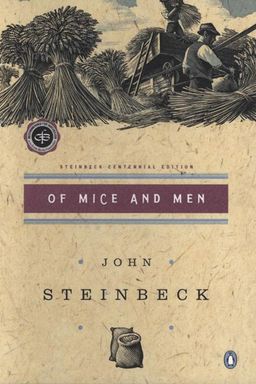
Of Mice and Men cover

Of Mice and Men

by John Steinbeck

Of Mice and Men is a timeless tale of friendship, dreams, and hardship during the Great Depression. Follow George and Lennie''s poignant journey as they navigate the harsh realities of life, exploring themes of hope, power, and the fragile nature of dreams in a world of adversity.

Dreams, Loneliness, and the Fragile Hope of Companionship

What happens to people who dream in a world that refuses to make room for their dreams? In Of Mice and Men, John Steinbeck poses this question through the story of two traveling laborers—George Milton and Lennie Small—who wander Depression-era California chasing the dream of owning a small farm. Steinbeck argues that the American Dream, as seductive as it is, becomes almost unreachable in a world defined by poverty, alienation, and systemic cruelty. Yet, in the face of that futility, what sustains his characters is companionship—the fragile but profound bond between two men who have no one else to hold onto.

Through this simple tale of hope and despair, Steinbeck exposes how isolation corrodes the human spirit and how a shared dream, however impossible, can keep people alive. The novel asks you to consider whether you could endure such loneliness, what you might cling to if all the world’s forces conspired to strip you of dignity, and whether genuine friendship can survive in a world that crushes the weak.

The Context: The Great Depression and the Death of Idealism

Set along California’s Salinas River during the Great Depression, Of Mice and Men situates its human tragedy within the economic despair of the 1930s. The era’s displacement of workers turned men into wandering souls, earning scant wages and clutching at any faint hope of a better life. George and Lennie dream of a piece of land they can call their own—“to live off the fatta the lan’,” as Lennie repeats like scripture. This mantra becomes their protection from despair, a way for them to believe in something beyond the endless cycle of labor and loss.

In this setting, Steinbeck observed men whose greatest poverty was not material—it was emotional isolation. Some, like Crooks the stable hand, are excluded because of race. Others, like Curley’s wife or Candy, the aging ranch worker, are exiled by gender and disability. Their loneliness mirrors a broader cultural desolation: in a world built on competition and survival, true companionship is both rare and revolutionary.

George and Lennie: Brotherhood as Resistance

At the core of Steinbeck’s fable is the bond between two men utterly unlike one another. George is small, sharp, and weary; Lennie is large, childlike, mentally disabled, and dangerously strong. George’s role as Lennie’s caretaker emerges from both compassion and responsibility. He often laments the burden—“I could get along so easy if I didn’t have you”—but his anger hides deep affection. Their friendship symbolizes a radical act of humanity in a society where, as Steinbeck writes, men are “the loneliest guys in the world.”

Lennie’s innocence contrasts with the cruelty of the world around him. His fixation on soft, living things—mice, puppies, and their imagined rabbits—represents a yearning for tenderness in a harsh reality. Yet his strength, combined with his mental incapacity, ensures tragedy. The novel thus becomes a meditation on interdependence: George needs Lennie’s faith as much as Lennie needs George’s guidance. Their dream farm exists less as a plan than as a ritual of survival—a story they tell each other to keep despair at bay.

The Fragility of Dreams

Steinbeck reveals how dreams crumble beneath systemic injustice. The itinerant workers’ hope of self-sufficiency is pitted against economic exploitation. Candy, who joins their plan after losing his old dog and recognizing his own obsolescence, invests his life savings to buy into the dream. Even Crooks, cynically hardened by racism, is momentarily moved to imagine “hoe’n in the garden.” But as quickly as that dream forms a fragile community of outcasts, reality intrudes to destroy it.

Curley’s wife—a lonely woman dismissed and objectified—unintentionally becomes the agent of its destruction. Her tragic encounter with Lennie exposes how men’s yearning for control, tenderness, or escape often collides with the raw brutality of life itself. In the end, the dream is not killed by malice alone, but by the inherent vulnerability of human imperfection within a merciless system.

The Meaning of Mercy

When George shoots Lennie to spare him a lynch mob’s cruelty, Steinbeck reframes mercy as both compassion and despair. George’s act, while devastating, is his final protection of Lennie—preventing the world from desecrating him. The closing scene, echoing the story’s opening by the river, forms a tragic symmetry: dreams begin and end in the same place, as though fate circles back to mock human hope.

Steinbeck doesn’t offer redemption; instead, he demands empathy. In George’s trembling hands and Slim’s quiet consolation—“A guy got to sometimes”—we glimpse the moral center of the novel: dignity can survive even in hopelessness when forged by love, loyalty, and the courage to face unbearable truths.

Like Faulkner or Hemingway (whom Steinbeck admired), he captures the stark moral tension between idealism and survival. Yet unlike them, Steinbeck turns socialism and spirituality into emotional realism. He shows that compassion, though powerless against fate, remains the only truly radical human act.

Core Insight

The tragedy of Of Mice and Men lies not only in lost lives but in lost dreams—how people cling to each other to survive a world that gives them nothing else. Steinbeck’s message endures: to be human is to keep dreaming, even when you know the dream will break.


Friendship as a Shield Against Isolation

For Steinbeck, friendship isn’t sentimental—it’s self-preservation. George and Lennie’s relationship defies the social order of itinerant labor, where men drift from job to job, detached from roots or relationships. In a world of suspicion and loneliness, their companionship stands out as almost subversive. It’s not just affection; it’s survival through connection.

George represents rational loyalty, while Lennie embodies primal trust. Their dependency mirrors the human need for both intellect and innocence to coexist. Through their dialogues—repeated stories of their “little place”—Steinbeck captures the power of shared imagination. That ritual storytelling both calms Lennie’s anxiety and reaffirms George’s purpose.

Loneliness as the Great Disease

Steinbeck viewed loneliness as the central affliction of modern America. Every character—Candy, Crooks, Curley’s wife—embodies a different form of isolation. Candy loses his lifelong dog, his only companion, mirroring the dread of being deemed useless. Crooks, segregated by race, guards his solitude fiercely, claiming that isolation makes a man “sick.” Curley’s wife, deprived of affection, seeks connection only to be condemned for it. Their pain reveals how social hierarchies dehumanize everyone involved.

George and Lennie’s partnership, therefore, becomes revolutionary—not politically, but morally. It symbolizes resistance against alienation. When Slim observes, “It’s funny how you an’ him string along together,” his rare empathy reveals how companionship itself has become an anomaly.

Key Takeaway

In Steinbeck’s world, friendship is not a luxury—it’s the last refuge of dignity. To walk alone is to die a little; to walk together is to remain human, if only barely.


The American Dream Reimagined

At its core, Of Mice and Men reinterprets the American Dream. While the national myth promises success through hard work and independence, Steinbeck presents it as a tragic illusion for most working-class Americans. The dream of owning land—“a few acres an’ a cow”—offers psychological escape from economic servitude. It gives meaning to endless toil, even though it can never be achieved.

The dream’s communal form is what makes George and Lennie’s version unique—they want to share it. When old Candy offers his savings to buy in, he transforms the fantasy into a collective possibility. Yet even this fragile hope is undone by circumstance, showing how capitalism isolates rather than unites people. Steinbeck’s critique resembles that found in Upton Sinclair’s The Jungle or F. Scott Fitzgerald’s The Great Gatsby: the American Dream sustains people emotionally even as it condemns them economically.

The Dream’s Illusion and Its Necessity

Though doomed, the dream is vital—it sustains hope and camaraderie. Its collapse serves not as mockery but as tragedy. Steinbeck suggests that people need dreams not because they’re achievable, but because they make life bearable. Lennie’s constant repetition of the dream illustrates this emotional truth: the dream creates belonging even in a world that denies it.

Key Takeaway

Steinbeck transforms the American Dream from a pursuit of wealth into a yearning for safety, dignity, and human connection—a dream that haunts the powerless more than it ever redeems them.


Power, Prejudice, and the Marginalized

Power in Of Mice and Men flows through social hierarchies: gender, race, age, and physical strength. Steinbeck uses the ranch as a microcosm of systemic oppression. Curley’s wife is nameless—a symbol of women reduced to property. Crooks, the black stable hand, lives segregated in the barn, embodying the era’s racism. Candy, disabled and aging, fears disposal like his shot dog. Each figure shows how society ranks human worth by utility.

Steinbeck’s genius is that he gives these characters interior lives. Crooks’ bitter dialogue with Lennie exposes the psychological toll of exclusion. His brief hope of joining the dream underscores how yearning persists even for the disenfranchised. In a moment of cruel reversal, Curley’s wife wields racial power to silence him: “I could get you strung up on a tree so easy it ain’t even funny.” It’s a chilling reminder of how oppression cascades downward—the powerless grasp power by demeaning others weaker than themselves.

Key Takeaway

Steinbeck exposes how prejudice fractures solidarity among the marginalized, ensuring that no group can unite against the real oppressors—the systems of labor and hierarchy that keep them divided and desperate.


Violence and Mercy in a Hard World

Violence saturates Steinbeck’s world not because people are evil, but because cruelty becomes normalized in desperate times. Characters devalue life to survive. Candy’s dog is shot as a utilitarian act; Slim drowns half his puppies for practicality. Such moments foreshadow George’s final act of mercy killing. By the novel’s end, killing merges with compassion.

George’s decision to shoot Lennie mirrors Carlson’s shooting of the dog—but with moral inversion. Where Carlson acts to rid himself of discomfort, George acts to spare pain. Steinbeck frames mercy as ethical clarity amid brutality. In contrast, Curley demands vengeance, revealing how violence without empathy corrupts justice.

This final mercy aligns George with the ancient archetype of the compassionate executioner—a theme found in Hemingway’s For Whom the Bell Tolls and echoed in Steinbeck’s later depiction of moral ambiguity in The Grapes of Wrath. Violence, in this sense, becomes an indictment of society itself: when kindness requires killing, civilization has already failed.

Core Moral Tension

In Steinbeck’s vision, violence and compassion are intertwined. Mercy demands courage; cruelty demands none. George’s act, therefore, is both tragic and transcendent—the only kindness left in a merciless world.


The Limits of Innocence

Lennie’s innocence makes him one of Steinbeck’s most iconic creations. Like a child in a giant’s body, he desires beauty and affection but cannot perceive his strength. His love for soft things—mice, the puppy, even Curley’s wife’s hair—reflects a tenderness distorted by ignorance. Steinbeck uses Lennie to explore moral innocence in a corrupted world: purity, when unprotected, becomes destructive.

Lennie doesn’t understand fear or lust; he understands only touch and comfort. When he kills by accident, Steinbeck portrays not evil but the tragic mismatch between moral simplicity and a brutal environment. As Slim says, “He ain’t mean.” This echoes biblical archetypes: Lennie is a fallen Adam figure, expelled from Eden not through sin, but through the uncontrollable consequences of innocence.

Key Reflection

Steinbeck challenges you to question whether innocence can survive without wisdom—and whether purity without understanding inevitably becomes destructive in a world built on cruelty.


Human Dignity in a Mechanized World

The ranch setting in Of Mice and Men doubles as a machine of production—men enter, perform, and are discarded. Steinbeck’s sociopolitical undertone reveals how industrial capitalism erases individuality. Workers like George and Lennie are interchangeable parts; their dreams rebel against this mechanical fate. Even Candy’s anxiety over becoming useless parallels the commodification of human life.

At the novel’s end, George’s despair signals the triumph of the impersonal system: the dream dies, companionship ends, and labor continues. Carlson’s final line—“Now what the hell ya suppose is eatin’ them two guys?”—summarizes the moral vacancy of modernity. To the pragmatic world, empathy itself has become alien.

Essential Insight

In Steinbeck’s moral economy, dignity isn’t derived from work or wealth—but from empathy. When society forgets that, it becomes efficient yet soulless, successful yet inhuman.

Dig Deeper

Get personalized prompts to apply these lessons to your life and deepen your understanding.

Go Deeper

Get the Full Experience

Download Insight Books for AI-powered reflections, quizzes, and more.