
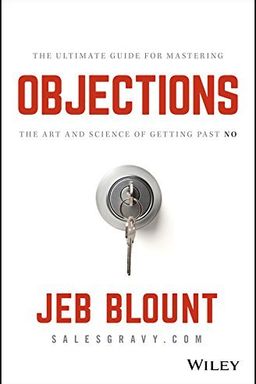
Objections cover

Objections

by Jeb Blount

Objections reveals the secrets of converting sales objections into opportunities for success. Combining psychological insights and practical strategies, it empowers salespeople to transform reluctant prospects into enthusiastic buyers, while embracing rejection as a natural part of the journey.

Mastering the Art and Science of Getting Past No

How do you stay confident when someone says no to you again and again? In Objections: The Ultimate Guide for Mastering the Art and Science of Getting Past No, Jeb Blount argues that every great salesperson must become a master of handling rejection—not because rejection can be eliminated, but because it is the unavoidable entrance fee to success in sales and life. He contends that the ability to ask decisively, manage disruptive emotions, and move past objections determines income and career success more than any other skill.

Blount builds his case on a compelling premise: people fail in sales not because they don’t know what to say but because they cannot manage how they feel when someone says no. He connects neuroscience, psychology, and decades of sales experience to reveal that getting past no is both an art—rooted in emotional intelligence—and a science, anchored in frameworks and repeatable behavior. Every conversation, from the first cold call to closing the deal, stands or falls on emotional control.

Why Objections Matter

Blount opens with a simple yet uncomfortable truth: whether you're selling software or ideas, asking is the most important discipline in sales. Yet, asking also triggers the salesperson’s deepest fear—rejection. Humans avoid rejection because, biologically and emotionally, it feels like pain. Our brains perceive rejection in the same neural regions that process physical harm. When confronted with a refusal, our fight-or-flight response kicks in. Blood rushes from the logical brain to the emotional centers, and panic follows. Blount’s central point is that this chemical reaction sabotages logical thinking and performance, unless you learn to control it.

Modern salespeople often confuse objections with rejection. But while rejection is final, objections are simply steps along the decision-making process. The problem is that they feel the same. By learning to differentiate the two, and by deploying structured responses through frameworks like “ledge–disrupt–ask,” you reclaim control of both your emotions and the conversation. Objections, rightly handled, signal that the buyer is still engaged.

The Framework of Four Objections

At the book’s core is Blount’s taxonomy of objections. He asserts there are four key types encountered in any sales process: prospecting objections, red herrings, micro‑commitment objections, and buying commitment objections.

  • Prospecting objections occur when you interrupt someone’s day to ask for time or attention.
  • Red herrings are irrelevant distractions that lead you away from the agenda.
  • Micro‑commitment objections appear when you ask prospects to take small steps forward.
  • Buying commitment objections surface at the close, when big decisions and risk are on the table.

Understanding where you are in the process determines how to handle each objection. The power of Blount’s approach lies in the fact that he doesn’t promise a list of magical rebuttals; instead, he provides frameworks adaptable to any context. The key, he teaches, is consistency: respond with emotional control, use pre‑planned techniques that let your rational brain catch up, and guide the conversation back to value.

The Psychology of Resistance and Rejection

Blount backs his frameworks with neuroscience and behavioral research—from Daniel Kahneman to Antonio Damasio—to explain why people resist change and why sales conversations trigger conflict. Buyers act out of cognitive biases: status‑quo bias (“better the devil you know”), negativity bias (focusing on what could go wrong), and sunk‑cost fallacy (throwing good money after bad). These make objections inevitable. To move past them, you must influence not just logic but emotion, using empathy, trust, and small steps to reduce perceived risk.

For the salesperson, disruptive emotions—fear, desperation, insecurity, need for significance—mirror those of the buyer. Blount’s concept of becoming “rejection proof” echoes Jia Jiang’s Rejection Proof, but he grounds it in a practical process of mental conditioning. Emotional resilience, he writes, can be trained just like a muscle—through exposure, visualization, physical fitness, and disciplined self‑talk. You can’t stop the fear, but you can manage it.

Why This Book Matters

Objections matter because they are not the end—they are gateways to trust. By reframing resistance as engagement, you transform “no” into information, and information into opportunity. Blount reminds readers that sales is fundamentally human: a meeting of two emotional systems deciding if they trust each other enough to change. Scripts and tricks fail because they don’t respect that humanity. Emotional control and consistent frameworks succeed because they do.

Across sixteen chapters, Blount walks you from the science of asking, through handling objections at each stage of the sale, to mastering your personal mindset. You’ll learn why avoiding objections is “stupid,” how to prime for yes, and how persistence—sometimes 52 calls deep—proves that “yes always has a number.” He ends with stories of persistence and grit, urging you to see rejection not as pain but as proof you’re on the path to mastery.

“In every sales conversation, the person who exerts the greatest amount of emotional control has the highest probability of getting the outcome they desire.”

This single line encapsulates Objections. Whether you sell products, ideas, or your own worth, Blount teaches that mastery begins not with clever answers, but with composure, persistence, and the courage to keep asking.


The Discipline of Asking

From the opening story of Richard—the salesperson who left seventy‑one voicemails before finally landing a meeting—Jeb Blount drives home one unshakable truth: nothing happens until you ask. The difference between average and exceptional salespeople is not knowledge, charm, or even luck—it is the discipline to ask relentlessly.

Fear and the Human Condition

Why is asking so hard? Because asking opens you to rejection, and rejection hurts. Blount traces this fear to our evolutionary wiring: for primitive humans, being rejected by the tribe meant death. Even now, your brain reacts to rejection like a physical wound—your body produces cortisol, your heart rate spikes, and blood drains from your rational brain. To protect yourself, you hesitate, soften your words, or avoid asking altogether. But in sales, hesitation costs opportunity and income.

The Assumptive Ask

Blount’s remedy is the assumptive ask: posing every request as if you naturally expect compliance. The way you phrase your question—your tone, pacing, confidence—transmits emotion. Because of emotional contagion, people subconsciously mirror the emotions of others. When you sound hesitant, you make your prospect uncertain. When you sound confident, you make them comfortable saying yes. This insight aligns with research from social psychology showing that people respond more to emotional signals than logical arguments.

Three Rules for Asking

Blount distills asking into three simple but challenging rules:

  • Ask with confidence and assume a yes. Always start from a mindset of positive expectation.
  • Shut up after you ask. Silence feels unbearable but talking undermines your authority and invites extra objections.
  • Be prepared for objections. Rehearsed frameworks keep you calm when no inevitably appears.

These rules transform how you communicate. A confident request like “Let’s schedule your training kickoff for Wednesday at 2:00” projects authority. A weak, fearful one—“Would Wednesday maybe work for you?”—projects doubt. As Jeffrey Gitomer says (quoted in the book), “the assumptive position is the strongest selling strategy in the world.”

Why Silence Wins

The hardest part of asking, Blount admits, is shutting up. Salespeople tend to talk themselves out of a sale, especially during awkward silences. Your brain screams, “Say something!” but effective salespeople hold the pause. That moment of tension is where influence lives. As Daniel Pink observed in To Sell Is Human, silence makes room for the buyer’s emotional processing—without it, you deny them time to agree with you.

In the end, asking is courage in action. Every great sales success story begins not with a perfect script but with the willingness to risk a no. “Grow your backbone,” Blount insists. “Ditch the wishbone.”


The Science of Resistance

Why do buyers resist even when your offer is obviously good for them? Blount explains that resistance is rarely logical—it’s emotional. Drawing on cognitive psychology, he shows how biases, heuristics, and fear of change hard‑wire prospects to say no first and justify it later.

Patterns, Biases, and Fear

Humans, he writes, are “pattern monsters.” We ignore what feels familiar and react only to anomalies—new, different, or threatening things. Because most salespeople look, sound, and behave the same, prospects’ brains file them away as uninteresting patterns, triggering the automatic “not interested.” To break this cycle, you must disrupt expectations—a concept Blount calls pattern painting. When you surprise instead of sell, you earn attention.

He details four major buyer biases that produce objections:

  • Status‑quo bias: people cling to what they know even when it’s dysfunctional (“better the devil you know”).
  • Safety bias: buyers overvalue avoiding loss versus achieving gain (Kahneman’s loss aversion).
  • Negativity bias: humans focus on what’s wrong rather than what’s right, amplifying small risks.
  • Sunk‑cost fallacy: we stick with bad decisions because we’ve already invested in them.

Together, these biases mean that people default to no. You cannot argue them into yes; pushing harder merely triggers psychological reactance—the instinctive rebellion against being pressured. Rather than overcome objections, you must guide emotions back toward trust and curiosity.

Emotions First, Logic Second

Building on Dr. Antonio Damasio’s work, Blount emphasizes that people feel before they think. Emotions drive the decision; logic simply rationalizes it. That’s why objections are emotional first. The salesperson who stays calm under pressure exerts greater influence. “In every sales conversation,” he notes, “the person with the most emotional control wins.”

Trust: The Antidote to Bias

Trust neutralizes fear. You earn it not by words but through behavioral consistency—showing up prepared, listening deeply, and respecting commitments. As Blount warns, good intentions don’t count; buyers judge you on your actions, not your intentions. A single defensive reaction or broken promise invokes negativity bias and undoes all your rapport.

In short, resistance is not a wall to be destroyed but a force to be understood. Manage your buyer’s biases, and you reduce objections before they form.


Becoming Rejection Proof

Imagine deliberately seeking out rejection every day until it no longer scares you. That’s what Jia Jiang did in his famous “100 Days of Rejection” experiment, and it’s the model Jeb Blount uses to teach emotional control. His message is clear: rejection isn’t fatal, but avoidance of it is.

The Seven Disruptive Emotions

Blount identifies seven emotional saboteurs that derail performance: fear, desperation, insecurity, need for significance, attachment, eagerness, and worry. Each one clouds judgment, fosters irrational actions, and feeds rejection cycles. For example, desperation makes you needy; neediness repels buyers, leading to more rejection, which breeds more desperation—a vicious loop.

Techniques for Emotional Regulation

Becoming rejection proof begins with self‑awareness. Notice when fear arises (“Here it comes”) and pause before reacting. Use visualization to rehearse success—mentally running through your call while breathing deeply and picturing yourself calm and confident. Blount draws from sports psychology, noting that elite athletes visualize performance before competing.

He suggests managing self‑talk by catching inner negativity and replacing it with constructive statements. A four‑letter word taped to his wall—“NEXT”—reminds him to move forward after rejection. Physical posture influences emotion too: stand tall, breathe deeply, and “power pose” (Amy Cuddy’s research) to raise testosterone and lower cortisol, producing confidence from the outside in.

Obstacle Immunity and Emotional Fitness

The concept of obstacle immunity parallels military conditioning. Soldiers aren’t fearless; they’re trained to act despite fear through repeated exposure. Likewise, salespeople can inoculate themselves against rejection by steady, deliberate practice—making calls, hearing no, and persisting. As Blount writes, “Self‑control in the face of obstacles is like a muscle. The more you use it, the stronger it becomes.”

Physical health supports emotional health. Sleep, nutrition, and fitness increase resilience; exhaustion and hunger magnify emotional volatility. Blount warns that sleep deprivation, in particular, destroys confidence more than any prospect’s objection ever could.

Facing Fear as a Choice

Ultimately, rejection proofing is a mindset. You can’t remove fear, but you can decide to face it. Every act of courage—every uncomfortable call, every follow‑up after a hang‑up—strengthens your defense against doubt. Adversity is the teacher, not the enemy. Put simply: no one gets confidence without earning it through pain.


Prospecting Objections and the Three-Step Turnaround

No stage of selling provokes fear like prospecting. Blount calls it “the most severe form of rejection”—cold calling, interrupting strangers, and asking for time. Yet, he insists, if you fail to interrupt, you fail to sell. Empty pipelines kill careers, and only consistent prospecting fills them.

The Rule of Thirds

Each call ends in one of three outcomes: one‑third say yes right away; one‑third say no and mean it; one‑third hover in “maybe.” The maybes are where your living is made, and how you handle their resistance determines success. Instead of winging it, Blount provides the Three‑Step Prospecting Turnaround Framework: Ledge → Disrupt → Ask.

Step 1: Ledge

A ledge is a memorized, reflex response that buys you time and emotional control. When someone cuts you off with “I’m not interested,” respond automatically with “That makes sense.” This pause gives your rational brain space to recover from fight‑or‑flight and decide your next move.

Step 2: Disrupt

Next, use pattern painting to surprise the prospect. People expect you to push back or beg for attention. Instead, agree, empathize, or joke. For example, if they say “We’re happy with our supplier,” answer, “Perfect—you should never change when you’re getting great service. Let’s meet anyway so I can keep those guys honest.” The unexpected humor disarms them and restarts engagement.

Step 3: Ask

Always end with another ask. Confidence fades if you don’t move forward. “That’s exactly why we should talk—how’s Tuesday at 2?” Half the time you’ll face a new, more honest objection; handle it again. Two rounds max, then move on graciously. Persistence, Blount says, “has a number.” He once called one prospect 52 consecutive days before getting a yes—and it became one of his biggest deals.

Repetition is key. Scripts aren’t the enemy of authenticity; they’re the foundation of confidence. Actors practice lines until they sound natural; salespeople must do the same. Knowing what to say frees you to focus on tone and connection.


The Power of Micro‑Commitments

Deals don’t die at closing; they die in the middle from lack of momentum. Micro‑commitments—small, low‑risk agreements—keep deals alive by converting interest into engagement. Each step forward (a call, a demo, a tour) increases psychological investment. “Never leave a meeting without a next step,” Blount warns. “Ever.”

Why Micro‑Commitments Matter

When prospects take action, they begin to value your relationship more; behavioral economics calls this the investment effect. Conversely, when you don’t ask for small commitments, deals stall and the pipeline clogs. Micro‑commitments test seriousness, reveal hidden objections, and build momentum toward the final yes.

Three‑Step Turnaround for Micro‑Commitment Objections

When a prospect resists (“Just send me the information”), Blount recommends another three‑step process: Ledge → Explain Value → Ask.

1. Ledge: stay calm—“That makes sense.”
2. Explain Value: articulate what’s in it for them. “I’d hate to waste your time with generic info. A quick 15‑minute call helps me tailor it for you.”
3. Ask: close with a confident next step: “Would Wednesday or Thursday afternoon work better?”

Each yes, no matter how small, raises emotional commitment. Over time, micro‑commitments compound like interest, making the buying decision easier and less risky.

Using Scarcity and the Take‑Away

Scarcity enhances perceived value. When a prospect says “We’re happy where we are,” a take‑away response such as “Then you should absolutely stick with your vendor” often pulls them back in. The moment you stop chasing, they start leaning forward. This psychological flip echoes Robert Cialdini’s principle of scarcity—people want what they’re about to lose.

Small steps may seem mundane, but they define professionalism. Organized, confident salespeople with clear next steps exude trustworthiness, while aimless ones seem unprepared. The micro‑commitment mindset turns every conversation into progress.


Bending Win Probability in Your Favor

Blount likens sales to poker or chess: every move has a probability of success. Ultra‑performers win not because they gamble but because they calculate. They turn selling into a game of managing variables—prospecting volume, qualification rigor, emotional control—to bend the odds toward yes.

Yes Has a Number

Every “yes” has a statistical price tag—the number of asks required. Whether it’s 10 cold calls or 52 follow‑ups, the numbers never lie. By tracking ratios—calls to conversations, conversations to meetings, meetings to deals—you replace luck with predictability. Like Daniel Kahneman’s “slow thinking,” data forces discipline over emotion.

Fanatical Prospecting and Qualification

A full pipeline is emotional armor. Desperation, Blount’s deadliest emotion, appears when you need every deal too badly. A packed pipeline lets you walk away from low‑probability prospects. He defines the law of need: “The more you need the deal, the less likely you are to win it.” Only fanatical prospecting—daily, disciplined outreach across channels—keeps the cycle healthy.

Precall Planning and Emotional Control

Preparation bends probabilities. Before every meeting, ask four questions: What do I know? What do I want to know? What’s my objective? What’s my next step? This clarity builds confidence, reduces surprises, and lowers emotional volatility. Likewise, murder boarding—anticipating every possible objection—prepares you for reality. When the real objection arises, you’ve already rehearsed your response.

Persistence: The Shaquem Griffin Lesson

In the final chapter, Blount tells the story of Shaquem Griffin—the one‑handed football player who refused to accept rejection, proving that persistence redefines probability. Just as Griffin trained beyond pain, elite salespeople persist through rejection until “yes” becomes inevitable. Blount’s closing mantra: success is always paid for in advance—with rejection, effort, and patience.

By treating every call, ask, and objection as a number in the probability game, you gain control of what others call luck. The grind of rejection becomes predictable progress. That, Blount insists, is the science—and the art—of getting past no.

Dig Deeper

Get personalized prompts to apply these lessons to your life and deepen your understanding.

Go Deeper

Get the Full Experience

Download Insight Books for AI-powered reflections, quizzes, and more.