
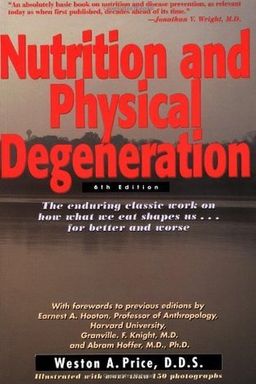
Nutrition and Physical Degeneration cover

Nutrition and Physical Degeneration

by Weston A Price

Explore the transformative insights of ''Nutrition and Physical Degeneration'' as Weston A. Price unveils the stark contrast between indigenous diets and modern processed foods. Discover how local, whole foods can enhance health, prevent tooth decay, and provide essential nutrients, reshaping your understanding of nutrition.

Nutrition, Modernity, and the Architecture of Health

Why do modern people suffer rampant tooth decay, narrow faces, and chronic disease while their primitive ancestors often enjoyed superb health? In Nutrition and Physical Degeneration, Weston A. Price argues that the answer lies not in germs or genes but in food systems. He traveled globally—from Swiss valleys to Pacific islands, from the Andes to the Arctic—seeking control groups: isolated peoples still eating ancestral diets. His findings overturn simple medical explanations and reveal a nutritional law that underlies human design and disease.

An observational experiment on a global scale

Price compares whole communities that differ only in diet exposure. Among people living entirely on traditional foods—whole grains, seafoods, dairy, organ meats—he finds near-total immunity to dental caries, tuberculosis, and physical deformity. Among neighboring groups introduced to white flour, sugar, polished rice, canned goods, and refined fats, decay and deformity appear within one generation. Statistical differences are stark: Swiss Loetschental children averaged 0.3 cavities per child; nearby St. Moritz, influenced by commerce and bakeries, soared to 29.8% teeth affected. Similar contrasts recur in Alaska (0.09% vs 21.1%), among Pacific islanders (0.3% vs 30%), and across continents.

Modernization as nutritional degeneration

Modern food, according to Price, triggers a predictable pattern—rapid decay, weaker bones, narrower faces, and lowered vitality. Children of parents who adopted refined foods often show crowded teeth, underdeveloped jaws, and susceptibility to infection—not because of hereditary change, but because formative tissues were built from malnourished parental germ cells and gestational diets. This same process connects to rising tuberculosis, infertility, and mental and moral decline in modern populations.

You can view Price’s research as an early systems biology: he connects ecology, soil chemistry, agriculture, food preparation, and reproduction as one continuum. His claim is radical in its simplicity: the architecture of the human face, the strength of the bones, and the balance of the mind all depend on specific fat‑soluble and mineral nutrients that modern civilization neglects.

The nutritional foundation of form and resistance

Across widely separated cultures he identifies a common formula: nutrient-dense foods rich in what he called “activators”—compounds now recognized as vitamins A, D, and related cofactors—combined with abundant minerals from seafood, organ meats, and unrefined grains. These diets supplied the raw materials to build wide dental arches, strong bones, and resilient immune systems. Traditional dairying peoples like the Swiss, pastoral Africans like the Masai, and coastal Peruvians merging sea products with inland crops all achieved the same outcome: physical excellence and disease resistance.

Beyond teeth: a social and ecological diagnosis

Price connects biological decay to societal trends. He observes lower vitality, mental dullness, delinquency, and reproductive failure in modernized groups whose diets lost ancestral nutrient balance. He further traces the ultimate source of decline to the land itself: depleted soils and phosphorus loss reduce plant and animal nutrient density, creating a hidden chain from soil exhaustion to human degeneration. In ancient Peru and other fallen civilizations, he sees parallels: once the irrigations failed or soils depleted, physical and cultural breakdown followed.

Purpose and implications

Price’s work culminates in a practical program: restore soil fertility, restore nutrient-dense foods, and restore preconception nutrition for both sexes. Public health, dentistry, and even moral education require biological reform through food. The book closes not in nostalgia but in urgency—connecting laboratory data, archaeological evidence, and field nutrition into one warning: if you want a thriving, beautiful, and intelligent civilization, you must build it from living soil and uncorrupted food.

Core lesson

Human degeneration is not an inevitable evolutionary path but a reversible nutritional injury. Civilization’s health mirrors its food sources, and every generation inherits the biological result of what the previous one eats.

Through that lens, Nutrition and Physical Degeneration is not only a travelogue but a manifesto for reconnecting medicine, ecology, and culture. It shows you that protecting human architecture—of bone, face, and mind—begins with protecting the architecture of the soil and the integrity of ancestral food wisdom.


Traditional Diets and Immunity

Across Price’s global survey, traditional diets stand out for their extraordinary power to preserve dental, facial, and systemic health. Communities that remained on ancestral foods—whole rye and summer butter in Switzerland, fish and seal oil in Alaska, shellfish and taro in Polynesia—showed near-total immunity to caries and skeletal deformity. These diets provided both macronutrient balance and fine-grained biological activators that modern analysis now identifies as vitamins A, D, K, and allied cofactors.

The global pattern of protection

Price’s data span dozens of ethnic groups. The Loetschental Swiss had 0.3 cavities per child; isolated Fijians had 0.42% teeth affected; Pacific islanders before trade rarely exceeded 1%. In every case, as trade and processed foods penetrated, decay leapt into two-digit percentages. The Rarotonga islanders went from 0.3% to 29.5%, precisely mirroring the introduction of white flour and sugar.

His evidence shows that robust oral health is not genetic luck but the predictable outcome of mineral-rich, activator-rich diets. The Swiss rye-and-dairy pattern produced the same results as the Masai milk-and-blood diet or the Eskimo fish-and-organ diet—different ingredients, identical results.

Defining the "activators"

Price’s “activators” correspond to what we call fat-soluble vitamins—particularly vitamins A, D, and K2—found in organ meats, fish eggs, high-vitamin butter, and marine oils. These substances allow the body to use minerals effectively. You can think of them as biochemical switches converting dietary calcium and phosphorus into bone and enamel instead of letting them pass unused. Primitive nutritional wisdom, without laboratory knowledge, consistently included these foods in daily life and in reproductive ceremonies.

Key takeaway

Strong bodies and immunity rest on whole nutritional programs, not isolated virtues. Where people maintained balanced traditional combinations of cereal, dairy, organs, and seafood, they displayed physical perfection by modern standards.

You can adopt this insight today by emphasizing nutrient synergy over calorie counting: eat whole foods that naturally pair minerals and fat-soluble vitamins rather than attempting to replace them with isolated supplements. The primitive model remains the most biologically coherent design for human nourishment.


Modern Foods and Degeneration

Price’s field comparisons reveal that modernization triggers swift biological collapse. Communities newly supplied with white flour, sugar, canned goods, and polished rice experienced explosive increases in cavities and deformities often within one generation. This speed makes clear that heredity is not the cause—the environment changed faster than genes could.

Rapid transformation across continents

Whether in Swiss valleys, Scottish islands, or Pacific ports, the same sequence unfolded. In formerly caries-free Loetschental valleys, introduction of bakeries caused decay to jump to 20–30%. On Scalpay Island, native oats and seafood gave way to bread and tinned food, producing a jump from 1% to 32.4% tooth decay. Among Eskimos, caries soared from 0.09% to 21.1% where stores opened. Even in mission schools with hygiene education but modern rations, caries advanced unchecked. The conclusion is unmistakable: refinement and nutrient dilution—rather than hygiene or race—drive degeneration.

From decay to deformity

Price demonstrates that defective diets reshape the body itself. Within the first generation, children of modernized parents develop narrowed faces, crowded teeth, and pinched nostrils. These were visible across race lines—from Swiss youths to Maori and Alaskan Eskimos—proving the universality of the effect. Facial narrowing, not genetics, becomes the physical signature of modern commerce foods replacing whole, local diets.

Price’s warning

You cannot out-brush or out-sanitize a deficient food supply. Dental hygiene, pasteurization, or synthetic vitamins may delay symptoms but cannot replace the living matrix of mineralized, activator-rich foods.

For modern medicine and dietetics, this challenges reductionism. It is not one toxin or pathogen but many absences—missing vitamins, minerals, and activators—that explain our uniform global pattern of degeneration. Prevention begins not in clinics but in the restoration of food quality long before conception.


Nutrition Shapes the Face

One of Price’s most striking contributions is his proof that facial and dental-arch form are nutritional outcomes, not fixed heredity. Across every race he studied, traditional eaters displayed broad arches, straight teeth, and balanced profiles; their descendants consuming modern foods developed narrow jaws and crowding within one generation.

The morphological fingerprint

Narrowing of the maxilla, pinched nostrils, and underdeveloped lower jaws consistently appeared after modernization. Price’s photographs—Eskimo sisters, Maori schoolchildren, Australian Aborigines—show the same recurrent deformities. Because parents who changed diet retained normal faces while their children showed malformation, heredity cannot explain the pattern. The deformity begins in prenatal and early infant growth, reflecting missing nutrients during cell and bone differentiation.

Mechanism and implications

Price links deformity to deficient availability of fat-soluble activators during germ-cell formation and pregnancy. When those activators are missing, mid‑facial bones fail to expand fully, leaving inadequate room for permanent teeth and constricted airways—a physical precondition for the respiratory and orthodontic epidemics we see today. This also illuminates why orthodontics treats symptoms rather than causes: expansion can rearrange teeth, but only nutrition can build bone correctly from the start.

Preventive insight

Restoring facial form begins in the diets of parents—not in mechanical correction after birth. Prenatal and early childhood nutrition determine the human countenance as surely as genetics.

Price’s photographs make this theory visible, transforming nutrition from an invisible process to a sculptor’s tool shaping bone. His evidence reframes heredity itself as something that nutrition modulates across generations.


Parental and Prenatal Nutrition

Extending beyond childhood diet, Price argues that nutritional preparation of parents before conception largely determines the vitality of their children. Primitive cultures he studied—from the Maori to African tribes—had formal preconception feeding rituals, giving prospective parents months of special foods rich in fats, organs, and sea products. These customs encoded empirical wisdom about germ‑cell health long before modern science confirmed it.

Disturbed heredity and reproductive decline

Price’s term “disturbed heredity” captures how malnutrition damages germ cells without altering DNA sequences. Children born after parental diet decline show deformity, disease proneness, and often lowered mental and social function. In Alaskan, Maori, and African case studies, robust parents produced deformed younger children after adopting white man’s foods. Modern prenatal deficiency thus masquerades as genetic degeneration.

Scientific corroboration

Animal research supports these findings. Deprivation of vitamin A before conception in sows produced blind and malformed pigs; restoration of proper diets reversed the next generation’s defects. Paternal nutrition also matters: rams under poor conditions had high abnormal sperm counts and sired defective offspring. Human epidemiology—older mothers, depleted mineral stores—repeats the trend with higher birth defect rates.

Practical outcome

Preconception and prenatal nutrition programs for both parents are essential public health tools. Education, community feeding, and protection of nutrient sources can prevent many congenital anomalies inaccurately attributed to heredity.

Price’s insight restores moral agency to biology: future generations are not victims of immutable genes but beneficiaries or casualties of our food choices. Societies that ignore this chain risk not only defects but lowered collective vitality and intelligence.


Food, Soil, and Civilization

Price broadens his argument to the landscape itself. Human health rests on soil fertility; declining mineral content of crops mirrors the depletion of phosphate and organic matter in farmland. When nations export grain and livestock without replenishing minerals, they export their people’s vitality. The book’s final sections connect agronomy to anthropology, showing that civilizations rise and fall with soil chemistry.

Soil depletion and disease

Phosphorus is the limiting factor in many soils. Depletion through cropping and erosion explains declining food quality and rising degenerative disease. Seasonal studies show that butter from cows eating green spring pastures—rich in vitamins A and D—corresponds with lower human mortality from pneumonia and heart disease. When butter vitamins fall in late winter, deaths rise. Thus, nutritional seasonality of the land directly shapes public health.

Historical parallels

Ancient Peru exemplifies this ecological principle. Its remarkable irrigation and soil management once supported immense populations; when systems collapsed from neglect or climatic stress, desert reclaimed the fields and civilizations vanished. Price reads these ruins as geological autopsies of nutritional collapse—a foreshadowing of what industrial agriculture risks repeating.

Policy lesson

Rebuilding health means rebuilding soil: re-mineralization, crop rotation, watershed protection, and high-vitamin forage programs must accompany medical reform. Agriculture is the true foundation of preventive medicine.

By linking soil chemistry to human biology, Price anticipated ecological nutrition. You cannot separate clinical practice from environmental stewardship; fertile soil is the first nutrient supplement any civilization requires.


Restoring Ancestral Wisdom Today

Price closes with a practical call: apply primitive wisdom in modern form. Prevention must begin before conception and continue through pregnancy, infancy, and soil management. His program integrates biology, culture, and ethics—demanding we re‑organicize daily life around nutrient quality rather than industrial convenience.

Steps for individuals and society

  • Include both parents in preconception preparation with organ meats, high‑vitamin butter, and seafoods.
  • Provide pregnant women small, fresh doses of cod-liver oil and high‑vitamin butter or fish eggs.
  • Space births two to four years apart to restore maternal reserves.
  • Replace refined carbs with whole grains, broths, and organ stews for children.
  • Strengthen national policy for re-mineralized soils and nutrient-rich dairying.

Clinical evidence of repair

Price’s experiments showed that with suitable diets—whole milk, bone broths, whole grains, and butter-oil/cod-liver-oil mixtures—active cavities hardened and healed radiographically. Schools that added small daily doses of these foods saw a 40% reduction in decay within months. These results make nutrition an active therapeutic, not a passive lifestyle choice.

Living application

Primitive wisdom endures because it obeys biological laws that modern habits ignore. You can modernize technology, but not physiology: the same activators, minerals, and soil vitality determine your children’s health as surely as they did the Eskimos’ or the Swiss centuries ago.

Price leaves you with an urgent mandate: reunite agriculture, medicine, and family nutrition. In doing so, you reclaim not just health but the continuity of human excellence that modern diets have imperiled.

Dig Deeper

Get personalized prompts to apply these lessons to your life and deepen your understanding.

Go Deeper

Get the Full Experience

Download Insight Books for AI-powered reflections, quizzes, and more.