
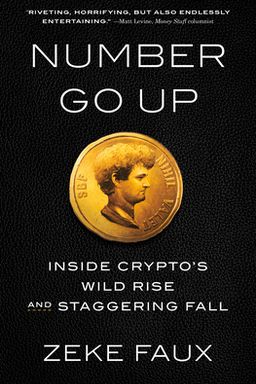
Number Go Up cover

Number Go Up

by Zeke Faux

Number Go Up takes you inside the volatile world of cryptocurrencies, exploring Bitcoin''s rise, stablecoins'' controversies, and El Salvador''s ambitious experiment. Discover the transformative impact of digital currencies on global economies and their future potential.

Crypto’s Illusion of Wealth and Power

What happens when technology promises to make you rich, decentralized, and free—all at once? In Number Go Up, journalist Zeke Faux exposes the global crypto boom as a morality play about human belief, greed, and illusion. He argues that crypto’s rapid ascent wasn't driven by innovation alone; it was fueled by psychological contagion, opaque infrastructure, and reckless financial engineering that collectively created the illusion of a self-sustaining system. When the illusion cracked, millions of people—from Bahamian billionaires to Filipino gamers—were caught in the fallout.

Faux’s investigation stitches together disparate threads—stablecoins with uncertain reserves, exchanges built on self-dealing, DeFi protocols that promise impossible yields, NFTs sold as social status, and scams that exploit technology to enslave humans—all into one narrative about the cultural and moral consequences of unchecked speculation. Each story reveals a variation of the same structure: belief drives value, and value justifies belief.

The Psychology of “Number Go Up”

At the heart of the book is a mind virus: “Number go up.” It means prices always rise, and rising prices prove the technology works. This simple meme became the ideology of the crypto movement. Conferences in Miami turned into revival meetings. Traders rationalized bubbles as progress. Social media amplified early wins into moral proof that believers were smarter than skeptics. As Faux shows, when market validation measures faith, rationality dissolves—value becomes a reflection of collective optimism.

(Note: The phenomenon mirrors classical asset bubbles from tulips to dot-coms, but with a new twist—crypto’s infrastructure enables price worship at digital speed.)

The Plumbing Beneath the Hype: Tether and Hidden Leverage

Behind every wild price chart sits Tether (USDT), a so-called stablecoin pegged to the dollar. Faux uncovers how Tether became crypto’s invisible backbone despite opaque reserves. Its executives—Giancarlo Devasini, Brock Pierce, and Phil Potter—promised full dollar backing but quietly broadened definitions to include loans and commercial paper. Banks refused to cooperate, so Tether routed funds through shadowy intermediaries. When Bitfinex, its sibling exchange, lost nearly $1 billion with a payment processor, Tether’s own reserves filled the hole. This blurred line between liquidity and leverage made USDT both indispensable and dangerous: a trillion-dollar ecosystem balanced on unverifiable collateral.

The Mirage of Utility and the Drift Into Spectacle

As Faux tracks crypto’s culture, utility gives way to performance. NFTs become tickets to belonging; conferences become stage shows with celebrities, mayors, and skateboarders. “Decentralization” turns into brand identity. The core of engagement shifts from solving technical problems to trading social proof. You see how even Sam Bankman-Fried leveraged moral signaling—effective altruism—to legitimize risky behavior. In this world, spectacle replaces transparency, and ideology masks exploitation.

The Human Cost and Structural Fragility

The book’s later chapters reveal what happens when the speculative machine collides with everyday lives. Faux travels from the Bahamas to the Philippines to Cambodia, showing how crypto’s global reach blurs boundaries between finance and labor, investment and crime. The Axie Infinity boom briefly turned gaming into survival income before collapsing. Pig-butchering scams industrialized human exploitation, trapping thousands in Southeast Asian compounds to steal crypto via romance cons. In each instance, blockchain’s neutrality—a feature celebrated by proponents—became a tool for predation.

Across all of these stories, Faux exposes a moral contradiction: technologies meant to democratize wealth often recreate old hierarchies. Tokens circulate freely, but power concentrates among the developers, traders, and exchanges capable of manipulating flows. The book ends not as an anti-crypto screed but as a warning system: transparency without accountability creates a perfect stage for fraud.

Core insight

Crypto promises decentralization but repeatedly reproduces centralized risks—opaque institutions, insider conflicts, and unchecked optimism—that mirror old finance while accelerating its speed and reach.

By the time you finish Faux’s narrative, you see the system whole: a web of cultural mania, moral signaling, and digital plumbing that turns belief into money faster than history has ever seen. It’s both an anatomy of a bubble and a study in how ideology conceals fragility—and how easily technology built for freedom can become a factory of illusion.


Stablecoins and the Shadow Dollar

Stablecoins like Tether promise the simplicity of dollars on a blockchain, but Zeke Faux reveals how that promise is built on fragile, hidden foundations. You learn that USDT became the de facto infrastructure of crypto—used by exchanges and traders to move billions daily—yet its creators operated far from regulatory transparency.

Origins and Expansion

Starting as Realcoin, Tether repositioned itself as a dollar substitute—a token redeemable 1:1 for USD. Traders adopted it to bypass banking restrictions, turning USDT into crypto’s lubricant. But its backers—Pierce, Devasini, Potter—soon faced blocked accounts, seized funds, and inconvenient audits. Banks like Noble Bank and Deltec handled partial reserves, while much of Tether’s cash flowed through opaque intermediaries and commercial paper holdings.

Red Flags and Regulatory Battles

The New York Attorney General’s 2019 investigation revealed Tether lent $900 million of reserves to Bitfinex, its sister company—a self-dealing practice that shook trust. Evidence of holdings in Chinese paper, unsecured loans, and frozen accounts painted a troubling picture. Though Tether settled for $18.5 million, full disclosure still never arrived. Faux phrases this as the mystery of crypto’s “digital dollar”: indispensable yet unverifiable.

Tether After the Crash

Even after crypto’s 2022 meltdown, Tether survived—claiming profit from government bonds and managing billions in redemptions without breaking its peg. For you as a reader, that duality matters: stability built on opacity. Faux’s takeaway is clear—the world trades confidence, not collateral, and when billions rely on that belief, the border between market faith and systemic risk becomes dangerously thin.

Key reflection

Tether shows how “trust me” economics can underpin an entire global market—and how a peg sustained by secrecy turns decentralization’s dream into financial dependency.

Faux’s interviews and leaked ledgers make Tether the book’s central metaphor—crypto’s plumbing works, but its pipes run through shadows. The stablecoin’s presence links every story that follows, from FTX loans to scam transfers, proving that digital liquidity can mask a very human fragility underneath.


Sam Bankman-Fried’s Moral Math

Sam Bankman-Fried (SBF) appears in Faux’s journey as crypto’s philosopher king—a man who blended quantitative expertise with utilitarian ambition. His empire, FTX and Alameda Research, became the perfect portrait of how ethical rationalization collides with flawed governance.

The Utilitarian Promise

SBF’s ideology came from “effective altruism”—a rationalist movement focused on maximizing global good. He built trading algorithms at Jane Street and then applied that mindset to crypto, designing FTX as a liquidity hub meant to generate philanthropic capital. The beanbag, unwashed hair, and chickpea meals reinforced his authenticity—an ascetic genius earning to give.

Business Entanglement and Betrayal

In practice, FTX and Alameda weren’t separate. Faux documents flows of billions of Tethers between them, funneled by close associates—Gary Wang, Nishad Singh, Caroline Ellison—sharing both office and balance sheet. Alameda wielded special privileges inside FTX’s code, able to borrow customer funds at will. When markets crashed after Terra-Luna, Alameda’s debts became FTX’s downfall.

Collapse and Reckoning

The CoinDesk scoop exposed concentrated FTT holdings; Binance’s CZ triggered a run; and in days, $8 billion vanished. Faux’s reporting recounts the wreckage—the Bahamas penthouse strewn with toys, the moral language of altruism giving way to courtroom confessions. SBF admitted “mis-accounting” billions, underscoring how complex intentions can mask structural irresponsibility.

Core takeaway

Even noble motives can’t redeem bad math—SBF’s case shows how crypto systems can transmute moral ambition into systemic fraud when unchecked by governance and transparency.

By following SBF’s fall, you see crypto’s ideological paradox made flesh: “effective altruism” weaponized to justify risk, leverage, and deception. It’s not merely about one man—it’s about how belief in doing good becomes an excuse for breaking every rule that guards against harm.


DeFi, Yield, and the Mirage of Interest

When money seems to grow just by clicking a button, you’re seeing the symptom of DeFi’s paradox. Zeke Faux explains how decentralized finance reinvented lending and interest through code—but those code promises turned into mechanisms of leverage and confusion.

Automated Temptation

DeFi platforms automate yield through liquidity pools and tokens. Projects like SushiSwap and C.R.E.A.M. paid users with new tokens for participation, briefly inflating prices and making yields look magical. Traders like Jason Stone navigated this blur—running vast token strategies for Celsius, the yield-bank founded by Alex Mashinsky. Celsius promised “Unbank Yourself” but funded its payouts through risky DeFi speculation.

Celsius’s Unraveling

Faux shows internal dysfunction: loans to Tether, missing collateral, and an accounting void where liabilities exceeded assets. When markets crashed, withdrawals froze, exposing reality—the promised interest came from unsustainable inflows. Traders like Stone fled to tax havens while customers begged courts for restitution.

The Yield Paradox

For you, the lesson is simple: if returns are extraordinary, ask where they come from. In DeFi’s case, payouts often relied on token emissions—newly issued assets rather than earned profits. As Faux writes, it looked like innovation but behaved like a Ponzi. The technology worked perfectly; it was the economic logic behind it that failed.

Moral insight

Automation doesn’t remove greed—it scales it. In DeFi, software replaced bankers but not human impulse, and digitized hubris turned into contagion during the 2022 collapse.

By tracing Celsius’s implosion and Terra’s cascade, Faux connects the dots: code-based finance isn’t safer when the human incentives remain the same. “Smart contracts” may execute flawlessly, but smart judgment remains painfully rare.


NFTs: Art, Belonging, and Speculation

NFTs embodied crypto’s crossover from money to meaning. Faux captures the mania through Bored Ape Yacht Club and Mutant Cartel, showing how tokens became passports into cultural tribes where art and investment blur.

Owning Identity

Bored Apes weren’t valued for aesthetics but for status. Celebrities displayed them; ApeFest became a ritual of belonging. Collectors like Jason Stone and Lior Messika treated ownership as identity—social proof overwhelming artistic merit. Owning rare traits meant having “grails,” establishing hierarchies within a supposedly democratized movement.

Commercialization of Culture

Yuga Labs capitalized on this psychology, turning Apes into a product ecosystem—ApeCoin, virtual land, a billion-dollar valuation backed by venture capital. Faux’s reporting reveals how art became business decks and speculative metaverses, monetizing belonging itself.

Fragility and Reflection

When the market collapsed, satire and lawsuits followed—Ryder Ripps’ RR/BAYC replicas exposed philosophical contradictions about ownership and meaning. Faux’s own buying experiment with Mutant Ape #8272 revealed the technical fragility: gas fees, seed phrases, and mistakes could erase value instantly. NFTs were not just art—they were operational anxiety wrapped in cultural theater.

Core interpretation

NFTs turn ownership into a social act—a performance of wealth and community that collapses when the story loses believers. Their drama reveals crypto’s most human dimension: the need to belong, even in speculation.

Faux ends the NFT arc by reframing digital art as theater: technology didn’t make culture freer—it made it tradable. The Apes became crypto’s mirror, reflecting both aspiration and absurdity at once.


Scams, Exploitation, and the Dark Underside

You may imagine crypto crime as hackers in hoodies, but Faux’s reporting exposes something worse: industrialized human exploitation. Through pig-butchering scams and laundering networks, he reveals how crypto’s global rails became conduits for coercion and theft.

Inside the Pig-Butchering Machine

The scam begins with a text from a stranger—someone like “Vicky Ho.” It unfolds through romance, fake apps, and USDT transfers. Victims buy Tether on legitimate exchanges and send coins to phantom wallets. The proceeds fund criminal compounds in Sihanoukville and Myanmar, where thousands of trafficked workers, trapped under armed guards, run these scams under torture and quotas.

Tracing the Flows

Experts like Rich Sanders of CipherBlade trace coins from victims to Binance and other exchanges—but anonymity and weak compliance block justice. Blockchain transparency catches transactions but not identities. Faux’s estimate—hundreds of millions per compound—quantifies the horror: crypto crimes scaled like factories.

Moral and Institutional Lessons

Tether’s reluctance to freeze scam addresses reveals another truth: crypto institutions often exercise discretion only when it suits PR. That selective morality sustains systemic abuse. Faux’s documentation connects the dots from castle-like compounds to global silence—the price of crypto speed is human suffering.

Ethical insight

Crypto’s decentralization promises freedom, but in practice it enables exploitation where responsibility disappears. Transparency without accountability enables tyranny disguised as technology.

This section transforms the book from financial thriller into moral investigation. Faux shows that the same systems used by traders in New York also sustain human trafficking in Cambodia—demonstrating that sophistication without ethics is just cruelty digitized.


Contagion and Collapse

Faux ends his story amid crypto’s great unwinding—the 2022 contagion. The interlinked failures of Terra-Luna, Celsius, Three Arrows Capital, and FTX illustrate a cascade born of circular credit and misplaced faith.

Terra’s Algorithmic Doom

Do Kwon’s TerraUSD promised mathematical stability through its sister token, Luna. When redemption pressure rose, Luna’s supply exploded, destroying the peg and vaporizing $60 billion. The collapse revealed how token economics could mimic perpetual motion—until physics (and markets) intervened.

Celsius and Networked Leverage

Celsius froze withdrawals, exposing hidden exposure to Terra and opaque loans. Employees joked about being “Ponzi consultants.” Customers like Chappy lost life savings. Then Three Arrows defaulted, spreading insolvency across lenders. Each node amplified shock through rehypothecated collateral and token-based credit—a self-referential liquidity loop.

Lessons From the Meltdown

For you, the contagion shows how interdependence without oversight breeds catastrophe. Every protocol promised autonomy but was structurally entangled. Every company marketed transparency but hid leverage. Faux presents this as the ultimate irony: systems built to resist central failure collapsed in perfect synchronization.

Final reflection

Crypto’s crash wasn’t a single failure—it was a network failure of belief. The ecosystem proved that decentralization without prudence simply decentralizes fragility.

Through meticulous reporting and vivid storytelling, Faux leaves you with a sobering conclusion: markets built on memes and moral mathematics cannot sustain real economies. When the illusion fades, what remains is a trail of brilliant code, broken trust, and the human need to believe that technology can save us from ourselves.

Dig Deeper

Get personalized prompts to apply these lessons to your life and deepen your understanding.

Go Deeper

Get the Full Experience

Download Insight Books for AI-powered reflections, quizzes, and more.