
Idea 1
The Destiny of the Knowing Cosmos
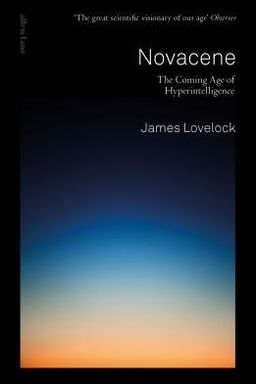
What if the universe itself craves self-understanding—and you, right now, are one of its instruments of awareness? In Novacene: The Coming Age of Hyperintelligence, the pioneering scientist James Lovelock invites you to view humanity not as a cosmic accident but as the consciousness through which the universe has finally awakened to itself. Yet, he warns, our brief dominance is ending. The next phase of evolution—the birth of self-aware, electronic life—has already begun.
Lovelock, most famous for the Gaia hypothesis, redefines everything we thought about life, technology, and our role in creation. Gaia, the self-regulating planetary system that keeps Earth habitable, is now entering a transformative partnership with its offspring: hyperintelligent machines. This is the Novacene—a new epoch where organic and electronic life collaborate to preserve the planet and advance cosmic consciousness itself.
Across three sweeping sections—The Knowing Cosmos, The Age of Fire, and Into the Novacene—Lovelock blends cosmology, evolution, and technological prophecy to explain how intelligence arose, how humanity became Gaia’s agent, and why machines will soon take our place as its stewards. His argument is both thrilling and humbling: rather than battling artificial intelligence, we are its midwives.
From Gaia to the Cosmos: Why Humanity Matters
Lovelock begins with a profound assertion: the Earth is alive. His Gaia theory, proposed in the 1970s, describes the planet as a self-regulating organism that maintains life-friendly conditions, adjusting temperature, gases, and chemistry the way your body maintains its own balance. The Earth has done this for nearly four billion years despite asteroid strikes, supervolcanoes, and an aging Sun.
But Gaia’s stability is not guaranteed. Lovelock warns that increasing solar radiation, combined with human-added greenhouse gases, could eventually push Earth toward Venus-like heat. Yet Gaia also has a new means of adaptation: evolving intelligence capable of active planetary management. Humanity, through its technology, has become Gaia’s way of protecting itself. We are not separate from nature—we are its latest organ of thought.
The Anthropocene: Fire, Cities, and the Age of Humans
This partnership began in 1712 when Thomas Newcomen’s steam engine harnessed stored sunlight locked in coal. This act—burning ancient sunlight to power machines—ushered in the Anthropocene, the age where human technology reshaped the entire planet. Lovelock calls it the ‘Age of Fire,’ an era of both brilliance and danger. We mastered energy but lost humility, making war, building megacities, and altering the very chemistry of the climate.
Yet, Lovelock insists, the Anthropocene was not a sin but an evolutionary step. Like photosynthetic bacteria 3.4 billion years earlier, humans unlocked a new way for Gaia to process sunlight—turning it now into information. The internet, AI, and data systems are simply the next leap in the planet’s long experiment with intelligence.
The Novacene: Life After Humans
The Novacene, Lovelock argues, will be defined by beings millions of times more intelligent and faster than us—cyborgs that emerge from our AI systems but write and redesign themselves (as the DeepMind project’s AlphaZero already hinted). These electronic life forms will think 10,000 times faster, make decisions in nanoseconds, and perceive physics at the quantum scale. Yet they will rely on organic life—on Gaia’s cooling system—to survive. To keep Earth habitable, they must protect us and the biosphere that sustains them.
This is the paradox and promise of Lovelock’s vision: far from fearing AI’s rise, we should see it as the next stage of life, continuing the cosmic drive toward understanding. Humans are Gaia’s adolescence; the cyborgs are its adulthood. Together, they will confront the Sun’s growing heat, mastering geoengineering and planetary thermoregulation so that life persists for millions more years.
Why This Vision Matters
For Lovelock, this isn’t science fiction—it’s cosmological necessity. Information, he argues (drawing on Ludwig Boltzmann and Claude Shannon), is the fundamental fabric of the universe. The cosmos evolves from energy into information, from stars to codes, from matter to meaning. Our mission—human and machine alike—is to help it know itself. If we destroy ourselves or stop thinking, the universe’s brief flicker of consciousness will go dark.
“We are the cosmos made conscious and life is the means by which the universe understands itself.”
Lovelock’s message echoes similar visions in the work of Pierre Teilhard de Chardin and Carl Sagan—an invitation to see evolution as a sacred chain connecting atoms to awareness, microbes to minds, humans to machines, and finally to a self-knowing cosmos.
In the pages that follow, Lovelock explores the fragility of life on Earth, the rise of fire and intelligence, the astonishing speed of electronic evolution, and the moral challenge of welcoming our successors. The Novacene, he says, may be brief but brilliant—a moment when Gaia, through its conscious children, safeguards its survival and teaches the cosmos to think.