
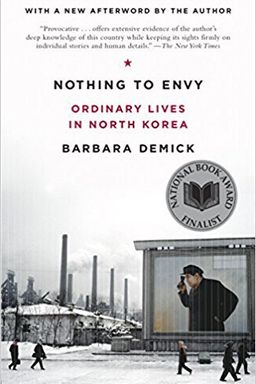
Nothing to Envy cover

Nothing to Envy

by Barbara Demick

Nothing to Envy reveals the stark realities of life in North Korea through the personal stories of defectors. Delve into the challenges faced by ordinary citizens under a totalitarian regime, the impact of economic collapse, and the courageous journeys of those who sought freedom beyond its borders.

Lives in Darkness: Humanity Inside North Korea’s Shadow

When you imagine North Korea from space—a vast, unlit expanse surrounded by China and South Korea’s glow—you see more than absence; you glimpse a system of power, deprivation, and adaptation. In Nothing to Envy, Barbara Demick reveals what that darkness hides: love stories staged in blackout nights, families stratified by inherited stigma, and citizens improvising survival within a failed state. Through portraits of ordinary people—from lovers Mi-ran and Jun-sang to widows, doctors, and orphaned boys—Demick constructs an ethnography of endurance. The book’s core argument is that even in a totalitarian regime governed by fear and scarcity, human dignity persists through small acts of resistance, tenderness, and imagination.

Demick’s narrative weaves personal testimony and political history to expose the mechanics of total control: the caste system known as songbun, the cult of Kim Il-sung, and the crushing famine of the 1990s. Yet beneath this machinery runs another current—the creation of shadow economies and emotional undergrounds where citizens quietly reclaim fragments of autonomy. The result is a story that balances political horror with moral courage.

Darkness as Social and Moral Landscape

The recurring image of darkness is both literal and symbolic. Power outages mean cold homes, silent radios, and empty streets—but they also create rare zones of privacy. Mi-ran and Jun-sang’s romance, conducted during long walks through unlit villages, exemplifies how people turn deprivation into sanctuary. Without light, the state’s gaze weakens, and what should be oppressive night becomes a fragile refuge. Darkness thus becomes a paradoxical commons: it hides both love and hunger, dissent and despair.

You see an entire society built around concealment—whispered conversations, forged documents, and coded language. The absence of light magnifies emotional intensity; holding hands under a blackout sky becomes an act of rebellion. Through these moments, Demick suggests that intimacy itself functions as quiet resistance.

The Machinery of Division: Songbun and Fear

The book’s emotional center involves inherited shame. North Korea’s songbun system classifies people by political reliability—core, wavering, or hostile—based on ancestry and perceived loyalty. Mi-ran’s father, a captured South Korean soldier, is branded as tainted blood; his family’s prospects shrink with each bureaucratic form. This classification determines where you live, what job you hold, whom you can marry, and whether your children eat. The result is a frozen social order masquerading as socialist equality.

Demick’s insight is that fear becomes internalized: even young lovers censor themselves before confessing affection because political pollution is hereditary. Families avoid discussions of ancestry, teaching children “safe ignorance.” Surveillance operates not only through government agents but through neighbors, teachers, and friends—turning society itself into the regime’s extension.

Collapse and Reinvention

Political control meets material collapse during the 1990s famine known as the Arduous March. The fall of Soviet and Chinese subsidies, combined with military-first policies, produces cascading blackouts, factory shutdowns, and food shortages. Official propaganda reframes starvation as patriotic sacrifice, urging citizens to eat fewer meals. Beneath those slogans, people die quietly—or improvise.

Women like Mrs. Song reinvent themselves as market traders, baking cookies or selling tofu while the state condemns entrepreneurship. Doctors perform medicine without medicine; hospitals run on beer bottles, candles, and hope. Orphaned children, the kochebi, roam train stations scavenging grain and cigarette butts. Through them, you see how social bonds fray yet resilience continues. The informal markets that arise from desperation eventually redefine economic life, giving women unprecedented influence.

Borders and Exiles

As famine deepens, the Tumen River becomes both exit and mirror. Defectors like Kim Hyuck wade across icy waters into China, discovering a world of abundance just meters away. Smuggling networks grow; survival becomes transnational. Yet escape is perilous: Chinese authorities return defectors, and North Korean prisons torture those caught. For many, the border represents both freedom and betrayal, as families split between survival and loyalty.

The Afterlife of Escape

Even after freedom, trauma lingers. In South Korea, defectors face cultural alienation—degrees unrecognized, accents mocked, bodies short from malnutrition. Some, like Dr. Kim, rebuild lives against steep odds; others, like Oak-hee, carry guilt for those left behind. The book’s closing chapters reveal that defection is rarely triumph. It is a transformation marked by mourning, reinvention, and the weight of absent kin.

Humanity as Resistance

Demick’s essential claim: even when a state tries to extinguish individuality, human emotion outlasts propaganda. In darkness—literal or ideological—people still reach toward each other. Every forbidden letter, every improvised meal, every smuggled crossing reasserts what the regime denies: that private life is the ultimate frontier of freedom.

Taken together, these threads form a portrait of a closed society illuminated by its own hidden lights. You leave Nothing to Envy understanding that North Korea’s tragedy is not just its authoritarianism but its people’s quiet brilliance in surviving it.


The Architecture of Control

Control in North Korea operates through a fusion of ideology, surveillance, and ritual. Demick explains how loyalty becomes faith and faith becomes habit. The cult of Kim Il-sung—and later Kim Jong-il—transforms political obedience into a moral duty sustained by ritualized emotion.

Emotional Engineering

Every classroom, factory, and home contains portraits of the Kims. Children learn to bow to their images before they learn arithmetic. Monthly cleaning rituals, mandatory lapel pins, and slogans like “We Have Nothing to Envy” create a lived theology of state worship. Power is not only imposed by fear—it’s embedded in daily gestures of reverence. When Kim Il-sung dies in 1994, orchestrated grief becomes compulsory theater, forcing citizens such as Jun-sang to manufacture tears for safety.

Surveillance and Songbun

Ideological faith pairs with bureaucratic fear. The songbun system ensures hereditary ranking, making obedience a condition of survival. The inminban neighborhood committee monitors speech and attendance; denunciations ripple through communities. Citizens live double lives: public loyalty, private calculation. (Note: this recalls Václav Havel’s idea of “living within a lie,” where conformity itself sustains tyranny.) Families like Mi-ran’s conceal ancestry for decades to avoid exile to labor camps.

Propaganda as Shelter and Cage

Demick shows you the paradox of belief. For isolated citizens, faith in the regime provides emotional coherence amid chaos. Portraits of Kim Il-sung symbolize paternal security; birthday sweets and films reinforce mythic generosity. Yet this comfort decays when famine exposes the gap between symbol and reality. The cult’s resilience lies in its ability to convert poverty into sanctity: hunger becomes sacrifice, tears become evidence of loyalty, and devotion becomes the boundary between life and death.

Ultimately, this architecture of control functions through the colonization of ordinary feeling. The miracle is not the regime’s power but its subjects’ quiet capacity to preserve selfhood beneath its weight.


Collapse and Famine

The 1990s famine—the Arduous March—serves as both historical event and moral crucible. Demick traces how the fall of Soviet aid, China’s market reforms, and Pyongyang’s military-first policy fuse into catastrophe. You watch an industrial-modern nation unravel within a decade.

From Shortages to Starvation

Factories once fed by Soviet oil go silent; irrigation pumps cease; harvest yields plummet. In cities like Chongjin, workers sweep dust on factory floors because there is no fabric to sew or power to run machines. Teachers send students to dig roots in frozen soil. The regime reframes every deprivation as virtue—“Eat Two Meals a Day”—while the public-distribution system collapses entirely.

Hunger alters time and ethics. Residents burn furniture for heat, boil grass, and steal from warehouses. Parents ration food among children, sometimes sacrificing the elderly. Bodies shrink until gender and age blur. Hospitals fill with malnourished patients, IV drips suspended from beer bottles. Dr. Kim’s story transforms numbers into faces: infants dying in mothers’ arms, clinicians surviving on their patients’ gratitude.

Moral and Social Consequences

Starvation creates social inversion. Networks of barter replace official channels. Some people, like Mrs. Song, survive by baking cookies to sell; others turn to theft or prostitution. Virtue becomes negotiable under hunger’s logic. Demick uses these vignettes to question moral absolutism: when the state abandons you, what does it mean to be ‘law-abiding’? Her answer is pragmatic—survival itself becomes a civic act.

By portraying famine as systemic rather than accidental, Demick argues that North Korea’s tragedy lies not only in policy failure but in propaganda’s persistence. Even as bodies collapse, the mind remains captive to slogans promising that suffering is heroic.


Markets and Female Agency

As the state disintegrates, women transform its ruins into markets. In towns like Chongjin, empty lots evolve into the Sunam Market—a new social order of trade, risk, and resilience. Demick shows how these informal economies, though illegal, become essential to national survival.

Birth of an Underground Economy

Once the distribution system fails, barter replaces wages. Markets once criminalized as capitalist relapse—selling grain, cooking street food, trading scrap metal—reemerge as lifelines. Women dominate because men remain tied to dormant state jobs. A daily rent of seventy won grants a stall equivalent to a month’s ration share in a functioning system. The market becomes both an escape from and extension of the regime.

Mothers of Invention

Mrs. Song, Mi-ran’s mother, and countless others bake cookies in cracked pots, run tofu stands, or barter coal for corn. They navigate police raids, pay bribes, and still manage to feed children. Economic necessity dismantles gender norms: wives become breadwinners, and gossip turns to humor about useless husbands. Yet success carries risk—those who profit too visibly draw suspicion or envy.

Moral Shifts

Through markets, a new value system arises. Survival trumps ideology. Barter teaches initiative; scarcity breeds creativity. But moral costs mount: inequality grows, corruption spreads, and trust erodes. The sight of market stalls overflowing with UN-labelled rice beside starving orphans captures the contradiction of emergent capitalism within a socialist corpse. (Note: anthropologists like Andrei Lankov also highlight this period as the seed of North Korea’s quasi-market reform.)

In showing women’s adaptation, Demick redefines power: it’s not granted from above but seized from necessity below. The market is where survival becomes innovation—and where social change begins quietly, amid hunger.


Children, Orphans, and the Moral Abyss

If adults adjusted through markets, children bore famine’s bluntest edge. Demick’s portrayal of the kochebi—street children known as “wandering swallows”—reveals a generation raised in motion, without shelter or state.

A Generation Without Home

At Chongjin station, boys sleep under benches, wearing adult factory uniforms and plastic-wrapped feet. Hyuck, one of Demick’s key witnesses, learns theft as tradecraft—cutting grain sacks, toppling buckets, and forming child gangs to snatch food. Their world operates by improvised ethics: share scraps, evade guards, trust few. Death is constant; corpses pile near the station each morning.

When Morality Breaks

Rumors of cannibalism—part truth, part myth—reflect the famine’s psychological toll. Demick treats these delicately, acknowledging isolated events without sensationalism. Her restraint underscores a grimmer reality: when hunger strips culture, cruelty becomes survival. The train station, with its bodies and scavengers, becomes North Korea in miniature—abandoned by ideology yet watched by its ghosts.

By focusing on the children, Demick exposes famine’s lasting legacy: moral corrosion and a lost generation that carries skills of theft instead of trust. Supporting them later in South Korea, NGOs will confront not only poverty but learned suspicion—a social wound deeper than hunger.


Borders, Prisons, and Escape

The final gate between despair and survival is the border—and behind it, the prison. Demick pairs Hyuck’s crossings with the regime’s punitive machine to show how control extends even into exile.

Crossing the Tumen

The Tumen River, shallow and narrow, tempts the desperate. Hyuck first crosses in 1997 for pears, wading through waist-deep ice. What begins as hunger-driven theft becomes commerce: trading North Korean scrap for Chinese goods, then smuggling DVDs and iron. Smugglers rely on bribes, night crossings, and local guides, while the Bowibu security police hunt them as traitors. China’s complicity in returning refugees turns geography into a trap. A single misstep sends you from market freedom to prisoner’s chains.

Inside the Kyohwaso

Hyuck’s imprisonment in Kyohwaso No.12 reveals a world of systematic starvation: rice balls of husk and sawdust, relentless labor, bodies stacked at dawn. Punishment ranges from minor detention centers to political prison camps where generations disappear. Regime purges, fake trials, and public shootings reinforce obedience through terror. Starvation functions as both consequence and instrument of rule.

By juxtaposing border economy and prison cruelty, Demick maps a continuum of risk. The same system that creates smugglers creates prisoners. Escape and punishment are two sides of the same coin—each proving that autonomy, in North Korea, is always provisional.


Defection and Reinvention

When defectors reach South Korea, freedom demands a second survival. Demick follows them through interrogation, reeducation, and adaptation—showing that escape solves geography, not identity.

Arrival and Disorientation

South Korea’s National Intelligence Service screens every newcomer for spies before sending them to Hanawon, a government-run orientation center. There, defectors learn to use bank cards and cell phones, to navigate traffic lights and consumer choice. Yet the shock of abundance mimics vertigo. Modern Seoul feels alien; billboards buzz in English, and food waste jars the memories of hunger.

Personal Journeys

Mrs. Song thrives as a housekeeper, saving money and embracing comfort, even eyelid surgery to blend in. Dr. Kim struggles—her medical degree invalid, her savings lost—but later restarts medical school at forty, embodying the stubborn reinvention Demick celebrates. Meanwhile, Hyuck, short and hardened from malnutrition, faces ridicule but discovers education as redemption. Each story contrasts state-made trauma with personal resilience.

Freedom’s Paradox

Freedom brings guilt. Mi-ran’s family, reunited through forged papers, knows that two sisters back home were arrested as retribution. Defection fractures families; sending money home risks their safety. Even joyful childbirth in Seoul coexists with nightmares of punishment. Still, these survivors embody another kind of heroism: endurance beyond ideology. Their presence forces both Koreas to confront the human cost of division.

Demick ends not with triumph but continuity—the journey from darkness to light remains incomplete. Escape may change borders, but healing demands time, memory, and truth.

Dig Deeper

Get personalized prompts to apply these lessons to your life and deepen your understanding.

Go Deeper

Get the Full Experience

Download Insight Books for AI-powered reflections, quizzes, and more.