
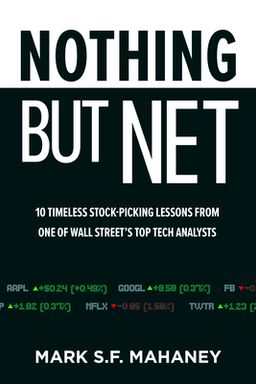
Nothing But Net cover

Nothing But Net

by Mark Mahaney

Discover how to successfully invest in tech stocks with Mark Mahaney''s insights. Learn to focus on revenue growth, customer-centricity, and logical analysis over hype. Prepare for setbacks and embrace a strategy-driven approach to maximize investment potential.

Winning the Long Game in Growth Investing

What separates legendary investors from those who simply play the noise? In Nothing But Net, Mark Mahaney distills decades of Wall Street experience into a structured, durable framework for identifying and owning the highest‑quality technology stocks. His central claim is simple but hard to internalize: the winning investor focuses on long‑term fundamentals—revenue momentum, product innovation, TAM expansion, and leadership quality—while avoiding the traps of short‑term trading.

To win in growth and internet investing, you must accept that pain and volatility are inevitable. There will be bad stocks (execution disasters), good stocks that bleed temporarily, and countless distractions disguised as opportunities. Mahaney argues that enduring success comes from identifying durable business models and using moments of dislocation to accumulate—not react emotionally.

The Core of Quality: Growth, TAM, Product, and Management

Mahaney distills quality down to four recurring inputs he calls the “Four Horsemen” of durable tech growth: consistent revenue growth, large or expandable Total Addressable Markets (TAMs), relentless product innovation, and strong management. Every enduring winner—from Amazon to Netflix to Google—scores highly on these dimensions. These metrics intertwine: innovation expands TAM; TAM expansion drives growth; growth attracts scale; and management orchestrates the entire system.

Amazon’s combination of a massive TAM (commerce and cloud), breakthrough product launches (Prime, AWS), and founder‑driven management anchored in long‑term strategy serves as the archetype. Netflix’s reinvention through streaming and content creation under Reed Hastings carries the same pattern: customer obsession, product evolution, and disciplined growth investment.

The Reality of Bleeding and Losses

Every investor must face two truths: (1) Even great stocks bleed, and (2) bad execution can turn promising ideas into disasters. The book’s early sections show that short‑term volatility doesn’t necessarily equal a broken thesis. Companies like Facebook (2018 privacy costs) and Netflix (subscriber misses) endured 30–40% drawdowns—but both recovered as long‑term revenue and user growth stayed structural. Your discipline lies in distinguishing short‑term dislocation from structural degradation.

In contrast, Blue Apron, Groupon, and Zulily demonstrate avoidable pain: poor management retention, underestimated logistics complexity, and flawed value propositions. The takeaway is precise: you’ll lose money at times—but those losses can teach you operational red flags that help prevent repeat mistakes.

Revenue Is the Truth Serum

Mahaney elevates one heuristic above all: revenue growth is the single most reliable financial signal of quality. Companies that sustain 20%+ annual top‑line expansion for multiple years are rare—and almost always outperform. This “20% Law” reframes your analysis: margin fluctuations, EPS volatility, and near‑term cost cycles are less predictive than consistent top‑line momentum. Investors chasing cosmetic profitability miss that lasting cash flow follows long‑term growth, not the reverse.

He backs this with history: Google, Amazon, Netflix, and Booking.com each enjoyed decade‑long runs of 20%+ growth. eBay and Yahoo!, once dominant, stagnated as growth slowed—showing that even profitability can’t compensate for lost momentum.

The Investor’s Mindset: Patience, Rationality, and DHQs

You can’t control markets, but you can control your process. Mahaney’s “DHQ” (Dislocated High‑Quality) framework offers a disciplined mindset: identify high‑quality businesses and wait for temporary dislocations—20–30% drops from transitory news—to buy with conviction. The method works because quality names always cycle through fear and overreaction. Buying Facebook at its 2018 trough or Netflix after 2019 subscriber dips both rewarded patient holders. He urges you to think in years, not quarters, and to use volatility as a friend.

The Book’s Broader Message

If you synthesize Mahaney’s map, you find a progression: understand operational risk (Lesson 1), accept volatility (Lesson 2), ignore quarterly noise (Lesson 3), prioritize revenue and innovation (Lessons 4 and 5), verify TAM and management execution (Lessons 6 and 7), and finally act rationally on valuation and dislocation signals (Lessons 8–10). His framework doesn’t promise precision; it promises repeatability. Discipline, scalable growth, and management quality are the constants.

Core message

Markets reward long‑term fundamentals. Use volatility intelligently. Prioritize revenue over optics. Trust execution, not hype—and never confuse noise for signal.

In essence, Nothing But Net is a manifesto for fundamental investing discipline in an era of constant excitement. The book equips you to distinguish temporary bleeding from fatal flaws, flashy hype from durable innovation, and market noise from true compounding. It’s about surviving long enough—and thinking clearly enough—to capture the compounding power of quality growth.


When Good Stocks Go Bad

Owning equities means eventually losing money on some of them. Mahaney opens with the humbling truth: good analysis doesn’t guarantee good outcomes. Bad stocks usually die from self‑inflicted execution wounds, not macro events. The early case studies—Blue Apron, Groupon, Zulily—are cautionary tales that reveal patterns of failure investors can learn to detect.

Operational Complexity and Misjudged Fundamentals

Many disasters happen when companies underestimate execution realities. Blue Apron’s refrigerated logistics were far more complex than its pitch acknowledged. Founder turnover compounded the problem. Zulily’s slow shipping and no‑returns policy optimized near-term margins but alienated customers. Groupon’s global overreach stretched operational discipline until it snapped. These stories show that when fundamentals—unit economics, churn, logistics—don’t support the narrative, the stock eventually collapses.

Fundamentals vs. Market Psychology

Even if your forecasts on revenue and margins prove right, you can still lose if you misjudge market psychology. The market’s willingness to pay a high multiple for earnings can shift before fundamentals do. Distinguishing between broken fundamentals and shifting sentiment is key. The best investors anchor to evidence—management quality, product differentiation, and operational metrics—rather than to general optimism or panic.

Core takeaway

You can model earnings perfectly and still lose money if you misread execution or the market’s willingness to assign a premium multiple.

Operational and Management Red Flags

  • Early executive departures after IPOs often signal lack of durable leadership.
  • Fast expansion into areas requiring new capabilities (like e‑commerce moving into logistics) can outstrip competence.
  • Weak customer retention or narrow value propositions limit addressable markets and drive valuation compression.

Understanding these failure patterns sharpens your judgment. Avoiding one big execution blow‑up can mean more to long‑term performance than catching two small winners. Mahaney’s message: scrutinize operations and management before falling in love with TAM or story stocks.


Volatility Without Fear

Even elite companies bleed. The investor who can remain rational during large drawdowns has a compounding advantage. Mahaney’s narratives of Facebook, Amazon, Google, and Netflix prove that volatility is the price of admission for long-term outperformance.

Separating Self‑Inflicted and Market Shocks

Some corrections arise from company choices. Facebook’s 2018 security investment announcement, which led to a 43% collapse, was self‑inflicted—but strategic. Others, like Amazon’s 32% drawdown amid macro fears, come from external shocks. Knowing whether a decline stems from execution misstep or temporary sentiment helps you either buy the dip or protect against unrecoverable damage.

Example Lessons

  • Netflix’s repeated subscriber shortfalls caused 30–40% drops yet rewarded patient holders who recognized durable TAM and content strategy.
  • Google’s brief 2019 pullback showed how even perceived growth decelerations trigger corrections in premium names before stabilization.

Insight

If the long-term fundamentals are intact, temporary price bleeding is opportunity, not danger.

Mahaney introduces DHQs—Dislocated High‑Quality stocks—as structured opportunities when fear separates price from value. The key discipline: verify that TAM, revenue, and management competence remain unbroken. Volatility, properly understood, becomes your competitive edge against impatient investors.


Revenue as the North Star

Mahaney’s simplest and most powerful rule is numerical: follow revenue growth above 20%. It’s the empirical shortcut that captures product‑market fit, TAM expansion, and management execution better than any EPS metric. Sustainable revenue momentum signals operational health and long-term compounding potential.

The 20% Law and Why It Works

Across the S&P 500, fewer than 3% of firms maintain 20% annualized revenue growth for five years. Those that do—Google, Netflix, Amazon, Booking—generate multiyear outperformance because they compound both revenue and valuation multiples. The market rewards consistency. When growth slows materially below 20% without clear cyclical explanation, re‑rating ensues, as seen with eBay, Yahoo!, and Yelp.

Revenue vs. Earnings Engineering

Earnings can be massaged through cost cuts or accounting choices; revenue can’t. Growing top line at scale while maintaining or improving unit economics is the truest signal of product strength. Profitability tends to follow scaling revenue because operating leverage improves naturally. That is why Mahaney urges you to track multi‑quarter revenue acceleration, not one‑off EPS beats.

Growth Drivers and Initiatives

He introduces Growth Curve Initiatives (GCIs)—price hikes, new products, and geographic expansion—as catalysts that reignite or extend revenue growth. Companies like Netflix (price) and Booking (geography) mastered GCIs to sustain their 20% law effect. Investors should judge not only the current growth rate but the levers available to maintain it.

Rule of thumb

Treat revenue momentum as your stock’s pulse. When it breaks below 20% without credible GCI catalysts, reevaluate the thesis.

This discipline keeps you anchored in measurable signals and helps you avoid both overreaction to short-term losses and attachment to fading growth stories.


Innovation, TAM, and Scale

Innovation fuels revenue; TAM gives it room to run; scale multiplies its power. Mahaney links these forces as the structural gears of compounding growth. You should look for businesses where new product ideas continuously expand use cases and TAM.

How Innovation Expands Markets

AWS, born inside Amazon to solve an internal problem, became a multi‑billion dollar cloud platform that redefined enterprise IT TAM. Netflix cannibalized DVDs to unlock streaming scale. Spotify’s podcast pivot created new ad and engagement opportunities. Stitch Fix’s personalization features show even small product tweaks can reignite user growth. Innovation isn’t aesthetic—it increases value per user and enables pricing power.

TAM Thinking and Friction Removal

TAM (Total Addressable Market) represents potential runway, but great companies don’t stop there—they expand it. Removing consumer friction (as Uber did with on‑demand rides, or DoorDash with food logistics) effectively enlarges TAM by converting occasional users into habit. Mahaney warns to size TAM creatively: estimate customer problems solved, not legacy category revenues.

Scale as Compounding Advantage

  • Experience curves: repetition improves efficiency (Booking mastered paid search).
  • Unit cost leverage: fixed costs shrink in percentage as revenue scales (Amazon’s G&A ratios fell steadily).
  • Moats and network effects: Netflix’s content spending and Uber’s driver‑rider loops create defensible barriers.

Big TAM plus innovation plus scale equals lasting growth. A company with modest market share of a trillion‑dollar market can sustain premium growth for years. As an investor, you prefer firms intentionally removing friction and layering new use cases—that’s where compounding hides.


Leadership and Long-Term Discipline

Management turns potential into performance. Mahaney frames management quality as the decisive differentiator once TAM, product, and growth opportunity are clear. He especially values founder-led or founder‑mentality teams that balance innovation with execution rigor.

The Founder-Led Advantage

Founders like Bezos, Hastings, Zuckerberg, and Musk share uncommon long‑term orientation. They tolerate misunderstanding, delay gratification, and repeatedly bet on the customer first. Bezos’ letters outline “All About the Long Term,” while Hastings’ painful transition to streaming demonstrated resilience under public pressure. Mahaney notes that founder‑led control often protects innovation cultures from quarterly myopia.

Traits of Effective Leaders

  • Candor and accountability (acknowledging mistakes publicly).
  • Operational depth and clarity on unit economics.
  • Capital allocation focused on long‑term growth curve initiatives.

Conversely, Blue Apron’s early executive exits, Groupon’s post‑IPO mismanagement, and Zulily’s poor customer tradeoffs illustrate how weak leadership magnifies every operational challenge.

Test for management quality

Ask: Do the leaders behave like owners focusing on the next decade, not the next quarter?

When management quality aligns with product innovation and scalable TAM, compounding accelerates. When it doesn’t, even promising models stall.


Patience, Valuation, and the DHQ Edge

After establishing what to own, Mahaney explains when and how to buy. His valuation philosophy is pragmatic: context beats precision. Growth‑adjusted valuation—comparing multiples relative to sustainable growth rates—helps avoid both overpaying for hype and underpaying for optionality.

Growth‑Adjusted Thinking

A company growing earnings or revenue at 20% merits a higher multiple than one compounding 10%. Over time, its intrinsic value catches its initial premium. Rather than relying solely on DCF gymnastics, Mahaney encourages common sense—compare peers, scenario test, and watch whether margin leverage and TAM pathways stay credible.

The DHQ Framework in Action

“Hunt DHQs” is the meta‑rule: identify high‑quality companies that temporarily trade at a discount because of news flow or sentiment swings. A PEG below 1, or a 20–30% pullback from highs, marks candidate entries. History shows FANG names saw double‑digit dislocations multiple times between 2016‑2020—and each time, patient buyers were rewarded within months.

Tactical advice

You rarely buy the bottom. Use dislocations as buying zones, phase in, and let fundamentals—not headlines—dictate position sizing.

In a market obsessed with timing and short-term gains, patience becomes a true competitive edge. Growth, value, and discipline can coexist—if you remember that volatility offers more entry points than exits.

Dig Deeper

Get personalized prompts to apply these lessons to your life and deepen your understanding.

Go Deeper

Get the Full Experience

Download Insight Books for AI-powered reflections, quizzes, and more.