
Idea 1
Staying Human on a Nervous Planet
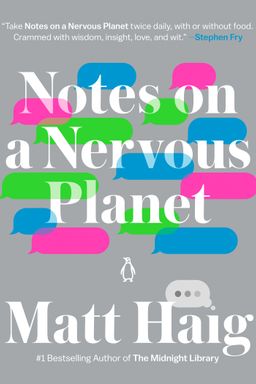
Why does the world seem to move faster each year, leaving us breathless and constantly on edge? Matt Haig’s Notes on a Nervous Planet begins with this question—a deeply personal yet universal reflection on what it means to stay human in a time of information overload, technological obsession, and cultural anxiety. Haig, who has written candidly about his own experiences with panic disorder and depression, builds on his earlier memoir Reasons to Stay Alive, to ask a different, equally urgent question: how do we live well when the world itself is sick?
A World with Too Much of Everything
Haig argues that modern life is saturated—with news, marketing, noise, and expectation. We suffer from what he calls “life overload”: a state in which we are bombarded by choices and pressures that our Stone Age brains were never meant to handle. You don’t have to live in a war zone to feel attacked; all you need is a smartphone. The beeps, feeds, alerts, and endless scrolls hijack attention and keep us trapped in cycles of comparison, fear, and craving. In this context, anxiety isn’t an individual malfunction—it’s a symptom of a collective breakdown. The planet itself has become nervous, like one giant overstimulated mind.
Haig draws on personal anecdotes to show how these pressures manifest. His panic attacks in shopping centers, his inability to stop checking Twitter, and his eventual need to detox from the internet become metaphors for what’s happening to all of us. The world moves at increasing speed, yet what we need most—silence, stillness, and connection—has been crowded out by noise. As he puts it, “we’re sold unhappiness, because unhappiness is where the money is.”
The Economics of Anxiety
One of the book’s central insights is that modern capitalism depends on our discontent. Happiness, Haig says, isn’t good for the economy. If you were content with who you are, what would you spend your money on? From beauty products to diet fads, the marketplace thrives by manufacturing inadequacy. We are constantly told that we lack something—a better phone, a better body, a better life—and then sold temporary relief. Yet every purchase only deepens the hunger. This isn’t accidental; it’s designed. Advertisers and tech companies exploit what former Google ethicist Tristan Harris calls our “vulnerability to distraction”, using algorithms that keep us swiping, buying, and craving more.
Haig’s observation echoes themes in books like The Happiness Industry by William Davies and Digital Minimalism by Cal Newport. Both argue that our attention and anxiety have economic value. But Haig takes a more intimate approach, weaving philosophy and confession into a narrative that shows how these systems play out inside a single human mind. His message is philosophical yet practical: if the world is structured to make us nervous, then sanity itself becomes a form of rebellion.
Learning to Disconnect
To reclaim calm, Haig proposes a “life edit.” Instead of adding more therapies or hacks, he suggests removing things: turn off notifications, stay off news loops, walk outside, breathe deeply. In one chapter, he recounts deliberately disconnecting—no emails, no screens, no TV—and slowly feeling his anxiety plateau. “Unlike my smartphone,” he writes, “there is no slide-to-power-off function for anxiety. But I stopped feeling worse.” This minimalist philosophy mirrors thinkers like Marie Kondo and Fumio Sasaki, who link happiness with reduction. For Haig, detachment from hyperconnectivity isn’t escapism—it’s recovery.
Modernity and Mental Illness
A recurring connection throughout the book is between social change and mental health. The rise in anxiety, addiction, eating disorders, and insomnia isn’t isolated; it coincides with rapid modernization. Studies from Fiji, for example, show eating disorders spiking after exposure to Western TV, and Haig sees this as proof that cultural ideals—thinness, success, youth—become psychological toxins. The internet intensifies this infection by globalizing comparison. You no longer compare yourself to people in your town—you compare yourself to curated perfection.
In this sense, Notes on a Nervous Planet is both diagnosis and prescription. It’s a challenge to look at our emotional pain not just as personal failure but as social feedback—a signal that something in the system is wrong. We can’t cure an anxious mind while living in an anxious culture without questioning the culture itself.
Rediscovering Humanity
What Haig ultimately offers is hope. Technology and capitalism may have accelerated the tempo of existence, but they haven’t erased what matters. The trick is to remember what we are: embodied, feeling, social animals who need nature, affection, and rest. Reconnecting with these timeless needs is not nostalgic; it’s necessary. As he writes, “The sky has always been the sky.” Even in an age of screens, some things—love, empathy, kindness—haven’t changed.
This book, then, is an invitation to look up from the feed and reclaim your mind. It speaks to anyone who feels dizzy in the rush of modernity and longs for solid ground. Haig doesn’t promise perfect peace, but he insists that awareness is the first step toward it. Once you see the system, you can begin to opt out, one breath, one choice, one disconnected moment at a time.