
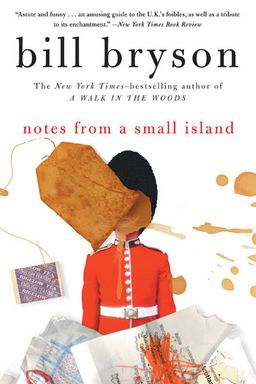
Notes from a Small Island cover

Notes from a Small Island

by Bill Bryson

Join Bill Bryson on a humorous and heartfelt farewell tour of Britain, exploring the island''s captivating landscapes, rich history, and charming eccentricities. With his keen eye for detail and love for his adopted home, Bryson offers a delightful exploration of what makes Britain truly unique.

Discovering Britain Through Time and Travel

How can you understand a nation through its landscapes, people and everyday routines? In his reflective travel narrative, Bill Bryson uses decades of journeys across Britain—from his first bewildered arrival in 1973 to later returns in the 1980s and beyond—to show how humour, politeness, eccentricity and resilience define the spirit of the country. The book blends travel writing, social history and affectionate critique, using personal mishaps and careful observation to trace how Britain has changed, and how it remains unmistakably itself.

A comic arrival and an education in difference

Bryson’s first night in Dover is a study in cultural misunderstanding. Exhausted, he bungles into milk bottles, mistakes underwear for headwear, and spends a cold night on a park bench. Yet out of embarrassment he learns the first rule of travel: humiliation teaches adaptation. The old man walking his dog, the landlady with strict guesthouse rules, and the residents’ lounge full of subtly judgmental regulars initiate him into the rhythms of British hospitality—defined by kindness mixed with procedure. (Think of it as your first course in “social code comprehension.”)

You realize that Britain rewards those who can laugh at errors and notice nuance: the misheard “transport caff,” the instruction to remove a counterpane, or the silent condemnation for leaving hair in a plughole. Bryson’s comic disasters become the method by which he learns the national character—patient, restrained and quietly hilarious.

A country in crisis and continuity

Landing in 1973 means walking into an age of turmoil. The country faces inflation, miners’ strikes, and the contemplation of three-day workweeks, yet daily life persists. Bryson’s pages capture both the macro—Britain entering the Common Market, the Cod Wars with Iceland—and the micro—rising chip prices and endless queueing. Through him, you learn to see how ordinary routines absorb political tension. People adapt through tea, understatement and humour. The book thus doubles as an account of social endurance in miniature.

Later, his time on Fleet Street and in the Wapping dispute reveals another Britain: from the smoke-filled, union-ruled editorial rooms of The Times to Murdoch’s fortified Wapping plant, a transformation from craft journalism to corporate modernity unfolds. Here, Bryson becomes witness to technological revolution and the human casualties of efficiency. What began as comic confusion in Dover expands into a full social history of labour, class and identity.

Walking as wisdom and heritage

As he moves beyond offices and ferries, Bryson finds meaning in walking. On the Dorset coast or in the Yorkshire Dales, trudging through sleet becomes a spiritual act. The land itself becomes an archive—revealing abandoned villages like Tyneham, Roman floors hidden in woods, and hedgerows vanishing under tractors. The countryside is simultaneously magnificent and endangered. (You’re reminded here of writers like W.G. Hoskins or Richard Mabey who treat landscape as history made visible.) To walk is to connect with time, to realize Britain’s fragility beneath its charm.

Cities, decay and design

Urban Britain fascinates him just as deeply. London glitters with humour and vitality, Oxford stuns and infuriates with equal force, and Milton Keynes demonstrates how rational planning can build sterility instead of community. In towns like Bradford or Morecambe you see post-industrial scars: disused mills, empty piers, abandoned hotels. Yet these places are never only tragic; regeneration flickers in museums, galleries and ingenious local energy. Bryson’s praise of Saltaire, Liverpool’s Albert Dock and Bradford’s Pictureville Cinema shows his faith in cultural resilience.

Alongside social commentary runs a sustained attack on poor architecture. From Edinburgh’s concrete infill to Harrogate’s faux-Georgian mall, Bryson argues that bad planning isn’t just ugly—it erodes civic confidence. A well-loved street or Victorian warehouse is a social organism; demolish it and you wound memory itself. (If Jane Jacobs had written about Yorkshire, she’d have nodded in agreement.)

Eccentricities and everyday culture

Throughout these journeys, eccentric characters—aristocrats burrowing under estates, miners painting with poetic realism, meticulous train-spotters counting carriages—illustrate how individuality thrives in constraint. The fifth Duke of Portland’s underground ballroom at Welbeck Abbey epitomizes this blend of wealth and oddity that turns England’s history into comedy. Meanwhile, northern humour, polite queues, and unassuming decency function as the real social glue. You discover that civility isn’t superficial—it’s cultural infrastructure that converts conflict into comfort.

Connecting the dots

When you combine these layers—Dover confusion, Fleet Street tension, landscape reverence, urban critique—you get a portrait of Britain constantly balancing decline with charm. Its trains rattle, towns crumble, and hedgerows disappear, yet kindness persists, and humour redeems frustration. Bryson’s Britain is not a museum or utopia but a living conversation between affection and exasperation. If you read him closely, you learn to travel not as a consumer but as an engaged witness—to laugh at bureaucracy, to protest when planning fails, and to cherish the small civilities that make life here not only endurable but extraordinary.


Humour, Humility and the Art of Arrival

Your first arrival in an unfamiliar country is always a test of temperament. For Bryson, Dover on a foggy night in 1973 becomes a crash course in comedy and cultural learning. Exhausted and unprepared, he misinterprets signs, crashes through bottles and turns underwear into improvised headgear. This absurd beginning sets the book’s tone: self-deprecating, observant and warm. You soon grasp that travel’s mistakes are its richest lessons.

Missteps as miniature education

Bryson’s embarrassment in front of Dover’s hospitality regimes—Mrs. Smegma’s five-night minimum, strict breakfast hours and rules about counterpanes—illustrates a national paradox: friendliness administered by formality. You learn how British politeness protects boundaries as much as it expresses welcome. Each routine—a tea at 10, the residents’ lounge rituals, the shame of forgotten hair in a plughole—becomes ethnography in miniature. Bryson’s key insight: you cannot understand people until you first misunderstand them.

Language and politeness as navigation tools

From the 'transport caff' translation to the lecture on plugholes, misheard slang and subtle manners dictate Britain’s rhythm. Politeness functions as armour: it prevents chaos, promotes fairness (think of the perfectly disciplined bank line), and even tames criminality—like the gunman who’s politely told to queue. Humour undercuts anxiety and redefines dignity. (Note: this civil restraint anticipates the tone of later travel writers such as Alain de Botton, who treat courtesy as moral philosophy.)

The moral of comedy

You emerge from these scenes realizing that laughter is survival. Humour transforms the foreign into the familiar and humiliation into belonging. For Bryson, that balance—of politeness, humility and irony—becomes his lifelong key to reading Britain. He discovers that national character doesn’t announce itself in monuments; it hides in small talk, teacups and shared embarrassment.


Britain in Upheaval: The 1970s to Wapping

When you trace Bryson’s timeline from 1973 to the 1980s, you witness Britain navigating two decades of economic distress and industrial transformation. The early 1970s unfold amid strikes, spiraling inflation and volatile oil prices. Headlines speak of civil servants walking out, fuel shortages and VAT confusion. Yet life continues; people still gossip at cafes and school runs go on. You begin to sense a national genius for functioning amid dysfunction.

Crisis as culture

Bryson uses these years to show how minor inconveniences—petrol queues, three-day workweeks—build resilience. Everyday life isn’t insulated from politics; it absorbs it. The reader sees how domestic rituals, from rationed tea to watching the blank TV after nightly shutdown, forge solidarity. Even decline has its etiquette: the British face shortages with order rather than panic, humor rather than bitterness.

Fleet Street and the age of print

Working at The Times introduces Bryson to another institutional drama: the battle between tradition and modernization. Fleet Street’s culture thrives on camaraderie, expense fiddles and the hidden power of unions like NATSOPA. But under Murdoch, efficiency takes its revenge. The confrontation at Wapping becomes more than a labour dispute—it’s a parable of how Britain shifts from industrial identity to technological capitalism. Bryson watches camaraderie dissolve into redundancy, and the smoky newsroom yield to sterile, secure digital halls.

In miniature

From Dover to Wapping, the journey represents Britain’s post-war arc: from bemused empire survivor to pragmatic, sometimes bruised modern democracy learning to trade nostalgia for adaptation.


Travel, Scale and the Pleasure of Getting Lost

Bryson’s journeys teach you that how you move defines what you see. Walking, buses and slow trains reveal characters and quirks invisible from cars. The British network of footpaths, lanes and erratic timetables becomes both setting and narrative device—a map of conversation and culture. Every misconnection is a story; every unexpected layby, a classroom in geography and patience.

Walking as immersion

When Bryson trudges along Dorset’s coast or up Bow Fell, he proves that endurance and discovery are twins. On foot, the country’s density of history unfolds: Roman mosaics beneath weeds, medieval hedgerows slicing the fields, villages erased for war games. These aren’t postcard walks but acts of intimacy with time itself. (Compare this to Robert Macfarlane’s belief that walking retrieves memory embedded in landforms.) To walk Britain is to live inside its layered past.

Public transport and human observation

Trains and buses, for all their delays, connect travelers to humanity. Bryson’s love-hate with British Rail—its spectacular views like the Settle–Carlisle route against its maddening Sunday closures—reflects a nation torn between nostalgia and neglect. Voyages introduce “Vodaphone Man,” chatty seatmates, and entire social ecosystems. You learn that mobility in Britain is less about efficiency and more about story-gathering.

Driving and the illusion of control

Driving, however, becomes an exercise in frustration: narrow lanes, chaotic parking columns, and uncooperative ticket machines. Bryson likens multi-storey car parks to bureaucratic traps. By contrast, public transport and walking cultivate curiosity and contact. The lesson is clear: inconvenience often yields insight; comfort breeds blindness.


Heritage, Landscape and the Cost of Progress

Britain’s beauty, Bryson shows, resides in both its scenery and its fragility. The hedgerows of Dorset, Cotswold footpaths and ghost villages embody centuries of balance between nature and humanity. Yet development, neglect and short-term planning steadily corrode that harmony. You watch him mourn 96,000 miles of vanished hedgerows while celebrating the rediscovery of a Roman mosaic near Winchcombe. Conservation emerges not as nostalgia, but as civic duty.

Landscape as living memory

Every path carries story: Tyneham village frozen by military needs, Judith’s Hedge marking medieval boundaries, or Ballard Down revealing Dorset’s geological history. To walk here is to read an uncurated museum where layers of empire, agriculture and war coexist. Bryson contrasts this with modern developments—soulless estates and concrete offices—that erase identity in the name of modernization. He insists that protecting a view or field isn’t sentimental; it’s safeguarding continuity.

Restoration versus desecration

Bryson salutes successful revivals like Blenheim’s managed grandeur or Saltaire’s adaptive reuse, but condemns the careless modernism that raped northern skylines. The conservation message echoes all through: what you fail to defend, you deserve to lose. Walking teaches humility because it shows what neglect reveals—plastic over Roman floors, weeds through marbled gates, or heritage sold to developers.


Towns, Cities and the Human Scale

Bryson’s urban observations form a complex love letter to Britain’s built environment. You move from the grandeur of London’s parks and pubs to the dereliction of Morecambe’s piers and the sterile geometry of Milton Keynes. Through these contrasts, you grasp why design and planning shape not only appearances but the moral temperature of communities.

Charm and failure side by side

London’s civility—polite drivers, neat pillar boxes, the genius of Harry Beck’s Underground map—stands beside architectural vandalism like Seifert’s towers. Oxford glows under medieval spires yet bleeds through modernist insertions such as the Clarendon Centre. Bradford showcases faded Victorian pride under concrete Arndales. Each example demonstrates how small design choices ripple into collective mood.

Decline, resilience and reinvention

Post-industrial decline leaves cities scarred but not inert. Bradford’s Pictureville Cinema revives culture; Liverpool’s docks become art spaces; Blackpool compensates spectacle with sheer persistence. Bryson admires these second acts. He also sees instructional extremes—Harrogate’s pastiche malls versus Saltaire’s sensitive reuse—proving that good design dictates civic dignity. (This argument channels Jane Jacobs’ principle that “eyes on the street” sustain community vitality.)

Planning as moral art

Through his sarcasm and affection, you learn that urban vitality emerges from neighbourliness and scale, not from traffic grids. Civic space, like humour, is a public good requiring defense. When you cherish streets and preserve proportion, you invest in collective optimism.


Eccentricity, Museum Culture and Memory

Beyond landscapes and economies, Britain’s identity thrives on oddity and curation. Bryson delights in characters and institutions that appear small but hold immense symbolic weight: the reclusive fifth Duke of Portland tunneling under Welbeck Abbey; miners at Ashington painting their daily toil; and local museums preserving grandeur on shoestring budgets. Together they signal a national love of preservation laced with eccentricity.

Aristocratic whimsy and democratic culture

Welbeck’s underground ballrooms contrast with Pictureville Cinema’s open doors. One hoards luxury; the other shares wonder. Bryson’s visit to a Cinerama screening, with its sweeping roller-coaster scenes and stereophonic thrill, demonstrates that provincial institutions can offer cultural experiences as powerful as any metropolis. Meanwhile, local initiatives—from Woodhorn Colliery Museum to the Burrell Collection—remind you that heritage depends on local custodianship, not only national funding.

Why eccentricity matters

Eccentricity, Bryson argues, is creative defiance against conformity. The Duke’s buried mansion, quirky regional art scenes and the enduring politeness of museum volunteers all testify that Britain’s character blossoms in the margins. To travel here is to celebrate the beautifully pointless enterprise of keeping memory alive, whether through geological exhibits or rusting train lines reborn as heritage rails.

Dig Deeper

Get personalized prompts to apply these lessons to your life and deepen your understanding.

Go Deeper

Get the Full Experience

Download Insight Books for AI-powered reflections, quizzes, and more.