
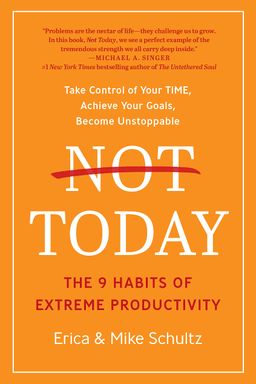
Not Today cover

Not Today

by Erica Schultz and Mike Schultz

In ''Not Today'', Erica and Mike Schultz share nine powerful habits for achieving extreme productivity. Learn how they balanced running a business and caring for their ill son, Ari, by adopting simple, effective strategies. This inspiring guide provides actionable insights to help you manage time, stay motivated, and overcome life''s challenges with resilience.

Time, Loss, and the Pursuit of Meaningful Productivity

How do you find the strength to be productive when life itself feels unpredictable or unfair? In Not Today: The 9 Habits of Extreme Productivity, Erica and Mike Schultz mix heart-wrenching memoir with meticulous research to answer that question. Following the loss of their young son, Ari, to congenital heart disease after years of treatment and waiting for a heart transplant, the authors redefined what productivity—and living fully—mean. They contend that true productivity isn’t about squeezing more hours into your day, but about learning to fill your time with meaning, energy, and purpose. In their view, being productive means choosing how to spend your precious, finite time, and ensuring it aligns with your values and the life you want to live.

The Schultz family’s story grounds the book in emotional clarity. During Ari’s years in and out of hospitals, both parents had to keep their consulting business alive to afford healthcare and stability for their family. Juggling crisis after crisis, they created systems to extract focus and motivation under pressure. Those same systems became the foundation of what they now call The Productivity Code, a research-backed framework that combines psychology, neuroscience, and habit-building to teach anyone how to become one of “The Extremely Productive (The XP)”.

Rethinking Productivity as a Human Process

Traditional productivity advice focuses on efficiency—doing more tasks faster—which treats people like machines. The Schultzes argue instead for a human-centered model inspired by what they learned through tragedy: time is a gift, not a guarantee. The book’s central thesis is that true productivity grows out of awareness, purpose, and energy management. It asks: are you using your time to do what matters most? Or are you lost in busywork that drains your life of meaning? Their approach moves productivity beyond checklists and planners into a holistic view that blends motivation, priority management, focus, and recovery.

They frame their philosophy with the acronym TIME, representing four levels of how we spend our hours: Treasured, Investment, Mandatory, and Empty. Treasured time fills your heart and connects you to what you love. Investment time builds your skills and furthers your goals. Mandatory time is what you feel obligated to do. Empty time is wasted or aimless, time lost to scrolling or autopilot routines. The key, they emphasize, is learning to Take Treasured, Increase Investment, Minimize Mandatory, and Eliminate Empty. This one model defines the ethos of the whole book: focus on what matters most, and protect it at all costs.

The 3 Keys and 9 Habits of Extreme Productivity

The Schultz framework builds on three major stages, or “keys,” each containing habits that together form The Productivity Code:

  • Key 1 – Manufacture Motivation: You can’t rely on natural drive alone. Instead, you must learn to manufacture it through clarity of purpose, planning, and behavioral design. The first three habits—Recruit Your Drive, Ignite Your Proactivity, and Reengineer Your Habits—build self-starting systems that keep your energy and discipline steady even when circumstances are chaotic.
  • Key 2 – Control Your TIME: Learn to direct your attention where it counts most. This includes Obsessing over TIME (knowing exactly where your hours go), Saying No (to protect boundaries), and Playing Hard to Get (by controlling accessibility and distractions).
  • Key 3 – Execute in the Zone: Focus deeply and sustain performance by Sprinting into the Zone (a blend of timeboxing and flow science), Fueling Your Energy (cultivating the mind-body-spirit connection), and Righting the Ship (recovering quickly when you fall off track).

Across these keys, the Schultzes link psychological research with real-world application, introducing tools like the Productivity Quotient (PQ)—a measure of your personal productivity habits—and showing how those with higher PQ scores are not just more effective workers, but also happier and more fulfilled humans. This research, drawing on over 2,300 global participants, supports their claim that productivity, satisfaction, and happiness rise and fall together.

Why These Ideas Matter

The book’s emotional foundation makes its methods resonate beyond spreadsheets or time-tracking. For Mike and Erica, productivity became a lifeline—a way to survive financially, emotionally, and spiritually while caring for their critically ill son. That urgency led them to develop systems for execution under unimaginable stress: color-coded medication tracking, hospital-based work sprints, and nightly reflection rituals to maintain perspective. Their lived experience gives gravity to their claim that productivity is not about speed, but about meaning.

“It’s not about getting more done; it’s about choosing what you get done and what you don’t.”

For readers burnt out by the cult of busyness, Not Today reframes achievement as an act of purpose rather than endurance. Its lessons—born of love, grief, and persistence—invite you to slow down, to choose meaning over motion, and to claim your time as the sacred, finite resource it truly is. What follows are the nine habits that show how.


Manufacturing Motivation: The Engine of Focus

Motivation isn’t something you have or don’t have—it’s something you build. The Schultzes upend the old myth that driven people are born that way. Their chapter on Manufacturing Motivation redefines enthusiasm as a skill rather than a trait. Drawing on decades of psychological research and their RAIN Group data from 2,377 professionals, they argue that motivation can be systematically created through structure, accountability, and intention. In short, if you can design your days, you can design your drive.

The Three Habits That Build Motivation

  • 1. Recruit Your Drive: Write down your goals, plan your weekly actions, and track your progress. People who did these three things in the RAIN Group study were five times more likely to call themselves “extremely productive.” The act of writing goals transforms vague desires into tangible commitments—like Erica crafting her goal to invest weekly in her marriage and family after losing Ari. It’s not discipline that keeps you going; it’s meaning.
  • 2. Ignite Your Proactivity: Beat procrastination by lowering the activation energy to start. The authors introduce three catalysts—calendaring your investment time, positive self-talk, and the 3…2…1…Go! rule (borrowed from Mel Robbins’ neuroscience-backed approach). Mike uses the countdown whenever hospital chaos threatened to derail him: he’d whisper “3…2…1…Go!” and dive back into a critical task while waiting for Ari’s doctors.
  • 3. Reengineer Your Habits: Recognize that thought is the missing piece in the traditional trigger–response–reward habit loop. By inserting awareness between cue and action, you regain control of your routines. For example, Erica swapped her end-of-day dishwashing ritual for bedtime storytime with her kids—shifting a ‘Mandatory’ task into ‘Treasured’ time.

From Willpower to Systems

Rather than depend on bursts of inspiration, the Schultzes suggest setting up feedback loops that reinforce motivation. Accountability partners, weekly reviews, and visible progress checkpoints compound emotional momentum. This method echoes findings from Teresa Amabile’s The Progress Principle: seeing growth, no matter how small, sustains enthusiasm far more than external rewards. When participants shared weekly updates with partners, 70% met their goals—double the rate of those who didn’t.

By the end of this section, you come to see motivation not as lightning that strikes, but as a fire you feed. When you recruit your drive through purpose, ignite it with small wins, and sustain it through habits, you move from pushing through your days to being pulled by your purpose.


Controlling Your TIME: Choosing What Matters

If key one is about building motivation, key two—Control Your TIME—is about channeling it. The Schultzes’ fundamental argument is that your calendar tells the truth about your priorities. Most people, they note, spend almost half their workdays on low-value Mandatory or Empty activities, yet believe they “don’t have time” for what fulfills them. The cure is deliberate time design using their now-renowned TIME Model: Treasured, Investment, Mandatory, and Empty.

The TIME Framework in Action

To control your TIME, you adopt a simple but radical habit: classify every activity by how it makes you feel and what it contributes. Treasured time fills your heart—like Mike’s return to golf as a way to connect spiritually with his late son and grandfather. Investment time moves the needle on your long-term goals, such as writing a business book or preparing for a promotion. Mandatory time is necessary but joyless—filing expenses, mowing the lawn, commuting. Empty time wastes your life through digital autopilot and aimless scrolling. The goal is to ruthlessly reallocate time from the bottom levels to the top two.

With this structure, even ordinary tasks can shift categories. Commuting becomes Investment if you use it for podcasts or reflection. Cooking dinner can flip from Mandatory to Treasured if you reframe it as teaching your child healthy habits. The TIME model isn’t about judgment—it’s about awareness. Once you see where your hours go, you realize how much power you already have to reclaim them.

The Discipline of Boundaries

Three habits help anchor this key: Obsess over TIME, Say No, and Play Hard to Get. Obsessing means tracking how you actually spend each hour. The authors recommend doing a short “TIME audit” over two days—recording your minutes in real time. As with budgeting money, awareness changes behavior. Then, saying no protects your priorities. One workshop participant realized she didn’t have to do all the laundry and errands herself—delegating those tasks turned hours of stress into new work and family opportunities. Finally, playing hard to get means guarding your attention from constant interruption. When Mike worked at Boston Children’s Hospital, noise-canceling headphones and “Do Not Disturb” signals saved him from continual small talk so he could write proposals and keep the business alive.

“If you don’t take control of your time, someone else will.”

By pairing measurement with boundaries, you transform time from a scarcity into a canvas. When you Take T, Increase I, Minimize M, and Eliminate E, you start living on purpose instead of by default.


Executing in the Zone: Becoming Unstoppable

After mastering motivation and time control, the final key—Execute in the Zone—teaches you how to perform at your highest level. Drawing on Mihaly Csikszentmihalyi’s concept of flow, this section shows that you can’t sustain peak performance by brute force; you need rhythm, recovery, and energy alignment. The authors define flow as “an optimal state of consciousness where you feel your best and perform your best.” In that zone, time melts away, focus deepens, and output multiplies fivefold.

The Habit of Sprinting

Their approach, called TIME Sprinting, adapts timeboxing into a more flexible, research-backed routine. Instead of fixed 25-minute Pomodoro slots that can yank you out of concentration, you count up with a stopwatch for 20–90 minutes, immersing yourself fully. Each block becomes a “sprint,” and four sprints form a “relay.” Between sprints, you rest for up to six minutes; after a relay, take a longer 15-minute break. This cadence mirrors your brain’s natural 90-minute rhythm cycles, balancing intensity with renewal. When Mike applied sprints at the hospital, he turned chaotic days into structured victory laps—writing client materials between medical rounds without losing focus.

Fueling Mind, Body, and Spirit

Productivity, the Schultzes argue, is physiological as much as psychological. The happiest, top-performing participants in their studies balanced energy across three dimensions: mind (clarity through positive self-talk and mindfulness), body (health through sleep, food, and exercise), and spirit (connection through purpose and Treasured time). Erica’s experience at a grief retreat, where yoga and meditation helped her reconnect with herself and Ari’s memory, demonstrates how spiritual renewal directly fuels long-term stamina.

Recovery and Free Won’t

Finally, when motivation falters—as it inevitably will—you “Right the Ship.” The tools include practicing “Free Won’t” (interrupting automatic bad habits with a simple “3…2…1…Stop!”), making micro changes, and using commitment contracts to enforce accountability. When Mike vowed to lose weight, he put money on the line—literally donating to an organization he opposed if he failed. The prospect of that loss kept him consistent until the habit stuck. These methods reflect behavioral economics in action (echoing Dan Ariely’s work in Predictably Irrational): people follow through when their systems make failure costly and success visible.

Execute in the Zone closes the loop of The Productivity Code. When you align your energy, build intentional focus structures, and recover quickly from setbacks, productivity stops being an act of striving and becomes your natural state of being. You stop surviving your days—and start living them fully.

Dig Deeper

Get personalized prompts to apply these lessons to your life and deepen your understanding.

Go Deeper

Get the Full Experience

Download Insight Books for AI-powered reflections, quizzes, and more.