
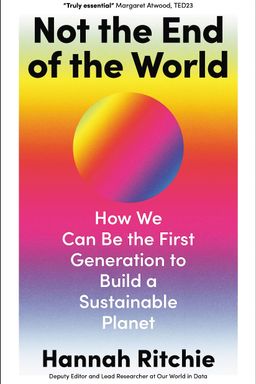
Not the End of the World cover

Not the End of the World

by Hannah Ritchie

Not the End of the World by Hannah Ritchie is a refreshing take on climate change, presenting data-backed optimism amidst environmental challenges. It highlights significant strides in sustainability, urging readers to shift from despair to actionable hope for a thriving planet.

Building a Realistic Hope for the Planet

Can you remain hopeful about the planet without being naive? In her evidence-driven exploration of global environmental challenges, Hannah Ritchie argues that you can—and must. Drawing on data from Our World in Data and decades of environmental research, she introduces the mindset of urgent optimism: a balance between acknowledging our crises and recognising our capacity to solve them. Unlike apocalyptic doomism, urgent optimism insists that progress is both real and possible—but conditional on purposeful action.

Rejecting Defeatism, Embracing Agency

Many young people believe humanity is doomed, but Ritchie dismantles such fatalism. Doom narratives, she explains, undermine scientific credibility, empower denialism, and paralyse action. Drawing on Hans Rosling’s influence, she urges you to look at long-term data: hunger, poverty, and child mortality have all plummeted, even as environmental challenges persist. Recognising both progress and peril is key—panic doesn’t yield solutions, but data-driven determination does.

The Two Halves of Sustainability

At the heart of sustainability lies a dual goal: meeting current human needs while preserving environmental capacity for the future. The world has never truly managed both. Historically, societies that lived in ecological balance suffered from poverty and high mortality, while rapid industrialization lifted billions but damaged ecosystems. The twenty‑first century challenge is unprecedented: enabling prosperity for all while bringing environmental impact near zero per person.

Ritchie shows that population control or economic degrowth are neither ethical nor effective answers. Instead, the practical route is decoupling—reducing per‑capita environmental harm while improving quality of life. If each person’s footprint approaches zero, total impact can vanish even with 10 billion people. That’s the conditional optimism at the book’s core: sustainability is achievable if technology, policy, and social norms evolve fast enough.

Where Progress Is Possible

Ritchie structures her evidence around big environmental systems: air, climate, food, forests, biodiversity, and oceans. In each, she busts myths, highlights measurable wins, and identifies practical levers that scale. Beijing’s air pollution, for example, halved in less than a decade once government and citizens aligned; Brazil once cut Amazon deforestation by 80% through satellite monitoring and enforcement; renewable energy now undercuts fossil fuels on cost. These examples show that large‑scale reversals can happen fast—if politics and incentives line up.

Conditional Optimism in Practice

Urgent optimism rejects both complacency and despair. It asks you to believe things can improve, but only through action. That means focusing on the highest‑impact levers: halving coal, shifting diets, protecting primary forests, and developing clean technologies—rather than fixating on low‑impact lifestyle gestures. Ritchie calls this thinking action‑weighted environmentalism: directing your limited effort and attention toward the systemic changes that actually bend the curve.

The Moral of the Book

This book’s deeper argument is psychological as much as empirical: humanity’s biggest obstacle isn’t ignorance but resignation. If you believe efforts are futile, you disengage; if you see successes and understand the mechanisms behind them, you stay engaged. Ritchie’s message—echoing thinkers from Paul Romer to Kate Marvel—is that optimism doesn’t mean ignoring danger; it means betting on our capacity to respond. Progress is not automatic, but it is possible, and every effective action compounds. You are invited not to cheer blindly, but to act intelligently and persistently.


Making Sustainability Work for People and Planet

The central ethical challenge of the twenty‑first century, Ritchie argues, is dual: ensuring human well‑being today while preserving the planet for tomorrow. She revisits the UN’s 1987 definition of sustainability and shows why progress must serve both aims together. Past development rarely met that bar—industrialisation improved human life yet eroded ecosystems; pre‑industrial societies were sustainable but impoverished. Your task is to make economic and environmental goals converge for the first time in human history.

Why Growth Still Matters

Ritchie rejects popular degrowth and depopulation narratives. Global population is already peaking late this century around 10–11 billion, and purposely shrinking it would be inhumane and slow. Degrowth, meanwhile, would freeze billions in poverty because redistribution alone can’t lift global income to sustainable levels. Economic growth is morally necessary—but its environmental intensity must plummet through cleaner energy, higher yields, and lower consumption per person.

The Math of Decoupling

You achieve sustainability not by stopping growth, but by slashing the emissions and material footprints per unit of prosperity. This is already happening: per‑capita CO₂ peaked around 2012 and is falling in many countries even as incomes rise. Rich nations have grown while restoring forests and cutting air pollution—proof that economic and environmental trends can diverge.

The Realistic Path Forward

Ritchie frames sustainability as engineering, not altruism: redesigning systems so good outcomes emerge naturally. Policies that raise living standards—such as clean cooking for 3 billion people reliant on wood fuels—also cut emissions and save lives. Investments in modern energy, efficient agriculture, and urban design are moral acts because they serve both present and future. By focusing on per‑capita impact rather than population or GDP, humanity can finally make the world fit for everyone—and for the long run.


Clearing the Air and Cutting Carbon

Air pollution and climate change are the twin frontiers where solving one helps solve the other. Ritchie treats them as interconnected crises born of combustion. Fossil fuels, cooking fires, and transport emissions not only kill millions via polluted air but also heat the planet. The encouraging truth: we already know how to fix both.

Air Pollution: Fast Health Wins

Beijing’s 2013 'war on pollution' shows what coordinated policy can achieve. Tight restrictions on coal, industrial emissions, and vehicles cut particulate levels by about 55% within seven years—adding an estimated 4.6 years of life expectancy. Similar regulations cleaned Europe and North America after the deadly smogs of the mid‑twentieth century. The key is to swap dirty fuels for electricity and gas, install scrubbers, and push for clean stoves globally. These yield immediate public‑health dividends while cutting CO₂.

Climate Change: Long‑Term Alignment

The climate chapter distinguishes alarm from realism. The world will likely cross 1.5 °C, but the difference between 2.1 °C and 2.9 °C by 2100 is massive—and still under human control. Decarbonisation depends on electrifying transport and industry and switching to low‑carbon power. Solar, wind, and batteries have tumbled in price by 70–98% in recent decades, meaning clean energy is no longer a luxury but often the cheapest option. A strong carbon price and support for adaptation can steer markets and innovation simultaneously.

From Crisis to Coordination

Both clean‑air and climate success show that progress requires three ingredients: technology, governance, and social will. Air quality turned only when citizens demanded enforcement; emissions will peak only when policy, markets, and voters align. You don’t have to wait for perfection—just steady directional progress. Every coal plant retired, every power line electrified, and every household transitioned from smoke to clean cooking inches the world toward breathable skies and a stable climate.


Food Systems and the Power of Choice

Food connects nearly every environmental issue—land, water, emissions, and biodiversity. Ritchie emphasises that the world already grows enough calories for everyone, yet hunger persists because of waste, inequality, and inefficient use. Roughly 40% of cereals feed livestock, not people, and another 10% go to biofuels. Feeding the planet equitably therefore requires better distribution and smarter consumption, not simply more farming.

The Transformation of Agriculture

Two revolutions enabled humanity’s population boom: synthetic fertiliser (Haber–Bosch) and high‑yield crops (Borlaug’s Green Revolution). These saved billions from famine but raised new environmental costs—fertiliser runoff, emissions, and land pressure. Now the task is a third revolution: sustaining abundant food with minimal footprints using precision inputs, genetic innovation, and better global logistics.

Food Waste Fixes

About one‑third of all food is wasted. In developing regions, losses occur early (poor storage, transport), while in rich nations they happen at home and in retail. Practical interventions—plastic crates replacing sacks in South Asia, refrigeration chains, smarter packaging, and donation policies—can cut waste dramatically. Reducing waste isn’t just moral; it saves land and water embedded in the food we never eat.

Evidence Over Intuition

Ritchie debunks trendy but inefficient fixes: local and organic food aren’t panaceas. Transport causes only ~5% of global food emissions, and organic yields are typically lower, demanding more land. What you eat matters far more than where it’s grown. Policy should reward high yields with lower chemical runoff and push innovation, not ideology. A realistic path combines equitable distribution, modern technology, and evidence‑based choices to feed 10 billion sustainably.


Diet Shifts and Meat Reduction

If you want one lever to ease climate, land, and biodiversity stress simultaneously, it’s diet. Beef and lamb alone consume vast land area and emit disproportionate methane. Globally, livestock occupy about four billion hectares—most farmland on Earth. Dropping ruminant meat could free land twice the size of the US for habitat or carbon storage.

From Perfection to Progress

You don’t need to become vegan overnight. Ritchie shows that partial shifts—like replacing a few beef meals a week with chicken or plant protein—deliver large benefits. Behavioural nudges ("Meatless Mondays" or blended dishes) outperform moralising. If half the population skipped meat two days a week, the global emissions drop would exceed adding a few million vegans. The goal is cultural normalisation of lower‑impact diets, not perfection.

Substitutes That Scale

Plant‑based and hybrid meats are mainstream tools. Products from Beyond Meat, Impossible Foods, and Quorn can cut emissions by over 90% versus beef, while hybrid burgers blending plant and beef halve impacts without alienating consumers. Even dairy alternatives—soy, oat, almond—outperform cow’s milk on most metrics. As energy grids decarbonise, these substitutes become cleaner still and more affordable globally. By supporting them, you accelerate a market transition that complements cultural change.

Policy and Market Roles

Governments and businesses can multiply these gains: shift public procurement (school and hospital meals), fund food‑tech innovation, and reform subsidies that favour beef and biofuels. Consumers can amplify the signal through consistent, enjoyable habits. The climate payoff is immense: halving global red‑meat demand could eliminate billions of tonnes of CO₂ and free land for rewilding. In your plate lies planetary leverage.


Forests, Biodiversity and the Web of Life

Forests and wildlife embody interlocking problems—carbon storage, species loss, and human livelihoods. Ritchie clarifies that the Amazon doesn’t supply a fifth of Earth’s oxygen (a persistent myth); its true value lies in biodiversity and carbon. Deforestation mainly results from agriculture, especially beef pasture and feed crops like soy. Addressing it means reshaping incentives, not guilt trips.

Stopping and Reversing Loss

Ritchie describes a 'forest transition' pattern: nations deforest when poor, then reforest with wealth and regulation. Tropical regions are mid‑transition and uniquely critical. Solutions proven to work include enforceable zero‑deforestation supply chains, satellite monitoring, yield improvements so farmers need less land, and international payments (REDD+) compensating nations for preservation. Brazil’s dramatic 2003–2010 turnaround exemplifies coordinated success.

Biodiversity Truth and Action

Headlines like '69% decline in wildlife' mislead without context—this figure reflects average population trends, not total animal numbers. Still, wild mammal biomass has collapsed by ~85% since humans dominated, and current extinction rates far exceed natural baseline levels. Insects show mixed patterns: some regions improve as others crash. Because humans cause these losses, we can also reverse them by addressing core drivers—land use, climate, pollution, and resource waste.

Restoring the System

Reducing meat, halting deforestation, and managing fertilisers all aid biodiversity. Protecting existing primary forests is vastly more effective than replanting afterward. Conservation areas matter, but integrating sustainability into food, energy, and land policy matters more. The web of life depends on shrinking humanity’s footprint smartly, not retreating from progress.


Oceans, Plastics and Fisheries Recovery

The seas, too, are fixable if addressed accurately rather than sensationally. Ritchie dismantles viral myths—like claims that the oceans will be 'empty by 2048' or that plastic will outweigh fish by mid‑century—and replaces them with constructive data. Roughly one million tonnes of plastic enter oceans annually, mostly via about 1,600 rivers in Asia and Africa. Concentrated sources mean concentrated solutions.

Plastic Reality and Response

Most marine plastic originates on land, not from dumping at sea. Investing in waste management—landfills, collection, recycling—yields disproportionate payoff. River interceptors, booms, and beach cleanups complement these systemic fixes. Myths aside, the plastic crisis is solvable with infrastructure and industry redesign, not despair.

Fisheries and Aquaculture

Overfishing once seemed inevitable, but cooperation between scientists (Boris Worm, Ray Hilborn) produced a new consensus: management works. Quotas and monitoring have rebuilt many stocks; the EU cut overfished stocks from nearly 80% to 30% in two decades. Meanwhile, aquaculture now produces more seafood than wild catch, with feed efficiency improving from a 2:1 to 0.3:1 fish‑in to fish‑out ratio. Well‑regulated aquaculture can feed billions with moderate impact.

Restoring the Blue Planet

From coral reefs threatened by warming to by‑catch waste improving through better gear, solutions rely on governance and science. Consumers also help: trusted certifications (MSC, ASC) and sustainable seafood guides steer demand. The ocean narrative need not be tragic—it’s a story of ecosystems that can recover if given time, regulation, and cleaner human behaviour.


Choosing High-Impact Actions

At the end of the book, Ritchie circles back to personal and political agency. In a world of limited attention, the hardest task is prioritization. She calls for an impact hierarchy approach: focus efforts on the actions that produce the biggest improvements for health, climate, and equality rather than symbolic gestures.

Personal Leverage Points

Your main opportunities are straightforward: eat less beef, fly less, choose electric or public transport, insulate your home, and support clean energy access (especially for households still burning wood). These steps outperform micro‑choices like paper straws or reusable coffee cups in orders of magnitude. Ritchie urges honesty about scale: some 'feel‑good' actions barely register, while major lifestyle or policy changes shift global metrics.

Systemic Levers and Fairness

Collective policy delivers transformative change: carbon pricing with rebates, phasing out coal, protecting tropical forests via REDD+ payments, and funding agricultural productivity where it’s lowest. The principle is to prioritise intersections of effectiveness and equity. Climate policy that punishes the poor fails morally and politically; design incentives that help both environment and well‑being.

Staying Purposeful and Hopeful

Urgent optimism isn’t blind cheerfulness—it’s sustained engagement. You act from evidence that progress is achievable, not faith that someone else will fix things. By focusing your time and advocacy on the largest levers, you multiply your influence. Ritchie’s closing message is as much motivational as empirical: don’t let perfectionism or panic distract you from progress. The future is not predetermined; it’s conditional—and that’s precisely why your actions matter.

Dig Deeper

Get personalized prompts to apply these lessons to your life and deepen your understanding.

Go Deeper

Get the Full Experience

Download Insight Books for AI-powered reflections, quizzes, and more.