
Idea 1
Truth, power, and one woman’s day in court
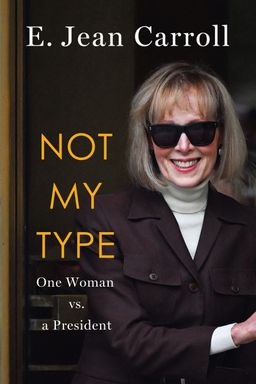
What does it really take to confront someone far more powerful than you and be believed? In Not My Type, E. Jean Carroll argues that justice for sexual assault survivors hinges less on sweeping movements and more on the credibility of one person telling the truth, under oath, in a room where the rules hold. Carroll contends that her two civil trials against Donald J. Trump—one establishing liability for sexual abuse and defamation, the other setting damages—prove that a single, well-prepared witness, sustained by a disciplined legal team, corroborating evidence, and a judge who enforces the rules, can puncture decades of impunity. But to do so, you must understand the theater and the grind: trauma science, jury psychology, pretrial prep, wardrobe strategy, relentless cross-examination, and the emotional cost of being publicly disbelieved and harassed in real time.
A memoir braided to two trials
Carroll blends memoirish vignettes (a Mohs surgery eye patch she jokingly calls her “pirate scar”; a deposition opener listing her eight lovers—Fred Schmidt, Stephen Byers, George Butler, Bob Datilla, Anthony Haden-Guest, Ben Vereen, Richard Harris, and her husband, John Johnson) with a granular chronicle of litigation. We sit inside the Ruth Bader Ginsburg Conference Room on the 63rd floor of the Empire State Building as Carroll prep-talks with civil-rights legend Robbie Kaplan, strategist Shawn G. Crowley, and silver-tongued trial partner Mike Ferrara (once nicknamed the “sexy blur” on the track). We ride through mock juries that force the team to pivot from a #MeToo frame to a tighter narrative: one woman, one man, one dressing room.
Courtroom as runway, and why that matters
Carroll treats Judge Lewis A. Kaplan’s courtroom as a literal runway—blue carpet threading between oaken tables, the jury corral, and the witness box. Appearance matters because Trump’s first-line defense was “She’s not my type.” So hair (Lisa Corvelli’s 1996 bob revival), fabric (an Oscar de la Renta chocolate dress or a Dior-esque Zara navy suit), and carriage become part of the evidence of plausibility. It’s a frank acknowledgment: jurors are human, stories need coherence, and a witness has to be legible as her younger self from the moment that matters (1996 at Bergdorf Goodman).
The science of hurt—and the myths of reaction
Carroll brings in Dr. Leslie Lebowitz (architect of sexual-assault protocols for the U.S. Air Force) to explain how traumatic events can silence language, trigger avoidance, and disable desire without erasing memory. That expert testimony meets culture-war myths head-on: the idea that a “real victim” must scream, or flee, or report immediately. Against that myth, the defense repeats: Why didn’t she scream? Why did she laugh? Why did she go into a dressing room? The book shows how those questions flatten human physiology and social context.
Evidence beats celebrity
The narrative’s engine is showing—not asserting—credibility: the empty sixth-floor lingerie department at night (corroborated by Bergdorf leaders Cheryl Beall and Robert Salerno), the dressing-room door mechanics, contemporaneous confidences to friends (Lisa Birnbach and Carol Martin), and pattern evidence from other women (Jessica Leeds on a Braniff flight; People reporter Natasha Stoynoff at Mar-a-Lago). We also hear Trump himself, in deposition, misidentify Carroll as his ex-wife (“That’s my wife”), undercutting his “not my type” line.
Harassment as a strategy—and a damages problem
As the trials run, Trump attempts to speak over Kaplan’s evidentiary rulings via posts and press, a firehose of “hoax,” “whack job,” and “Dem operative” messages. Carroll documents the torrent of threats those posts unleash and brings in Northwestern’s Prof. Ashlee Humphreys to quantify reputation repair: from six figures in the first trial to $7.2–12M in the second, alongside punitive damages calibrated to “make him stop.”
Why this matters to you
If you’ve ever wondered whether personal truth can stand up to institutional power, Carroll’s answer is clear: yes—if you refuse to perform someone else’s idea of the “perfect” victim, if you prepare like an athlete, and if you understand trials are persuasion in a rules-bound theater. You see how humor (her default), style (intentionally dialed), hard evidence, and careful lawyering can turn a life story into a credible case. And you leave with a framework for meeting disbelief—not with louder outrage—but with the kind of painstaking detail that convinces nine strangers who owe you nothing.
Core promise
Justice isn’t a viral moment. It’s a strategy of truth under pressure. Carroll shows you how to make truth legible—fact by corroborated fact—until even a former president must pay attention, and pay damages.