
Idea 1
The Logic of Non-Zero-Sum History
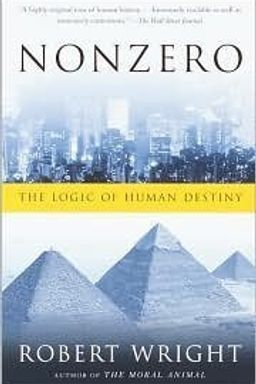
What if the grand pattern of life—from bacteria to the Internet—could be explained by a single logic? In Nonzero: The Logic of Human Destiny, Robert Wright argues that both biological evolution and human history are guided by what he calls non-zero-sum logic: the potential for interactions that create mutual benefit. Where zero-sum games pit winners against losers, non-zero-sum games reward cooperation. This potential, Wright claims, drives the rise of complexity, social organization, and culture itself.
Wright asks you to treat life as an unfolding series of games. From the Apollo 13 astronauts whose survival depended on total cooperation to the evolution of complex ecosystems and societies, the underlying logic is consistent: when organisms or people can coordinate to gain together, they often do. Over time, such interactions accumulate, creating ‹an arrow of history› that points toward increasing interdependence and intelligence.
Non-zero-sumness as life's engine
At its most basic, non-zero-sumness is the opportunity for shared gain. It is not mystical—it arises whenever communication, trust, and complementarity make cooperation profitable. Wright follows thinkers from John von Neumann to Teilhard de Chardin, rejecting mysticism for game theory. The biological world abounds with such games: mitochondria and cells cooperate for mutual survival; humans build economies and institutions that do the same. The direction of history, Wright argues, tracks how those non-zero-sum opportunities multiply and deepen.
New technologies—fire, writing, the printing press, the Internet—are not the arrow’s direction but its instruments. Each reduces communication costs and accelerates coordination, weaving individuals into larger, smarter webs of mutual dependence. For Wright, this is not destiny in the mystical sense but high probability given human nature. Just as every poppy seed is designed to bloom though many fail, social evolution is biased toward larger forms of cooperation even if local collapses occur.
Human instincts and cultural scaling
Non-zero-sum logic relies on psychological machinery shaped by evolution—emotions such as gratitude, indignation, and loyalty that stabilize cooperation. Wright links this to reciprocal altruism (help those who help you) and status competition (gain prestige through useful innovation). Together, these create the dual energies of progress: the glue that binds people into cooperative webs and the spark that drives innovation.
From the Shoshone rabbit-nets and Polynesian feasts to markets and states, the expansion of cooperation depends on evolving institutions that reward mutual gains while punishing freeloaders. Wright emphasizes that even in cooperation, a zero-sum layer persists: groups must still negotiate how to divide shared benefits. This tension becomes a perpetual source of ethical and institutional creativity.
The information arc: from cells to civilization
Behind both biological and cultural evolution lies what Wright calls the invisible brain. Just as neurons form a mind, interconnected societies form vast information-processing networks. Population density, communication speed, and trust are the levers that expand this brain’s complexity. As transport and communication cheapen—from caravans to telegraphs to fiber optics—societies connect more minds and thus innovate faster.
Wright pairs this with the idea of the noosphere: a global layer of thought emerging from digital interconnection. He reinterprets Pierre Teilhard de Chardin’s poetic vision in concrete terms—each new medium of communication (writing, print, electronics) becomes a neural upgrade in humanity’s collective brain. The history of civilization, from Sumerian bureaucracy to the Silicon Age, is one long expansion of information flow and cooperative capacity.
Conflict and integration
Even destructive episodes—wars, barbarian invasions, or social collapses—fit Wright’s pattern. Because external conflict demands internal coordination, war often catalyzes non-zero-sum integration at higher scales: tribes bond into kingdoms, empires reform as federations, and rival cities unite in leagues. The European “competitive neighborhood,” with many small states borrowing from each other, exemplifies this paradox: competition drives innovation and cooperation simultaneously.
From biology to purpose
Wright extends non-zero-sum logic beyond history into biology and philosophy. Natural selection itself is an information processor—a distributed computation finding ever-better ways of coordinating matter and energy. Cooperation among genes, cells, and species generates complex order. When cultural evolution piggybacks on this process, it becomes evolution’s latest self-reflective phase.
That trajectory raises profound questions. Is life advancing toward something like consciousness or purpose? Wright doesn’t answer with theology, but he concedes the evidence of direction: increasing integration, intelligence, and moral awareness. If evolution has a telos, it lies in the logic of non-zero-sumness itself—the tendency of life and mind to organize complexity more intricately over time, producing not utopia but ever-larger circles of cooperation.