
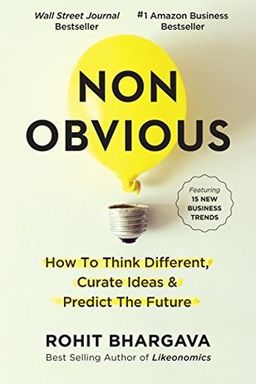
Non-Obvious cover

Non-Obvious

by Rohit Bhargava

Non-Obvious by Rohit Bhargava is your guide to uncovering hidden trends that shape our future. Learn to think differently, curate impactful ideas, and predict market dynamics beyond the obvious. Perfect for business innovators seeking a competitive edge.

The Art of Seeing What Others Miss

Have you ever found yourself wondering why some people spot opportunities or patterns that others miss entirely? In Non-Obvious Thinking: How to See What Others Miss, Rohit Bhargava and Ben duPont argue that what separates remarkable innovators, leaders, and creators from everyone else isn’t genius or luck—but their ability to notice what others ignore. They call this ability non-obvious thinking, and they believe anyone can cultivate it through deliberate frameworks and habits.

The authors’ central claim is that today’s world urgently needs more non-obvious thinkers—people who can question assumptions, empathize deeply, and spot overlooked connections. This skill is neither mystical nor innate. It is a discipline that can be learned through practice. By training your mind to see differently, you can unlock creativity, innovation, and empathy in any context—from professional challenges to personal growth.

How Non-Obvious Thinking Works

To illustrate what non-obvious thinking looks like, Bhargava and duPont open with three vivid stories. In 1968, Olympic athlete Dick Fosbury changed the world of high jump by inventing the backward “Fosbury Flop,” winning gold and redefining the sport. In Steven Spielberg’s imagined world of Ready Player One, a gamer wins an impossible race by driving in reverse—finding a hidden path no one else saw. And at MIT, computer scientist Joy Buolamwini launched a movement to fight algorithmic bias after facial recognition software failed to identify her dark-skinned face. Each of these moments began with someone noticing something invisible to others and daring to look deeper.

Non-obvious thinking begins with observation, but it goes further. It involves recognizing patterns, questioning conventional “truths,” and turning small deviations into paradigm-shifting insights. Where most people see obstacles or routines, non-obvious thinkers see opportunities for reinvention.

The SIFT Framework: A Blueprint for Thinking Differently

To help you build this ability step by step, the authors introduce the SIFT framework. SIFT is both a metaphor and an acronym, derived from the kitchen process of sifting flour—removing impurities and isolating what is valuable.

  • S – Create Space: Learn to mentally and emotionally declutter so you can perceive new ideas. Instead of rushing through routines and multitasking, cultivate habits like controlled breathing, reflective moments, and openness to risk.
  • I – Uncover Insights: Train yourself to notice patterns and meanings beyond the obvious. This means learning to ask better questions, read subtle social cues (like the Korean concept of nunchi), and immerse yourself firsthand in experiences.
  • F – Focus Your Ideas: Once you’ve gathered observations, narrow your attention to what matters most. Real breakthroughs hinge on clarity—identifying core problems, embracing constraints, and learning when “good enough” is truly enough.
  • T – Define the Twist: Finally, push your thinking one step further by finding your non-obvious twist—reversing norms, combining unexpected ideas, or introducing a unique concept that changes the narrative.

The SIFT process mirrors a creative journey: first clearing clutter, then gathering raw insight, next distilling it into coherent focus, and finally transforming it into original action or innovation. It’s less about genius than mental fitness.

Why This Approach Matters Today

Bhargava and duPont argue that modern life rewards reactive, obvious thinking. Algorithms feed us predictable content. Workplaces celebrate efficiency over depth. As a result, society often amplifies confirmation bias and incremental thinking instead of curiosity or dissent. The cost is visible—polarized politics, shallow innovation, and cultural division.

But they insist the tide can turn. By intentionally learning to “see what others miss,” you cultivate empathy, resilience, and relevance. Whether you are a leader seeking big ideas, a creative professional striving for originality, or simply a human trying to live more consciously, non-obvious thinking becomes a daily practice of awareness and curiosity.

The authors’ decade-long experience running Non-Obvious Dinners—gathering Nobel laureates, senators, and students for bold idea exchanges—proves that diverse, non-expert voices often fuel the most creative outcomes. Their goal is not to create a new elite of innovators but to empower anyone to contribute fresh perspectives.

“Non-obvious thinkers are the instigators who come up with bold, original ideas that propel all of us forward.”

In this book, you’ll move from creating mental clarity (Part I) to discovering hidden truths (Part II), refining focus (Part III), and finally defining your twist—the unique insight that can change your direction or even the world (Part IV). The journey ends with a challenge: dare to question your own certainties and “undiscover” your Sandy Islands—the false assumptions we all carry.

In short, Non-Obvious Thinking offers both philosophy and practice. It’s an antidote to sameness—a call to engage with life as an explorer rather than a tourist, to question even what feels unquestionably true, and to transform small observations into big ideas.


Create Space for Thinking

The first step of the SIFT framework—creating space—is about quieting noise and clearing mental clutter to let deeper awareness surface. In a world that glorifies speed and constant connection, Bhargava and duPont argue that the greatest barrier to insight isn’t ignorance but overstimulation. We see distractions everywhere, from endless notifications to nonstop meetings; as a result, our capacity for deep thought shrinks.

Breathing and Awareness

They begin, fittingly, with breathing—a function that feels trivial until it’s studied. Extreme athlete Wim Hof, known as “The Iceman,” demonstrates how controlling breath can unlock extraordinary endurance. Science journalist James Nestor’s research similarly shows how deep, conscious breathing enhances focus and emotional regulation. The lesson: if you can control something as automatic as breathing, you can also reclaim conscious control over your thinking.

Letting Go of Prebuttals

Next, the authors encourage you to ditch prebuttals—the habit of rejecting ideas before they’re fully expressed. Prebuttals represent a form of intellectual self-sabotage, blocking empathy and discovery. Think of political pundits who craft responses before hearing the question or coworkers who shut down new ideas with an instant “that won’t work.” By suspending this reflex, you create the mental spaciousness needed to consider fresh perspectives.

Making Oasis Moments

Through events like their Non-Obvious 7-Minute Meetups at SXSW, Bhargava’s team created “oasis moments”—intentional pauses in overstimulating environments. These tiny interludes for reconnection demonstrate that space isn’t always time alone; it can also be social stillness—a moment to listen and reflect before reacting. Even seven minutes of focused conversation can reset awareness and foster meaningful connection.

Inviting Friction and Novelty

Non-obvious thinkers also embrace danger. By introducing manageable risk—like navigating without GPS, switching routines, or experimenting beyond comfort zones—you restore alertness dulled by safety. The Land, a Welsh playground encouraging children to light fires and use tools, illustrates how controlled danger builds awareness and adaptability.

Changing Rituals and Time Spaciousness

Breaking repetitive patterns is another form of creating space. Chef Ferran Adrià’s habit of eating a different fruit every morning kept his perspective fresh. Authors recommend reversing routines or delaying judgments to snap out of autopilot. They also introduce the idea of time spaciousness—slowing down enough to focus on what matters. Filmmaker James Cameron’s decade-long movie cycles and Jane McGonigal’s concept of “urgent optimism” model how patience and persistence generate richer ideas.

Creating space is not about clearing your schedule. It’s about clearing your mind’s bandwidth for the unfamiliar.

When you cultivate this spaciousness—through breath, reflection, disruption, and patience—you prepare your brain to make non-obvious connections. Like tidying up mental clutter, you make room for insight to breathe.


Uncovering Deeper Insights

Once you’ve created mental space, the next step is to uncover insights—truths that explain why things are the way they are. This requires observation layered with curiosity and empathy, moving from surface-level noticing to understanding hidden context. Bhargava and duPont dedicate this section to developing the perceptual muscles necessary to decode meaning behind behavior, communication, and systems.

Ask Story Questions

Pulitzer-winning journalist Jacqui Banaszynski’s interviewing method exemplifies this principle: she doesn’t script questions; she builds them dynamically from each answer. This “story-questioning” loop elicits authentic narratives instead of rote information. It teaches that listening deeply is an act of pattern discovery. You can practice this anywhere—by focusing on afterthoughts in conversation or building “question trees” that reveal underlying motivations and fears.

Hone Your Nunchi

In Korea, nunchi means reading the room—tuning into unspoken emotions. The authors connect this to emotional intelligence and contextual awareness. Watching body language, noticing tone, and interpreting silence can expose insights words conceal. Practicing nunchi is like turning on emotional subtitles for human interaction. Techniques such as watching a video on mute or observing a café crowd help sharpen this intuitive perception.

Get Your Hands Dirty

Understanding often requires immersion, not analysis. Uber’s CEO Dara Khosrowshahi learned about driver frustrations by becoming one himself. Similarly, the TV show Undercover Boss shows how direct experience bridges perception gaps. By “getting your hands dirty”—either through volunteering, shadowing, or experimenting—you gather insights that data alone cannot provide.

Spot Natural Wisdom

Architect Mick Pearce’s termite-inspired design for Zimbabwe’s Eastgate Centre illustrates how nature encodes solutions humans overlook. Studying ecological balance leads to creative breakthroughs: Japan’s bullet train borrows from the kingfisher; Velcro mimics burrs. Nature, the authors argue, is the greatest teacher in systems-thinking if you slow down to observe its patterns.

Find the Right Room and Step Into Others’ Shoes

Finally, transformative insights often come from proximity to diverse minds. Spielberg’s secret 1999 “idea summit” that helped envision the movie Minority Report exemplifies assembling “the right room.” Likewise, empathy grows when you consume media outside your interests—such as flipping through a niche magazine or experiencing virtual reality simulations of refugees or prisoners. Both acts expand perspective and challenge bias.

To uncover insights means to look again—and again—until something invisible becomes undeniable. These exercises build curiosity, empathy, and humility: the foundations of non-obvious thinking.


Focus on What Matters Most

After gathering insights, Bhargava and duPont urge you to focus: distill abundance into essence. This phase mirrors curation—choosing what to emphasize and, more importantly, what to ignore. Just as Turkish rose farmers distill thousands of petals into a drop of oil, distillation transforms scattered observations into purposeful action.

Identify the Real Problem

Inventor Elisha Otis’s 1853 “elevator pitch” clarified that real innovation fixates on solving fear, not mechanics. His dramatic demonstration of elevator safety brakes countered public hesitation—not just technical issues. Similarly, successful thinkers ask why repeatedly to uncover root causes. The Toyota-inspired “five whys” technique shows how peeling back assumptions guides attention to meaningful problems.

Discover the Water

Astronomers searching for alien life don’t scan all the stars—they look for water, the common element for life. Applying this analogy, Rohit Bhargava identifies unifying “themes” (like humanity’s craving for authentic connection in a digital world). Finding your “water” means locating recurring patterns across ideas and experiences to focus your creative energy.

Be a Satisficer

Influenced by Barry Schwartz’s The Paradox of Choice, the authors differentiate maximizers—who pursue the perfect outcome—from satisficers—who embrace “good enough.” Satisficers conserve cognitive energy and deepen their commitment to chosen paths. This mindset counters modern FOMO culture and sharpens focus through decisive effort.

See the Other Side

Focus also demands perspectival agility—the ability to hold dual truths. The classic “duck or rabbit” illusion symbolizes this flexibility. Accepting multiple interpretations nurtures empathy and adaptability. When life presents rudeness or conflict, asking what could justify it (“maybe they’re rushing to a hospital”) expands understanding while preserving balance.

Adding Constraints and Collaboration

Constraints, paradoxically, liberate. Dr. Seuss’s word limits birthed The Cat in the Hat and Green Eggs and Ham. Henri Matisse’s immobility produced his brilliant paper cutouts; Nintendo’s five-note limitation created the Super Mario theme. Limiting tools, time, or words forces focus and innovation. Similarly, augmented creativity—from AI tools to peer feedback—can “sweeten” ideas without replacing human intuition, much like Charley Douglass’s laugh track enhanced television humor.

Focusing, then, is not restrictive—it’s clarifying. The authors redefine it as an act of selection and amplification: discover the essence, drop the rest, and channel attention into the meaningful few.


Define Your Twist

The final phase of the SIFT framework, Defining the Twist, invites you to push boundaries and apply your insights in unexpected ways. This is where imagination meets courage—where you don’t just see differently but act differently. Each of the six techniques in this section helps you reframe conventions and introduce originality into familiar systems.

Seek Flip Solutions

Teachers Aaron Sams and Jonathan Bergmann revolutionized classrooms by flipping them: lectures moved online, discussions went in-person. Similarly, Vivek Ravisankar’s HackerRank reimagined hiring by replacing résumés with skill challenges. Flip thinking means overturning assumptions to reveal hidden efficiencies or fairness. Asking “What if we did the opposite?” often unlocks innovation.

Find Option C

Genrikh Altshuller’s TRIZ method of inventive problem-solving urges us to defy binary choices. His discovery: every contradiction holds a hidden “third option.” When Boston designer William Brouwer merged Japanese futons with Western furniture, the result—the futon sofa—became a hybrid success. Finding Option C demands tolerance for contradiction and creativity beyond either/or scenarios.

Practice Enigmatology

Inspired by puzzle master Will Shortz, this mindset turns the familiar strange. The skateboard evolved from surfing but added a twist—the kicktail. Puzzle-like reframing helps you assign new meaning to the ordinary—transforming a beer glass into Stella Artois’s trademark chalice or a paper fastener into the now-ubiquitous paperclip.

Think Un-Whatever

Sometimes distinction comes from defining against norms. Taco Bell’s “Think Outside the Bun,” Hummer’s hypermasculine branding, and Amsterdam’s “worst hotel in the world” campaign succeed by flipping cultural expectations. In your own projects, challenge what everyone assumes “will never change.” The authors use Harley-Davidson’s and oat milk’s repositioning as powerful examples of declaring an “enemy” to sharpen identity.

Mind the Intersections and Create Your Argot

Innovation thrives where ideas intersect—like Tu Youyou’s Nobel-winning discovery blending ancient herbal wisdom with modern science. Similarly, “bank cafés” merge financial services and coffee culture to foster connection. To anchor your twist, create your own argot (a shared language). Like GE’s “We bring good things to life” or Bhargava’s “Non-Obvious” branding, concise taglines and coined terms turn ideas into movements.

Non-obvious thinkers don’t just think differently—they define difference itself.

Defining your twist means crafting an identity around originality—infusing language, perspective, and intersection so your ideas become unmistakably yours. It’s the final act of transformation in non-obvious thinking.


The Courage to Undiscover

In their thought-provoking conclusion, Bhargava and duPont invite readers to practice what they call undiscovery: questioning what you already “know.” The story of Sandy Island—a landmass that existed on maps for a century but turned out not to exist at all—symbolizes how easy it is to confuse assumption with fact. Non-obvious thinkers are willing to update their mental maps.

Just as Google erased the island after sailors confirmed it wasn’t real, you too can remove outdated ideas from your worldview. This intellectual humility empowers innovation. The authors pair this metaphor with another linguistic curiosity: Scottish researchers identifying 400 words for snow. Different language lenses don’t change the snow—but they expand how we experience it.

The broader lesson: life’s richness lies in multiple perspectives. “No two snowflakes look alike,” they write, reminding you that diversity of thought, culture, and imagination doesn’t separate humanity—it strengthens it. To undiscover is to rediscover curiosity, connection, and kindness in an age that too often rewards certainty.

“There is a Sandy Island in each of our mental maps. The challenge is discovering—or undiscovering—what it is.”

Ultimately, Non-Obvious Thinking closes with a call to intellectual bravery: to embrace ambiguity, empathy, and exploration. The world may indeed be full of obvious things, but the art is in learning to observe them differently—and daring to raise the bar of your own perception.

Dig Deeper

Get personalized prompts to apply these lessons to your life and deepen your understanding.

Go Deeper

Get the Full Experience

Download Insight Books for AI-powered reflections, quizzes, and more.