
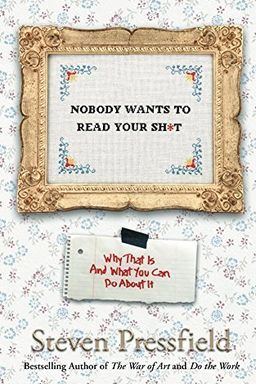
Nobody Wants to Read Your Sht cover

Nobody Wants to Read Your Sht

by Steven Pressfield

Dive into the world of writing with Steven Pressfield''s guide, offering invaluable insights and practical advice to craft compelling narratives. Whether you''re an aspiring novelist, screenwriter, or copywriter, this book equips you with the tools to create stories that captivate and resonate with audiences, drawing from a seasoned writer''s 30-year industry experience.

The Harsh Truth: Nobody Wants to Read Your Work

Have you ever poured your heart into a story, essay, or proposal only to realize no one seemed to care? Steven Pressfield’s Nobody Wants to Read Your Sh*t begins with this uncomfortable truth: the world isn’t waiting for your next masterpiece. People are busy, overwhelmed, and inundated with content. If you want them to read what you write, you must make it irresistible.

Pressfield’s message is both brutal and liberating. The title itself is a wake-up call—a reminder that great writing begins with humility. Whether you’re crafting an ad, a novel, a screenplay, or a self-help guide, your reader owes you nothing. The burden is entirely on you to earn their attention. Throughout the book, Pressfield reveals how mastering storytelling, structure, and empathy can transform your work from self-indulgent to compelling.

Understanding the Core Premise

The phrase “Nobody wants to read your sh*t” originated from Pressfield’s early career in advertising. In the Madison Avenue grind, he discovered the unspoken rule: no one cares about your cleverness unless it sells. Copywriters had seconds to hook readers; their success depended on empathy and clarity, not ego. He learned that every piece of writing is a transaction—the reader gives time and attention only in exchange for something meaningful, entertaining, or useful. This insight later guided his entire writing career across fiction, screenwriting, and nonfiction.

A Journey Through Disciplines

Pressfield’s structure mirrors his improbable journey as a writer. The book moves through several creative worlds—advertising, Hollywood, fiction, nonfiction, and even self-help. Each domain sharpened his understanding of communication. In advertising, he learned simplicity; in Hollywood, story structure; in fiction, truth through imagination; and in nonfiction, purpose through theme. The cumulative lesson is that great storytelling transcends genre—it’s all about making the audience care.

The Responsibility of the Writer

If nobody wants to read your work, what can you do about it? Pressfield insists that writers must flip their mindset. Instead of asking, “What do I want to say?” ask, “What does the reader want or need to hear?” This perspective transforms the act of writing from self-expression to service. It’s the difference between a diary entry and an unforgettable story. It’s about digging for universal truths—the theme, conflict, stakes, and emotional resonance that speak to readers on a human level.

The Craft Behind the Message

Pressfield unpacks the craft techniques that make audiences engage. He connects lessons from ancient myths to modern cinema, illustrating how structure and theme give shape to meaning. For example, every story has an inciting incident, a villain, an All Is Lost moment, and a transformation. Whether you’re writing Breaking Bad or a blog post, the pattern holds: tension, reversal, catharsis. This revelation turns storytelling into a discipline rather than a mystical gift. (Similar to Robert McKee’s Story and Joseph Campbell’s Hero with a Thousand Faces.)

The Deeper Message: Discipline Meets Spirit

By the end, Pressfield expands his idea beyond writing. The book becomes a philosophy for any creative life. Resistance—your inner critic, procrastination, self-doubt—is the true enemy. Success doesn’t come from chasing fame but from mastering your craft with humility and devotion to truth. The “sh*t” everyone rejects is the unrefined, ego-driven output before the transformation through practice, failure, and clarity.

Pressfield’s ultimate challenge is not cynicism—it’s empowerment. Once you accept that nobody cares, you become free to serve your reader fiercely, tell stories that matter, and do the hard work that turns raw clay into art. The book is both a creative memoir and a master class in emotional honesty. It’s the creative slap every writer secretly needs.


Writing as a Transaction

Pressfield insists that writing is not self-expression—it’s commerce in attention. Every reader trades their time and focus for the promise of value. Whether in advertising, fiction, or nonfiction, this transaction defines success. To honor that exchange, you must hook them immediately, sustain their curiosity, and deliver emotional reward.

Learning Through Advertising

In his Madison Avenue years, Pressfield worked as a copywriter surrounded by brutal deadlines. He learned that even brilliant ideas die if they don’t connect instantly. Pitches that rambled lost attention; taglines that hit emotion sold instantly. “Nobody wants to read your sh*t,” his boss would say—not as an insult, but as a rallying cry to simplify, clarify, and inspire. That sense of urgency later informed how he approached novels and screenplays. Every paragraph had to earn its place.

Empathy Over Ego

The only way to make people care is to see through their eyes. Pressfield learned to inhabit the reader’s or viewer’s mind, asking, “What’s in it for them?” He realized that flashy vocabulary or clever wordplay means nothing if it doesn’t connect with desire—freedom, beauty, success, or meaning. Great writers channel empathy; they build emotional bridges, not show off their brilliance.

Turning Commerce Into Art

Surprisingly, this ‘sales mindset’ doesn’t make art shallow. Instead, it deepens integrity. Ads that respect the consumer’s intelligence win loyalty. Stories that respect the reader’s investment win hearts. The most powerful creative works balance message and story with awareness of audience needs. (Pressfield’s mentor in publishing, editor Shawn Coyne, later formalized this approach in The Story Grid.)

When you treat writing as an act of generosity rather than an act of ego, every word becomes sharper, every page becomes lighter, and readers feel seen rather than sold to. That’s how you transform indifference into engagement.


The Power of Concept and Structure

One of Pressfield’s recurring lessons is that compelling ideas can be summarized in a single, vivid sentence. In both Hollywood and publishing, concept clarity defines success. As he writes, every hit movie or bestselling novel can be described in ten seconds—a concept people instantly understand and want to experience.

From 'Die Hard' to 'Game of Thrones'

Pressfield recalls how Hollywood producers could sell entire films as high-concept pitches: “Die Hard on a bus,” “Die Hard in space.” Clarity sold tickets. Likewise, literature follows a similar rule: Game of Thrones is “the power struggle of medieval war and political betrayal.” The Iliad can be distilled into “Honor versus rage in war.” A simple but strong concept creates emotional clarity; it signals what’s truly at stake.

Structure as the Writer’s Blueprint

In Hollywood, Pressfield learned to see story through structure. He demystifies the three-act arc: inciting incident, rising crisis, climax. Every story—screenplay or novel—follows this rhythm because it mirrors human experience. We begin in balance, encounter conflict, and emerge transformed. Even nonfiction benefits from this architecture; that’s how The War of Art was later structured into three acts by editor Shawn Coyne.

Why It Matters

Without a clear concept and structure, your work drifts. With them, it sings. They’re not shackles but score sheets allowing your creativity to soar. When you identify the problem, its stakes, and its resolution, readers instinctively follow along. (Note: This insight echoes Aristotle’s Poetics and modern storytelling frameworks taught by gurus like McKee and Vogler.)

Structure transforms chaos into meaning. If you respect the form, the reader will trust you enough to lose themselves in the story's substance.


Every Story Needs a Theme

Pressfield argues that stories, no matter the genre, are unified by their controlling theme—the fundamental question or moral tension that gives the narrative coherence. Without a theme, you don’t have a story; you have events strung together without meaning.

What the Story Is Really About

Themes answer the question “What is it about?” In The Godfather, it’s about family and power. In Breaking Bad, it’s about transformation and moral corruption. In Hamlet, it’s the conflict between action and indecision. Pressfield stresses that even comedies or thrillers must stand for something beyond plot mechanics—otherwise, audiences feel hollow at the end.

Theme as a Moral Compass

In his own novels like Gates of Fire or The Legend of Bagger Vance, Pressfield uses theme as both anchor and compass. His stories explore honor, duty, and self-overcoming—themes that cut across time. Similarly, when he pivoted to nonfiction with The War of Art, the theme became resistance versus creative commitment. The unifying insight: every great story pits two eternal values against each other and resolves their tension through transformation.

Theme transforms entertainment into meaning. It’s the heartbeat that makes the difference between a story people enjoy and one they remember for life.


The Hero’s Journey and Transformation

Pressfield embraces Joseph Campbell’s Hero’s Journey as the universal structure for transformation. The pattern—ordinary world, call to adventure, trials, death, rebirth, return—mirrors not only narrative arcs but also creative growth itself.

Heroes, Villains, and Counter-Themes

Every hero needs a worthy antagonist, because villains embody the counter-theme—the worldview the hero must confront. In Wall Street, Gordon Gekko argues that greed is good, and he’s partly right. That’s what makes him powerful. The antagonist’s logic forces hero and audience alike to grasp deeper truths. This emotional depth keeps stories alive in memory.

The 'All Is Lost' and Epiphanic Moments

A hallmark of Pressfield’s storytelling is the All Is Lost moment—the crucible when the hero seems doomed. In Rocky, it comes when he realizes he won’t win, but can still go the distance. The epiphanic moment that follows is what reveals the story’s theme: triumph through endurance. Likewise, writers endure creative despair to experience breakthrough—mirroring their hero’s trials in real life.

Stories work because they mirror our own transformation. Every writer who struggles through rejection is walking the archetype they write about. That’s why these moments matter—they’re not just narrative techniques, but metaphors for life itself.


Fiction as the Path to Truth

Paradoxically, Pressfield claims that fiction reveals deeper truths than literal accounts. “Fiction is the truth,” he writes, “because it shows what we wish were real.” When writers imagine honestly, they tap into emotional and mythic realities that facts alone cannot reveal.

Why Fiction Feels Truer Than Fact

Through his novels like The Gates of Fire and Tides of War, Pressfield confronts courage, fear, and meaning—truths so profound they require story to express them. By contrast, nonfiction often organizes these truths after discovery. This is why even in The War of Art or The Lion’s Gate, he uses storytelling techniques—heroes, villains, thematic arcs—to make nonfiction as emotionally resonant as fiction.

For Pressfield, imagination is not escape. It’s exploration. Fiction lets readers face truths too large for daily life—and gives writers the courage to confront their own.


Mastery, Surrender, and the Muse

Late in his career, Pressfield blends craft and spirituality. He describes the creative process as a duel between ego (Resistance) and inspiration (the Muse). Success, he argues, demands both mastery and surrender: mastery of form, and surrender to mystery.

Resistance vs. Calling

Resistance, the inner saboteur, will use every distraction—self-doubt, procrastination, perfectionism—to stop you. The antidote is calling, your inner summons to create. Pressfield’s discipline comes from facing the blank page daily, honoring routine to make space for inspiration. “Enter the void,” he says, “and come out with something.”

Channeling the Muse

Artists, in his vision, are not inventors but receivers. They tune in to the “cosmic radio station,” bringing down fragments of truth. This echoes ancient notions of the Muse as divine intermediary. The job of the professional is to stay open to it through disciplined craft. Genius is not conjuring brilliance—it’s clearing space for it to arrive.

The paradox of the creative life, as Pressfield describes it: you master the work so you can forget yourself. You surrender control to express something beyond your ego. That’s when your writing stops being “sh*t” and starts to matter.

Dig Deeper

Get personalized prompts to apply these lessons to your life and deepen your understanding.

Go Deeper

Get the Full Experience

Download Insight Books for AI-powered reflections, quizzes, and more.