
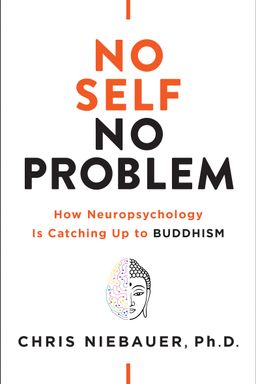
No Self, No Problem cover

No Self, No Problem

by Chris Niebauer

No Self, No Problem explores the intersection of neuroscience and Buddhism, challenging the notion of a continuous self. Through evidence and practices like meditation, Chris Niebauer offers readers tools to understand and lessen mental suffering, fostering a more balanced and peaceful life.

Losing Your Self to Find Clear Consciousness

Have you ever heard that small voice in your head narrating everything you do — the one that judges, worries, and insists it is you? What if that voice isn’t who you truly are? In The No Self, No Problem Workbook, neuropsychologist Chris Niebauer invites you to consider a radical truth: your sense of a permanent, separate self is nothing more than a story invented by the left side of your brain. Once you recognize that the self is an illusion, he argues, you uncover what he calls clear consciousness — a state of present, non-conceptual awareness that brings peace, creativity, and joy.

Niebauer’s central claim bridges Buddhist philosophy and modern neuroscience. For over 2,500 years, Buddhist teachers have spoken of anatta — the doctrine of “no self.” Meanwhile, brain science now reveals that the left hemisphere, which handles language and logic, continually constructs stories to explain the world, including the grandest story of all: the story of “me.” The problem? This interpreter gets things wrong — often — and then defends its mistakes with unshakable certainty. The result is mental suffering, anxiety, and disconnection from reality.

The Thinking Mind and Its Trick

The key insight of Niebauer’s work is that the thinking mind is a useful tool that has taken control of its user. The left brain — what he calls the “interpreter” — has evolved to connect patterns, create meaning, and tell stories, all in the name of survival. Yet those same skills now lead it astray. Niebauer draws on the famous split-brain studies of Michael Gazzaniga and Roger Sperry, showing that when the two hemispheres are cut off from each other, the left brain still invents reasons for actions it did not cause. When a person’s right brain points to a snow shovel and their speaking left brain can’t see the image, the left brain quickly fabricates a believable story — “The shovel goes with the chicken coop.” This tendency, Niebauer argues, drives nearly every story the brain tells, including the one called “I.”

Moving from Concept to Experience

Learning that you have no self isn’t enough; you must experience it. That’s why this book is a workbook filled with exercises, reflections, and experiments. You’re encouraged to notice how automatic your thoughts are, how easily your mind fills in the blanks, and how it constantly turns life into categories, judgments, and rules. You’ll test how your mind interprets reality through illusions and logic puzzles that demonstrate just how confidently wrong it can be. Through these experiences, Niebauer helps you see that mental suffering arises from identifying with thoughts and mistaking them for reality.

The antidote? Reconnecting with what he calls clear consciousness — the wordless, right-brained awareness that exists before thinking starts. This is mindfulness stripped of dogma. It’s the same experiential knowing that the Buddha described as awakening, or what modern neuroscience interprets as direct, sensory consciousness. You already know it when you lose yourself in music, nature, or deep presence. The workbook’s practices — from mindful breathing to drawing with your non-dominant hand — help you strengthen that presence and loosen the grip of thought.

Why “No Self” Matters

When you stop believing the mind’s story of a separate self, Niebauer says, problems begin to dissolve. Just as the Buddha taught that attachment and aversion create suffering, neuroscience now shows that the brain inflates problems to give itself something to solve. Modern humans — with technology, comfort, and abundance — live better than any kings of old, and yet our minds still generate anxiety, envy, and dissatisfaction. “The mind is a problem creator, not a problem solver,” Niebauer writes. The trick lies in recognizing that the self who claims to have problems doesn’t even exist as an independent thing.

In practical terms, “no self” means freedom. When you see your thoughts as neural patterns rather than ultimate truth, you stop arguing with life. You forgive more easily, cultivate gratitude, embrace uncertainty, and meet experience with curiosity rather than fear. Niebauer’s tone is remarkably down-to-earth — instead of grand spiritual promises, he offers small, tangible steps, like taking one conscious breath or noticing how your attention moves. He calls this the “power of small moves,” a practical way to outsmart the left brain’s addiction to perfection and control.

Bridging Science and Spiritual Practice

This work stands at the intersection of Eastern mysticism and Western empiricism. Niebauer joins figures like Jill Bolte Taylor (author of My Stroke of Insight) and Ian McGilchrist (The Master and His Emissary) in rethinking how the hemispheres shape consciousness. He translates Buddhist wisdom into the language of modern neuroscience: instead of simply telling you to “let go of ego,” he shows how your brain constructs the illusion and how awareness can dissolve it. The result is a handbook for integrating the scientific and the spiritual, reconnecting the “two sides” of mind into one sane, balanced whole.

Ultimately, The No Self, No Problem Workbook is about remembering who you already are beneath thought. You are not the chatter, not the stories, not even the thinker. You are the clear consciousness that observes it all — vast, aware, and at peace. And from that perspective, as the saying goes, there truly is no self, and therefore, no problem.


The Left Brain’s Great Illusion

At the center of Niebauer’s argument lies a shocking discovery: the brain invents explanations, then believes them. Decades of split-brain research revealed that the left hemisphere acts as an “interpreter,” spinning stories to make sense of actions and perceptions it doesn’t fully understand. When deprived of information, it doesn’t say, “I don’t know” — it fills in the blanks with convincing fictions. This is not a flaw; it’s what kept our ancestors alive. But in modern life, this machinery fuels illusion, self-importance, and unhappiness.

The Storytelling Machine

In one classic experiment by neuroscientist Michael Gazzaniga, a split-brain patient saw a chicken foot with the left hemisphere and a snowy scene with the right. Asked to choose a related image, the right hand (left brain) picked a chicken; the left hand (right brain) picked a snow shovel. When asked why, the patient’s speaking left hemisphere—cut off from the right brain’s vision—answered confidently: “You need a shovel to clean the chicken coop.” It fabricated a plausible story on the spot. Niebauer highlights this as evidence that the narrative of self is equally made up — the ultimate “shovel explanation.”

Whether thinking about who we are, why we acted a certain way, or how others see us, our interpreter continuously weaves incomplete data into coherent tales. The cost of this narrative compulsion is high: we mistake thoughts for facts and stories for truth. When the mind’s analysis becomes the only reality we trust, we drift into abstraction and lose direct experience of life.

How Fiction Becomes Identity

The storyteller mind doesn’t just explain actions; it invents a character — you. It remembers what happened last week, projects what could happen tomorrow, and arranges these events into a continuous narrative. Over time, the left brain convinces itself that this ongoing commentary is permanent and logical. But neuroscience and Eastern philosophy agree: the self is neither permanent nor logical. It’s a mental construct.

That’s why Niebauer writes that “you are not the story in your head.” What feels like a solid “I” is only a collage of memories, roles, and repetitive thoughts. Realizing this can feel destabilizing at first — the left brain panics when its champion illusion is challenged — yet it’s profoundly freeing. When this identification loosens, what remains is a panoramic awareness, the right brain’s perspective of total presence.

Seeing Through the Interpreter

Through cognitive games and paradoxes, Niebauer helps you catch the interpreter in action. Simple exercises like guessing the next number in a sequence (2, 4, 6, …) or assuming why “Joe went to get his glasses” reveal how the brain leaps to conclusions. The correct answer — “I don’t know” — rarely occurs to the mind. He calls this the practice of the “don’t-know mind”, a cornerstone of Zen. It’s not ignorance but humility, a space where curiosity replaces certainty.

Learning to recognize the interpreter’s fabrications replaces blind belief with playful observation. As you begin to doubt the mind’s authority, the illusion of self softens. You no longer have to defend the narrative, because you see that it’s only a function — not a fact.

(As philosopher Alan Watts noted, “We seldom realize ... that our most private thoughts and emotions are not actually our own.” Niebauer’s neuroscience gives this intuition experimental grounding.)


Escaping Left-Brain Laziness

Although the left brain prides itself on intelligence, Niebauer reveals that it’s also lazy and biased. It runs on shortcuts — confirmation bias, motivated reasoning, and cognitive dissonance — to protect its sense of being right. Instead of looking for truth, it seeks comfort and consistency. The irony is that this ancient efficiency mechanism now keeps us stuck in patterns of misunderstanding and stress.

Biases that Shape Reality

The mind’s default mode is to confirm existing beliefs, not challenge them. This explains why even well-educated thinkers fall for logical errors. Niebauer explains phenomena like the Wason selection task—where most people choose the wrong cards to test a rule—and motivated reasoning, where people unconsciously defend beliefs that serve their self-image. His examples are vivid: when told that coffee may increase cancer risk, habitual coffee drinkers (especially women) found far more flaws in the study than non-drinkers. The mind doesn’t seek truth; it seeks reassurance.

The Bias of Being “Better Than Average”

Another irresistible illusion is the belief that we are just a bit above average — in intelligence, honesty, and work ethic. Statistically impossible, yet nearly universal. Why? Because admitting flaws would trigger cognitive dissonance — the discomfort of inconsistency between belief and fact. We soothe it by bending perception instead of changing behavior. The left brain’s obsession with being right blinds us to self-awareness, fortifying the illusion of a competent self.

Overcoming Laziness with Awareness

Niebauer’s approach to “outsmarting” the lazy brain is paradoxical: don’t fight it with willpower but notice it with awareness. Exercises like teaching others, seeking opposing views, or assigning a dollar “penalty” for wrong answers expose the cost of being sloppy. What keeps the left brain honest isn’t effort — it’s attention. Awareness activates curiosity, a right-brained quality that broadens understanding.

He writes, “Use the mind, or it will use you.” Awareness isn’t another form of thinking; it’s the witnessing of thought. By observing rather than obeying mental chatter, you awaken a second, deeper intelligence. This echoes the teaching of cognitive scientist Daniel Kahneman in Thinking, Fast and Slow: our automatic “System 1” can’t be eliminated, but our slow, deliberate awareness can keep it in check.

When you recognize that your mind is lazy, not evil, you stop resisting it and start working with it. Small moves — pausing before snapping back, checking facts, breathing — create micro-awakenings. Each pause is a moment of freedom from the autopilot of thought.


Awareness: The Antidote to the Illusion

If the left brain generates illusion, then awareness is the light that reveals it. Throughout the workbook, Niebauer emphasizes awareness not as an idea but as an experience—what Buddhism calls mindfulness and he reframes as clear consciousness. Awareness lives in the present moment, before interpretation begins. When you are aware, even the mind’s chatter becomes harmless background noise.

From Thinking to Noticing

In practice, cultivating awareness isn’t about erasing thoughts but shifting your identification away from them. Niebauer’s body scan and breathing exercises teach you to inhabit sensation rather than story. When you anchor awareness in the body — noticing your feet on the floor, your breath, the hum of life — the left brain’s barrage of analysis softens. Awareness reveals that you don’t think your experiences; you experience them directly.

The Lazy Mind Hates Attention

Attention, another right-brained quality, naturally resists distraction. But the left brain thrives on chasing novelty. By training attention — through observing where your gaze goes, or noting what you failed to notice — you interrupt the mind’s automatic programs. In one simple exercise, Niebauer asks you to look around and list the first three things that catch your eye. Then ask, why those? Hunger, memory, or cultural conditioning? This reveals how much of our attention is pre-programmed, not freely chosen.

The Power of Observing Attention

Becoming aware of the mind’s mechanisms transforms life. Even unwanted emotions — anger, sadness, fear — can be met as passing weather, not identity. Niebauer helps readers practice “strengthening awareness” because, like any muscle, it grows with use. Awareness makes thinking transparent; you see through the storyteller’s tricks. In this seeing, the mind continues its storytelling, but it no longer runs the show.

(As meditation teacher Jon Kabat-Zinn writes, “You can’t stop the waves, but you can learn to surf.” Niebauer’s “clear consciousness” is the surfer.)

Ultimately, awareness bridges the brain’s hemispheres — it integrates logic with wonder, focus with flow. You don’t silence the left brain; you teach it its proper place as a servant, not the master. From here, the chatter loses urgency, and reality shines through freshly — simple, vibrant, unfiltered.


The Happiness of the Right Brain

In contrast to the left hemisphere’s obsession with stories, the right brain lives in direct experience. It sees connection where the left sees division, wholeness where the left sees categories. For Niebauer, the path to happiness isn’t about eliminating thought — it’s about restoring balance and giving the right brain a chance to speak.

Learning from the Pirahã

To illustrate right-brained living, Niebauer describes the Pirahã tribe of the Amazon, perhaps the happiest people on Earth. The Pirahã live entirely in the present, guided by direct experience rather than stories, hierarchies, or numbers. They have no words for counting, no myths of origin, and no interest in abstract talk about the past or future. When told about Jesus, they asked missionary-linguist Daniel Everett whether he had met Jesus personally; when he said no, they lost interest. Their wisdom: only direct experience counts.

The Pirahã also have no social hierarchy — no one orders anyone else around — and yet their communities remain harmonious. Their language, based on tone and song, engages the right brain’s musical capacity to process meaning beyond words. Niebauer calls them “the happiest right-brained people on the planet.” They exemplify what it means to live as awareness rather than self, in participation rather than separation.

Small Practices, Great Shifts

Inspired by such examples, Niebauer suggests small experiments: spend a day without telling stories about your past or future, or resist labeling everything with numbers and measures. Walk barefoot on the earth, literally grounding yourself to nature’s energy. These practices bypass the left brain’s abstractions and return you to living reality. As he explains through modern research, grounding even changes the brain’s electrical patterns, quieting overactivity in the left hemisphere.

This is the subtle secret of “no self”: your true being doesn’t exist as a concept but as alive, embodied presence. Artists, dancers, and musicians know this well. When you lose yourself in rhythm, or gaze at nature until perception softens, the sense of separation dissolves. The right brain doesn’t need to understand beauty — it becomes it.

Happiness, Niebauer concludes, is not something to find; it appears when the storytelling stops. In that silence, there is nothing missing — only consciousness itself, which is already whole.


Memory, Time, and the Fiction of Normal

Few passages in Niebauer’s book are as transformative as his exploration of memory. We like to believe that memory defines who we are, but neuroscience says otherwise. Memory is not a documentary of the past but a creative reconstruction of what the brain believes happened. Each time you recall an event, you rewrite it. In short, your memories — including the story of "you" — are myths you unknowingly repeat.

When Memory Becomes Identity

Niebauer recounts two extreme cases: Henry Molaison (H.M.), who lost the ability to form new memories after surgery, and Solomon Shereshevsky, whose photographic recall left him overwhelmed by endless detail. Henry lived peacefully without a past; Solomon suffered because he couldn’t forget. The lesson is profound: peace lies not in perfect memory but in freedom from it. Our happiness depends less on what we remember than on how tightly we cling to those stories.

Niebauer’s memory exercises reveal how easily we fabricate experience. When asked to recall a list of sleep-related words like “dream,” “night,” and “pillow,” most people confidently “remember” the word “sleep,” though it was never listed. The mind completes patterns automatically. Similarly, we remember relationships, failures, and regrets according to the stories we’ve already accepted. Realizing this opens the door to forgiveness — for others and for ourselves.

Letting Go of Past and Future

The self depends on memory to exist. When we stop replaying the past or anticipating the future, the self temporarily disappears — and peace emerges. Niebauer encourages practices like kintsukuroi on your memories, inspired by the Japanese art of mending broken pottery with gold. You revisit painful events and find the beauty in their scars, realizing how they’ve shaped your wholeness. Gratitude, rather than rumination, becomes the default.

He also dismantles the left brain’s obsession with “normalcy” and averages. Just as no pilot fits an “average cockpit,” no person fits an average self. “Normal,” he writes, is a mental category, not a reality. Recognizing that every moment and every person is unique releases enormous freedom. Normal is a fiction — and so is the self who tries to conform to it.

The more you see time, memory, and normality as conceptual scaffolding, the lighter life becomes. What remains isn’t emptiness but clarity: an ever-fresh now, immeasurable and alive.


Integrating Thinking and Being

If the path of No Self begins with questioning thought, it ends with integration — the reunion of the brain’s two halves, of science and spirituality, of mind and awareness. For Niebauer, enlightenment isn’t destroying the thinking mind but placing it back in harmony with the rest of existence. You don’t banish the left brain; you teach it to dance with the right.

Balance Without Control

When the left brain tries to control life, imbalance follows. Try to “not think about an elephant,” and the thought immediately appears. Try to fall asleep, and you stay awake. The secret is what Taoism calls wuwei — effortless action. Instead of pushing thoughts away, you allow them to exist and lose power through acceptance. As Viktor Frankl noted, “Whatever you resist, persists.” Acceptance restores balance naturally, like water settling when left alone.

The Feeling Universe

Right-brained integration goes beyond thinking into feeling. Emotions evolved before thoughts and often hold more truth. Practices like identifying where you “feel” a decision in your body — in the heart, gut, or limbs — nurture intuition over abstract reasoning. Niebauer describes this as finding your “whole-body yes.” The intellect becomes a servant of emotional and bodily intelligence. Integration, then, is unity across intellectual (IQ), emotional (EQ), and body (BQ) forms of knowing.

Ritual, Music, and Play

To integrate fully, the mind must rediscover ritual and play. Niebauer invites readers to create personal rituals — building an altar, drumming, dancing, or meditating — to re-engage the body and right brain. Music, he notes, activates every area of the brain and bypasses the interpreter entirely. That’s why pianist and Holocaust survivor Alice Herz-Sommer could say “Music is God.” Music unites all brain functions in harmony — it is, literally, integration in sound form. Through creativity and play, thought becomes art, not control.

Integration doesn’t end with serenity; it ends with laughter. Seeing that the mind’s drama was always just a dream, you can finally relax and play inside it. “If good happens, good; if bad happens, good,” Niebauer quotes Lao Tzu. Reality no longer needs managing — it simply unfolds.

At last, thought becomes transparent. You can use it but not be used by it. You realize, as Niebauer concludes, that consciousness created the self only so it could rediscover itself. In that moment, the mind’s favorite story comes to an end — and true life begins.

Dig Deeper

Get personalized prompts to apply these lessons to your life and deepen your understanding.

Go Deeper

Get the Full Experience

Download Insight Books for AI-powered reflections, quizzes, and more.