
Idea 1
Building a Culture of Freedom and Responsibility
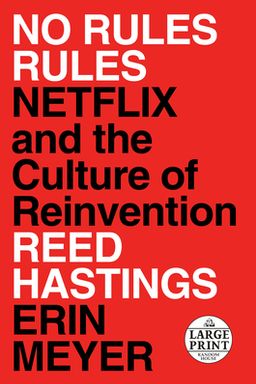
How do you build an organization where innovation runs faster than bureaucracy? Reed Hastings and Erin Meyer argue that culture—not strategy or technology—is Netflix’s real competitive edge. Their central claim is that when you combine high talent density, radical candor, freedom with responsibility, and context over control, you produce an agile, creative workforce capable of reinvention.
The book follows the evolution of Netflix’s unique management system: removing rules, empowering employees, and replacing control with trust. You’ll learn how Hastings and his leadership team dismantled traditional HR logic—bonus incentives, approval chains, and vacation policies—and instead built simple, judgment-based principles that scale across a global company.
From Crisis to Reinvention
The story starts in 2001 when Netflix laid off one-third of its workforce. Instead of a collapse, productivity soared. Hastings realized the lesson: with fewer but stronger people—what he calls talent density—collaboration becomes electric. Average performers drag down entire teams, but high performers challenge and elevate each other. Patty McCord and Hastings began to rebuild Netflix as a team of “stunning colleagues,” not a family of loyal mediocrity.
This shift unlocked further freedoms. Once talent density was high, leaders could remove controls—no vacation policy, no expense approvals—because they could trust judgment. (Note: this mirrors ideas in Ricardo Semler’s Maverick, where removing bureaucracy reveals intrinsic motivation.)
Candor as the Engine of Speed
High talent alone isn’t enough; communication must be brutally honest. Netflix institutionalized candor through feedback rituals—the 4A model (Aim to assist, Actionable, Appreciate, Accept or discard)—and live 360 dinners. Leaders model openness by publicly thanking critics and “shouting mistakes” while “whispering wins.” This transparency wipes out politics and boosts collective intelligence. Reed rewarded employees who challenged executives, making dissent a form of loyalty.
The principle is simple: say only what you’d say to someone’s face. Coupled with rejecting “brilliant jerks,” candor strengthens collaboration rather than fragmenting it. Leslie Kilgore’s blunt feedback to CFO Barry McCarthy became a turning point—proof that honesty with intent can transform leadership behavior.
Freedom and Responsibility
After building talent and candor, Netflix expanded trust through policies that sound radical but have pragmatic guardrails: unlimited vacations and decentralized spending. When people are trusted to “act in Netflix’s best interest,” most act responsibly. Abuse is punished individually, not by reinstating bureaucracy. Freedom is not permissiveness—it’s a privilege tied to accountability. (This echoes Daniel Pink’s idea in Drive: autonomy paired with mastery and purpose fuels motivation.)
Omarson Costa and Diego Avalos illustrate “freedom with responsibility” through contract-signing authority. They felt anxiety at first but quickly elevated their diligence and ownership. Netflix turns freedom into growth pressure—people perform better when entrusted deeply.
Leading with Context, Not Control
Traditional leadership favours commands and approvals; Netflix prefers context and accountability. Leaders share metrics, financials, and strategic bets openly—even pre-IPO data—instead of hiding information. With enough context, employees make better decisions faster. Ted Sarandos and Melissa Cobb use the “tree” metaphor: Reed is the roots, senior leaders the trunk, and employees the branches. The informed captain on each branch makes local calls, like Adam Del Deo’s $4.6M Sundance purchase of Icarus that won an Oscar.
Open data and decentralized authority collapse layers of delay. When decisions go wrong, the reaction isn’t punishment—it’s learning. Failure is “sunshined,” documented, and shared as collective wisdom rather than buried shame. This ritual makes risk-taking safe and continuous innovation normal.
Scaling the Model Globally
Freedom and candor do not translate identically across cultures. Hastings partnered with Erin Meyer (author of The Culture Map) to interpret how Netflix’s values land in Japan, Singapore, Brazil, and the Netherlands. They learned to add a fifth “A” to feedback—Adapt—to honor local norms while retaining openness. Structured feedback dinners replaced spontaneous critiques in Japan; softened phrasing became standard in Singapore. The core remains constant—trust, honesty, responsibility—but practices flex culturally.
The Philosophy in One Sentence
Freedom works only with talent, candor, and context.
Netflix’s model is simple but demanding: hire stunning people, pay them top of market, teach them to speak truth kindly, give them ownership, share all information, and hold them accountable. Replace control with trust, rules with judgment, and fear with curiosity.
If you apply these principles—dense talent, radical candor, freedom and context, and accountability through informed captains—you’ll build an organization that can adapt faster than competitors while staying humane. That’s the essence of a culture of Freedom and Responsibility.