
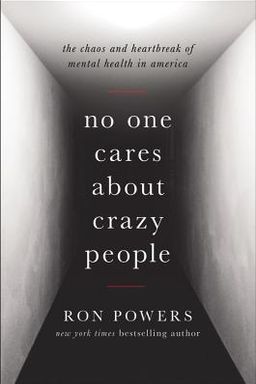
No One Cares About Crazy People cover

No One Cares About Crazy People

by Ron Powers

No One Cares About Crazy People delves into the turbulent history of mental health care in America, unveiling the impact of policy decisions on individuals and society. Through compelling narratives, it highlights the urgent need for reform and compassionate care.

Bearing Witness to Mental Illness and Silence

You begin with Ron Powers’s piercing question: why do societies tolerate suffering among the mentally ill when they would never tolerate it among any other vulnerable group? Through his family’s tragedies—the suicide of his younger son Kevin in 2005 and the psychotic collapse of his elder son Dean—Powers confronts this question with both personal and public urgency. The book that he once vowed not to write becomes his act of witness, a way of breaking silence born from shame and disbelief.

Private grief becomes public duty

You follow Powers from mourning to moral activism. For nearly a decade after Kevin’s death, he kept quiet—out of respect, out of fear of exploitation, out of exhaustion. Then Dean’s illness and a Vermont Senate hearing about psychiatric care awakened him. Seeing people with psychosis testify—speaking clearly, painfully—broke his abstraction about “the insane.” Powers realized he had treated their suffering as statistics. That hearing, and a contemptuous line from a Wisconsin political aide—“No one cares about crazy people”—became the phrase that shook him into action.

A broken system and a vow renewed

Outrage met understanding. Powers saw that mental illness was not a private tragedy but a systemic failure that extended from historical cruelty to modern neglect. The book thus threads together his family’s story and America’s institutional history—from chained patients at Bedlam through compassionate reformers like Philippe Pinel and Dorothea Dix to the shattered promise of deinstitutionalization in the twentieth century. He uses his sons’ experiences to ask whether policy, law, and medicine have become tools of abandonment rather than instruments of care.

The promise of medicine and the politics of desertion

The first antipsychotic drugs—Thorazine, Haldol, later atypicals—were hailed as breakthroughs. They promised liberation from lifelong confinement. But as Powers demonstrates, this pharmaceutical optimism carried a tragic corollary: politicians and hospital administrators rapidly emptied asylums without building the community infrastructure needed to care for patients outside. The result was the new visibility of untreated psychosis on urban streets and in prisons. Deinstitutionalization, he insists, became a humanitarian disaster disguised as progress.

Why witness matters

Powers’s witness is not simply personal testimony but an act of reclamation. He consecrates names—Kevin and Dean—as counterarguments to stigma. He writes to tell families they are not alone, to persuade the fearful that “those labeled crazy” are full, dimensional people, and to preserve memories that illness and bureaucracy would erase. His moral architecture rests on three pillars: to humanize, to educate, and to act. Personal loss becomes political conscience.

From memoir to movement

By merging memoir with historical journalism, Powers turns private despair into a call for systemic reform. His narrative moves from childhood idylls at Bread Loaf and the Homer Noble Farm—where his sons thrived in music, literature, and imagination—to their torment within the limits of law, pharmacology, and policy. The arc from joy to tragedy mirrors the nation’s descent from humane care to bureaucratic abdication. What began as a promise to his sons becomes a renewed vow to the reader: to care, to reform, to witness again until indifference itself is shamed into change.

Core moral claim

“No one cares about crazy people” is not a literal fact—it is an accusation against a culture that confuses autonomy with abandonment. Powers transforms that shameful sentence into the book’s organizing moral demand: care must be visible, funded, and sustained.

You leave this opening idea understanding that Powers’s book is not just about mental illness—it is about the national conscience. His family stands as evidence and indictment, his writing as an insistence that empathy must translate into action. (Comparable in tone to William Styron’s Darkness Visible and Andrew Solomon’s Noonday Demon, the book combines literary grace with civic urgency.)


The Biology and Faces of Schizophrenia

You then shift from moral question to scientific mystery. Powers guides you through what neuroscience and lived experience together reveal—and conceal—about schizophrenia. The illness, affecting roughly one percent of humans, symbolically stands for the whole struggle of psychiatry: a chronic brain disorder blurred by myth, stigma, and incomplete knowledge.

Genes, environment, and adolescent risk

Schizophrenia is not one condition but many overlapping failures of brain circuitry. Genes set the stage—hundreds of variants involved in dopamine, synaptic pruning, and neurodevelopment—but environment cues the onset. You learn about Feinberg’s pruning hypothesis: during adolescence, the brain sculpting process can accidentally eliminate too many synapses in the prefrontal cortex, allowing psychosis to surface. Prenatal stress, trauma, or drug use amplify the risk. (Note: similar principles apply across mood and neurodegenerative disorders.)

Symptoms beyond stereotypes

You should recognize three clusters—positive symptoms like hallucinations or delusions, negative ones such as emotional withdrawal, and cognitive deficits in memory and planning. Powers humanizes these abstractions through Kevin and Dean’s patterns: Kevin’s voices and grandiosity, Dean’s dreamy isolation. They illustrate how illness intersects with identity—the same imagination that produced art can turn against itself under disease pressure.

Anosognosia and family confusion

One of the book’s most haunting concepts is anosognosia—the brain’s blindness to its own illness. Roughly half of people with schizophrenia cannot recognize their condition. Kevin insisted he merely had "a condition," hiding pills and rejecting care. Families confronting anosognosia meet legal walls: in most states, involuntary treatment demands proof of "imminent danger," often long after the early rescue window closes.

Limitations of treatment

Medication stabilizes symptoms but rarely cures. Depot injections, as Dean later accepted, help when adherence fails. Yet side effects—tardive dyskinesia, weight gain, metabolic damage—make long-term use fraught. Imaging studies confirm altered brain regions but cannot explain causation. Powers translates these uncertainties into a human truth: families cannot wait for perfect science while suffering demands practical action now.

The research humility

Every technological insight into schizophrenia—a new scan, a new gene—arrives paired with one ethical obligation: remember that people live inside these data points.

You leave understanding schizophrenia not as madness but as a biologically driven, socially compounded human condition that families navigate daily, caught between the limits of medicine and the limits of law.


From Compassion to Collapse: The Asylum Story

You explore the historical arc that made modern failures possible. Powers reconstructs how Western society moved from cruelty to compassion—then back toward neglect—through the evolution of mental institutions. It’s a story of good intentions undone by scale and politics.

From Bedlam to moral treatment

Early asylums such as London’s Bethlem were spectacles of suffering: patients chained, mocked, displayed for entertainment. Reformers like Philippe Pinel and William Tuke reversed that model by advocating humane care—food, exercise, dignity. Their ideas inspired Dorothea Dix in America, who campaigned for state-supported hospitals. For a time, these sanctuaries embodied kindness.

The Kirkbride ideal and its decline

Architect Thomas Kirkbride designed asylums lit by sunlight and surrounded by ordered gardens. But overpopulation and budget erosion turned humane institutions into custodial warehouses. The ideal dissolved, and by mid-century, horror returned under new forms—chemical restraint, overcrowding, and indifferent bureaucracy.

Policy lessons

Moral treatment showed that kindness could heal, but only under sustainable conditions. When funding, oversight, and staffing collapsed, compassion turned to containment. Modern reformers must grasp this cyclical truth: without enduring political will, humane care erodes into cruelty.

Echo to the present

Systems degenerate when society treats the mentally ill as costs instead of citizens. You see the same dynamic repeating in prison wards and tent encampments today.

By restoring history’s moral experiment to memory, Powers asks you not to repeat its mistake: dismantling care before building its successor.


Deinstitutionalization and the Era of Desertion

You reach the twentieth-century pivot—when policy, medicine, and ideology converged to empty hospitals across America. The Community Mental Health Act of 1963 promised humane transition; instead, it triggered one of public health’s greatest collapses. Powers calls it deinstitutionalization’s unintended fallout.

Idealism and chemical hope

President Kennedy envisioned community centers replacing asylums, propelled by optimism about Thorazine and newly coined 'antipsychotics.' The assumption was simple: if medicine could manage symptoms, confinement was obsolete. Yet funding lagged, community infrastructure never materialized, and hospital doors closed anyway.

The California experiment

California’s Lanterman-Petris-Short Act led the way—limiting involuntary commitment and accelerating releases. Governor Reagan’s budget cuts compounded the exodus. Patients left with no housing or clinical support, and homelessness soared. Soon civil-liberties rhetoric combined with antipsychiatry theory (Thomas Szasz’s influence, Scientology’s campaigns) to redefine coercion as oppression even when lifesaving care was withheld.

Human faces of policy

Powers tells of families like Livy and her son Martin, trapped between legal thresholds and medical inertia. Because courts insisted he be an imminent danger before involuntary treatment, prolonged psychosis destroyed his functioning. Across America, thousands mirrored this trajectory—protected by rights, abandoned by care.

The moral refrain

“No one cares about crazy people” repeats here not as insult but diagnosis: good intentions without funding equal neglect disguised as compassion.

This idea completes the bridge between history and modern failure. You now see how legal protections, pharmaceutical faith, and fiscal austerity combined to leave the most vulnerable unprotected—an enduring caution to all reformers.


Medicine, Profit, and the Betrayal of Trust

Powers extends his critique to pharmaceutical and corporate systems. The same industry that created antipsychotics also exploited them through patent manipulation and off-label marketing. The result: a paradox where lifesaving drugs coexist with morally dubious business models.

From Thorazine to billion-dollar markets

You trace the path: laboratory accident to profit empire. Bayh-Dole (1980) let universities patent federally funded discoveries, privatizing public science. Companies like Smith, Kline & French evolved into multinational giants whose fines—Pfizer’s $2.3 billion, J&J’s $2.2 billion, Merck’s $4.85 billion—became routine financial penalties. Whistleblowers like John Kopchinski exposed concealed data and illegal promotion, but corporate inertia proved astonishing.

Clinical and ethical cost

Risperdal-induced gynecomastia in boys and dangerous interactions of Depakote or Paxil appear as tragedies between lab and courtroom. Powers emphasizes the moral injury of marketing drugs to institutions like nursing homes via kickback schemes. Profit incentivized overselling, transforming treatment into consumption.

Business as usual

“It’s just a cost of doing business,” one analyst quipped, encapsulating the moral vacancy at the heart of pharmaceutical economics.

For you as reader and citizen, the takeaway is vigilance: question prescriptions, monitor side effects, demand transparency. Powers argues that medicine’s miracles must be reclaimed from indifference and greed if mental health care is to regain credibility and compassion.


The Criminalization of Illness

One of Powers’s fiercest indictments targets the American justice system. In the vacuum left by deinstitutionalization, police, courts, and prisons absorbed the burden of mental illness—with deadly results.

Violence born of misunderstanding

Cases like Keith Vidal’s shooting in North Carolina and James Boyd’s execution in Albuquerque illustrate systemic failure. Officers untrained in psychiatric crisis escalate confrontations instead of defusing them. Body-camera footage serves as grim evidence that untreated psychosis is criminalized.

Jails turned hospitals

Facilities like Rikers now hold more mentally ill inmates than any hospital. Powers documents the deaths of Bradley Ballard and Jerome Murdough—neglect, heat, isolation. Solitary confinement worsens psychosis, producing suicides like Kalief Browder’s. The nation has traded psychiatric wings for punitive cages.

Systemic indictment

We replaced asylum abuse not with reform but with a new cruelty—mental illness punished as crime rather than treated as disease.

This chapter transforms outrage into evidence: each death or incarceration marks a breach of public moral duty. You’re asked to see prisons and policing as mirrors of policy negligence—and to imagine care that replaces punishment.


Science Twisted: Eugenics, Lobotomy, and Fallout

You next confront how misunderstood science mutates into cruelty. Powers revisits eugenics and lobotomy—two episodes revealing how technocratic zeal can erase humanity under the banner of progress.

Eugenics: the dark misuse of Darwin

From Francis Galton’s heredity theories to Madison Grant’s racial propaganda, evolutionary ideas became justification for sterilization and segregation. The Supreme Court case Buck v. Bell (1927) immortalized Holmes’s chilling declaration, “Three generations of imbeciles are enough.” These policies sterilized tens of thousands and inspired Nazi “euthanasia.”

Lobotomy: zeal without evidence

In the twentieth century, António Egas Moniz and Walter Freeman popularized lobotomy as cure-all. Freeman’s ice-pick method, performed on thousands, reduced people to docility. Critics like Stephen T. Paul called it “an act of defeat.” Powers contrasts this with the Menninger brothers’ humane psychiatry emphasizing therapy and dignity—the fork in medicine’s moral road.

Lesson from abuse

Scientific authority without ethical restraint breeds atrocity. Remember that humane intent must always meet empirical proof.

By marrying history to warning, Powers reminds you that even the best science can be corrupted by ideology or desperation. Ethical vigilance remains medicine’s first duty.


Paths to Recovery and Reform

You finish with hope—what works and how to rebuild. Powers highlights evidence-based recovery programs and legislative reforms showing that healing is possible when science and compassion align.

Community rehabilitation

The Vermont Longitudinal Study under Courtenay Harding revealed remarkable outcomes: when patients received job training, housing, and community integration, more than half achieved recovery. George Brooks’s Vermont model, NAMI’s advocacy, and Fountain House’s Clubhouse system prove that social scaffolding can sustain lives beyond symptom management.

Policy initiatives

Representative Tim Murphy’s Helping Families Act offers structural solutions—assisted outpatient treatment grants, data sharing between hospitals and families, and stronger federal coordination. Powers cites it as pragmatic reform balancing liberty and survival.

A humane synthesis

For caregivers, the strategy is integrated: early intervention, medication stewardship, psychosocial supports, and legal clarity about involuntary care. Dean’s eventual stability under Dr. Gordon Frankle demonstrates that persistence, trust, and structured community can convert survival into genuine living.

Final charge

Recovery depends as much on social will as on medicine. Without a culture that values dignity, even the best science will fail.

You close the book understanding that reform requires integration—of science, law, compassion, and sustained funding—and that personal witness like Powers’s must become collective responsibility.

Dig Deeper

Get personalized prompts to apply these lessons to your life and deepen your understanding.

Go Deeper

Get the Full Experience

Download Insight Books for AI-powered reflections, quizzes, and more.