
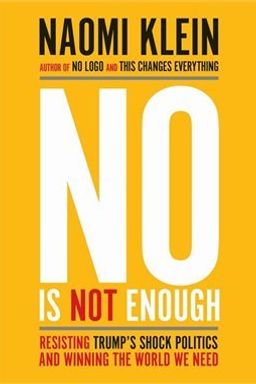
No Is Not Enough cover

No Is Not Enough

by Naomi Klein

Naomi Klein''s ''No Is Not Enough'' dissects the initial months of Trump''s presidency, revealing how his brand-driven tactics exploit crisis moments to push through controversial policies. The book offers strategies for resistance and outlines a hopeful vision for a more just society.

Defeating the Shock Politics of Our Time

Have you ever felt so overwhelmed by political chaos that you couldn’t imagine what comes next? In No Is Not Enough: Defeating the New Shock Politics, Naomi Klein argues that in our age of crises—political, environmental, and social—just saying "no" to bad leaders and bad policies isn’t enough. Klein contends that Donald Trump is not an anomaly but rather the logical product of decades of neoliberal ideology, rampant branding culture, and economic greed. To fight back, she insists, we must craft and defend an appealing, credible vision of the world we actually want—one that combines care, justice, and ecological sanity.

The Shock Doctrine Meets Branding Politics

Klein draws on research from her earlier work, The Shock Doctrine, where she showed how elites exploit collective crises to push through unpopular economic policies. Trump, she warns, operates exactly this way: generating chaos to distract the public while enacting a corporate coup. However, Trump adds a twenty-first–century twist—he brings to politics the logic of reality television and branding. When he became president, his for-profit empire merged with the White House, symbolizing a blurring of boundaries between governance and commerce. As Klein writes, the Trump brand represents “money, power, impunity, and greed—all the stories our culture has been telling for decades.”

Why Neoliberalism Paved the Way

To Klein, Trump didn’t create America’s problems—he exploited them. For forty years, neoliberalism dismantled public services, celebrated privatization, and normalized greed. When governments told citizens there was “no alternative” to corporate control (as Margaret Thatcher famously declared), despair set in, leaving people vulnerable to demagogues promising strength and restoration. Trump’s rise was helped by decades of bipartisan worship of the market, from Reagan’s tax cuts to Bill Clinton’s financial deregulation. Klein calls his administration “the naked corporate takeover” of U.S. democracy—a culmination of neoliberal policies that were always about concentrating wealth and eroding public accountability.

From Reality TV to Political Theater

Klein explores how Trump perfected his persona through television. The Apprentice transformed firing people into entertainment, turning cruelty and selfish ambition into virtues of “success.” It taught millions that being ruthless is heroic. Trump’s presidency, she writes, is simply season two—an ongoing spectacle whose real purpose is distraction. Every tweet, crisis, and scandal keeps the audience engaged while policy changes dismantle protections for workers, women, and the planet. The everyday drama is the strategy.

From “No” to “Yes”: Creating a Positive Vision

Klein’s deepest argument is that progressive movements must go beyond protest to articulate a vision people can fight for. She calls this project the “Leap”—a people’s platform designed around care, justice, and a transition from extractive capitalism to regenerative economics. She surveys global movements—from Standing Rock’s Indigenous water protectors to Black Lives Matter and youth climate strikes—showing how they already embody this affirmative approach.

Why This Book Matters to You

Klein invites you to see Trump as a mirror of our culture—a reflection of our obsession with wealth, branding, and instant gratification. Overcoming him means confronting those tendencies within ourselves and our politics. Her call is not just to resist but to build something better: democratic movements that unite racial, economic, and ecological struggles under a shared moral vision. The book urges each reader to become “shock resistant,” ready not just to survive the next crisis but to transform it into a generative moment of solidarity and change.


The Rise of the Branded Presidency

Naomi Klein traces how Donald Trump’s presidency represents the culmination of branding culture’s takeover of politics. Drawing from her foundational analysis in No Logo, she explains that corporations once sold products—but in the late twentieth century, they began selling identities and feelings. Trump brought this shift to its ultimate form, becoming a human logo whose greatest product is himself.

Trump as the Ultimate Lifestyle Brand

Starting as a real estate developer, Trump sold more than luxury buildings—he sold access to a fantasy of power and wealth. His gold-covered towers and ostentatious hotels offered a lifestyle brand for the ambitious and status-obsessed. Later, with The Apprentice, Trump turned his persona into television mythology, broadcasting the credo: “Be ruthless, and you’ll win.” Klein notes that Trump absorbed what Nike and Apple had discovered decades earlier—emotions were more profitable than objects. His transition from developer to celebrity and then to president mirrors the logic of neoliberal capitalism itself: shed substance, keep the brand alive.

The Merging of Commerce and Government

Once in office, Trump treated the presidency like a global franchise. His resorts, hotels, and family products all profited from his newfound power. Klein points out how his family’s brands benefited from political access—Ivanka Trump’s trademarks were approved in China the same day she dined with its president at Mar-a-Lago. The White House became a showroom for private gain. This blurring of public and private spheres illustrates a deeper cultural sickness: the triumph of individual ambition over collective value.

The Entertainment Presidency

Klein compares Trump’s rallies and televised feuds to professional wrestling—entertainment rooted in fake conflict and moral simplicity. At campaign events, he became ringmaster, leading chants like “Lock her up!” and turning politics into spectacle. Like wrestling fans, his audience knew the show was staged but enjoyed the cruelty. This dynamic, she warns, destroys empathy and much of democracy itself. When government becomes reality TV, facts no longer matter—only ratings do.

The Cultural Fallout

Klein shows how Trump’s presidency has normalized performative cruelty. On The Apprentice, firing people became entertainment; in office, cutting environmental programs or deporting migrants offers similar spectacle. Behind every act is neoliberal logic made visible: treat people as disposable, measure success by profit and dominance. Trump is not the disease but the symptom. And Klein’s warning is clear—until we reject branding as a substitute for morality and belonging, politics will remain a marketplace of illusion.


The Shock Doctrine Returns

Klein’s central thread connects Trump’s tactics to her legendary concept of “the shock doctrine”—the systematic exploitation of crises to impose unpopular economic agendas. She demonstrates how Trump uses chaos, outrage, and distraction as governing tools, echoing decades of disaster capitalism.

Shock as Strategy

Like Chile under Pinochet or Iraq after the U.S. invasion (both cases Klein explored in her earlier work), Trump sought to overwhelm citizens with rapid-fire policy shifts and scandals. During his first weeks, he issued an avalanche of executive orders—travel bans, deregulation, cabinet nominations that gutted agencies. This constant sense of crisis makes organized opposition harder. Klein calls it “government by hurricane,” where confusion itself becomes political currency.

Disaster Capitalism on a Global Stage

Trump’s cabinet, she argues, reads like a portfolio of disaster profiteers. Oil executives like Rex Tillerson exploit environmental destruction; military contractors thrive on foreign wars. The pattern is familiar: elites use social trauma—economic collapse, terrorism, climate catastrophes—to advance privatization and deregulation. Even natural disasters become opportunities: after Hurricane Katrina, cities like New Orleans privatized schools and housing. Klein warns that Trump could use future crises—terror attacks, economic crashes, superstorms—as pretexts for more authoritarian control.

Resistance Through Memory

The antidote to shock politics, Klein asserts, is collective memory. Societies that recall past manipulations are easier to mobilize. She cites Argentina and Spain, where recent histories of dictatorship and state terror helped citizens recognize and resist new authoritarian moves. In the United States, she emphasizes reclaiming stories of resilience—civil rights, women’s suffrage, Indigenous resistance—as models of how communities can act when democracy falters.

Becoming Shock-Resistant

Klein’s lesson to you: in an era of manufactured chaos, emotional steadiness and history are acts of defiance. When leaders use fear to justify war or repression, remember that “crises are not inevitable—they’re managed.” She urges movements to plan for shocks, responding not with confusion but with solidarity and clarity. “We can learn to be immune,” she writes, “not by avoiding crisis but by confronting it together.”


Climate, Capital, and Catastrophe

Klein dedicates key chapters to the intersection of climate disaster and economic greed. She recounts visiting the dying Great Barrier Reef just before Trump’s election—a vision of the fragile planet his administration endangers. Trump, she argues, represents not just denial of climate science but denial of empathy itself.

Profit Over Planet

Trump’s team, led by fossil fuel magnates and climate skeptics, treats environmental collapse as business opportunity. ExxonMobil and associates have spent decades funding disinformation while preparing to profit from melting ice caps and new drilling frontiers. Klein contrasts this cynicism with the moral urgency required now: scientists estimate humanity must end fossil fuel dependence almost immediately to avoid catastrophic warming. Instead, Trump pushes for coal expansion, pipeline construction, and withdrawal from the Paris Agreement—policies she calls “a death sentence written in crude oil.”

Climate and Inequality

Klein links ecological ruin to social injustice. Environmental destruction concentrates suffering among poor and nonwhite communities—the same people hit hardest by neoliberal austerity. The logic is identical: extract maximum value, dispose of those left behind. She introduces the concept of “slow violence” (drawing on Rob Nixon), describing how climate change quietly robs future generations of beauty and safety. Watching her own son encounter coral for the first—and possibly last—time, Klein frames climate collapse as intergenerational theft.

Building the Caring Economy

Against this, Klein proposes the “Leap” as a moral and practical framework: moving from an economy of extraction to one based on care. Renewable energy, local agriculture, public transit, and social equity can form an integrated transition. She urges readers to start re-imagining not only what we reject but what we affirm—a society that measures progress by collective well-being rather than consumption. The book’s message is clear: a livable climate requires a livable moral system.


The Politics of Hate and Division

Naomi Klein argues that Trump’s success depends on the weaponization of resentment. His emotional core isn’t policy but rage—against immigrants, women, Black activists, journalists, and anyone challenging traditional hierarchies. Klein situates this fury within capitalism’s broader strategy: divide and rule.

Race, Gender, and Economic Insecurity

The 2016 election, Klein writes, was driven by a blend of “whitelash” and “malelash”—white and male backlash against social progress. Many Trump voters feared declining economic and social status as jobs disappeared and women, immigrants, and people of color gained visibility. Trump spoke directly to that anxiety, promising to restore lost dominance. His rally cry “Make America Great Again” was less about prosperity and more about hierarchy. Klein reminds readers that this tactic isn’t new: elites have long used race and gender divisions to distract the public from class exploitation (as W.E.B. Du Bois and Michelle Alexander have shown).

Lovelessness as Policy

Neoliberalism, Klein argues, is institutionalized lovelessness—a system that treats people and the planet as disposable. When social safety nets are shredded and economic security evaporates, fear fills the void. That fear is easily redirected into hostility toward “others.” Trump’s cruelty on immigration and policing reflects an economy built on neglect. Klein quotes Cornel West: “Justice is what love looks like in public.” Trump’s agenda, by contrast, is lovelessness in public—a politics that glorifies indifference.

Hope in Intersectionality

Yet, across this bleak landscape, new alliances are rising. Klein praises movements that connect racial, gender, and economic justice—Black Lives Matter, climate activists, and Indigenous defenders—to craft an intersectional resistance. No one front can win alone; unity is our most radical act. As she puts it, “We can only beat Trumpism in cooperation with one another—when they come for one, they come for us all.”


How “No” Becomes “Yes”

At the heart of No Is Not Enough lies Klein’s prescription for moving beyond protest. She observes that after 2008, progressive movements worldwide shouted “no” to austerity and corporate greed—but rarely articulated what should replace them. The result was stagnation, leaving space for Trump’s “fake populism.”

Learning from Missed Opportunities

Klein revisits Barack Obama’s presidency as a turning point. In 2009, with the economy in crisis, Obama had massive public support and a mandate for transformation. Instead, his administration bailed out banks with few reforms, shortchanged green infrastructure, and let inequality deepen. The chance to rebuild Main Street rather than Wall Street was squandered. Klein warns that when progressive leaders settle for tinkering, the window for radical change closes—and regressive forces rush in.

Rediscovering Utopian Imagination

True change, she argues, requires daring to “dream out loud.” Past eras of transformation—the abolition of slavery, the New Deal, the civil rights movement—were powered by utopian visions. Today, however, imagination has atrophied. Klein urges movements to revive it by articulating democracy as care, equality, and ecological survival. Quoting Oscar Wilde, she writes, “A map of the world that does not include Utopia is not worth even glancing at.”

Building the Future as We Go

Klein’s solution is active creation: movements should model the values they fight for even before winning power. She highlights Standing Rock as an example—its camps functioned as schools for sustainable living and community care. There, activists didn’t just resist pipelines; they demonstrated an alternative way to coexist with land and people. In times of crisis, Klein insists, “we must build the world we want as we go.”


The Leap: Blueprint for a Caring Civilization

In her conclusion, Klein unveils The Leap Manifesto—the book’s most tangible vision for a post-Trump world. Co-created with activists, Indigenous leaders, and workers in Canada, it charts a pathway toward an economy based on caring for the earth and one another. The Leap transforms Klein’s critique into construction.

A People’s Platform

The Leap calls for a rapid transition to renewable energy, public transport powered by clean sources, and democratic ownership of essential systems. It insists that Indigenous rights and environmental protection must lead the way—communities most harmed by extraction should control the new green economy. Klein proposes “energy democracy,” where citizens—not corporations—own production, using profits to fund social programs. This unites climate action with economic justice.

From Extraction to Care

The manifesto reframes work itself: caring professions, education, and arts are “renewable energy.” By investing in people rather than pollution, societies can create jobs while healing communities. Klein argues that the root sickness of neoliberalism is endless taking—of land, labor, and life. The antidote is reciprocal caretaking: when we take, we also give back.

Turning Crisis into Opportunity

Klein concludes boldly: catastrophe can spark rebirth. Whether climate disasters, economic shocks, or pandemics, each can be transformed into a “People’s Shock”—a moment to leap forward toward justice instead of retreating to fear. The Leap teaches us to “build the caring majority within reach”—a global movement to replace extraction with regeneration and profit with purpose.

Dig Deeper

Get personalized prompts to apply these lessons to your life and deepen your understanding.

Go Deeper

Get the Full Experience

Download Insight Books for AI-powered reflections, quizzes, and more.