
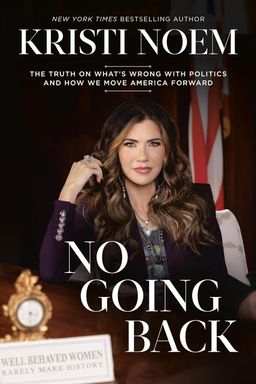
No Going Back cover

No Going Back

by Kristi Noem

The governor of South Dakota and author of “Not My First Rodeo” gives her take on where the Republican Party is headed.

Forward, Not Back: Citizens Over Establishment

When the next crisis hits your town—another pandemic, a border surge, or a school board firestorm—who do you expect will show up to fix it? In No Going Back, Kristi Noem argues that the answer can’t be “Washington.” Her core claim is stark and simple: help is not on the way from big government, political insiders, or party establishments. If America is going to move forward, you and your neighbors must lead—locally, constitutionally, and with common sense.

Noem contends that the country doesn’t need a return to “normal” politics; it needs a reset that puts citizens back in charge. That reset starts with two commitments: leadership rooted in oaths to the Constitution (not to parties or personalities) and a bias toward action close to home. The book uses South Dakota as a proving ground for this thesis—what she calls a “pilot project” for governing through freedom—and contrasts that approach with her years in a sclerotic Capitol where members read from staff scripts and vote based on index cards.

What you’ll find inside

You’ll see behind-the-scenes stories about Congress—committee chairs pre-writing members’ questions, leadership handing out “Yes/No” vote cards, and the farm bill fight that pushed Noem to confront then–Majority Leader Eric Cantor. You’ll also see how South Dakota became her counterexample: refusing COVID lockdowns, expanding gun rights while dropping fees, consolidating agencies, and recruiting workers through “Freedom Works Here.”

A large thread is a case for constitutional courage during crisis. As COVID models predicted mass hospitalizations in South Dakota (ten thousand on a single day), Noem checked her legal powers, refused to deem businesses “nonessential,” and left schools and churches open. She describes politely but firmly dissenting from the Fauci/Birx consensus, leaning on outside data and Dr. Scott Atlas, and writing practical funding guidance the Treasury later sent to all states. Agree or disagree, her emphasis is consistent: never outsource your judgment or your oath to “the experts.”

What “breaking and building” looks like

Noem groups today’s actors into breakers and builders. She credits Donald Trump with blowing up complacent assumptions (her roadside, eighteen-hour Nashville drive during 2016—passing MAGA hats and flags on trucker caps—cemented her sense that the “experts” were missing the country). But breaking isn’t enough; you need builders who translate disruption into durable policy. She recounts the messy work of uniting a divided state party, firing an attorney general of her own party for cause, and turning a viral joke—“Less COVID, more hunting”—into grassroots energy and national fundraising.

Education policy is another test case. The book’s most repeated mantra—talk moderately so you can govern conservatively—shows up in her school fights: pushing a plain-language civics revival, banning critical race theory from state universities, expanding homeschool freedom, and pressing school boards for transparency. She argues parents are the real experts (echoing the parent-led “education freedom” movement in other states)

Globally, she moves from treadmill runs at a razor-wired base in Afghanistan to the DMZ in Korea and hotel rooms ransacked by Chinese security. Those encounters animate a hawkish, pragmatic “Noem Doctrine”: America First but not America alone; peace through strength; fight to win; and treat immigration as national security. She details state-level counter-CCP moves—blocking state business with hostile regimes, banning TikTok on government devices, and seeking to restrict foreign adversaries’ land purchases.

A first principle

“Under God the people rule” (South Dakota’s motto) doubles as Noem’s civic philosophy. She frames her oath to the state and federal Constitutions as the governor’s true “job description,” a decision rule she uses on every bill: Is it constitutional? What are the 10–20 year consequences? Will it increase freedom?

Why this matters for you

If you’re frustrated by polarization, the book argues the cure isn’t nostalgia or more hot takes. It’s a concrete blueprint: show up (PTA to precinct), keep conversations neighborly and specific, insist on single-subject bills and paper ballot trails, and expect leaders to explain themselves at town halls. Her most quotable line may be the simplest: you are the most powerful person in government. In practice, Noem claims, three or four constituent calls inside her office are enough to flag an issue.

In short, No Going Back says the “adults in the room” aren’t coming. The “adults” are you and the people on your street. Channel your anger on behalf of others (she cites Arthur Brooks on rejecting contempt), take risks with your own “wolf pack,” and rebuild from the ground up—because durable freedom is local, constitutional, and lived.


Break Washington’s Scripts

Noem’s eight years in Congress convinced her that insiders prize choreography over problem solving. She recounts walking into her first committee hearing prepared with questions—only to be handed a paper: “Here are the chairman’s questions you’re going to ask.” When she declined, staffers warned that the chairman needed a specific “narrative.” She asked her own questions anyway. That defiance becomes a theme: if you let others define the script, you also let them define the outcome.

The vote-card culture

On the House floor, she saw members clutching color-coded cards from staff—Yes on 8, No on 9; Motion to recommit—No—often without reading the bill. “Most of my peers often had no idea what they were voting on,” she writes. The “helpful” index cards were more than reminders; they were minders. This hollowed-out process—staff scripts, leadership pressure—explains, in her telling, how complex omnibus bills snowball behind closed doors while constituents are kept in the dark.

A farm bill, a poison pill, and a showdown

Her signature DC story is the 2013 farm bill. After Republicans tacked on work requirements for SNAP, Democrats bolted and the bill failed—“needlessly,” Noem says. She marched to a GOP conference mic and challenged Majority Leader Eric Cantor for having “no plan” to resurrect must-pass food and farm policy. Summoned to his office and scolded for embarrassing leadership, she dug in. The bill later passed after hard bargaining. The lesson she draws for you: coalitions still matter, but outcomes follow only when someone is willing to stand in the uncomfortable place and say “this is unacceptable.”

Single-subject bills or single points of failure

To fix congressional dysfunction, Noem backs a simple, radical reform: one subject per bill. Rather than stapling farm supports to welfare riders to Pentagon budgets to arts earmarks, she wants clean votes that citizens can track and representatives can explain. (Note: This echoes reformers from James Madison’s warnings about “logrolling” to modern good-government advocates; it also rhymes with Sen. Ben Sasse’s calls for transparency.) She argues a Speaker could launch this norm tomorrow without a constitutional amendment.

Constitution first, then consequences

The antidote to scripting is an anchor. Noem describes insisting that her governor’s office lawyers triage every bill through two filters: 1) Is it constitutional (state and federal)? 2) What are the 10–20 year impacts if we do this—or don’t? She learned long-term thinking from ranch life. Her father taught that “land doesn’t lie”: it records your choices years later. She extends that ethic to public finance and regulation.

(Context: Ronald Reagan made a similar case for principle before politics in his 1964 “A Time for Choosing.” More recently, Yuval Levin has argued for restoring “institutional responsibility”—people acting as, not just in, their offices. Noem’s version is more hands-on and executive: the oath as a daily decision rule.)

Practical takeaway for you

Ask your member of Congress to back single-subject rules in the House. Locally, insist your city council and school board publish agendas with one clear decision per vote and a plain-English summary of tradeoffs. You can make “anti-script” culture contagious from the bottom up.


Money, Messaging, and Missed Waves

Noem doesn’t deny that money matters; she reframes how to handle it. She tells donors bluntly: “This is the worst part of the job—asking for your money. But I’ll be a good investment.” She’s an introvert who hates dialing for dollars, which made her obsess about accountability. In her gubernatorial reelect, she personally reviewed ad buys and invoices, demanded line-item deliverables, and—she points out—won by her widest margin. The broader message: transparency beats “trust me” even inside your own campaign.

The beat-up Buick and cultural contrast

Noem’s old 2001 Buick LeSabre—the family car with smashed fenders her team drove to the White House—became a metaphor: “It’s just South Dakota!” Secret Service waved them through after seeing the oil-stained parking spot. The story stands in for her critique of consultant culture: optics matter less than authenticity. If your campaign budget is buying polish but not persuasion, you’re paying the wrong people.

Why the “Red Wave” fizzled

Her verdict on 2022 is unsparing: Republicans coasted on Biden’s unpopularity, the RNC underperformed on legal preparedness and messaging, and big-dollar resources weren’t aimed where they could move votes. She calls for a “communications SWAT team” of governors and congressional communicators to barnstorm swing districts for late momentum—an idea she pitched (unsuccessfully) to then–Speaker McCarthy. More deeply, she says Republicans must tell voters what they’re for, not just what they’re against (an echo of Newt Gingrich’s 1994 insight in Contract with America).

Small dollars, big ownership

Her advice to you is specific: send the $10 check, then expect follow-up. She jokes about her mom wanting to give Kevin McCarthy $20 after a text blitz—and telling her to save it. Her larger point: small donations build a psychological contract. People who invest even a little are likelier to show up at caucus night. (Parenthetical context: In political science, this is the “costly signaling” effect; see Eitan Hersh on civic labor.)

Make your own message memorable

During COVID, Noem filmed herself pheasant hunting: three misses, one bird, and a smile—“Less COVID, more hunting.” Legacy media scolded; hunters made T‑shirts; small donors lit up. That self-deprecating video did two things you can copy: it localized a national issue (freedom in fields) and humanized the messenger. “If you can’t answer hostile media,” she quips, “do something honest that your people will share.”

Action for your next election cycle

Pick one down-ballot race you care about. Volunteer two hours. Give $25. Then ask for receipts—literally. Candidates who welcome accountability will also welcome your neighbors.


South Dakota: A Freedom Pilot Project

Noem’s argument isn’t abstract; it’s a scoreboard. She cites South Dakota’s blend of low taxes, surging personal incomes (up 30% since she took office), and ultra-low unemployment (fewer than 700 on unemployment at one point) as proof that a lean state can run hot. The state never imposed COVID closures. It cut fees for concealed carry permits to zero (and pays the federal background check cost), and it banned critical race theory in state universities. These are not talking points so much as policy artifacts designed to be felt at a gas pump or a gun shop.

Lead with the oath, not the outrage

Early in her term, Noem put two oaths at the center of her office wall—state and federal constitutions—and asked her attorneys to treat them as operating manuals. Every bill faced three questions: Is it constitutional? What are its 10–20 year effects? Who actually makes the call—state, local, or citizen? That framework shaped moves like consolidating the Departments of Agriculture and Natural Resources (so water testers work next to feedlot permitters) and trimming the number of cabinet secretaries.

“Why wouldn’t we?” as a governing habit

Noem describes flipping bureaucratic reflexes. Instead of “Why would we do this?” she asks staff “Why wouldn’t we?”—forcing clarity on constitutional limits, cost, and capability. If there isn’t a good reason not to, they try. This “bias to the doable” shows up in her push to bring high-speed internet statewide in a single budget year and in the private-sector styled recruitment campaign “Freedom Works Here.”

Gas stations, gun shops, and governance

Her best governance tool, she claims, is a motorcycle and unannounced stops. Over pie in small-town cafés she met a teacher buying birthday cookies because a family would forget, and church ladies who asked to pray for her. Those conversations reroute priorities. She empowers receptionists in the governor’s office to solve simple citizen problems immediately—because they hear about issues first. Her rule of thumb: if three or four people call about the same thing, something’s off.

When party loyalty clashes with the law

The hardest example of “govern first” was Attorney General Jason Ravnsborg, a fellow Republican who struck and killed a man with his car and misled investigators. Facing “good old boy” backlash and threats of political retaliation, Noem demanded transparency and pushed impeachment. Ravnsborg was removed from office and barred from future service. She frames it as a test of the narrow road: if you won’t hold your own side accountable, you can’t claim to defend the rule of law.

A replicable model

Start each local meeting with: What’s constitutional? What’s the twenty-year effect? Who should decide—state, city, or citizen? Then schedule a “gas station hour” once a month. Governing in public beats governing on paper.


COVID: Principle Under Pressure

South Dakota was the only state, Noem emphasizes, that never closed a single business during COVID. When models predicted 10,000 simultaneous hospitalizations (the real peak was about 600), she asked a different first question: what does the law allow a governor to do? She concluded she had no authority to label businesses “nonessential,” restrict churches, or order shelter-in-place, and she didn’t. The promise she offered instead: total transparency and trust in personal responsibility.

Check the oath, check the data

Noem describes compiling outside research and calling in contrarian expertise (notably Dr. Scott Atlas) to review international approaches and ask “what’s actually working?” Meanwhile, inside the White House, she believed Vice President Pence elevated Dr. Anthony Fauci and Dr. Deborah Birx in ways that made politics inevitable. By August 2020, President Trump himself was distancing from Fauci; still, their guidance shaped state pressures. Noem chose to resist, politely and publicly.

Writing the rules others used

With former Treasury talent on staff, South Dakota drafted practical guidance on spending federal public-health dollars. When Treasury lacked details, her team sent templates that other states later received. That quiet bureaucratic win let hospitals and counties move money faster and more flexibly. It’s a pattern throughout the book: even when you can’t set national policy, you can write better operating memos and force Washington to follow.

Open for business—and persuasion

In a June 2020 address, she argued “freedom is a better friend of science than centralized control,” invited Americans to “come to South Dakota,” and reminded leaders that essential workers—not Zoom elites—kept the country alive. Whether you agreed or not, the speech modeled a persuasion-first approach: fewer mandates, more arguments citizens can test in their own lives.

The loyalty lesson

Noem’s postmortem isn’t bitter, it’s diagnostic: teams failed because loyalties were vague. Future crises require leaders whose first loyalty is to constitutions, then to people, not to reputations or cable hits. She adds a cultural warning: CCP-tied tech like TikTok surged to record downloads precisely when Americans were locked at home. That’s not accidental, she argues. Psychological capture now will become political capture later unless you act (South Dakota banned TikTok on state devices and later barred state business with certain adversary-linked firms).

Your crisis checklist

Before you ask “What should we do?” ask “What are we allowed to do?” Then insist on rival data, write plain-English guidance your neighbors can use, and explain your choices at town halls—even if people yell. Respect grows from candor.


Breakers, Builders, and Authenticity

Noem’s political reorientation came in a pickup truck on an eighteen-hour drive from Nashville to South Dakota in October 2016. On interstates and at truck stops, she saw red MAGA hats and flags everywhere—evidence the Beltway had misread the public. Trump, she argues, is a “breaker”: he shattered norms that insulated politics from the people. But her emphasis is on what comes next. If breakers don’t become builders, the swamp seeps back (as she says it did after 2020).

Authenticity vs. performance

The golden escalator moment that pundits mocked didn’t bother many voters, she notes, because Trump didn’t pretend to be someone else. That authenticity—plus toughness—sparked loyalty across classes (she jokes about church ladies who dislike swearing but liked that he fought). Noem warns against imitators who copy tone without substance. Bomb-throwing is easy; getting a farm bill across the finish line is hard. Builders propose, count votes, and deliver.

A story named Beth

Noem’s most endearing vignette is her friend Beth, a sixty-something volunteer who left her job to help in 2010. After a White House meeting as governor, Noem asked President Trump if Beth could say hello. He brought her into the Oval Office and chatted for twenty minutes, posing for a photo with Beth’s hands resting on his shoulders “like lifelong friends.” It’s a parable about what moves people: dignity granted, not slogans. (Compare to retail politics greats like Bill Clinton’s rope-line empathy.)

Fix your own house

Noem describes a 2022 GOP state convention in South Dakota that devolved into Republicans attacking Republicans. She worked to recruit a chair, fund an executive director, and raise legal and operating cash. Even so, she concedes that sometimes you must “let it break to reset”—then recruit “surprise people” (farmers, teachers, business owners) to build anew. Breaking must be in the service of something better, or you just get shards.

Builder’s rule

“Talk moderately so you can govern conservatively.” Say less, do more, and let results—like job growth or school transparency—carry the debate.


Wolf Packs, Not Lone Wolves

Noem borrows a frame from Abby Wambach’s Wolfpack (2019): girls are told to be Little Red Riding Hood; many are actually wolves. She applies this to leadership—especially for women. Risks aren’t defects in your character; they’re how you build it. Her own career flips conventional scripts: ranch kid to legislator to congresswoman to governor, with a through-line of doing “impossible chores” that trained her to take on bigger ones.

Fairness in women’s sports: iterate to win

South Dakota’s girls’ sports bill became a national flash point when Noem rejected an early version as a litigation magnet (its steroid language could’ve accidentally banned asthmatics on inhalers). Critics accused her of retreat; she issued two executive orders to protect girls’ sports, then pushed “style and form” changes and ultimately signed the nation’s strongest legislation. Her lesson for you: don’t trade long-term victory for a one-day headline. If your first draft fails in court, you hurt the cause you claim to champion.

A cautionary call with Nikki Haley

Noem recounts a summer 2020 phone call from Ambassador Nikki Haley offering mentorship—and, as Noem heard it, a warning that there’s “only room for one Republican woman in the spotlight.” She presents it as a contrast with how she tries to build “wolf packs” of women in her office who step into vacuums, run agencies, remodel houses, bathe babies on video calls, and still deliver. The cultural point: women should have each other’s backs rather than compete over scarcity.

Respect the office, not yourself

Another leadership vignette concerns formality. Noem initially brushed off staff reminders that audiences stand when governors speak. A senior aide (Beth again) scolded: you may not need it, but the institution does. Moving the governor’s office to its historical room—with giant “high chairs” that make your feet dangle—drove home that the seat is bigger than its occupant. Leaders who remember this, she argues, become more persuasive and less performative.

Women at the peace table

As a member of Congress on Armed Services, Noem co-led the Women, Peace, and Security Act to make women’s participation a standard in U.S.-supported negotiations. She cites research that peace deals are 35% likelier to last 15 years when women are involved—because they focus on family, schools, and commerce that sustain agreements. The cross-aisle coalition (Noem with Democrat Jan Schakowsky) models how to pair conviction with coalition.

Build your pack

Invite two women to your next civic meeting. Share credit, share mentorship, and share the mic. Pack beats lone wolf—and lasts longer.


Parents, Speech, and Schools

If you want a preview of America’s future, Noem says, look in the classroom. She recalls Bill Clinton’s 1996 State of the Union—school choice, character education, uniforms, parents as “first teachers”—as a time when Democrats still voiced common ground. Today, she argues, the establishment too often treats parents as problems to be managed. Her remedy is unapologetically local: train school board members, expand options, and insist on transparent civics and history.

The teacher-pay lesson

As a state legislator, Noem introduced a minimum teacher salary bill. Education groups promised support—until she refused to tie raises to bigger district budgets. The night before the vote, they pulled out and then testified against it. She calls it her “teaching moment” about incentives: bureaucracies fight for themselves. In office, she’s pushed to ensure increased K–12 funding actually reaches teachers, not just overhead.

Civics, not cynicism

She proposed a basic citizenship test for high school graduation, met GOP resistance, and later remade the state’s social studies standards into what Heritage called among the nation’s best—fact-based, patriotic, honest about triumphs and failures. She banned CRT in state universities, nixed federal grants that would require it, and told regents to dismantle DEI bureaucracies. The through-line: unite around shared history to restore shared citizenship (compare E.D. Hirsch’s “cultural literacy” case for content knowledge).

Parents first, then policy

Noem expanded homeschool freedom, made homeschoolers eligible for the state Opportunity Scholarship, and boosted tax-credit scholarships for private K–12. She also spotlights a practical squeeze point: school boards’ “executive sessions” and the procedural fog that deters parents. Her fix: free, statewide training for board members on authority, liability, and budgets—and for parents, a first step as simple as just attending a meeting.

Books, boards, and boundaries

She recounts how sexually explicit books reach shelves via “free” boxes from publishers or as part of packaged curricula. Her line is not to “ban everything,” but to make processes transparent and age-appropriate. Two 2023 incidents—board members swearing in on explicit books—illustrate, for her, a broken compass. Your move, she says, is to demand clarity on who approves what and how parents can appeal.

A parent’s first move

Attend one school board meeting this month. Ask for the curriculum map and the materials approval policy. Bring a neighbor. Change begins with a chair, a pen, and two sets of eyes.


From Main Street to the World Stage

Noem’s foreign policy posture is shaped by dirt-under-nails experiences. After a 20-hour hop into Afghanistan, she ran on a squeaky treadmill by a window—watchtowers with machine guns on one side, barefoot kids playing soccer outside the wire on the other. In Korea’s DMZ, she watched North Korean soldiers spit across the line at American troops standing between adversaries. In China, she found hotel rooms ransacked and cameras on every street. Those images inform a blunt “Noem Doctrine.”

The Noem Doctrine

America First but not America alone; peace through strength; fight to win; immigration is national security; intelligence should target adversaries, not law-abiding citizens. Sanctions and freezes are tools, but results—not rhetoric—must govern. And stop sending money to your enemies. (Context: This echoes Reagan’s “peace through strength” and the Trump-era Abraham Accords instinct to realign interests first, ideology second.)

State-level foreign policy

Governors can act. South Dakota banned TikTok on state devices, stopped state and local contracts with companies tied to China, Russia, Iran, North Korea, Cuba, and Venezuela, and pressed to block CCP-linked purchases of ag land (citing a 5,300% jump in Chinese ownership of U.S. farmland from 2010–2020). She pushed federal lawmakers to stop classifying China as an “emerging market” in pension investments. The logic: those who control food and energy control the future; don’t sell them the keys.

Photo ops vs. people ops

At home, she prefers “people ops” to stagecraft. In Iowa for the 2024 caucuses, she found many Trump supporters reluctant to fly their flag; fear replaces persuasion when politics becomes performative. Her antidote is the same one that won her first race: Virginia and the Silver Bullets, a crew of senior volunteers who stuffed envelopes, sat in the front row of debates, and flashed thumbs-up when the jeers got loud. The lesson for you: two smiling neighbors on the rope line beat a viral clip.

Bikers, Rushmore, and distributed security

When South Dakota hosted July 3 fireworks at Mount Rushmore in 2020, Noem worried about miles of back roads and possible disruptions. She didn’t “officially” deputize anyone. Yet bikers—many of the same who attend the Sturgis Motorcycle Rally—parked along routes as a civic signal: enjoy the night; don’t try nonsense. The message: a free society self-polices through norms and neighborliness long before it needs force.

She pairs that with a skeptical story about foreign aid: a Kenyan grandmother needed $40 for a second cow to sell milk; nine months of NGO process later, a bill arrived for $840.92—plus a photo op. Her punchline is not indifference but efficiency: cut middlemen; deliver help that works the first time.

Your arena

Find one place this month where “people ops” can replace “photo ops”—a town hall, a neighborhood watch, a PTA sign-up. The world you want starts on your street—and ripples outward.

Dig Deeper

Get personalized prompts to apply these lessons to your life and deepen your understanding.

Go Deeper

Get the Full Experience

Download Insight Books for AI-powered reflections, quizzes, and more.