
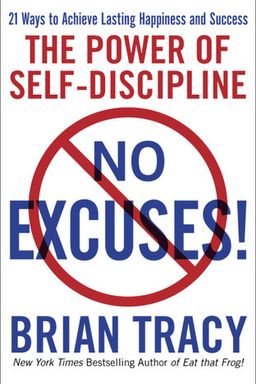
No Excuses! cover

No Excuses!

by Brian Tracy

No Excuses! by Brian Tracy reveals how self-discipline is the cornerstone of success across personal, professional, and emotional domains. Through actionable insights and proven strategies, readers learn to eliminate excuses, confront fears, and achieve lasting happiness and financial independence.

The Power of Self-Discipline

Why do some people achieve incredible success while others—equally intelligent, equally educated, equally ambitious—stall out halfway? Brian Tracy’s No Excuses! The Power of Self-Discipline answers this question with uncompromising clarity: success is not an accident. It’s predictable, built step by step through the steady practice of self-discipline. Tracy argues that this single quality—more than talent, intelligence, or luck—determines who rises to the top and who remains among the frustrated majority. And the best part? Self-discipline is learnable.

The book begins with an irresistible metaphor: most people live on “Someday Isle.” They promise themselves they’ll start working toward their dreams someday. They spend enormous energy rationalizing why they remain stuck—blaming their parents, the economy, or bad luck. Tracy’s first invitation is radical responsibility: vote yourself off Someday Isle. Stop making excuses and start doing. Winners make progress; losers make excuses. From that decision grows every success that follows.

Self-Discipline as the Master Key

Tracy defines self-discipline as the ability to do what you should do, when you should do it, whether you feel like it or not. This idea, borrowed from success researcher Elbert Hubbard (and confirmed decades later by psychologist Roy Baumeister’s work on willpower), is the book’s core “law.” Master this one principle, Tracy says, and all other success habits—goal setting, time management, leadership, health, wealth—follow automatically. Without it, no method, strategy, or motivation can sustain progress.

Drawing on his own transformation—from a high school dropout and laborer to bestselling author and corporate consultant—Tracy demonstrates that virtually anyone can achieve remarkable outcomes if they apply self-discipline. Early in life, he began asking, “Why are some people more successful than others?” Hundreds of biographies, mentors, and role models led him to the same conclusion: successful people have simply learned to do the things failures don’t like to do.

Self-Mastery Versus the Path of Least Resistance

According to Tracy, your two greatest enemies are the Path of Least Resistance—the impulse to do what’s easy—and the Expediency Factor—the temptation to pursue short-term pleasure over long-term reward. These drive people to procrastinate, overindulge, and avoid hard work. Self-discipline reverses that pattern. It is the practice of delayed gratification, choosing the harder right over the easier wrong. Quoting Harvard’s Edward Banfield, Tracy notes that the most successful individuals are “long-term thinkers”: they act today in alignment with their 5-, 10-, or 20-year goals.

Short-term rewards, Tracy warns, often carry hidden long-term pain. Spending impulsively feels good now but results in debt; skipping exercise feels easy but breeds illness later. Conversely, short-term discipline—saving, studying, training, forgiving—yields exponential rewards over time. Like compound interest, every act of self-discipline multiplies future possibilities.

Developing the Habit That Builds All Habits

Tracy insists that discipline is a muscle: it strengthens with use. Every time you choose responsibility over excuse, you weaken your internal “default mechanism” toward laziness and strengthen your self-mastery. Over time, behaving without discipline feels uncomfortable. Eventually, self-discipline becomes your natural state.

His formula mirrors Aristotle’s definition of excellence—habitual right action—and echoes the modern research of Charles Duhigg (The Power of Habit): by repeating purposeful behaviors and refusing exceptions, you rewire the brain’s automatic responses. “Everything is hard before it’s easy,” Tracy reminds you. Persist until discipline feels easier than its absence.

The Payoff: Self-Esteem and Freedom

Why is self-discipline so powerful? Because it directly feeds self-esteem. Tracy calls it a universal law: the more you practice self-mastery, the more you like and respect yourself. You become proud of your own reliability. In contrast, every broken promise to yourself chips away at confidence. Thus, the greatest reward of self-discipline isn’t material success—it’s personal freedom, a sense of control and peace of mind.

Tracy’s book unfolds this theme across 21 areas of life—from personal goals and character to leadership, money, happiness, and family. Each section reinforces one truth: your future depends less on external conditions and more on the consistent inner practice of doing what needs to be done. As Tracy writes, “When you master self-discipline, you become unstoppable.” In this summary, you’ll explore how that mastery transforms not only your productivity but your personality, relationships, and ultimate sense of purpose.


Building Character Through Integrity

Tracy identifies character—especially integrity—as the foundation of all achievement. Success without honor is failure disguised, he insists, echoing Emerson’s line: “What you do speaks so loudly that I cannot hear what you say.” Your reputation, both in your own eyes and others’, derives from consistent truth-telling and trustworthiness. To build strong character, you must exercise the discipline of doing the right thing, even when it’s inconvenient or unseen.

The Structure of Personality

Tracy describes your character as a structure built from three components—self-ideal, self-image, and self-esteem. Your self-ideal is who you wish to become; your self-image is how you see yourself now; and your self-esteem is how much you value yourself. The closer your daily actions align with your self-ideal, the stronger your self-image and the higher your self-esteem. Moral compromise, on the other hand, fragments this integrity and creates inner conflict.

Integrity as the Guarantee of All Virtues

Integrity is the “core virtue” that validates all others. You can be intelligent, talented, or charming, but if people can’t trust you, you will fail over time. Conversely, even an average individual who never lies, honors commitments, and accepts responsibility will rise naturally into leadership. Trust, Tracy emphasizes, is the ultimate lubricant of human relationships and the bedrock of free societies (a point also explored by Francis Fukuyama in Trust). Every act of honesty reinforces this foundation; every lie dissolves it.

The Discipline of Truth

Living honestly requires practice. You cultivate integrity by telling the truth even when it’s hard, refusing to make excuses, and owning mistakes. Each moment of truthfulness strengthens your moral core like a muscle under stress. Tracy includes a moving parable: the old Indian who said two wolves live within us—one good, one evil—and the one that grows stronger is the one we feed. The same is true of integrity: focus on upright thoughts and behaviors, and they multiply within you.

Ask yourself daily, “What’s the right thing here?” and act accordingly. Over time, this discipline cultivates both internal peace and external reputation. When your values, words, and actions align, Tracy says, “you feel wonderful about yourself.” This harmony—being the same person in private as in public—is the mark of genuine self-respect and lasting success.


Accepting Complete Responsibility

Of all the disciplines, Tracy calls personal responsibility the gateway to adulthood. Until you accept that you are 100% responsible for your life—your choices, emotions, finances, and relationships—you remain a mental child, dependent on others or fate to rescue you. The moment you take full ownership, you move from victim to creator.

From Complaint to Control

Tracy’s life-changing revelation came in a freezing apartment when he realized, “This is my life.” Nobody was coming to save him. That awakening turned a laborer into a lifelong learner. He discovered the simple rule that every problem improves the moment you say, “I am responsible.” This phrase stops the spiral of blame and instantly restores your power. Instead of ruminating, you start acting.

Negative emotions—anger, resentment, guilt—survive only as long as you assign blame. Accept responsibility and they evaporate. This turns you inwardly from “economic child” to “economic adult,” capable of managing money, time, and life deliberately.

The Antidote to Excuses

Tracy critiques modern “irresponsibility culture”: the lawsuits, excuses, and entitlement attitudes that keep people stuck. Freedom, he teaches, lies not in avoiding responsibility but in embracing it fully. The happiest people feel a high sense of control; the unhappiest feel at the mercy of external forces. Accepting responsibility dramatically raises this “internal locus of control.”

His prescription is clear: never complain, never explain. You cannot change past events, but you control your reaction to them. Take purposeful action toward your goals. As you do, negative emotions fade, personal leadership grows, and a deep calm replaces resentment. This discipline, Tracy says, is nothing less than freedom itself.


The Discipline of Clear Goals

Tracy calls goal-setting the master skill of success: “You can’t hit a target you can’t see.” Only 3% of adults have written goals—and that 3%, he notes, earns more than the other 97% combined. The act of writing crystallizes your desires and directs your mind’s “success mechanism,” transforming vague wishes into achievable objectives.

The Seven-Step Goal Method

Tracy provides a precise seven-step formula: Decide exactly what you want; write it down; set a deadline; list everything you must do; organize the list by priority; take action immediately; and do something every day that moves you closer to your goal. This process stimulates the subconscious to generate ideas, motivation, and momentum. The final rule—“do something every day”—transforms intention into habit.

Mindstorming and Focus

One of his most creative tools is “mindstorming.” By writing your goal as a question (“How can I earn $100,000 this year?”) and forcing yourself to generate twenty answers, you unlock ideas that routine thinking would overlook. Acting on just one idea often triggers others, creating a feedback loop of progress. It’s not magic—it’s disciplined brainstorming with action bias.

The Law of Cause and Effect

Every result, Tracy reminds you, has specific causes. If others achieve a result you desire, identify and duplicate their causes. With repetition, you will inevitably reproduce their success. This principle reframes achievement from luck to law—empowering anyone willing to practice sustained discipline.

By setting goals and acting on them daily, you align your short-term behaviors with long-term vision. You move from random effort to directed purpose. In Tracy’s words, “Goals unlock your potential and unleash your future.”


Striving for Personal Excellence

Excellence, Tracy insists, isn’t a talent—it’s a habit. You become excellent by deciding to be excellent and committing to continuous improvement. The marketplace, he notes, always pays more for excellence than for mediocrity. Since most people stop growing after they learn their jobs, the field clears quickly for those who dedicate themselves to lifelong learning.

Lifelong Learning and the 3% Rule

His formula: invest at least 3% of your income each year in self-education—books, courses, seminars. This principle mirrors modern findings about skill acquisition (e.g., Anders Ericsson’s 10,000-hour rule): deliberate practice compounds. Tracy tells of a salesman who began by investing $600 a year in learning, doubled his income repeatedly, and eventually became a millionaire before age thirty-five. Continuous reinvestment in yourself produces exponential career growth.

The Power of Compounding Improvement

By improving just half a percent per week—through better focus, new skills, or smarter habits—you become 26% better each year, producing a tenfold improvement within a decade. Tracy calls this “the 1,000 percent formula.” Like financial compound interest, the effect begins invisibly and then accelerates exponentially. Excellence, he insists, is built daily, not discovered suddenly.

Follow the Leaders

Don’t reinvent success—model it. Observe the top performers in your field, study what they read, how they spend their time, and emulate their behaviors. When one salesman did this relentlessly—dressing, planning, and acting like his company’s best—he rose from the bottom tier to the national top within four years. As Tracy puts it: “If you want to fly with the eagles, you can’t scratch with the turkeys.”

Self-discipline in personal growth transforms you from ordinary to extraordinary. The moment you commit fully to mastery, “the world conspires to help you.”


Courage, Persistence, and the Refusal to Quit

Two of Tracy’s most vital disciplines are facing fear and persisting in adversity. “Courage,” he writes, “is rightly considered the foremost of the virtues, for upon it all others depend.” Everyone feels fear—of failure, rejection, criticism—but success belongs to those who act despite it. You cultivate courage by doing the thing you fear until it no longer controls you.

The Habit of Action

Tracy recommends reversing fear through deliberate opposite action. Afraid to speak up? Volunteer to present. Fearful of rejection? Make more calls. (Sales teams, he notes, sometimes reward the first person to get ten rejections daily—a clever way to inoculate against fear.) This “act as if” method mirrors William James’s psychology: feelings follow behavior, not vice versa.

Persistence as Character in Action

Persistence, Tracy says, is “self-discipline in action.” It’s the habit of staying the course when enthusiasm fades or obstacles mount. Every great success, from business to marriage, requires passing “the persistence test.” Failures quit early; winners hang on long after it’s uncomfortable. He recalls the warrior’s creed: “I will lay me down to bleed awhile, and then rise and fight again.”

Optimism and Resilience

Optimism fuels persistence. When things go wrong, discipline your mind to ask: What’s good here? What can I learn? Tracy quotes Norman Vincent Peale: “When God wants to send you a gift, He wraps it up in a problem.” Successful people see setbacks as stepping stones, not signals to stop. They focus on solutions, not on the sting of failure.

Ultimately, persistence transforms self-discipline into destiny. Every refusal to quit builds confidence, crushes fear, and proves that you are indeed unstoppable.


The Fruits of a Disciplined Life

In its closing chapters, No Excuses! shows how self-discipline radiates through every domain of life—work, money, relationships, health, and inner peace—producing what Tracy calls “the good life.” Far from being austere, self-discipline creates happiness because it gives you control.

Discipline in Work and Money

At work, discipline means doing first things first: focusing on high-value tasks, starting early, and working all the time you work. It’s the practical expression of Peter Drucker’s advice: “Do what is most valuable.” With money, discipline translates into saving, investing, and breaking Parkinson’s Law—the tendency to let expenses rise with income. Even saving 1% and increasing it gradually, Tracy shows, leads to financial independence through the miracle of compound interest.

Discipline in Relationships and Health

In marriage and friendship, discipline means listening with full attention, practicing forgiveness, and making others feel important. In health, it’s eating sparingly, exercising regularly, resting adequately. Tracy’s formula for fitness—“eat less and exercise more”—echoes the timeless simplicity that often eludes complex diet cultures. Each act of moderation compounds vitality.

Discipline in Spirit

Finally, self-discipline matures into spiritual serenity. The same control that conquers procrastination also conquers resentment. Inner peace, Tracy writes, comes from letting go—of blame, of justification, of the need to be right. Forgiveness, practiced for your own liberty, clears the mind like sunlight after a storm. In mastering yourself, you master happiness itself.

Tracy ends with a simple truth: every freedom has a price. The price of success is self-discipline. The price of failure is excuse-making. Both demand energy—but one leads to fulfillment while the other leads to regret. The choice, as he reminds readers in every chapter, is entirely yours.

Dig Deeper

Get personalized prompts to apply these lessons to your life and deepen your understanding.

Go Deeper

Get the Full Experience

Download Insight Books for AI-powered reflections, quizzes, and more.