
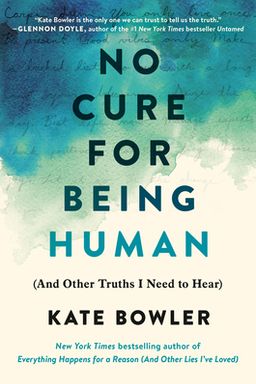
No Cure for Being Human cover

No Cure for Being Human

by Kate Bowler

In ''No Cure for Being Human,'' Kate Bowler offers a heartfelt memoir that challenges the pervasive culture of relentless positivity. After a life-altering cancer diagnosis, she confronts the pressures of ''living your best life'' and discovers profound lessons in embracing the chaotic beauty of existence.

Facing Finitude: Living When Life Is Uncertain

What happens when you realize there’s no cure for being human? Kate Bowler’s No Cure for Being Human asks this haunting, beautiful question as she pieces together life after a terminal cancer diagnosis. Her story is not just about surviving illness—but about dismantling the illusion that life can ever be perfectly managed. From hospital rooms to classrooms, Bowler reorients the reader toward what truly matters when tomorrow is uncertain and all self-help formulas fail.

The Myth of Control

Bowler begins by noting that American culture worships the idea of mastery: with enough discipline and belief, we can supposedly turn chaos into progress. She grew up studying the prosperity gospel—a religious movement promising health, wealth, and happiness as the reward for faith—and realized how deeply its logic underpins our secular ideals. The wellness industry echoes these beliefs, convincing us that with the right attitude or productivity tools, we can be invincible. But Bowler’s stage IV cancer diagnosis at thirty-five shattered that illusion. “I cannot out-pray my cancer,” she admits. Human life, she discovers, is stubbornly mortal. The real miracle is accepting that fact and still choosing to live.

Beyond the Self-Help Gospel

From Joel Osteen’s Your Best Life Now to Oprah’s affirmations, Bowler explores how America’s self-help culture romanticizes the self-made success story. We’ve been taught that suffering is simply an opportunity for self-improvement—that tragedy will somehow "teach" us something. But standing in a hospital gift shop after surgery, Bowler realizes that such optimism borders on cruelty. Books that promise healing through positive thinking are laughably inadequate for someone whose body is failing. Through this moment of confrontation, she exposes the hollowness of philosophies that cannot tolerate pain. Being human is not a problem to be solved, she insists. It’s a condition to be lived within.

Time, Mortality, and Meaning

Time becomes Bowler’s second antagonist. Every breath, meal, and diaper change for her toddler is measured against the ticking of a countdown—730 days, two years, maybe less. She calls this “timekeeping,” an attempt to make meaning while racing against death. The book plays with different metaphors of time—circular and eternal in Christian thought, linear and productive in modern life—and finds that both collapse under the weight of suffering. Her oncologist gives her a survival rate of fourteen percent, and instead of despairing, she starts calculating how many Christmases she might have left. She replaces efficiency with intimacy, realizing that love is not measured in productivity but in presence.

Living Without a Formula

Through each chapter—from Bucket Lists to YOLO—Bowler dismantles the formulas we invent for living well. Americans, she says, oscillate between two extremes: endless striving for success and desperate escapism. Either we make lists to control our fates or we pretend the future doesn’t exist. Both responses miss life’s complexity. Her illness teaches her to inhabit the uncomfortable middle—planning for death while changing diapers, crying in hospital bathrooms while making jokes about tacos passed down restaurant tables. Bowler’s realism isn’t bleak; it’s luminous. Acceptance, she argues, doesn’t mean giving up hope. It means replacing fantasy with love.

Faith, Fragility, and Freedom

Bowler’s Christian theology anchors the book. She contrasts Stoic ideas of self-mastery with a faith that embraces vulnerability. For her, God doesn’t promise safety or success but companionship—a presence through time, suffering, and uncertainty. “God loves you but won’t do your taxes,” she jokes in the Appendix, distilling heavy theology into humor. Through spiritual and philosophical reflection, Bowler reframes freedom: we are free not from finitude but within it. True courage, she writes, is learning to live here—between fear and meaning, grief and ordinary beauty.

Why This Book Matters

In a culture obsessed with optimization, No Cure for Being Human is radical. It reminds you that life’s fragility is not a flaw but a fact—and that facing it honestly opens the door to compassion. Bowler’s storytelling, studded with absurd humor and unsentimental faith, invites you to imagine a version of thriving that doesn’t depend on guarantees. You may not get more time, but you can get deeper time—the kind measured in laughter, kindness, presence. Her message isn’t “everything happens for a reason.” It’s “everything happens, and we face it together.”


Rejecting the 'Best Life Now' Illusion

In the opening chapter, Bowler takes aim at the American ideal of the “best life now” fabricated by optimism moguls and prosperity preachers. From Joel Osteen’s megachurches to Instagram influencers, this philosophy teaches that your life should be a nonstop highlight reel. But for those facing illness, loss, or limitation, this worldview can feel cruel. The idea that the right mindset or faith guarantees happiness collapses when your body or world fails you.

The Gospel of Wellness

Bowler explores how the prosperity gospel seeped into secular culture. She identifies its modern reincarnation in the wellness industry—a trillion-dollar enterprise selling self-perfection. We buy fitness programs and meditation apps believing they’ll deliver salvation through control. Even self-help books and Instagram life coaches frame virtue as positivity. Bowler’s frustration reaches a breaking point in a hospital gift shop, where she confronts a shelf of titles promising divine healing and happiness through belief. Her sarcastic protest—“You can’t sell this to me”—becomes a rebellion against false hope.

God’s Plan vs. Human Reality

She contrasts two common religious narratives: one where God’s plan ensures prosperity and happiness, and another where every trial is a lesson in moral growth. Both, she argues, miss the mark. She rejects the notion that her cancer is part of a cosmic teaching moment. “Good or bad, I will not get what I deserve,” she writes. This theological honesty offers freedom. You don’t need to find meaning in tragedy to live meaningfully.

Why Embracing Imperfection Is Freedom

In abandoning perfection, Bowler discovers a strange liberation. She calls it the “freedom of ordinary days”—the ability to laugh, cry, binge Netflix, and hold your kids without demanding that each moment add up to enlightenment. Life is not a moral play where the hero triumphs; it’s a patchwork of joy and pain stitched together by love. This insight echoes other anti-optimization thinkers like Oliver Burkeman (Four Thousand Weeks), who also criticizes productivity as spiritual performance. Bowler’s conclusion: stop trying to master life. Just live it, flawed and fleeting as it is.


Timekeeping: When Every Minute Counts

How do you measure a life when time itself feels weaponized against you? In Chapter Two, Bowler describes the transformation of time after her diagnosis. She begins counting everything: days left, seasons remaining, holidays still to come. Time becomes a ledger—an accountant’s version of mortality. But this fixation ultimately teaches her something deeper: productivity and longevity are poor substitutes for presence.

A Family Under Siege

Bowler’s Durham house becomes a hive of survival. Her relatives, Mennonite workaholics by nature, busy themselves with cleaning, cooking, and prayers. She notices that their frantic energy—what she calls “the quiet speed of despair”—mirrors wartime sieges she once studied as a historian. Like besieged cities rationing supplies before collapse, her family inventories towels while waiting for the enemy to breach the walls. The metaphor makes her illness a collective battle, showing how time constricts not just for the sick but for those who love them.

Learning the Math of Finitude

Under chemotherapy, hours take on new meaning. Tasks once habitual—laundry, emails, teaching—now carry existential weight. She compares her daily regimen to industrial time management: Frederick Taylor’s obsession with efficiency. Bowler realizes she’s been worshiping productivity like a faith. But illness dismantles that altar. She discovers that true stewardship of time means using it gently—reading with her son, laughing over pasta, being unhurried. As she puts it, “I’m a pocket watch that must be wound up again every few hours.”

The False Theology of Gratitude

Bowler experiments with gratitude lists, marking small blessings on a whiteboard. But when she tries to turn gratitude into a cure for despair, it slips away. You can’t outthink mortality, she learns. The true work of time is not counting but noticing. Through gratitude that refuses measurement, she reclaims what matters most: love that resists scarcity.


Pragmatism and Letting Go

In Chapter Three, Bowler’s psychologist offers her advice borrowed from hikers: when facing a long, painful journey, ask what you can set down. This becomes her guiding metaphor for living with loss. Pragmatism—doing what works rather than what’s ideal—helps her shed unnecessary expectations. But letting go, she finds, is not a one-time act; it’s lifelong practice.

The Language of Necessity

Bowler reconstructs daily life through survival triage. Clothes with tight zippers and fancy buttons? Gone. Plates, policies, luxuries—all re-evaluated by utility. She calls this a “blue stage” of life—hospital blue, surgical blue, the color of surrender. This rational stripping away mirrors philosophical pragmatism from William James: truth is what helps us endure. For Bowler, practicality becomes spiritual discipline.

Systems Without Mercy

Her encounters with bureaucracy—insurance agents, parking officials—illustrate the cold efficiency of modern life. When an employee refuses to issue her a handicapped pass because her doctor’s note says she “can’t walk in the cold” rather than “can’t stand,” Bowler exposes how rules often replace compassion. Yet one human—Linda from HR—shows genuine empathy, writing her number on a folder to help her family when she’s gone. “The best person to have in a foxhole knows the cost of what must be done,” Bowler reflects.

Learning the Hard Economy of Love

This chapter reframes pragmatism as emotional economy: prioritizing what you can’t replace. For Bowler, that’s laughter, her son’s giggles, her husband’s gentleness. Everything else—career milestones, social expectations—becomes negotiable. Her message to you: when life demands too much, pack light. Only carry what keeps you human.


The Trouble With Bucket Lists

Bowler begins Chapter Four confronting one of our favorite clichés: the bucket list. Counselors urge her to make one—to chase dreams before death—but she realizes it’s another consumer fantasy disguised as meaning. Rather than helping us face mortality, bucket lists often replicate the same hunger for achievement that exhausts us in life.

Counting Wonders Instead of Moments

The modern bucket list, she explains, comes from the same impulse that produced ancient pilgrimages and the Seven Wonders of the World. But today’s version has turned spiritual longing into experiential capitalism. We don’t seek enlightenment; we seek bragging rights. Bowler browses library shelves filled with titles like 1,000 Places to See Before You Die and feels the absurdity of chasing infinity through finite time. “It’s much easier to count items than to know what counts,” she quips.

Redefining Completion

For Bowler, the bucket list masks a dark question: what makes a life complete? She writes about her father’s dream of seeing Troy, his lifelong inspiration, only to find that achieving it left him strangely hollow. “Then everything was over,” he told her. The story becomes parable: accomplishment is not the same as fulfillment. Completion is an illusion; longing is what keeps us alive. (Similarly, Viktor Frankl noted in Man’s Search for Meaning that meaning comes not from satisfaction but from striving.)

The Only List That Matters

Near the end of the chapter, Bowler rereads her teenage wish list—pyramids, cello solos, decent bread—and realizes those goals weren’t about dying well; they were about living hopefully. The transformation is subtle but profound: lists are fine, but their purpose must be love, not completion. When life narrows to a dot on the horizon, she chooses to dream anyway.


YOLO and the Courage to Live

In Chapter Five, Bowler examines the mantra “You Only Live Once” and its tangled meanings. When a partygoer tells her she should “go out with a bang,” she sees how YOLO culture conflates fearlessness with recklessness. Yet after battling cancer, she discovers a gentler version of YOLO—one rooted not in thrill-seeking but in presence.

Living in the Moment, Not Dying for It

Bowler contrasts ancient hedonism with modern mindfulness. Philosophers like Seneca saw courage in savoring the present, but today “living in the moment” has become a consumer slogan. She jokes about her own foolish escapades—Nicaraguan rum and abandoned mine exploration—as reminders that immediate joy isn’t always wisdom. True mindfulness is attention, not adrenaline.

Risk and Reverence

Through stories like zip-lining with her friend Katherine, Bowler dramatizes the tension between fear and freedom. “If you’re not going to try, then I’ll have to take you down the mountain now,” the guide teases her. She freezes, confessing she’s spent years trying not to die. But the moment becomes revelation—the guide reminds her that “not all risks are equal.” This insight transforms survival into courage. You don’t escape fear; you carry it with you into living.

The Sacred Present

When Bowler holds her son, Zach, in the predawn hours, she calls her illness “a terrible gift” because it teaches her the value of a single minute. Heaven, she realizes, is not tomorrow—it’s the flash of eternity in an ordinary day. “Hope,” she writes, “is a kind of arsenic.” When overdosed, it poisons presence; in small doses, it sustains it. Her philosophy echoes Buddhist and Christian mystics alike: to be human is to balance mortality and miracle.


Work, Calling, and the Meaning of Effort

By Chapter Six, Bowler turns toward her profession. After miraculous remission, she debates whether to return to Duke University—a world of tenure clocks and endless ambitions. Her story about pursuing an academic career revisits her father’s own struggles as an adjunct scholar. Work, she finds, is both curse and calling.

Ambition vs. Humanity

Faced with uncertain reintegration into normal life, Bowler asks, “How will I know when this work has cost me too much?” A bishop friend answers: when it stops being calling and becomes career. Her conversations with colleagues in dim bars over margaritas reveal a raw fear—what if she dies chasing tenure? Yet an unexpected reply reframes it: “If the worst happens, your son will still find you in your books.” Work done with love endures as testimony.

The Real Price of Success

Bowler links her father’s academic life of poverty and frustration to her own risk of hollow achievement. Both embody America’s meritocratic myth—that meaning must be earned. As her father learns later, life isn’t a ledger of success; it’s permission to hope again. When he receives a note from students written on toilet paper reading “Slow down, there’s still plenty of time,” it becomes comic wisdom. Success without mercy is failure in disguise.

Calling as Legacy

In writing her final book under the shadow of death, Bowler redefines calling: it’s not what you achieve but what you leave as love’s trace. If effort can become devotion, then work itself—done honestly, imperfectly—can outlive you. Her father blesses this realization: “You didn’t fall very far.” Her faith in work becomes faith in wonder itself.


Living Between Befores and Afters

Later chapters explore what Bowler calls “befores and afters”—the psychological gap between past identity and future uncertainty. After remission, she feels suspended in what psychologists might term liminal space. Old friendships fade, new fears bloom. How, she asks, can one move forward when the future still feels fatal?

The Myth of No Regrets

Bowler critiques America’s obsession with “no regrets.” People claim that every mistake made them who they are, but she insists some losses—like health or innocence—simply hurt. Her longing to have another child becomes a symbol of impossible return. When she tells her psychologist, “I can’t move forward without knowing what happens next,” he replies, “Fear has been a wonderful friend—but you can’t live here anymore.” The lesson? Courage is not the absence of fear, but the willingness to act while afraid.

Finding Hope After the Cliff

Bowler’s humor returns when she learns that what doctors thought was a new tumor is actually a “fat deposit.” The absurdity underscores a recurring theme: uncertainty is permanent. Life may swing between tragedy and comedy within 24 hours, and that’s the joke—and mercy—of being human. You can’t build safety, but you can build belonging.


Unfinished Cathedrals: The Art of Incompletion

The book’s final chapter culminates in a stunning metaphor: the unfinished cathedral. Visiting the Batalha Monastery in Portugal, Bowler encounters an open-roofed chapel abandoned mid-construction. An old man tells her, “We’re never done, dear—even when we’re done.” The image captures her closing message: human life is unfinished, unnecessary, and utterly beautiful.

Failure, Faith, and Finitude

After researching how clinical trials commodify patients, Bowler experiences the weight of exploitation and grief. Then she chooses a different salvation—not scientific victory but human incompleteness. Her father’s long-delayed book publication becomes another lesson: meaning may come decades late, but it comes. “Progress, not perfection,” he says. The unfinished cathedral reminds us that ambition can end in grace rather than completion.

Hope Without Resolution

Bowler’s theology of incompleteness echoes writers like Anne Lamott and Henri Nouwen: holiness lies in imperfection. In the pandemic, she sees the whole world confronting what she had learned privately—that suffering is unjustly distributed, and no positive thinking will fix it. Her faith ends not with certainty but with wonder: as long as we breathe, we hope. Dum spiro spero: while I breathe, I hope.

The Final Vision

In an epilogue-like scene, Bowler attends a sunrise service with a friend who once faced cancer too. As the sun rises, they marvel not at healing but at renewal. Life remains unfinished—but gloriously ongoing. That’s the cure, she implies: not perfection, not permanence, only presence.

Dig Deeper

Get personalized prompts to apply these lessons to your life and deepen your understanding.

Go Deeper

Get the Full Experience

Download Insight Books for AI-powered reflections, quizzes, and more.