
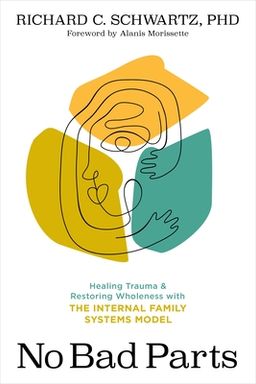
No Bad Parts cover

No Bad Parts

by Richard C Schwartz

No Bad Parts explores the Internal Family Systems Model, showing how engaging with our inner voices can heal trauma and foster self-transformation. Discover your core Self and learn to harmonize your internal family for a richer, more compassionate life.

Healing Through Internal Family Systems

Have you ever wondered why certain parts of you seem to sabotage your best intentions, repeat painful patterns, or lock you in cycles of fear and shame? In No Bad Parts, Richard C. Schwartz argues that every aspect of your inner life—even the ones you've judged as destructive or unlovable—deserves to be heard, understood, and healed. He contends that the path to wholeness begins not by fighting or fixing what’s broken, but by getting curious and compassionate toward the multiplicity within you.

At the heart of Schwartz’s groundbreaking Internal Family Systems (IFS) model is a radical claim: we are not one mind but many. Inside each of us lives a community of inner parts—distinct personalities, emotions, and sub-selves that carry specific roles and burdens. These parts, whether protective or exiled, are not bad. They’re trying to help you survive, even if their methods cause distress. Beneath all these parts rests the Self: an undamaged essence characterized by calm, clarity, confidence, compassion, courage, creativity, curiosity, and connectedness—what Schwartz calls the eight Cs. Your Self is the inner leader capable of bringing harmony to your internal family.

The Mono‑Mind Myth

Western culture, Schwartz explains, has been dominated by the mono‑mind paradigm—the idea that a healthy person has one unified personality and that multiplicity equals sickness. From Freud’s drive theory to religious doctrines of original sin, we’ve inherited an assumption that humans are inherently flawed and must control their impulses through willpower or faith. This has led generations to suppress or shame parts of themselves that don’t fit the ideal. When we exile pieces of ourselves, we create inner wars—between the rational mind and the emotional one, the disciplined self and the impulsive self—leaving us fragmented and fearful.

Schwartz’s model turns this view inside out. He asserts that multiplicity is the mind’s natural state, and that integration—not suppression—is the goal. He discovered this through decades of clinical practice, starting with patients who binge ate, self‑harmed, or dissociated. When he stopped trying to cure them and instead asked to speak directly with the voices inside, he found coherent personalities—parts with histories, motivations, and fears. By treating these inner beings with the same respect he would offer clients in family therapy, he saw that they could heal through compassion rather than control.

The Discovery of the Self

In those early years, Schwartz stumbled upon a miraculous phenomenon. When a client’s protective parts relaxed, something new emerged: a calm, centered presence that knew how to heal without instruction. This healing presence—the Self—was not a part; it was the person’s core essence, untouched by trauma. The Self could listen, comfort, and transform wounded parts spontaneously. Schwartz found the Self surfacing again and again in clients of all backgrounds, even those with severe trauma. Over time, he realized the Self is in everyone—and it cannot be damaged.

This insight reshaped his therapeutic approach. Instead of helping clients analyze or restructure their thoughts, he guided them to develop loving internal relationships with their parts and to lead from Self. Through dialogue, visualization, and embodiment exercises, clients learned to unblend from parts, witness their stories, and help them release burdens—beliefs and emotions absorbed during painful moments. Once unburdened, parts transformed: critics became wise advisors, addicts became connectors, and rageful protectors became boundary‑setters. Schwartz compares this process to turning toward the lepers and outcasts within, echoing Jesus’s radical compassion or the Buddhist bodhisattva’s commitment to heal all beings—including the ones inside us.

The Spiritual Dimension

As IFS evolved, Schwartz saw profound spiritual parallels. Every tradition—Christianity’s divine image, Buddhism’s Buddha nature, Hinduism’s Atman—echoes the idea of an indestructible essence within. When we access Self, we reconnect not only with our inner world but with something larger: the field of universal Self or Spirit that links all beings. Schwartz’s model thus bridges psychology and spirituality, offering a path to awakening that is practical, embodied, and relational. Unlike spiritual bypassing, it doesn’t transcend pain but embraces it lovingly until it transforms.

Why “No Bad Parts” Matters

Schwartz’s message is revolutionary both personally and culturally. When you learn to treat your inner parts as sacred rather than sinful, you stop warring internally—and that inner peace radiates outward. Families, nations, and even global systems, he suggests, mirror our inner structures. When we exile parts of ourselves, we also exile groups of people. Healing your internal family is thus activism for the planet. In a world fractured by polarization, judgment, and fear, IFS invites you to lead your inner and outer life from compassion instead of coercion.

Core Insight

“Love is the answer in the inner world, just as it is in the outer world.”—Richard Schwartz

In short, No Bad Parts proposes a radical shift: from inner warfare to inner leadership, from shame to curiosity, and from isolation to connection. You’ll learn to map your parts, recognize protectors and exiles, release burdens, and live from the Self—a state of openhearted presence that naturally fosters healing within you and harmony in the world.


Multiplicity of the Mind

Schwartz dismantles the long‑held assumption that a healthy psyche is singular. Instead, he reveals that everyone is a multiple personality in the healthiest sense. Each inner part has its own age, emotions, desires, and worldview. You’ve likely experienced this plurality when debating with yourself—one voice says, “Go for it!” while another warns, “Don’t you dare!” IFS invites you to stop dismissing these voices as random thoughts and start viewing them as intelligent sub‑selves, all striving to protect you.

Types of Parts

IFS identifies three main categories of parts: managers, firefighters, and exiles. Managers are the internal disciplinarians trying to control life and prevent pain. They keep you functioning, but their vigilance can become oppressive—they shame you for mistakes and demand perfection. Firefighters act impulsively when emotional pain breaks through; they distract you with addictions, anger, sex, or numbness. Exiles are the tender, wounded inner children banished after trauma—they carry shame, fear, or grief. None of these parts are bad; each plays a protective role shaped by your history.

For example, in Schwartz’s early work with bulimic clients, one part would binge to escape unbearable loneliness, another would criticize mercilessly, and yet another would collapse in despair. When he listened instead of fought, he discovered that each part had a protective logic. The bingeing part shielded against pain; the critic tried to prevent rejection; and the despairing part carried childhood trauma. By allowing these parts to tell their stories, healing began.

No Part Is Evil

Schwartz insists that even parts that engage in violent or self‑destructive behaviors are not inherently evil. Working with offenders at Onarga Academy, he found that their abusive parts originated as protectors during their own childhood trauma. These parts had absorbed the perpetrator’s rage and power as a desperate shield. Once their pain was witnessed with compassion, these parts unburdened that destructive energy and transformed. This insight led to the book’s title: No Bad Parts. Every destructive impulse hides a sacred intention to protect.

In understanding multiplicity, you begin to see yourself as an internal family—not a fractured mess but a living system capable of love and reconciliation. When the Self leads, these inner beings harmonize, becoming allies rather than adversaries. Like a wise parent mediating between children, your Self can listen, comfort, and guide each part toward safety and connection.


Unburdening Trauma

Trauma, Schwartz explains, doesn’t destroy parts—it burdens them. These burdens are the intense beliefs, emotions, and energies absorbed during painful experiences. They might sound like: “I’m worthless,” “No one can be trusted,” or “Love always hurts.” Parts carry these as if infected with a virus. Healing requires separating the part from its burden and helping it release what doesn’t belong.

Personal and Legacy Burdens

Schwartz distinguishes between personal burdens—emotions and beliefs from direct trauma—and legacy burdens, inherited from family, culture, or history. Racism, patriarchy, individualism, and materialism are examples of collective burdens that shape our inner systems. You carry not only your own wounds but your ancestors’ and society’s. Recognizing these influences helps liberate you from internalized oppression. For instance, when a protector drives you to overwork, it may be carrying a cultural burden of self‑worth through productivity.

The Process of Unburdening

When a part releases its burden, transformation is immediate. Schwartz compares it to a sleeping beauty curse being lifted. The inner critic becomes a cheerleader; the addict part becomes a connector; the vigilant protector becomes a boundary expert. In therapy, clients often visualize this release symbolically—sending toxic energy into light, fire, or water. After unburdening, parts feel lighter, joyful, and playful. Healing requires compassion, curiosity, and patience from the Self, not willpower or judgment.

By practicing unburdening, you rewrite your inner history. You stop identifying with the pain you carry and start reclaiming the innate goodness that was never lost. This not only heals emotional wounds but reshapes your neurological and spiritual orientation, reconnecting you with others and the world through the clear lens of the Self.


Becoming Self-Led

Being Self-led means letting your calm, compassionate essence guide your system instead of reactive parts. Schwartz defines the Self through the eight Cs—curiosity, compassion, calm, confidence, clarity, courage, creativity, and connectedness—and five Ps: patience, persistence, presence, perspective, and playfulness. In Self-leadership, you don’t eliminate parts; you build trust with them so they relax and follow your authentic inner leader.

Unblending and Embodiment

When blended with a part, you see the world through its fears or impulses. Unblending means separating enough to witness it. Schwartz teaches simple meditations—checking which parts are active, asking them to step aside, and noticing the calm spaciousness that arises. Clients often feel warmth, tingling, or energy flowing through their bodies, which he calls Self energy. This embodied Self becomes a felt state of “enoughness,” where you realize nothing needs fixing; everything is already okay.

The Self in Relationships

Self-leadership extends outward. When you lead your inner world with compassion, you relate to others the same way. Schwartz calls this “attachment theory taken inside.” You become the secure parent to your inner children, freeing partners and friends from carrying that responsibility. In sessions like with Ethan and Sarah—the activist couple who transformed their conflict—he shows how Self-guided dialogue dissolves polarization. The destroyer part fighting injustice became calm once its pain was heard, turning conflict into collaboration.

Being Self-led doesn’t mean passive kindness. The Self can set firm boundaries, speak with courage, and act with clarity. When you embody Self, even amid fear or chaos, you become “the I in the storm”—a presence that guides your parts and interactions toward connection rather than defense.


Systems Thinking and Collective Healing

Schwartz borrows from systems theory to show that your mind functions like an ecosystem. Parts form alliances, polarizations, and feedback loops much like families or societies. Healing an internal system parallels healing external ones: peace emerges when leadership is compassionate and relational, not authoritarian. Just as war against protectors makes them stronger, punishing social problems (like addiction or crime) reinforces them. Listening and love, instead, restore balance.

Inner and Outer Parallels

Cultural “burdens” such as racism, patriarchy, and greed replay the same dynamic at scale. When you exile parts of your psyche, you mirror societal exiling of marginalized groups. Schwartz argues that global healing requires systems thinking: recognizing interconnection among individuals, communities, and nature. His metaphor of the Earth as Gaia—an organism struggling for homeostasis—illustrates this. Crises like climate change or pandemics are stabilizing feedback loops, the planet’s way of correcting imbalance.

Interbeing and the Field of Self

Quoting thinkers like Charles Eisenstein and Donella Meadows, Schwartz introduces the “Story of Interbeing”—the realization that all things are connected. He envisions the Self as both particle and wave, a field that resonates among people. As Self-leadership spreads, collective resonance arises: groups and nations can act from compassion instead of fear. Imagine institutions led by Self-energy—where leaders serve rather than dominate, and cooperation replaces competition.

In this sense, personal healing becomes planetary activism. Every act of inner compassion contributes to a global field of Self that can heal systems of oppression and restore harmony with the Earth.


Embodiment and the Body’s Wisdom

Schwartz emphasizes that true healing must include the body. Trauma disembodies—you survive by leaving the body behind. When parts begin to trust Self, they allow you to re-inhabit your physical presence. Embodiment anchors healing in sensation and restores aliveness. Clients often discover that physical symptoms communicate messages from parts, just as emotions do.

Listening to the Body

In one study with rheumatoid arthritis patients, Schwartz asked participants to talk to their pain as a part. The pain responded: “You never take care of yourself.” As patients negotiated with caretaking parts to rest and set boundaries, their symptoms subsided. Some entered remission. The lesson: physical discomfort may embody emotional burdens. Instead of eradicating symptoms, ask them what they need you to know. This approach reframes healing from external control to internal dialogue.

Integration Over Control

Schwartz contrasts IFS with medical and spiritual traditions that treat the body as enemy or obstacle. In IFS, the body is sacred—an instrument of Self. Protectors often numb or punish the body to avoid pain, but when they recontextualize its signals as communication, they stop attacking. Embodiment practices like yoga, breathing, and mindful movement become invitations for parts to rejoin rather than retreat.

As you reconnect with your body, you integrate your entire system. Life energy flows freely, guiding choices and healing not only emotional wounds but physical imbalances. Embodiment, in Schwartz’s vision, is not a reward—it’s the natural consequence of loving all your parts back home.


No Bad Parts in Society

In the book’s later chapters, Schwartz expands the IFS principle—no bad parts—to communities, nations, and humanity. Just as individuals exile inner voices, societies exile groups. Racism, sexism, and political polarization stem from protectors running wild, unable to trust collective Self‑leadership. Healing these social wounds begins by recognizing that every group and ideology, like every inner part, holds valuable intent gone awry.

Collective Self and Resonance

When enough individuals embody Self, Schwartz believes, a critical mass of global Self energy arises. This “field” can harmonize conflicts spontaneously, much like synchronized vibration in physics. Leaders practicing servant and Self-led leadership can models this contagion—when one person leads from empathy and calm, others’ protectors relax, revealing their own Self. He cites studies and personal experiences confirming that compassion is neurologically contagious.

The Path Forward

Schwartz closes by calling for a paradigm shift: public institutions guided by Self rather than fear. Healing racism, capitalism’s exploitation, and ecological destruction demands internal work first—acknowledging our own protective parts that mirror systemic oppression. When we stop warring within, we stop projecting war outward. “When you can love all your parts,” he writes, “you can love all people.”

Ultimately, No Bad Parts is not just about personal therapy—it’s a manifesto for compassionate global evolution. The more we lead our inner worlds from Self, the more humanity can lead together—from connection, courage, and love.

Dig Deeper

Get personalized prompts to apply these lessons to your life and deepen your understanding.

Go Deeper

Get the Full Experience

Download Insight Books for AI-powered reflections, quizzes, and more.