
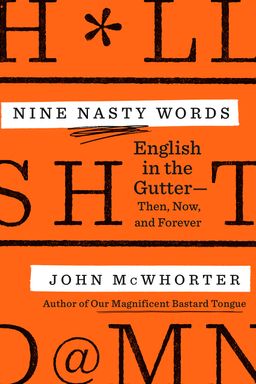
Nine Nasty Words cover

Nine Nasty Words

by John McWhorter

Nine Nasty Words delves into the evolution of profanity, unveiling the history and societal impact of linguistic taboos. John McWhorter takes readers on a fascinating journey through time, exploring how certain words gained their power and why they continue to provoke and challenge cultural norms.

How Swearing Reveals the Soul of Language

Why is it we lean on curse words when language fails us? What happens inside your brain when you yell “damn,” “fuck,” or “shit”? In Nine Nasty Words: English in the Gutter, Then, Now, and Forever, linguist John McWhorter argues that profanity is far more than verbal rebellion—it’s a key to understanding language itself. He insists that the words society shuns most fiercely are those that reveal the hidden architecture of thought, emotion, taboo, and identity. Swearing, McWhorter suggests, is how language shows its heartbeat.

Language, Emotion, and the Limbic Spark

McWhorter opens with delightful stories: Babe Ruth’s affair memorialized in a shocking affidavit, a linguistically cheeky mom shouting “Oh, jolly shit!”, and George Carlin’s classic list of forbidden words. In these moments, he exposes how profanity taps something deep in us. When we swear, the left side of the brain—the logical, structured half—takes a back seat, and the right hemisphere, seat of emotion, lights up. Swearing is less about words than about instinct. It’s not “language” in the normal sense but verbal lightning, a visceral outburst echoing evolution itself.

Neurological studies back this idea: people who lose the left hemisphere can’t speak, yet they can still curse. Conversely, those without an active right hemisphere can speak fluently but struggle to swear. This duality reveals that profanity operates from the limbic system—the emotion generator that governs impulses and catharsis. To yell “shit!” when you drop your phone is not to describe feces but to release tension, an ancestral reflex akin to how a frightened primate squeals.

Cursing as Cultural Evolution

In tracing verbal taboos across centuries, McWhorter reveals how profanity evolves alongside social priorities. The history of swearing in English falls into three eras. First came religious profanity: words like “damn” and “hell” scandalized medieval speakers because they profaned the sacred. Then, as religion relaxed its grip, the taboo shifted toward the body—sex, excretion, anatomy—giving us “fuck” and “shit.” Finally, the modern age brought social profanity: slurs, words that wound by demeaning group identity. Each phase mirrors shifting notions of sin and shame. As institutions change, so do the words we’re afraid of.

This linguistic evolution underscores a larger point: taboo never disappears; it only relocates. Our “nasty words” move with us, preserving society’s emotional hierarchies. A medieval priest feared “damning”; a Victorian matron blushed at “sex”; today’s conversation freezes around anything that targets race or gender. Language faithfully records our moral map.

Finding Science in Profanity

McWhorter insists that profanity isn’t chaos—it’s structure. He invites readers to view the lexicon of curses through the scientific lens of linguistics, a discipline that seeks order in verbal disorder. Linguists, he explains, conduct problem sets like physicists: they look for patterns underlying what seems arbitrary. And profanity, with its messiness, follows elegant linguistic principles. It changes form, function, and part of speech just like other words—sometimes faster.

Consider “ass”: it morphs from noun (body part) to adjective (“big-ass car”), pronoun (“your ass”), and even suffix (“loud-ass music”). “Hell” evolves into a scalar intensifier (“run like hell”) or punctuation (“what the hell?”). “Fuck” may yet become a question particle (“fuck’s that?”). Each shift mirrors natural grammatical drift, the same process that turned “will” from meaning “want” into a future tense marker. These transformations aren’t linguistic decay—they’re the art of evolution in motion.

Taboos and Identity

Across nine core chapters, McWhorter explores each of English’s bedrock swears—“damn,” “hell,” “fuck,” “shit,” “ass,” “cunt,” “bitch,” “nigger,” and “faggot”—each a time capsule of cultural anxiety. He examines how power and vulnerability shape our sense of offense and how speakers appropriate insults to form identity, community, and resistance. For instance, Black English transforms the slur “nigger” into “nigga,” reshaping hate into solidarity, while “bitch” evolves from misogynistic sneer to feminist emblem. The study of profanity becomes the study of social transformation.

By following these words from the monastery to the Twitter feed, McWhorter shows how English adapts to our hearts and politics. Swearing, far from being linguistic failure, is authenticity made audible—the moment when language drops its mask.

Why It Matters

McWhorter’s message is both scholarly and liberating: to understand language, you must embrace its dirt. Profanity teaches us not only where taboo lurks but how humans express self, hierarchy, and emotion. It’s how we mark the boundaries of propriety and test freedom of speech. In the end, these “nasty words” are not linguistic failures—they’re proof that language is alive, adaptive, and gloriously human.


The Birth of Bad Words: Damn and Hell

Our linguistic ancestors didn’t start with “fuck.” They started with faith. In medieval English, the earliest “bad words” were spiritual: damn and hell. John McWhorter calls them profanity in prototype form—a glimpse of a world where cursing meant violating God rather than good taste.

From Sacred Swearing to Everyday Speech

Medievals classified speech sins by faith. To “swear” meant to call upon God falsely, and thus even uttering divine names frivolously was blasphemy. Saying “God damn you” or “Go to hell” trespassed into divine authority. McWhorter traces centuries of cautionary euphemisms—“darn,” “doggone,” “heck,” “golly”—as linguistic fig leaves. You weren’t permitted to call down eternal punishment, but you could fudge around it. Like the Harry Potter euphemism for Voldemort, these polite stand-ins proved English’s anxious dance between reverence and rebellion.

Linguistic Drift and Cultural Relaxation

By the twentieth century, “damn” and “hell” had lost their sting. Films from the 1930s like Glorifying the American Girl or Blessed Event used them freely. Even President Nixon said “damn” without fear of scandal. This linguistic mellowing reveals an evolution of taboo—from churches to bedrooms. What used to invoke supernatural terror now signals mild annoyance or comic intensity. Florida Evans’s anguished “Damn, damn, damn!” on Good Times became cultural catharsis, not heresy.

From Profanity to Grammar

McWhorter shows how these words even changed their grammatical role. “Hell” turned scalar (“run like hell,” “worked like hell”), “damn” became an intensifier (“damn good time”), and both slipped into everyday phrases like “What the hell?” or “That’s a damn shame.” These shifts follow linguistic natural law: frequent words melt into function. “Hell,” once a noun, became pure emphasis—a linguistic thermometer for emotional heat.

The Social Mirror

Tracing “damn” and “hell” reveals the pattern that governs all swearing. Profanity reflects social power: when faith ruled society, religion defined obscenity; when secularism rose, the body did; when identity politics took the helm, slurs did. Every era’s curse words are emotional fossils of what people fear most.

So when you mutter “What the hell?” under your breath, you’re voicing the residue of medieval theology—centuries of moral reform boiled down to a casual sigh. McWhorter’s genius lies in making you see the ordinary as archaeological.


The Evolution of Fuck

Few words carry more cultural electricity than “fuck.” McWhorter devotes an entire chapter to unraveling its etymology, rise, and grammatical explosion. Once medieval slang, now universal punctuation, “fuck” is how English flexes its emotional muscle.

A Hidden Ancestry

Its origins, surprisingly, hide in the mist of early Europe. We find names like Roger Fuckbythenavel in 1310 and a monk’s scribble “fuckin’ abbott” in 1528. The word likely emerged from Old English’s lost verb fucan (to copulate) or the Norse fukka. Scholars scoured dialects for cousins—German ficken, Dutch fokken—but McWhorter reminds us that linguistic trails rarely follow tidy genealogies. What matters isn’t where “fuck” began, but that it survived by being irresistibly expressive.

Forbidden and Then Freed

By the Renaissance, it had slipped underground, expunged from dictionaries for centuries. Soldiers mouthed it behind trenches, authors hid it behind dashes. Only after Lady Chatterley’s Lover broke obscenity trials in the 1960s did “fuck” come home to print. McWhorter links this liberation to cultural shifts—the sexual revolution, Vietnam cynicism, and a loosening of class decorum. “Fuck” reset English’s profanity hierarchy. What “damn” did for Victorians, “fuck” did for boomers.

Grammatical Wildfire

Beyond its scandal, “fuck” transformed English grammar. It became noun (“That’s some fuckery”), verb (“They fucked up”), adjective (“fucking brilliant”), adverb (“fuckingly awful”), and even a question particle (“Fuck’s that?”). McWhorter notes “expletive infixation” as linguistic delight—why we say “abso-fucking-lutely” but never “Al-fucking-toona.” Speakers instinctively know where emphasis belongs, proving that even swearing obeys syntax.

A Linguistic Reset Button

“Fuck” refreshes profanity’s cycle. As one curse loses potency, another rises. “Hell” gave way to “shit,” then “fuck.” McWhorter’s fieldwork in pop culture—from The Dick Van Dyke Show to Bono’s Golden Globes outburst—shows the resilience of moral panic. Society recoils, then adapts. Swearing, he argues, is moral evolution disguised as vulgarity.

Ultimately, “fuck” made profanity democratic. Everyone can use it, from teenagers to presidents, and each usage—rage, joy, delight, despair—reminds us that language listens as much to the heart as to grammar.


From Feces to Philosophy: The Word Shit

You may laugh at potty humor, but McWhorter insists that “shit” is linguistic poetry—proof that words born in filth can become metaphors of power.

Down the Linguistic Drain

Forget the sailor’s myth of “ship high in transit.” The real root is ancient: Proto-Indo-European *skei (“cut off”) morphed into Old English scit. That verb’s mechanical meaning—splitting, separating—turned physical, referring to excretion, and drifted phonetically into “shit.” Curiously, its cousin gave us “science,” meaning “to know.” Thus, “shit” and “science” share ancestry—a neat metaphor of knowledge born from decomposition.

From the Farm to the Factory

In medieval and rural life, “shit” was ordinary—it described what animals did and fertilizer was made of. Only when private toilets appeared, and bodily matters moved behind doors, did “shit” turn taboo. As Protestant moral strictness and indoor plumbing rose, language followed. “Feces” replaced “shit,” and politeness started with euphemism.

The Metaphorical Masterpiece

McWhorter marvels at how this one word now covers everything from universality (“Everyone has their shit”) to authenticity (“Get your shit together”) to humility (“My shit’s messed up”). It functions as pronoun, noun, verb, adjective, adverb, insult, and accolade. When someone “knows their shit,” they’re competent; when “the shit hits the fan,” chaos reigns. Linguistically, “shit” evolved to signal both the real and the worthless—the way humans juggle self-loathing and self-knowledge.

Through “shit,” English captures how taboo turns to texture. What once evoked disgust now binds humor, emotion, and identity. It’s language’s great equalizer: everyone, king or peasant, has to deal with it.


Ass and the Grammar of Rebellion

We use “butt,” “ass,” and “arse” so frequently they seem trivial, yet for McWhorter they unveil one of English’s most delightful phenomena—the way profanity becomes grammar itself.

From Donkeys to Pronouns

“Ass” began innocently enough—an animal. But when British speakers dropped the “r” in “arse,” the twin words merged. Suddenly English had a butt-horse hybrid ripe for humor. Over time, “ass” transmogrified from noun to grammar particle: “kick-ass,” “bad-ass,” even “your ass.” In some dialects, “your ass” replaces “you” entirely. “I’m gonna fire your ass” isn’t about anatomy—it’s a pronoun. Whole syntactic structures emerge from rebellion.

How Curses Become Grammar

McWhorter breaks down how overuse smooths edges. Frequent salty expressions sink from content to function. “Big-ass,” “cold-ass,” or “loud-ass” demonstrate how “ass” evolved into an informal suffix meaning emphasis or astonishment. Linguists label similar processes “grammaticalization”—when phrases like “going to” become “gonna.” “Ass” did something similar but with sass.

From Rump to Revolution

This shift carries cultural resonance, too. “Ass” became a badge of anti-formality—a linguistic rebellion for ordinary people against propriety. Its playful flexibility counters linguistic prescriptivism like Strunk & White’s rules. To say “big-ass party” is to reject stiffness and embrace the emotional grammar of life itself.

Profanity, McWhorter argues, turns out to be our most democratic speech act. An Oxford don diagramming syntax might miss that your “lazy-ass weekend” carries centuries of resistance inside it—proof that grammar’s truest rules come from the street.


From Parts to Power: Sex, Body, and Gendered Cursing

When McWhorter turns to “those certain parts”—words like dick, pussy, and cunt—language becomes anatomy. These are not just words for sex organs; they are mirrors of gender, power, and shame.

The Missing Neutral Words

English, unlike Old English, has no middle ground for genitals—you’re either clinical (“penis,” “vagina”) or crude (“dick,” “pussy”). McWhorter laments that linguistic polarization: somewhere between science and slang, English lost its neutral zone. The Old English terms pintel and cunt were once ordinary; prudery excised them, leaving only extremes.

Dick and Pussy: Gender and Agency

Tracing “dick” to “Richard” and “Tom, Dick, and Harry,” McWhorter shows how playful male nicknames became sexualized. “Pussy,” meanwhile, shifted from affectionate feline to sexual slur—a drift from tenderness to objectification. He contrasts the American response (“shock”) with the British ability to juggle dual meanings; Mrs. Slocombe’s “my pussy” joke on Are You Being Served? quotes sexual ambiguity without full taboo.

From Cunt to Cultural Taboo

“Cunt,” McWhorter notes, went from medical term to ultimate linguistic taboo—second only to racial slurs. Its journey charts the moral policing of female sexuality. Once neutral (a surname like “Fillcunt” existed in medieval records), it became a weapon. Feminist theory and pop culture reclaimed it partially—Eve Ensler’s The Vagina Monologues riffing on the word—but shame lingers. McWhorter observes that language’s dirtiest word may simply testify to patriarchy’s endurance in syntax.

For each term, meanings migrate through power and propriety. Our vocabulary of the body exposes cultural anatomy: how English learned to blush, one syllable at a time.


The Profanity of Identity: Slurs and Society

McWhorter’s most provocative chapters tackle slurs—especially “nigger” and “faggot.” He argues these modern taboos have replaced religious and sexual profanity as society’s deepest linguistic fears. These words are no longer merely insulting; they’re sacred negatives.

From Neutral Usage to Nuclear Taboo

Originally, “nigger” meant “Black person” as casually as “Negro.” McWhorter uncovers early examples—from 1570s diaries to Gil Scott-Heron—to show how it shifted from neutral descriptor to weapon. The transformation mirrors America’s racial conscience: as civil rights advanced, the word’s toxicity intensified. Today it’s linguistic plutonium—utterable only by insiders, forbidden elsewhere. Similarly, “faggot” evolved from “bundle of sticks” to slur via metaphoric drift from weakness to deviance.

Appropriation as Power

McWhorter unpacks how marginalized groups reclaim profanity. “Nigga,” “dyke,” “bitch”—each reappropriates stigma as solidarity. In African American Vernacular English, “a nigga” even functions as a pronoun (“A nigga got no breakfast”), testifying to linguistic reengineering within culture. He distinguishes between slur and in-group term—between “nigger” (hate) and “nigga” (identity). Language, here, heals through reuse.

The New Sacred Words

Modern profanity, McWhorter argues, centers on harm rather than heresy. To utter a slur is to violate a moral code, not divine law. The shift from “sin” to “social injustice” situates language at ethics’ frontier. Just as medievals feared “damning,” we fear discrimination made audible.

His linguistic insight reframes cultural sensitivity: even taboo can be democratic, because each generation renegotiates offense. As language changes, so does what we protect. Today’s forbidden syllables mark not blasphemy but empathy.


When Women Talk Back: The Word Bitch

If profanity measures power, “bitch” charts feminism’s arc. McWhorter explores how a word once meant for female dogs came to symbolize defiance, insult, and pride—all at once.

From Kennel to Culture

Old English bicge simply meant “female dog.” By the 1400s, it slipped into metaphor—comparing women to heat-driven hounds. Centuries later, “bitch” became shorthand for female indecency or rebellion. McWhorter shows its trajectory through literature—from Chaucer’s “skabde biche” insult to Hollywood’s coy dances around the word, like Crystal Allen’s razor-edged “kennel” line in 1939’s The Women.

Semantic Expansion

Eventually “bitch” transcended gender to mean complaint (“stop bitching”), difficulty (“life’s a bitch”), or authority (“head bitch in charge”). Grammar absorbed rebellion. The word became both insult and lightning rod—a linguistic echo of female assertion. McWhorter highlights hip-hop and feminist movements that repurposed it: Jo Freeman’s 1968 Bitch Manifesto, Skinny Bitch cookbooks, and pop figures like Cardi B using “A bitch is scared” as self-reference, converting stigma into subjectivity.

The Pronoun Revolution

McWhorter notes that “bitch,” like “ass” and “nigga,” even turns pronoun. “The bitch set me up,” said D.C. mayor Marion Barry—syntactically equal to “she set me up.” Such grammatical creativity transforms gender politics into syntax. Profanity becomes not exclusion but innovation.

“Bitch,” perhaps more than any other in McWhorter’s lineup, encapsulates language’s moral pendulum: insult becomes empowerment, taboo becomes grammar, and words once meant to silence turn into megaphones. When women talk back linguistically, English evolves.


Motherfucker: The Ultimate Linguistic Hybrid

McWhorter ends with laughter. “Motherfucker,” he says, is profanity’s symphony—a word so expressive it became universal punctuation, and so absurd it lost any literal sense.

From Insult to Identity

The term may sound brutal, but its history is surprisingly playful. First recorded in nineteenth-century Texas courtrooms, “motherfucker” spread in African American oral tradition, especially in the ribald “toasts.” Over time, it detached from incest accusation and became sheer swagger. Among Black speakers, it’s not sexual—it’s symbolic: “badass,” “everyman,” “friend.” Don King once called it “a Black invention”—a word of power claimed by the powerless.

Meaningless and Musical

McWhorter analyzes how the “mother” in “motherfucker” now carries zero meaning, functioning like a rhythmic prefix in Cambodian reduplication (“don-daap”). It’s jibber-jabber’s cousin. The term’s cadence, not content, gives impact. We don’t hear “mother” as genealogy; we hear it as emphasis—a linguistic drumbeat.

Universality of Humor and Humanity

His anecdote of a co-worker yelling “MothaFUCKuh!” in comic defiance captures its essence: communal laughter through linguistic mischief. Like “abso-fucking-lutely,” the joy lies in release. It’s swearing as human harmony—a reminder that even the crudest word can unite people in rhythm and catharsis.

When analysis meets hilarity, McWhorter’s closing lesson rings clear: every curse word, no matter how vulgar, traces the evolutionary elegance of language. “Motherfucker,” with all its foolish grandeur, is the perfect coda to English’s dirty symphony.

Dig Deeper

Get personalized prompts to apply these lessons to your life and deepen your understanding.

Go Deeper

Get the Full Experience

Download Insight Books for AI-powered reflections, quizzes, and more.