
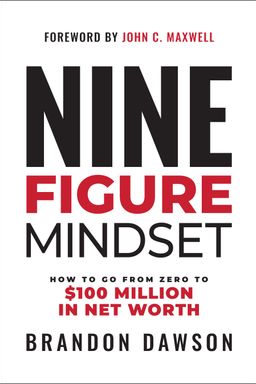
Nine-Figure Mindset cover

Nine-Figure Mindset

by Brandon Dawson

Nine-Figure Mindset reveals the strategies and mindsets needed to build extraordinary business empires and achieve significant wealth. Drawing from real-life entrepreneurial experiences, it provides a blueprint for transforming beliefs, managing employees effectively, and thriving in crises. Unlock your potential and embrace abundance for business success and personal fulfillment.

Building a Nine-Figure Mindset for Extraordinary Success

Have you ever wondered why some entrepreneurs turn modest beginnings into multimillion-dollar empires while others remain stuck at the starting line? In Nine-Figure Mindset: How to Go from Zero to Over $100 Million in Net Worth, Brandon Dawson argues that the difference lies not in talent or luck but in the scale of one’s thinking. Dawson contends that achieving exceptional success is not about working harder but about thinking bigger, acting with discipline, and building systems that magnify impact through others.

At its core, the book teaches that wealth creation and personal growth are products of intentional mindset engineering. Dawson reveals how mentorship, collaboration, and leadership alignment can transform ordinary business owners into industry dominators. More than a business manual, this is a psychological guide to scaling belief—turning internal confidence into external success by systematically multiplying value through teams, systems, and strategic execution.

From Farm Boy to Visionary Founder

Dawson opens with the story of himself as a 2.4 GPA high school graduate who worked on his parents’ walnut orchard in Oregon, dreaming of building something bigger. His entrepreneurial journey—from selling hearing aids to leading billion-dollar partnerships—illustrates his central argument: that success begins between your ears. He built and sold Audigy Group for $151 million, co-founded Cardone Ventures with sales icon Grant Cardone, and spent years studying leadership under John Maxwell. Each milestone reflects his belief that mindset, not circumstance, determines destiny.

Through vivid stories of struggle and triumph—losing his first company, receiving tough love from mentor Hector LaMarque, and reinventing his leadership philosophy—Dawson positions his own life as a living laboratory for the principles he now teaches. These experiences convinced him that failure is not fatal; it is feedback guiding you toward mastery. He argues that anyone, regardless of background, can build extraordinary wealth if they reengineer their thinking around abundance, accountability, and value creation.

Three Foundations of the Nine-Figure Mindset

First, Dawson teaches that success is a duty, obligation, and responsibility. Borrowing from Grant Cardone’s 10X philosophy, he insists that great entrepreneurs must take massive action—always thinking and doing ten times more than what seems realistic. Second, he explores the power of mentorship and modeling. By surrounding yourself with people who have done what you want to do, you bypass years of trial and error. Mentorship transforms potential into performance through accountability and perspective. Third, he emphasizes the importance of leadership alignment. Your company will only scale to the level of leadership you exhibit and develop in others. To turn ideas into impact, you must align every team member’s personal, professional, and financial goals with your organization’s success.

Why Mindset Outweighs Mechanics

While Dawson provides practical systems—such as employee maturity modeling, reverse consolidation, and his ‘3M method’ (Model, Mimic, Master, Multiply)—he continually returns to mindset as the core differentiator. Skill without belief leads to stagnation; belief without discipline leads to chaos. A nine-figure mindset harmonizes vision and execution through self-awareness, structured learning, and relentless personal growth. Dawson’s approach mirrors psychological frameworks from thinkers like Carol Dweck (Mindset) and Simon Sinek (Start With Why): your perception defines your performance.

The Moral Compass of Wealth

Dawson also reframes success as service. Citing leaders like Maxwell and Musgrave, he asserts that leadership is about creating value for others, not just yourself. True wealth is measured in impact—the ability to help others achieve their dreams while pursuing your own. The nine-figure entrepreneur, therefore, operates from moral clarity: wealth is amplified by purpose. Without purpose, money becomes meaningless; with it, it becomes legacy.

Why These Ideas Matter

In a world where most small businesses fail within ten years, Dawson’s philosophy provides a blueprint for lasting success. It’s not about survival—it’s about scale. His book challenges everyday entrepreneurs to transcend limitation thinking, cultivate self-mastery, and lead with vision. Whether you’re starting your first venture or refining a mature organization, this mindset redefines possibility. The nine-figure mindset is not merely financial—it’s existential: the commitment to think without ceiling, execute with integrity, and leave a legacy of multiplied success.


Mentorship: The Catalyst for Transformation

Brandon Dawson insists that mentorship is the most powerful accelerator for success. He recounts how his friend and mentor Hector LaMarque—the top leader from Primerica—changed his life with one painful insight: “What you think is what you say. What you say is what you do. What you do is what you’re known for. It’s your legacy.” That conversation pulled Dawson from victimhood to ownership and became the turning point toward what he calls Brandon 2.0.

Friendship vs. Mentorship

Dawson identifies a fundamental difference between friends and mentors. Friends love you as you are; mentors see what you can become. A mentor helps you grow through truth—often uncomfortable truth. Hector’s “tough love” moment revealed that Dawson was trapped in resentment from losing his company Sonus, which blinded him to new opportunities. Mentorship broke that pattern. Hector’s guidance redirected him to self-reflection and structured learning through the teachings of leaders like John Maxwell and Robert Kiyosaki.

Learning Through Modeling

From Hector, Dawson learned the 3M system—Model, Mimic, Master, Multiply. This principle defines growth as a transferable skill rather than a personal secret. First, you MODEL success by studying the best examples. Then, you MIMIC their behaviors through practice. Once proficiency becomes instinct, you MASTER it. Finally, you MULTIPLY mastery by teaching others, creating an exponential impact. (This method parallels Maxwell’s concept of developing leaders who develop others.)

Trust and Vulnerability in Mentorship

The book emphasizes that true mentorship requires vulnerability—the willingness to trust someone’s insight over your own ego. Dawson admits that his biggest downfall as a young entrepreneur was arrogance: believing he knew better than his advisors. He calls this phase “entrepreholism”—an addiction to self-validation through endless business ventures. Mentorship replaces that isolation with calibrated accountability. It anchors ambition to wisdom and transforms reckless drive into sustainable leadership.

Mentorship Across Life Stages

Through Hector and later mentors like John C. Maxwell and Grant Cardone, Dawson discovered that mentorship evolves as you scale. At the start, you need direction; later, you need reflection. Maxwell taught him the law of the lid—that leadership ability determines a company’s capacity for growth, echoing lessons from Ray Kroc’s expansion of McDonald’s. Cardone introduced the law of 10X—pushing activity and belief tenfold higher. Together, these mentors proved to Dawson that growth is a function of learning multiplied by execution.

Becoming a Mentor Yourself

Dawson’s evolution culminates in becoming a mentor himself. By building Audigy and later Cardone Ventures, he institutionalized mentorship—helping thousands of entrepreneurs rethink their leadership, structure, and scaling models. His message: you don’t just need mentors; you must become one. The ultimate proof of mentorship’s success is when those you teach multiply your lessons into their own communities. Leadership spreads like a ripple of transformation—and that, Dawson says, is how legacy is truly built.


Engineering Scalable Success

Dawson’s genius lies in transforming theory into systems. After losing his first company, Sonus Hearing Centers, he reinvented the consolidation model with Audigy Group—a “reverse consolidation” where entrepreneurs buy into the management company to grow their own businesses, rather than being bought out. This system exemplifies his operational ethos: build structures that make scaling inevitable.

Reverse Consolidation and Shared Equity

Traditional consolidation forces compliance—big firms cram down policies on acquired small businesses. Dawson’s model flipped that hierarchy. Under Audigy, small clinic owners became partners, receiving equity in the management company. Rather than dictating operations, Dawson’s team served these owners as clients, offering operational frameworks, marketing, finance, and leadership training. This created mutual growth: when partners succeeded, Audigy succeeded. Ownership became a shared mission rather than a transaction.

Personal, Professional, and Financial Alignment (PPF)

Central to this model was the alignment of PPF goals—personal, professional, and financial ambitions. Dawson taught that growth stalls when these goals conflict. In Audigy’s system, every team member created a roadmap showing how their personal dreams tied directly to company performance. This psychological engagement replaced compliance with commitment, mirroring Patrick Lencioni’s philosophy in The Advantage: clarity drives cohesion.

The Employee Maturity Model

To sustain scalability, Dawson introduced the Employee Maturity Model—a transparent career path showing exactly what skills and contributions were required to move up. Promotions didn’t occur by tenure but by demonstrated leadership maturity. His protégé, Mason Walker (a former Ferrari salesman), advanced from entry-level hire to Audigy CEO by mastering this process. Dawson’s approach teaches that scalable organizations mature through clearly defined progression, not politics or guesswork.

Operational Mastery and Discipline

Audigy’s 36-month rise from startup to $151 million sale showcases Dawson’s execution discipline. Through careful cash management, he demonstrated that growth need not rely on external capital—only on operational mastery. “Grow from cash flow,” he advised, contrasting with venture models that drown in debt. This framework of reverse consolidation and disciplined alignment became the foundation for Cardone Ventures, proving that scalable success comes from engineered ecosystems that reward collaboration, not competition.


Leadership and the Law of Alignment

For Dawson, leadership isn’t about control—it’s about alignment. Drawing inspiration from John Maxwell’s laws of leadership, he teaches that every company mirrors its founder’s mindset. If the owner is disorganized, fearful, or unclear, the organization inherits those traits. Leadership, therefore, is the act of creating alignment between vision, systems, and people.

The Entrepreneurial Dilemma

Most entrepreneurs, Dawson observes, suffer from what he calls the “entrepreneurial dilemma”—believing they must do everything themselves. They confuse busyness with productivity and independence with leadership. Statements like “I can’t find good people” or “No one cares like I do” are symptoms of misalignment, not reality. Dawson argues that your inability to attract capable people stems from your failure to inspire them with clarity and opportunity.

Finding, Aligning, Developing, Retaining

He proposes a five-tier framework for building cohesive teams: find great people, attract them with a compelling vision, align their success with yours, develop them through mentorship and accountability, and retain them through growth opportunities. By weaving these levels into business culture, leaders transform followers into partners—a concept that echoes Jim Collins’s principle in Good to Great: get the right people on the bus and keep them motivated toward a shared destination.

The Role of Belief

Belief runs like electricity through Dawson’s leadership philosophy. You teach others to believe in themselves by first modeling belief in them. When you elevate someone’s self-image, you elevate their performance. This insight influenced his training systems at Cardone Ventures, where employees learn to tie individual growth to organizational success. Leadership thus becomes emotional engineering—helping people rewrite their limiting scripts and replace fear with purpose.

Leading so the Business Works for You

Finally, Dawson redefines freedom: a business works for you when its people work through shared belief. The ultimate test of leadership is succession—when the organization can thrive without the owner’s constant presence. Through culture design and empowerment, Dawson teaches leaders to convert personal ambition into shared achievement. Alignment doesn’t just build a business; it builds legacy.


Purpose, Relationships, and the Power of Legacy

Success, Dawson writes, means nothing without relationship alignment. Through candid stories of his marriages, partnerships, and mentorships, he explores how personal misalignment can undermine professional triumph. His divorces revealed that passion without shared purpose leads to fracture. His partnership with wife and business ally Natalie Dawson demonstrates the opposite: success rooted in unity.

Alignment in Work and Marriage

Dawson’s lesson in partnership echoes Elena Cardone’s Build an Empire: couples who set shared personal, professional, and financial goals create synergy. He describes an exercise where partners list individual priorities on separate sides of a paper and shared ones in the middle column. The conversation that follows redefines collaboration—not as compromise, but as co-creation. Relationship alignment mirrors business alignment: clarity produces peace.

From Misalignment to Harmony

His second marriage crumbled because family expectations clashed with entrepreneurial drive. Dawson admits that passion for business sometimes made him neglect his family. That realization shaped his later approach with Natalie: to build enterprises that enrich rather than compete with family life. Together, they turned their shared aspirations into Cardone Ventures and became advocates for couples who blend love and leadership.

Legacy Through Shared Impact

For Dawson, legacy is not measured in personal wealth but in the multiplied progress of others. He envisions legacy as contribution—a ripple of transformation extending through employees, clients, and partners. “Success is the legacy you leave to others,” he writes. Building your nine-figure mindset means ensuring your achievements raise others alongside you. That, Dawson concludes, is the ultimate version of abundance.


Mindset as the Engine of Growth

Throughout the book, Dawson argues that mindset drives every outcome in business and life. He contrasts poor mindsets—based on fear, scarcity, and self-doubt—with rich mindsets built on accountability, resilience, and curiosity. Everything begins with how you think; every failure stems from how you limit that thinking.

Rich vs. Poor Mindset

A poor mindset says, “I can’t afford to grow.” A rich mindset asks, “How can I grow?” The distinction determines whether you’ll join the 97% of businesses that fail or the 3% that scale. Dawson’s mentors—from astronaut Story Musgrave to business magnate Grant Cardone—taught him that belief precedes evidence. You must think at scale before you can build at scale.

The Four A’s of Transformation

To change mindset, Dawson introduces the Four A’s: Acknowledge where you are, Accept responsibility, Act toward your intended direction, and Attack with intensity. This framework transforms thought into movement. He used it himself after being fired from his own company—acknowledging arrogance, accepting failure, acting on mentorship lessons, and attacking his next venture with relentless determination.

Intentions, Actions, and Attraction

Dawson blends mindset psychology with universal law: intention, action, and attraction. You attract the results your actions deserve. This aligns with Maxwell’s and Cardone’s teachings—combining spirituality with practicality. Mindset isn’t positive thinking; it’s disciplined execution rooted in belief. When you believe deeply and act consistently, results compound exponentially.

Mindset Drives Systems

Every technical system—from cash flow management to talent development—functions only as well as the beliefs powering it. Dawson notes that you must think like a millionaire long before you earn one. The nine-figure mindset is not arrogance; it’s abundance consciousness with action. “Your thoughts are the architecture of your results,” he writes. Changing your mindset isn’t motivational—it’s mechanical. It’s how you engineer greatness.


Turn Crisis into Opportunity

No entrepreneur escapes crisis, Dawson warns—but your response determines your destiny. Using lessons from the 2020 pandemic, he teaches how to transform uncertainty into acceleration. His book-within-a-book, The Emergency Business Response, outlines an exact methodology for thriving in chaos through disciplined leadership and decision design.

Context Before Reaction

When emergencies strike, people panic. Dawson’s first rule: stop, assess, and secure context. He lists five questions—Am I okay? Is my family okay? Are my people okay? How much time do I have? Who are my trusted resources? This step transforms fear into clarity. He compares the approach to military protocols shared by ex–Navy SEAL Adam La Reau, who emphasizes calm focus during uncertainty.

Contrast Scenarios

After gaining context, leaders must create contrast—evaluating alternative outcomes quickly and strategically. Reactive decisions made in panic lead to decline; strategic contrast fosters creativity. Dawson contrasts the 2008 economic collapse, where many business owners retreated, with his own expansion at Audigy, which grew during recession by doubling operational discipline and vision.

Crisis Reveals Weakness and Wealth

For Dawson, crisis exposes weaknesses that success disguises. If your foundations—people, process, systems—are fragile, turbulence reveals the cracks. Use those moments to rebuild stronger. He recounts working with clients like Equipment Experts, who turned a cash shortfall during COVID into structural reform. Preparedness, Dawson teaches, converts chaos into catalyst.

Prepared Mindset

Ultimately, he reframes crisis as character test: how you act under pressure defines you more than how you perform in peace. The nine-figure mindset doesn’t predict calm—it prepares for storms. Dawson’s mantra during crisis mirrors Stoic thought (Seneca’s resilience and Epictetus’s self-control): hardship isn’t random; it’s rehearsal for greatness. Crisis isn’t tragedy—it’s training.


Defining Your Abundance and Legacy

In his final chapters, Dawson elevates money from metric to philosophy. Abundance, he argues, is not accumulation—it’s circulation. Drawing on metaphors of flow, ponds, and universal law, he teaches that giving and receiving freely keep success alive. Hoarding or fearing loss constricts progress. True wealth is participatory.

Abundance vs. Scarcity

Dawson deconstructs the scarcity mindset—the belief that there isn’t enough opportunity, talent, or money. He counters with the abundance principle: there is infinite potential if you contribute to others. He likens money to current—energy that must flow. The more value you give, the more returns flow back. His readers are encouraged to circulate value through mentorship, gratitude, and generosity.

Affirmations of Wealth

Dawson offers intention statements to reinforce abundance consciousness: “I choose to build $100 million in net worth,” “I choose to teach others to be wealthy,” and “I choose to pay my employees well.” These statements serve as affirmations aligning belief with behavior. They parallel Napoleon Hill’s autosuggestion method (Think and Grow Rich)—where words program outcomes through conviction.

Legacy Through Multiplication

Dawson defines legacy as life multiplied through others. When you enrich your employees, family, and partners, you create compound impact. This is the nine-figure mindset’s ultimate goal: not to finish rich, but to finish significant. Every action creates a ripple. His collaborations with Grant Cardone and Natalie Dawson exemplify that legacy—partners building systems to empower millions.

Abundance as Leadership

To lead abundantly is to live without fear of competition or failure. Dawson writes, “You get what you give—and you get it multiplied.” Abundance completes the nine-figure arc: start with belief, build systems, lead others, and give relentlessly. Wealth, used responsibly, becomes freedom with purpose—a legacy that thrives beyond its creator.

Dig Deeper

Get personalized prompts to apply these lessons to your life and deepen your understanding.

Go Deeper

Get the Full Experience

Download Insight Books for AI-powered reflections, quizzes, and more.