
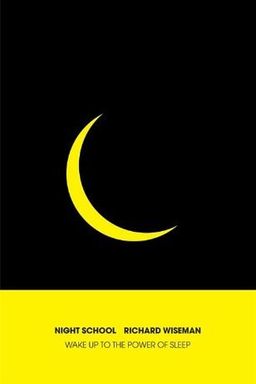
Night School cover

Night School

by Richard Wiseman

Night School delves into the profound impact of sleep on happiness and success. Richard Wiseman uncovers the science behind sleep, offering actionable insights to overcome insomnia and enhance your life. Discover how sleep affects your mental and physical health, and learn strategies for a restful night.

Unlocking the Power of Sleep and Dreams

Have you ever wondered what really happens to your mind and body each night while you sleep? In Night School, psychologist Richard Wiseman explores one of life’s most fascinating yet misunderstood activities—sleep—and shows that understanding what happens while you dream can dramatically improve your memory, creativity, health, and happiness.

Wiseman, a professor at the University of Hertfordshire, argues that we treat sleep as though it’s optional, when in fact it’s essential for thriving. His central contention is that sleep isn’t a passive state of rest; it’s an active, restorative process that determines how well you think, feel, and perform while awake. Drawing on decades of scientific research, he offers a practical curriculum—the “Night School”—that teaches you how to become a “super-sleeper,” someone who can sleep deeply, dream vividly, and harness the night to upgrade their life.

Why Sleep Matters More Than You Think

Wiseman opens with a striking story of his own late-night encounters with frightening visions of the devil—experiences he later learned were night terrors, not supernatural events. This moment of personal revelation launches his investigation into the science of sleep. Across history, humanity has misunderstood sleep as unproductive time, a gap in life’s action. Today, with 24-hour screens and overwork, we are living through what Wiseman calls an “international zombie epidemic,” a global decline in sleep that silently damages minds, bodies, and economies.

He explains that science now confirms what wisdom traditions have long suspected: when we rest, our brains are far from idle. They clean toxins, solve problems, regulate emotions, and consolidate memories. A night of deep sleep, he writes, is “the ultimate detox.” It renews your physical energy, sharpens decision-making, and even protects you from mental illness and disease.

The Structure of the Book

Night School is structured like a friendly scientific course taught after dark. Each lesson uncovers new discoveries—from how brainwaves create the stages of sleep, to how dreams help you regulate emotions, to how a mere six-minute nap can supercharge learning. Between these lessons are playful assignments: self-tests, dream-journals, and tongue-in-cheek quizzes (“What does your sleeping position reveal about you?”). The tone is part science guide, part sleep-lab diary, often humorous yet rigorously evidence-based.

Wiseman’s narrative blends history, pop culture, and science. He recounts experiments by pioneers like Hans Berger, who discovered the brain’s electrical rhythms, and Eugene Aserinsky, who accidentally identified REM sleep in his son. You also meet modern innovators like Stephen LaBerge, who taught himself to control dreams from within. Each experiment provides a stepping stone toward Wiseman’s key insight: every night, your brain embarks on a remarkable ninety-minute cycle between light sleep, deep sleep, and dreaming—a natural rhythm you can hack to live better.

From Myths to Practical Science

Wiseman debunks dozens of myths along the way: that some people can thrive on four hours of sleep (they can’t, unless they possess a rare gene mutation), that napping is lazy (it increases productivity and longevity), or that alcohol helps sleep (it fragments it badly). He connects poor sleep to a cascade of real-world costs—accidents, obesity, depression, and even premature death—offering simple evidence-based remedies along the way.

By the book’s end, Wiseman issues a call for a “sleep revolution,” arguing that schools, businesses, and entire societies need to revalue rest. He insists sleep is not weakness but wisdom in action. Those who master it—the true Night School graduates—become more creative, optimistic, and resilient. As Wiseman writes, “Night needs to become the new day.”

What You’ll Learn at Night School

Over eight lessons, you’ll explore the architecture of sleep, learn the “ninety-minute rule” for perfect wake-up timing, and discover how naps of different lengths affect your memory, creativity, and even cardiovascular health. You’ll examine dream control through lucid dreaming and how nightmares can be reframed into healing experiences. You’ll also test yourself with clever “assignments” that reveal everything from your chronotype (“lark” or “owl”) to your hypnotic susceptibility—the latter predicting how vivid and controllable your dreams might be.

Ultimately, Night School argues that the night is not lost time but the other half of a complete life. Just as education refines the mind by day, sleep perfects it by night. When you learn to respect and utilize your sleeping hours, you turn your bed into a classroom—and your dreams into teachers.


The Science of Sleep Cycles

Every night, your brain performs a symphony of biological rhythms far more structured than you might imagine. Wiseman explains that sleep isn’t one uniform state but a repeating cycle of stages lasting roughly ninety minutes. Understanding this cycle—and timing your bedtime around it—is one of the simplest and most powerful ways to transform your energy levels.

From Brainwaves to REM

The story begins with eccentric German scientist Hans Berger, who in the early 1900s accidentally discovered the brain’s electrical signals while chasing proof of telepathy. His device, the EEG machine, revealed that brainwaves change dramatically between wakefulness and sleep. Decades later, American researchers Eugene Aserinsky and Nathaniel Kleitman used EEGs to discover Rapid Eye Movement (REM) sleep—the stage when dreams occur. Aserinsky’s first subject was his own eight-year-old son, whose darting eyes in mid-sleep became the first proof that dream life has measurable biology.

Through these discoveries, scientists identified the sequence you go through each night: Light sleep (Stages 1–2), Deep sleep (Stages 3–4), and REM. Your night begins with slow drifting alpha waves, then theta, then delta. Light sleep helps you disconnect; deep sleep repairs tissue and boosts growth hormones; REM refreshes your mind and sparks creativity. Together, these phases form the architecture of nighttime wellbeing.

Wiseman calls the pattern the “ninety-minute rule”—the key to waking refreshed. You feel best when you rouse at the end of a ninety-minute cycle, not mid-way through one.

The Body’s Hidden Clocks

Sleep doesn’t exist in isolation; it’s wired into your body’s circadian rhythm—an internal 24-hour clock that cycles from alertness to fatigue. This discovery, traced back to eighteenth-century astronomer Jean-Jacques d’Ortous de Mairan (who locked plants in a cupboard to watch their leaves still open and close), explains why even in darkness your body keeps time. Later, French adventurer Michel Siffre confirmed that humans share this internal timer by living for months in caves without sunlight, where his sleep-wake rhythm persisted almost exactly 24 hours.

Your circadian clock is governed by the suprachiasmatic nucleus in your brain, which signals the pineal gland to release melatonin—the hormone of night. This rhythm differentiates early “larks” from late “owls” and influences everything from mood to metabolism. Wiseman notes that modern lighting and screens confuse this system, tricking your brain into thinking it’s noon at midnight. The fix? Dim your lights in the evening, avoid blue light from devices, and sleep at consistent times.

Resetting the Rhythm

Wiseman also offers practical tools to realign your internal clock. He introduces the “jet lag cure”: gradually shift your wake times before a trip, adjust to new time zones by seeking sunlight in the right part of the day, or even use melatonin supplements (with medical supervision). He points out that even everyday life can produce “social jet lag”—when school or work schedules conflict with our chronotype, leaving teens and night owls permanently groggy. Adjusting lifestyle and school start times, he argues, could yield immense cognitive and safety benefits—higher test scores, better moods, and fewer car crashes.

Learning your natural rhythm—and sleeping in sync with it—is the foundation of Night School. Once you master the ninety-minute rule, your mornings start feeling like sunrise rather than survival.


Sleep Deprivation: The Modern Epidemic

If you’ve ever bragged about “only needing five hours of sleep,” Wiseman has bad news. Chronic sleep loss, he shows, is quietly sabotaging health, productivity, and morality itself. His exploration of sleep deprivation reads like a cautionary tale for a civilization that decided to trade rest for lumens and Wi‑Fi.

How We Lost the Night

The story begins with Thomas Edison, whose invention of the light bulb effectively ended humanity’s natural alternation between daylight activity and nocturnal rest. Edison viewed sleep as wasted time, boasting he needed only a few hours. Wiseman calls this the moment the “war on sleep” began—a cultural shift where late work and all-night media became badges of honor. Today, more than a third of adults in industrialized nations don’t get enough rest, with America leading the “sleep-deprived league.”

What Sleep Deprivation Does to Your Body

Experiments have left no doubt: failing to sleep properly is lethal. In the 1980s Allan Rechtschaffen kept rats awake until they died—despite food being freely available, they literally perished from exhaustion. Milder human studies reveal profound psychological decay. In one case, radio DJ Peter Tripp stayed awake for eight days as a publicity stunt in Times Square. As the hours passed, he hallucinated mice, flames, and phantom undertakers. After it ended, his personality deteriorated permanently—proof, Wiseman notes, that even short-term deprivation warps the mind.

Modern tests confirm that missing even an hour or two of sleep degrades reflexes as sharply as alcohol. People overestimate how “fine” they feel, yet reaction time, empathy, and decision‑making plummet. Experiments at the U.S. Army Sleep Center and at Washington State University proved that seven hours’ sleep a night triggers deficits equivalent to a blood alcohol level of 0.1%. “You become the drunk who can still walk straight,” Wiseman quips, “just not think straight.”

The Cost of Sleeplessness

Sleep loss isn’t just personal—it’s institutional. Fatigue caused disasters from the Exxon Valdez oil spill to the Challenger explosion. In everyday life, it’s behind over 100,000 U.S. car crashes annually. In laboratories, tired volunteers make more ethical lapses, cheat more often, and show lower impulse control. Workers who miss rest also gain weight, crave junk food, and release stress hormones that accelerate aging. Long-term sleep deficiency doubles the risk of heart attack, diabetes, and some cancers.

Wiseman’s verdict is blunt: “Sleep isn’t idle time—it’s life-support maintenance.” Deprive it, and your body and morality begin to fray together.

The Way Back to Rest

Reclaiming the night starts with cultural change, but it also means personal discipline: keep consistent bedtime routines, darken rooms, stop screen use an hour before bed, and recognize that productivity without rest is a delusion. According to Wiseman, even a small nightly deficit creates “sleep debt” that no weekend can repay. Catching up requires weeks, not hours. His takeaway is simple yet radical: value your sleep as much as your diet or exercise, for without it, neither works.


The Secret of Super‑Sleep

Once you’ve accepted that sleep is vital, the next question is how to make it exceptional. In this lesson, Wiseman reveals how “super‑sleepers”—people who fall asleep easily, wake energized, and rarely suffer insomnia—build their habits. The secret isn’t magic; it’s consistent mastery of five key areas.

1. The Perfect Environment: The Bat Cave

Super‑sleepers treat their bedrooms like temples of darkness. Wiseman borrows from bats, which sleep 16 hours a day in secure, silent caves. Block light (especially blue light from screens), keep rooms near 18°C, filter out noise, and ensure the brain associates the bedroom with only two activities—sleep and sex. Even tiny light sources suppress melatonin, so covering LEDs or wearing sleep masks can dramatically deepen rest.

2. Daytime Habits That Influence Night

What you do during daylight determines how easily you’ll drift at night. Avoid long naps—twenty minutes tops. Exercise moderately several hours before bed; yoga or t’ai chi qualifies. Stimulate your mind with novelty—a museum visit or walk by the sea—since mental engagement heightens sleep drive. Most crucially, wake up at consistent times; erratic schedules confuse your body clock more than you’d think.

3. The Pre‑Sleep Ritual

Thirty minutes before bed, begin winding down. Warm baths help because when you exit the tub, body temperature drops—mimicking the natural cooling before sleep onset. Avoid caffeine and alcohol (contrary to myth, both fragment sleep cycles). Lavender scents can calm the nervous system, while jotting down to‑do lists or worries reduces mental clutter. Wiseman humorously calls this “brain housekeeping.”

4. Falling Asleep Fast

Wiseman’s clever experiments show paradoxical tactics often work best: try to stay awake and you’ll fall asleep faster. Counting sheep is less effective than visualizing pleasant scenes—your ideal holiday or winning the lottery. Acting “as if” you’re sleep‑ready also fools the body: yawn, relax muscles, keep eyes half‑closed. Behavioral science confirms such feedback loops (a nod to his own earlier book Rip It Up).

5. Handling Night Awakenings

If you wake at 3 a.m., don’t panic. Humans once slept in two segments historically. Get up if awake beyond 20 minutes, read or do a jigsaw under dim light, and avoid screens. Relaxation exercises work wonders: tense and release muscles from toes upward. And remind yourself your perception of wakefulness is flawed—most “insomniacs” are sleeping more than they think.

Taken together, these strategies form what Wiseman dubs the “Night School Manifesto.” Practice them and you shift from fighting the pillow to mastering it—waking clear‑headed, creative, and alive.


Sleep Learning and the Power of Naps

Can you learn Spanish—or quit smoking—while dozing? Wiseman explores the century‑long quest for sleep learning, from sci‑fi fantasies to modern neuroscience. His conclusion: you can’t acquire new facts in your sleep, but you can solidify old ones—and boosts come from the naps between.

The Rise and Fall of Hypnopaedia

The dream of sleep learning began in the 1940s when psychologist Lawrence LeShan tried curing boys’ nail‑biting by whispering aversive phrases into their ears at night (“My fingernails taste terribly bitter”). Some improved—until later EEG studies revealed many subjects hadn’t truly been asleep. Once scientists ensured participants were actually unconscious, results vanished. The hypnopaedia fad that inspired Brave New World died overnight.

What Sleep Actually Teaches

Real progress came when researchers examined how sleeping consolidates what we learn while awake. German psychologist Hermann Ebbinghaus charted the memory “forgetting curve,” discovering retention drops exponentially—except overnight. Sleep, it turns out, replays and stores critical information, pruning unnecessary memories. Students who learn before bed and sleep recall far more than all‑night crammers.

Experiments show naps trigger similar consolidation. In Harvard labs, people memorizing word lists improved dramatically after a 20‑minute nap—equal to many hours of rehearsal. Even six‑minute micro‑snoozes can enhance recall. Babies, who sleep up to twelve hours, appear designed for such learning: their brains, after naps, recognize grammatical patterns in invented languages.

The Art of the Perfect Nap

Wiseman turns napping into precision science. Short (10–20 min) naps boost alertness; 30–60 min deepen learning but may cause grogginess; 90‑minute “full cycle” naps enhance creativity and emotional resilience. NASA even found pilots improved alertness 35 % after a 25‑minute cockpit nap. Contrary to stigma, cultures with siesta traditions have 37 % lower heart‑related mortality.

Neuro‑Napping and Smelling the Roses

In 2007, Jan Born revived sleep learning with scent cues: students who learned words while smelling roses, then inhaled the scent during deep sleep, remembered far more data. Building on this, Wiseman suggests “neuro‑napping”—play the same background music during study and a nap to nudge your brain into replaying those patterns. Learning now continues, subtly, while you sleep.

The moral: don’t underestimate naps. They’re not lost productivity—they’re your brain’s unpaid interns, working the night (and afternoon) shift.


Dream Therapy and Emotional Healing

After showing how sleep strengthens memory, Wiseman dives into its second superpower: emotion regulation. Dreams, he argues, are your brain’s in‑house therapist—processing fears, replaying memories, and restoring mental balance. Every night you visit an inner counseling session; the question is whether you listen.

Why We Dream of Fear

Analyzing thousands of dream reports, psychologist William Domhoff found that 80 % feature ordinary events, but more than half involve anxiety or threat. When stress rises—divorce, trauma, war—the nightmares intensify. This isn’t dysfunction; it’s rehearsal. Our “nocturnal therapist” exposes us to distress in safe doses, gradually detaching fear from memory.

Laboratory experiments confirm it. Volunteers who watched disturbing films, then slept normally, showed less anxiety next day than those prevented from dreaming. Rosalind Cartwright discovered that divorcees who dreamed emotionally about their ex recovered faster from depression: the more vivid the dream, the greater the healing.

Too Much of a Good Thing

Paradoxically, depressed patients often dream excessively, entering REM early and frequently. Their brains work overtime processing distress, leaving little deep, restorative sleep. Experiments by Gerald Vogel showed that preventing such patients from entering REM reduced depression—an effect mirrored by many antidepressant drugs, which blunt REM naturally.

Turning Dreams into Therapy

The book offers practical frameworks to use dreams for insight. Psychologist Clara Hill’s dream work involves three steps: describe a vivid dream, interpret its real‑life parallels, then imagine constructive changes (perhaps transforming the dream’s ending). Another method, Teresa DeCicco’s “Storytelling,” translates dream images into short metaphors—stories that reveal emotional truth. Both approaches increase self‑understanding in controlled studies.

For faster problem‑solving, Wiseman cites William Dement’s “sleep‑on‑it” experiments, where half of subjects dreamt about puzzles overnight and far outperformed waking counterparts. Dream incubation—writing down a specific problem before bed—nudges your mind’s creative committee into working overnight. Thomas Edison, Robert Louis Stevenson, even Paul McCartney all famously found ideas in dreams. Wiseman’s advice: before sleeping, pose a question—and expect your nocturnal therapist to answer.


Mastering and Rewriting Your Dreams

The final Night School lessons reveal how to consciously influence your dream life—turning nightmares into adventures, and imagination into a training ground. Wiseman explores lucid dreaming, dream control, and imagery rehearsal, combining psychological history with practical guidance.

The Lucid Dreamers

Lucid dreaming—becoming aware you’re dreaming—was once dismissed until Stanford researcher Stephen LaBerge proved it in the 1970s by signaling his wakeful state through pre‑agreed eye movements during REM. Inside lucid dreams, people can fly, paint, rehearse skills, even solve mathematical problems. Studies show athletes practicing tasks (like throwing coins into cups) during lucid dreams improve their real‑world performance the next day. It’s mental rehearsal multiplied by imagination.

Training Techniques

LaBerge’s methods are simple: perform daytime “reality checks” (study your watch, reread lines of text, or try breathing through a pinched nose) to train awareness; visualize your desired dream before bed; and wake up briefly 30 minutes before your usual time, then fall back asleep thinking about it (“sleep interruption”). Gamers have a head start—video‑game players naturally report more lucid dreams, perhaps due to similar first‑person awareness.

Wiseman also describes atmospheric tweaks—music, scents, or cues played during REM—that influence dream scenery. In his own app project Dream:ON, users chose gentle “soundscapes” (rainforests, beaches) to steer dream settings. Millions of reports showed themes matching the chosen sounds, hinting that technology may eventually let us co‑author dreams safely.

Overcoming Nightmares

But not all dreams are pleasant. Around one percent of adults suffer recurring nightmares. Here Wiseman introduces Barry Krakow’s Imagery Rehearsal Therapy, proven to eliminate 90 % of cases. You simply write the nightmare’s script, change its ending into something safe or triumphant, and rehearse it while awake. When the nightmare returns, the new version often replaces it automatically. For children, drawing the scary scene and reshaping it with friendly helpers achieves the same result—story meets self‑control.

Dream control isn’t escapism. It’s emotional mastery. Whether through lucid awareness or rewritten scripts, you teach your brain that even fear can become fiction—and that’s the ultimate graduation exercise of Night School.


The Sleep Revolution

Wiseman concludes with a call to arms: modern civilization must “reclaim the night.” The sleep crisis, he argues, is as serious as climate change or diet‑related disease—and entirely solvable if society shifts its values.

Destroying Myths About Sleep

He lists twelve pervasive myths—from “sleep is for wimps” to “I can catch up on weekends”—and dismantles them with data. We can’t train ourselves to need less rest; alcohol ruins, not enhances, slumber; cheese doesn’t cause nightmares. Teenagers aren’t lazy—they’re biologically delayed owls. Reeducation, he insists, must start early. Sleep literacy should be as essential as reading or math.

The Night School Manifesto

To encode sleep wisdom into everyday life, Wiseman compiles ten universal rules. Highlights include: honor natural cycles via the ninety‑minute rule; use amber lenses to block blue light before bed; imagine pleasant scenes instead of counting sheep; jot down worries beforehand; and use imagery rehearsal to fix nightmares. More profoundly, he encourages viewing dreams as allies in goal‑achievement: visualize your aims before bed and let sleep rehearse your success—a modern twist on dream incubation practiced since ancient Greece.

He envisions schools starting later for teenagers, workplaces providing nap pods like Google’s, and hospitals applying sleep protocols to patient recovery. “Night,” Wiseman concludes, “needs to become the new day.” For readers, this isn’t just bedtime advice—it’s a manifesto for reclaiming one third of life as deliberately as we do work or love. The diploma, symbolically, is a clear mind at dawn.

Dig Deeper

Get personalized prompts to apply these lessons to your life and deepen your understanding.

Go Deeper

Get the Full Experience

Download Insight Books for AI-powered reflections, quizzes, and more.