
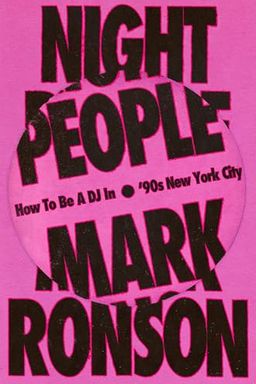
Night People cover

Night People

by Mark Ronson

The multiple award-winning record producer recounts his time as a D.J. in New York in the 1990s.

How Night People Make a City Pulse

When was the last time music made a whole room feel like one body—and you felt like the conductor? In Night People, Mark Ronson argues that DJing is far more than playing hits; it’s the invisible art of connection. He contends that the 1990s New York DJ wasn’t a playlist-puncher but a craftsman who read rooms, sequenced emotion, and built trust one blend, break, and left-field swerve at a time. To get there, you need to understand not only the technical skills (beat-matching, crate-digging, crowd psychology) but also the ecosystem—promoters, door people, record shops, and architecture—that either amplifies or smothers the sound.

In this guide, you’ll discover how Ronson learned the craft from the ground up—marking doubles with stickers like Grandmaster Flash, studying Stretch Armstrong’s routines, and hauling crates through snow to play for thirty kids in a back room. You’ll learn how New York’s clubs—Limelight, Tunnel, Roxy, Cheetah, Life—each enforced different physics on music, and how promoters like Bill & Carlos, Big Frank, and Jessica Rosenblum shaped the culture. You’ll also trace the sample family tree through record fairs and Japanese dealers, watch the scene survive Giuliani’s cabaret-law crackdown, and see how a left-field gambit—dropping AC/DC in a hip-hop room—cracked open a new identity.

The Core Claim: DJing as Empathy and Control

Ronson’s central claim: the great DJ is an empath with a fader. Yes, you need skills. But the deeper job is to carry a room through tension and catharsis while navigating egos, acoustics, and timing. That means playing the right record sooner than anyone thinks to ask for it—and knowing when the next record should be an unexpected risk. As Ronson puts it, “This isn’t like sex; it’s like sex with three hundred people at once.” He found this first at age ten, when choosing Eric Clapton’s “Wonderful Tonight” revived his mother’s backyard wedding. He’d later chase that feeling through hip-hop’s golden age, carrying two Technics and fifty records like a portable altar.

Why This Era Mattered

The 1990s in New York fused hip-hop’s neighborhood genius with downtown’s bohemian melting pot. Stretch & Bobbito’s radio show flooded the streets with underground anthems; record shops like Rock and Soul served as universities; and promoters turned deconsecrated churches (Limelight) and old stables (Shelter) into sanctuaries. Then came a crackdown: Giuliani weaponized a Prohibition-era cabaret law to padlock dance floors unless you navigated impossible licensing. Even so, the culture innovated. The hip-hop room shared headspace with rave main floors; bottle service emerged; and producers like Q-Tip and Premier collapsed decades of Black American music into new forms through sampling. Ronson’s memoir puts you backstage at that hinge moment—before Vegas EDM, before Serato—and lets you feel how fragile and electric it was.

What You’ll Learn

First, how to build the craft: beat-matching, marking breaks, reading architecture, and obeying the opener’s code (no hits). Then, how to build taste: crate-digging at Roosevelt Hotel record fairs, decoding the Tribe Called Quest sample bible, and understanding the ethics of secrecy and sharing (Tip shrugging “I don’t know” when asked about the “Bonita” sample). You’ll see the social math of scenes—why door people like King at Life could change your night with a nod; why Big Frank’s presence kept soul parties safe; why a new room can die—or go supernova—based on lighting and ceiling height alone (Kid Capri losing the room under 60-foot coffered ceilings at Puff’s birthday before Ronson re-stabilizes the floor).

The Stakes: Identity, Ethics, Cost

Ronson doesn’t flinch from thorny questions. What does it mean to be a white, Jewish kid spinning Black music? At Buddha Bar, a Black DJ, Jeff Brown, confronts him: white DJs were taking gigs. Ronson negotiates a split and, more importantly, sits with the truth. He also wrestles with antisemitism in records he loves (Public Enemy) and the messy reality that Jews held power in labels that exploited Black artists. The cost is physical and psychic: tinnitus, torn tendons, panic attacks, friends lost to addiction, and the haunting emptiness after a club clears and you’re left alone with ringing ears and a cab ride home.

From Booth to Studio—and Back Again

Night People also doubles as a creation story. DJ AM’s mind-bending routines expose a new virtuosity frontier. Lauryn Hill’s Jones Beach show shows how a band can honor samples without losing their grit. Electric Lady sessions with Questlove, Pino Palladino, and James Poyser help Ronson fuse hip-hop swing with live musicianship. When DJ Premier calls his “Like a Feather” beat “haaaaard,” you feel a coronation: the DJ who was once a student in the booth now has something to add to the canon.

This book matters because it preserves the muscle memory of a vanished craft—and argues for a way of being that still applies whether you’re behind decks, leading a team, or hosting friends: build trust, risk tastefully, respect the room, and give people what they need before they know they need it. (Think Jeff Chang’s cultural history in Can’t Stop Won’t Stop meets the practical, club-floor wisdom of Brewster & Broughton’s Last Night a DJ Saved My Life.) If you care about music, cities, or how scenes become history, Night People gives you the mix-in-captions you didn’t know you were missing.


Learning The Booth: Craft First

Ronson explains that DJing is a manual art before it’s a mental one. You first learn the hands and ears: how to cue on headphones while the room hears something else; how to nudge pitch so kick drums become one heartbeat; how to turn two identical records into an infinite break. He buys Technics 1200s and a Gemini Scratch Master at Rock and Soul, then promptly makes every rookie mistake—sliding needles off platters, knocking tonearms, and getting bullied by the motor torque. His solution is repetition: four records, a thousand attempts, a second brain forming from failure.

(Parenthetical context: This “muscle memory first” path mirrors how Grandmaster Flash refined Herc’s Merry-Go-Round by adding headphone cueing and clock-face stickers—essentially inventing live loop extension. Ronson copies that lineage almost literally.)

Beat-Matching and Doubles

Enter Manny Ames, a Collegiate School alum and B-boy maven who arrives like a drill sergeant. He slaps Maxell stickers onto Redman’s label like a sundial: kicks at three o’clock, snares at nine. Suddenly the record isn’t a circle but a map. With doubles, he can rewind precisely to a hit and extend a break forever. Ronson practices until he can slam “DWYCK” into Black Moon on a dime, unlearning panic and replacing it with small, confident calibrations.

Reading The Room

At Jungle Jim’s and the Surf Club, he learns a harder skill: diplomacy. As an opener, you don’t touch the headliner’s weapons. You warm the room—B-sides, sleepers, old-school gems—so when the main act arrives, the floor is oxygenated. He invents stitches like Cypress Hill’s “Hummin’, comin’ atcha…” into Redman’s “time-time-for some action,” turning familiar lines into call-and-response. He also learns to spy on downstairs DJs, pivoting genres to avoid overlap: if the main room is R&B, he flips to reggae; if they’re on dancehall, he returns to funk.

Mic vs. Mix

Clubs sort DJs into two archetypes: mic commanders like Kid Capri (who can fill a floor with a roar) and mix magicians like Stretch Armstrong (who choreograph the crowd’s voice). As a white DJ with a “thin, reedy” mic timbre, Ronson leans into Stretch’s innovation—ducking volume at the perfect syllable so the room shouts, and using the crowd as his hypeman. That trick scales, whether he’s lifting a Tuesday at New Music Café or salvaging a chaotic bathroom lounge at Tunnel.

Architecture Is an Instrument

He discovers the booth is only half the instrument; the room is the other half. Club USA’s Mugler Room suspends decks on rubber bands to fight bass feedback—a nightmare for scratch-heavy sets. At Puff’s gala in the marble temple at 55 Wall Street, 60-foot ceilings smear transients; Capri’s mic pyrotechnics rebound into mush. Ronson fixes it with “room-aware” sequencing: tighten up BPMs, add tracks with strong, dry transients (e.g., the Marley Marl foundation under “One More Chance (Hip Hop Mix)”), and minimize mic chatter.

The Opener’s Code—and Breaking It Carefully

By the time he opens upstairs for Tilt while Stretch commands downstairs, Ronson lives the opener’s oath: no hits, no crowd theft. He assembles sets of scaffolding records (“Time’s Up,” “The World Is Yours,” “Fool’s Paradise”), the kind that embolden bodies without emptying the main floor. This discipline later earns him trust when rooms are his to lose. Only then does he risk a left turn—like the night he Trojan-horses AC/DC into the biggest hip-hop room in the city. The rule isn’t “never break code;” it’s “build enough goodwill that a break becomes a gift, not a revolt.”

By the end, you understand that excellence comes from thousands of tiny calibrations more than a single drop. DJing is the craft of not losing one dancer—and then earning the right to change everyone’s mind at once.


The 90s NYC Club Ecosystem

To grasp Ronson’s world, you need to see the whole organism—rooms, rulers, rituals, and laws. The 1990s New York club ecosystem was a messy democracy where ravers, rappers, skaters, supermodels, label reps, and downtown vanguards all squeezed into repurposed power plants, churches, roller rinks, and brew halls. The venues weren’t interchangeable; each had rules that remixed you in return.

Rooms with Physics

Limelight: a deconsecrated church where Michael Alig’s Disco 2000 mixed Club Kids in ghoulish couture with suburban teens on Wednesdays. The Shelter/NASA: a horse-stable-turned-rave where underage kids rolled on E to squelching 4/4, while a back room let Super DJ Dmitry spin jazz-disco. Club USA: Broadway sleaze with a three-story slide, money drops, and a Mugler Room whose 60-foot ceilings devoured quantized beats. The Roxy: a roller rink reborn, with a janitor’s-closet-sized hip-hop booth upstairs—still the city’s best Friday because Tom Mello packed 3,000 kids into the main floor below. Den of Thieves and New Music Café: LES and SoHo dens where Sweet Thang (Big Frank + Marc LaBelle) turned Tuesday soul into a 2,500-covers-per-night pilgrim’s route. Life’s VIP: a beige corridor elevated to Olympus by King at the rope and the SKE crew’s downtown youth coalition; bottle service turned seating into status and the DJ into a prop—until Ronson flipped it back into a dance floor with surgical sequencing.

Promoters as Mayors

Bill & Carlos curated downtown with museum precision—Cey Adams flyers, Manhattan Brewing Company’s industrial grandeur, Stretch as resident. Big Frank—Alphabet City hardcore veteran built like a comic-book hero—kept chaos out through presence, not menace, even calling Ronson’s mother to promise he’d get the teenager home safely. Jessica Rosenblum’s Mecca Sundays with Funk Flex at Tunnel proved hip-hop could rule the main floor, not just the side room. King at Life—six-foot-six in sheepskin—was the velvet rope’s philosopher-king, reducing dualities (in/out; cool/not) to the nod of a thumb on a latch.

The Law as Rhythm Breaker

Mayor Giuliani revived a 1926 cabaret statute to criminalize dancing. If a cop caught “one hand and one foot in the air” without a license, the venue could be fined or padlocked. At 2i’s, Ronson switches from Usher to the Cheers theme as police walk in, freezing dancers into citizens. (Compare to Jeff Chang’s account of NYC’s “quality of life” policing: culture framed as disorder.) Clubs shifted to bottle service and lounges to avoid enforcement, with music’s social role rerouted into seating plans and champagne theatrics.

Rituals and Routines

Every downtown set followed a shared arc: 10–12 soul/disco, 12–1 old school hip-hop, 1–2 new hip-hop/R&B, 2–2:30 dancehall, 2:30–3 hip-hop, 3–4 anything to keep ’em. The canon (Maze “Before I Let Go,” Tom Tom Club “Genius of Love,” Meli’sa Morgan “Fool’s Paradise”) was a communal hymnbook; the final 25% was your handwriting. Post-brawl records were a category (Marvin’s “Let’s Get It On”; Marley’s “Three Little Birds”); post-raid records were another (TV themes until cops left).

Why It Matters

An ecosystem frames taste. Without Bill & Carlos’s Friday-Saturday conveyor, there’s no ladder for an opener to graduate. Without Rock and Soul on Fridays, there’s no shared language. Without Den of Thieves, Ronson doesn’t learn soul’s power with a hip-hop crowd; without Life, he doesn’t learn how to flip a VIP corridor back into a dance floor. The rooms taught him which risks were possible.

By seeing the clubs as a city’s nervous system—venues, promoters, door, police, radio—you’ll better understand how scenes rise and recode themselves. It’s not nostalgia; it’s system design for culture.


Crate-Digging And Sample Lineage

Ronson became fluent in hip-hop because he learned its mother tongue: the original records. His teacher at Vassar was Ben Velez, a dreadlocked vinyl sage who treated rare grooves like scripture. Sitting cross-legged in dorm light, Ronson hears Tom Scott’s “Today,” the sax-and-12-string source behind Pete Rock & C.L. Smooth’s “T.R.O.Y.”—and suddenly the beat he’s lived inside for months blooms into its ancestry. Once you’ve heard the origin, you never hear the sample the same way again.

The Record Fair, The Dealer, The Canon

At the Roosevelt Hotel’s monthly fair, DJs and producers dig like archeologists. RAMP’s “Daylight” (the heart of “Bonita Applebum”) jumps from $5 to $100 once Q-Tip loops it into history. Rotary Connection’s sitar on “Memory Band” becomes another “Bonita” pillar; Ronnie Foster’s “Mystic Brew” feeds “Electric Relaxation” despite its odd 3-bar structure. Weldon Irvine’s “We Gettin’ Down,” Minnie Riperton’s “Inside My Love,” Jimmy McGriff’s “Green Dolphin Street”—each entry expands a shared vocabulary. Then come the Japanese dealers like San, who unearth sealed boxes of 24-Carat Black, selling gold to the beatmakers who will melt it again.

Secrecy vs. Communion

Legends guard sources. When Ronson asks Q-Tip if Rotary Connection is the “Bonita” sample, Tip deadpans, “I don’t know,” and walks off. The impulse isn’t petty; it’s economic (you get scooped) and mythic (some magic needs opacity). But the other half of the culture is generosity: Ben throwing on records like Angela Bofill and Grant Green in his dorm; Rock and Soul clerks slipping you a Meli’sa Morgan if you’ve earned it; Soul Kitchen residents (Frankie Inglese, Jack Luber) educating floors weekly. The tension—hoard vs. share—produces both scarcity value and shared canons.

From Digging to Doing

Sampling isn’t scavenging; it’s composition. Ronson’s first remix (De La Soul’s “Dinninit”) fails when a Wu-Tang engineer gives him a murky mix that doesn’t suit the Lowrell loop he chose—an early lesson that sonics must serve concept. Later, at Electric Lady with Questlove, Pino Palladino, and James Poyser, he watches samples become arrangements: how to honor Dilla swing with a human drummer; how to make live keys feel like tape-warbled Rhodes. Finally, in LA, a thrifted prog record becomes the chopped DNA of “Like a Feather,” the song that earns DJ Premier’s co-sign. Digging’s endgame is to add, not imitate.

Why The Lineage Matters To You

Learning the originals upgrades your taste and your ear. You’ll recognize when a room needs the source, not the sample—Mary J.’s “You Bring Me Joy” into Barry White’s “It’s Ecstasy” lands because it lets the choir hear the hymn. You’ll know when to let the Ohio Players’ “Pride and Vanity” wander, testing adventurousness, and when to anchor with Al Green. And if you make anything—mixes, products, presentations—lineage reminds you to combine sources with intent, not for trivia points. (See also: Dan Charnas’s Dilla Time for a parallel story of how microtiming became a language.)

Crate-digging wasn’t a hobby; it was Ronson’s liberal arts education. The diploma is a floor that trusts you with a curveball because they know you studied the roots.


Night People: Light And Shadow

The book’s heart is the tribe in its title. Night people are the ones who become more themselves after dark: den mothers, wingmen, record whisperers, bouncers, and dancers who make a city feel like family. Ronson paints them lovingly—and honestly—because the light and shadow are braided together.

The Magnets

Lysa Cooper: Robert Mapplethorpe muse, Nolita stylist, and Juicy cofounder whose velvet-rasp authority made women-centered nights feel safe and riotous. Blu Jemz: anime-haired evangelist who turned basements into pilgrimages and always knew a white-label Armand Van Helden would create lift-off. Big Frank: the Avengers-sized security chief who’d phone Ronson’s mom to promise safe cab rides, then curate soul nights with the sensitivity of a lifelong punk. DJ Belinda: a dancer turned selector whose taste orbit—Brooklyn to Seoul to Jo’burg—modeled discovery as devotion.

Angels In The Undertow

Night also offers sanctuary. When Ronson stumbles out of Save the Robots—after-hours haze, plywood ceilings, dub delays—and starts to tip into a panic, Kathleen Cherry brings him home to sleep, no moves, just mercy. The same after-hours circulate drugs and danger; heroin’s pallor stalks friends; panic attacks mutate radiator clangs into threats. Yet the community’s net—Tom and Neil Mello tucking him into bed after a bad night; friends like Daniel, Alex, and Mayhem holding him to craft—keeps him from vanishing.

The Cost

There’s a ledger: tinnitus C6 ringing, torn tendons from wrestling floor wedges, an SI joint fried from asymmetrical stance (“DJ Foot”), and the harder losses—Clark Kent, Mister Cee, Manny Ames, Paul Nice, Blu Jemz—gone too soon. Fame’s center of gravity can warp nights; Ronson clocks Puff’s force field (part star-making machine, part chaos engine) and remembers the simpler electricity of Biggie at Sweet Thang, patiently waiting outside while Frank blinds each of forty guys for weapons.

Why The Tribe Matters

You can’t DJ a city alone. Doormen decide your fate; sound guys save your set; record clerks upgrade your vocab; promoters build ladders or pull them up. More importantly, the tribe tells you who you are—“tears of a clown,” as Ronson and Jemz would mutter when the laughs masked the ache. The best nights didn’t just make people move; they taught Ronson how to belong without earning it through achievement. Night people, at their best, practice extravagant care in a world that trains you to chase only attention.

If you’ve ever built a team, started a scene, or kept a little community thriving, this portrait will feel uncannily familiar. The characters change; the physics don’t.


Race, Class, And DJ Ethics

Ronson faces a question anyone in cross-cultural spaces must confront: What does it mean to prosper inside a culture you didn’t build? As a white, Jewish kid spinning Black music, he’s benefited from doors that open more easily for him—and he says so plainly. The toughest scene occurs at Buddha Bar, where Jeff Brown, a Black DJ, tells him he’s sick of white boys taking gigs. Ronson doesn’t debate. He works out a split—and carries the truth home.

Credibility vs. Community

In New York’s downtown, Jews and Black artists worked side by side—Stretch (Adrian Bartos), Bill Spector, Dante Ross on one side; Flex, Premier, Guru on the other—but antisemitism and exploitation existed. Ronson loves Public Enemy and still feels the sting of Professor Griff’s comments (and Chuck’s hedged apology). He also acknowledges that some label execs who robbed artists of publishing were Jewish. The discomfort doesn’t cancel the music; it sharpens his awareness of the power dynamics in which he participates.

Biting, Borrowing, Honoring

Hip-hop says “no biting,” yet every DJ learns by mimicry. Ronson steals Stretch’s “DWYCK” drop into “Gin and Juice,” and later hears that Stretch knows. Shame pushes him to build his own voice—culminating in the AC/DC gambit at Cheetah, which isn’t theft but conversation with Bambaataa’s crate (Squier, Monkees, Aerosmith). The ethical line: Are you deepening the dialogue—or photocopying someone else’s homework?

Money and Meaning

Bottle service shifts music’s purpose from communal pulse to private spectacle. At Life, Ronson is initially hired to soundtrack a static corridor of $800 Belvedere buckets. He fights to restore movement—his craft as an intervention against the velvet-seated status game. Later, he acknowledges the flip side: he benefits from fashion gigs and Tommy Hilfiger tours, even as he rolls his eyes at neon nepo-baby bus wraps. The book refuses a moral purity test; it argues for clarity: know what game you’re playing, and who’s paying.

What This Means For You

If your work lives in cultures not born from your experience, humility and reciprocity matter. Credit your sources out loud (even when the culture hoards secrets). Build ladders while you climb (like Big Frank did for Ronson). When confronted, listen first; then change practices (split the night, hire the missed talent, or relinquish a slot). And push yourself to add to the conversation with something only your journey could produce. Ethics aren’t an add-on; they’re the secret to long-term belonging.

In a book full of drops, this is the one that echoes: taste without integrity is just consumption.


From DJ To Producer (And Back)

Ronson’s transition from booth to studio is a template for reinvention. The skills transfer—sequencing emotion, respecting groove, arranging surprise—but the tools change. The early misfire (a Lowrell-based De La Soul remix smothered by a Wu-Tang–styled mix) teaches him that sonics must reflect the song’s spirit, not the engineer’s signature. From there, he apprentices himself to musicianship without abandoning hip-hop’s grain.

Jones Beach: A North Star

Seeing Lauryn Hill with an eight-piece band and DJ Supreme cutting Herman Kelly live, he understands the assignment: keep Dilla swing and SP-1200 crunch in the room even when a drummer is on the kit. It’s not nostalgia; it’s fidelity to what made the records breathe. That sound—organic instruments performing machine feel—becomes a lifelong pursuit (compare to The Roots’ and D’Angelo’s approaches circa Voodoo).

Electric Lady: The Laboratory

At Jimi Hendrix’s storied studio, Questlove, Pino Palladino, and James Poyser turn loops into language. Ronson watches Justin Stanley reposition mics by millimeters, learns that the mic pre you choose is as musical as a chord, and that a drummer can be taught to swing like a sampler if the producer knows how to ask. He also learns jealousy of excellence is best cured by curiosity; instead of being intimidated by Fiona Apple’s When the Pawn… drum assault, he sets a higher bar for himself.

“Like a Feather”: A Personal Thesis

Back in LA, a thrift-store prog loop and a live bassline curl around Nikka Costa’s rasp until the pieces click. The song carries hip-hop’s head-nod and rock’s electricity; handclaps and double-tracked fuzz guitar nod to both sides. When DJ Premier walks into the booth at D’Angelo’s Voodoo party and asks, “Who did this beat?”—then calls it “haaaaard”—the student becomes a peer. Ronson presses the track to acetate and does the scariest thing a DJ can do: drop his own record mid-peak. The floor holds. That’s graduation.

Return Flights

Even as he produces pop titans later, Ronson never completely leaves the booth. He learns that hits can trap you into playing your own songs on loop; that Serato’s infinite library can paralyze taste that crates once sharpened; that the cure is to DJ like before—stack a few hundred records with a plan, earn the right to risk, and remember why dance floors matter. In one late-party reset, he drops pre-planned “Valerie”/“Uptown Funk” autopilot, reverts to Snoop/Nas wordplay stabs, and rebuilds the room from first principles. Producer status didn’t save him; DJ instincts did.

If you’re pivoting careers, this arc is instructive: mastery travels if you honor the original constraints and relearn the new ones. Keep the groove; change the gear.


Party Science And Risk

Every memorable night is a story. Ronson treats sets like novellas: setup, tension, misdirection, reveal, denouement. He builds this through sequencing, medleys, and architecture-aware choices—then gambles at the exact moment a crowd will reward a new idea. The payoff arrives at Cheetah with a move that could have ended his career in thirty seconds.

The Arc

Opening with Mtume and Gwen McCrae warms joints and shortens strides. Old-school hip-hop next turns bodies from head-nod to pelvis. New heat raises temperature (Junior M.A.F.I.A., Jodeci remixes), while dancehall at 2 a.m. re-synchronizes hips. The “whatever it takes” last hour demands close monitoring for departures—a first trickle becomes an exodus if you overthink. Post-fight and post-raid moves get their own toolkits. The story isn’t just songs; it’s contingency plans.

Medleys and Wordplay

At the Roxy’s Skybox, Ronson bides time with full-length album cuts, then unleashes 5-minute barrages—“G Thang” → “Gin & Juice” → “Ain’t No Fun”—using shared kicks to smooth cuts and lyrics to pivot (“six in the morning” into Nas’s “Oochie Wally”). The trick isn’t showing off; it’s compounding recognition euphoria. He also leverages sample relationships (Le Pamplemousse under both Dru Hill and Redman remixes) to make the floor feel smarter than it knew it was.

The AC/DC Gambit

With “Benjamins” peaking, Ronson sneaks in the “Shot Caller Remix” (Dave Grohl’s live drums acting like a palate cleanser), then counts four and drops “Back in Black.” Faces flicker confusion, then surrender to the riff’s inevitability. A hip-hop cathedral explodes to hard rock in 4/4—and from then on, the city accepts that Zep can ride with Lil’ Kim, Joan Jett can piggyback DMX, and Jane’s Addiction can kiss Tribe. It wasn’t novelty; it was history (Bambaataa used Squier and Monkees; WBLS once spun The Clash). Ronson’s move re-opened a door the canon had quietly let close.

Timing Risk

Risk early and you lose trust; risk too late and you waste nerve. Ronson risks after building goodwill—precisely as Biggie’s verse ends—and selects tracks whose drum language translates. He reads rooms in layers: ceiling height, monitor placement, bartender line of sight, and—crucially—how much risk capital remains. A hostile banquette guy later sneers, “What the f*** are you playing, white boy?” reminding him that not every table wants the canon expanded. That’s part of the science: know whether you’re in a museum or a lab tonight.

If you lead teams or events, steal this: build momentum, bank trust, pick the exact cliff, and jump only when the floor is asking to fly.


Legacy, Loss, And Keeping The Beat

By the book’s end, you feel the ache of what’s gone—and a renewed urgency to keep what matters. Serato gives you the world but can numb your ear; Vegas turns producers into button-pressing headliners; phones capture nights but flatten memory. Ronson doesn’t rage against the future; he chooses practices that keep him human.

The Toll

Years of monitors at skull-splitting volumes leave tinnitus that a hair dryer once masked for DJ AM. Dragging crates and standing asymmetrically produce joint damage and “DJ Foot.” The emotional tax includes friends gone too young and heroes lost to bullets (Biggie), the city’s shifted gravity (Studio 54’s corporate re-enactment), and the emptiness after lights-up cab rides.

The Countermoves

Return to vinyl occasionally (Caius Pawson’s nudge) to re-engage constraint. Build sets with a few hundred records and a thesis rather than scrolling infinity. Play for dancers, not phones—if the crowd is filming you, change the energy until they film each other. When autopilot tempts you to rinse your own hits, choose the harder route: earn them the old way, then surprise them with a banger they didn’t expect.

Fatherhood, Continuity, Grace

The final scenes—walking SoHo with Ruthie in a big-kid Baby Bjorn, her pointing at “reh-koods,” Sundays at his mother’s with Mick (now battling Parkinson’s), bedtime Neil Young—turn craft into inheritance. The boy who was tucked in by Robin Williams at Circus Road now tucks in his daughter and tells stories about records and rooms. He admits the old hungover him wouldn’t have been present enough to catch the knife she grabs off the table. Growth is the best banger: you don’t have to be the same person to keep playing the same beat.

Why It Matters To You

Scenes end; cultures morph; the craft survives if someone keeps practicing it on purpose. If your field has been digitized and monetized into oblivion, ask: What are the constraints that made my skill sing? Rebuild them. What are the rituals that made us family? Reinstate them. What are the risks that made us alive? Schedule them. A city’s pulse depends on night people who remember how to listen.

In the last image, he’s at a DUMBO fashion party, tempted to press the button—then throws a volley of Snoop wordplay instead. Phones go away; bodies listen again. That’s the legacy: earn the drop, give the room back to itself, and leave before you overstay your welcome.

Dig Deeper

Get personalized prompts to apply these lessons to your life and deepen your understanding.

Go Deeper

Get the Full Experience

Download Insight Books for AI-powered reflections, quizzes, and more.