
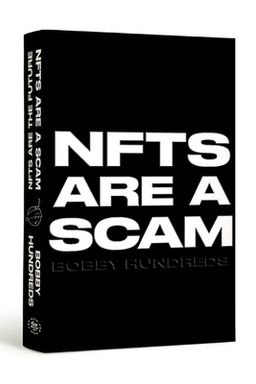
NFTs Are a Scam  NFTs are the Future cover

NFTs Are a Scam NFTs are the Future

by Bobby Hundreds

NFTs Are a Scam / NFTs Are the Future delves into the controversial world of non-fungible tokens, exploring their impact on art, investment, and digital culture. With insights into scams, opportunities, and the future of digital ownership, Bobby Hundreds offers a balanced guide for skeptics and believers alike.

NFTs as a Mirror of Culture and Chaos

How do you make sense of technology that everyone swears is either the next revolution or the biggest scam in history? That’s the question Bobby Hundreds asks in NFTs Are a Scam / NFTs Are the Future, his deeply personal and cultural exploration of Web3. Hundreds argues that non-fungible tokens (NFTs) aren’t just speculative digital assets—they’re a mirror of modern society’s confusion, ambition, greed, and creativity. They reveal who we are, what we value, and how we build community in the digital age.

Hundreds, cofounder of the streetwear brand The Hundreds, entered the NFT space in 2020 and quickly became one of its most thoughtful observer-participants. He contends that NFTs represent the next cultural and technological wave after Web2 social media, uniting art, finance, technology, and community under a decentralized ethos. Yet they also expose the human flaws of haste, hype, and exploitation. The book argues from both sides: NFTs are a scam—and they’re also the future.

The Bigger Picture: From Hippies to Crypto

Hundreds begins by drawing a provocative comparison between the Web3 movement and the 1960s counterculture. Just as hippies sought to dismantle old social structures, crypto advocates were trying to decentralize control and create fairer systems. He quotes Vice interviews and Joan Didion’s accounts of the Sixties to show how idealism can crumble under exploitation and confusion. Web3, he says, is experiencing its version of Manson: bad actors, scams, and greed. Yet, as with hippies, the ideals—community, creativity, freedom—will outlast the chaos.

Three Revolutions at Once

Hundreds frames NFTs as part of a trifecta—crypto, the Metaverse, and Web3—each redefining ownership, identity, and connection online. Crypto reimagines money, NFTs reimagine property and art, and the Metaverse reimagines space and experience. Together, they promise a world where users—not corporations—own their data and creations. This vision of decentralization drives the enthusiasm, but also the mania. For every Beeple multimillion-dollar sale, there’s an FTX-level implosion confirming that early revolutions are messy by design.

The Culture Between Scams and Salvation

Rather than taking sides, Hundreds plays both skeptic and believer. He recounts stories of cynical neighbors calling NFTs “Pet Rocks 2.0,” while corporations like Nike and Amazon pour millions into digital collectibles. He explores the psychology behind why NFTs make people angry or dismissive—they challenge our instincts about what is real or valuable. “If NFTs are a scam,” he writes, “so is the entire world built on fabricated commodities like money and art.”

Throughout the book, Hundreds weaves vivid cultural parallels. He compares NFTs to sneakers, streetwear, cult movements, and religion—each offering a sense of identity and belonging while flirting with zealotry. Just as Supreme or Air Jordans made physical fashion into art and status, NFTs turn digital art into community and membership. And like any religion, they inspire fervent faith and provoke heresy.

Art, Identity, and the Power of Community

The book’s heart lies in Hundreds’ belief that NFTs are ultimately tools for creative empowerment. He himself launched Adam Bomb Squad—an NFT project built on his brand’s iconic cartoon bomb—to explore how digital ownership could strengthen community ties. His experiment becomes the lens through which he examines the psychological, social, and spiritual dimensions of Web3. NFTs, he says, aren’t just about making money; they’re about expressing identity, equity, and collective creation. “It’s what happens,” he writes, “when the community builds the brand.”

Why This All Matters

Hundreds positions NFTs as a cultural time capsule—a snapshot of humanity caught between doubt and belief, greed and creativity. Whether they become the future or fade into memory, their story teaches us how technological revolutions expose our deepest hopes and weaknesses. He doesn’t claim certainty. In fact, one of his recurring mantras is, “We’re still early.” The NFT movement, like every paradigm shift from printing presses to social media, requires patience, failure, and faith. If you want to understand not just blockchain but the human emotion driving it, Hundreds’ book insists you must look at NFTs as both mirror and prophecy.

Key Takeaway

NFTs aren’t the moral or technological endpoint—they’re the story of how a generation wrestles with authenticity, value, and belonging in a world where reality is mostly online.


NFTs as Modern Mythmaking

Hundreds approaches NFTs not just as digital receipts, but as the newest form of mythmaking—a way humans assign meaning to intangible things. He draws on economic theorist Karl Polanyi, who argued that every society invents fictions like money and land ownership, which later feel natural and moral. NFTs continue that tradition, turning digital files into certificates of value and belonging. “So,” Hundreds asks, “are NFTs a scam—or are they just new myths we haven’t normalized yet?”

The Power of Fictional Commodities

Polanyi’s notion that society sells fabricated goods resonates deeply in the crypto world. If money and land once seemed absurd commodities, perhaps JPEGs are simply the next evolution. Hundreds uses this theory to unpack how all economics rests on collective storytelling: we believe the dollar has value, just as we now believe the blockchain preserves truth. NFTs extend this myth by recording ownership immutably, stripping subjectivity from authenticity.

Scams, Speed, and the Story of Innovation

The author notes that every technological revolution begins as a con game. He points to historical parallels—the 18th-century “Spanish prisoner” scam, the 1990s Nigerian letter fraud, and even the dot-com bubble. The difference now is speed: technology amplifies both innovation and deception. Email scams evolved into NFT phishing; blockchain’s openness invited hackers and opportunists. This duality, Hundreds says, is the price of progress. “Technology isn’t inherently evil—it’s just moving faster than our moral guardrails.”

Why Fakes Make Us Real

Hundreds flips the idea of authenticity on its head. He claims that scams force us to define what’s genuine. When the internet was young, spam emails and fake Nigerian princes taught society how to protect identity online. NFTs are undergoing the same moral education. The influx of rug-pulls and pump-and-dump projects isn’t corruption—it’s crash-course evolution. Through fraud, users sharpen their understanding of ownership and trust. In his view, scams don’t destroy revolutions; they accelerate them.

Key Takeaway

NFTs mirror our oldest societal habits—creating value from imagination and learning morality from chaos. Like religion or money, their truth lies in the stories we agree to believe.


NFTs and the Culture of Community

A central theme in Hundreds’ philosophy is that the true power of NFTs lies not in technology but in the communities that form around them. He argues that Web3 offers a new social contract where communities—not corporations—govern brands, value, and even creative direction. To illustrate, Hundreds introduces readers to projects like Deadfellaz (led by Betty and Psych) and his own Adam Bomb Squad, both demonstrating how culture outweighs cash.

Building on Digital Trust

In an interview with Deadfellaz founder Betty, Hundreds explores how culture becomes the glue that holds NFTs together when markets fall. Betty compares building Web3 brands to constructing something “structurally sound on a foundation of a children’s ball pit”—unstable until real values are added. Culture creates belonging beyond market cycles. It’s an antidote to volatility and greed, grounding NFTs in emotional meaning.

The Birth of a New Kind of Brand

Hundreds’ own project, Adam Bomb Squad, becomes a case study for how community can build a brand rather than merely consume it. Unlike traditional fashion, where customers advertise someone else’s identity, NFTs let users own and influence the brand’s trajectory. Members holding Adam Bomb NFTs don’t just buy merchandise—they gain stake and say. For Hundreds, this democratization reflects Web3’s ethos: decentralization as empowerment.

From Ownership to Fellowship

The author contrasts old hierarchies with emerging forms of communal leadership. In decentralized autonomous organizations (DAOs), decisions rise from the bottom-up mosaic of contributors. Betty calls this a “mosaic of behavior,” with small groups shaping big ideas collectively. Web3 doesn’t eliminate leadership—it redistributes it. The progression mirrors streetwear’s evolution: from secretive elitist scenes to inclusive global tribes connected by shared values.

Key Takeaway

NFTs thrive when they’re treated as shared culture, not speculative products. In Web3, community is currency, and belonging is the most valuable asset.


NFTs and the Reinvention of Art

Hundreds enters the NFT art discussion as both artist and patron, declaring that this technology reclaims value for creators. He laments that social media turned artists into unpaid laborers, enriching platforms instead of makers. NFTs, powered by blockchain’s transparency and smart contracts, solve this injustice. “Your art finally gets paid for its life,” he writes—every resale delivers royalties forever.

The Beeple and Idiot Effect

Hundreds cites headline moments like Beeple’s $69 million sale and Sean Williams’ “Idiot” NFT photo to show how everyday artists suddenly became millionaires. But he also warns that behind the hype lies an authentic revolution: digital work now holds financial and emotional equity. NFTs turn memes, GIFs, and photography into permanent assets, proving digital creativity equals physical artistry.

Digital Possession and Emotional Worth

He personalizes the phenomenon through his own creative struggles—years shooting photos dismissed as “worthless” because they lived online. NFTs shift that perception by giving digital files provenance. For him, it’s a spiritual awakening reminiscent of artists reclaiming meaning amid industrial capitalism (a comparison to Walter Benjamin’s idea of reproducible art losing aura). Blockchain restores that aura by certifying uniqueness.

The Future Museum

Hundreds predicts that NFTs will redefine curation and the museum concept itself. When ownership lives on-chain, galleries become networks and collectors become communities. Artists and fans can create economies around empathy and taste rather than gatekeeping. “Look beyond the million-dollar JPEGs,” he insists. “There’s a cultural revolution rumbling beneath.”

Key Takeaway

NFTs reimagine value creation for a digital generation, not as luxury hype, but as justice for overlooked artists whose online creativity finally earns permanence and pay.


NFTs as Fashion and Identity

Fashion, Hundreds argues, has always been about identity—and now that identity is primarily digital, clothes must evolve too. He sees metaverse wearables and profile picture NFTs as the next frontier of self-expression, freeing design from physics and material limits. “The Metaverse,” he writes, “is infinite design for boundless self-expression.”

Dress Beyond the Body

Hundreds traces fashion’s roots back to technology-driven shifts: tailoring emerged when new tools allowed personality to show through clothing. Now, digital technology enables fashion without constraint. He asks, “Why can’t Katniss just be the fire instead of wearing a dress made of it?” Metaverse fashion discards garments for emotional skins—avatars become the outfit itself. In this way, NFTs are the couture of cyberspace.

Streetwear Meets the Metaverse

Hundreds connects the NFT revolution to his own streetwear journey. He observes that streetwear taught people how to assign value to limited creations—Supreme drops, Nike collaborations, BAPE logos—exactly how NFT scarcity works. In the Metaverse, design becomes collective: users dress their avatars to signal tribe and taste. Companies like Gucci and Nike are already manufacturing virtual items, proving fashion’s power persists even when untouchable.

Identity and Imagination

He concludes that metaverse fashion revives the original spirit of style—identity as art. In a digital space where race, gender, and physics are irrelevant, self-expression becomes purer and freer. Our avatars, screens, and even profile pictures all become aesthetic statements. NFTs aren’t accessories to identity; they are identity.

Key Takeaway

In the Metaverse, fashion isn’t fabric—it’s data, emotion, and storytelling. NFTs allow us to wear who we are, even beyond the physical limits of the human body.


NFTs, Religion, and the Search for Meaning

One of Hundreds’ most provocative arguments is that NFTs function like religion. Both hinge on invisible value, ritual, and faith in unseen truths. He narrates how, after political and social disillusionment under Trump and COVID-19, people sought meaning in digital tribes. NFTs became their new churches, complete with doctrine, prophets, and salvation—or damnation.

God, Blockchain, and Belief

Hundreds draws parallels between divine truth and blockchain consensus. In Christianity, God is immutable and omniscient; in blockchain, code is unchangeable and transparent. “If God is truth,” he speculates, “then perhaps God is the blockchain.” Both systems promise objective reality amid chaos. Faith becomes consensus—the shared agreement that validates fact.

Digital Immortality

He expands this metaphor through fascinating examples of virtual resurrection: Tupac’s hologram concert, Kim Kardashian’s holographic father, and Korea’s digital child reunion. NFTs and the Metaverse promise eternal presence—the afterlife rendered in data. Projects like Somnium Space even plan avatars that live forever on servers. For Hundreds, these tools express humanity’s ancient longing to defeat mortality, now through code instead of creed.

The New Church of Web3

NFT culture, he observes, mirrors religious zeal—from preachy influencers to blind followers chanting slogans like “We’re still early.” The apocalypse (market crashes) and redemption (new mints) cycle repeatedly. Yet, beneath satire, he sees sincere spiritual hunger. When institutions fail, faith shifts to technology. We worship decentralization because it feels like control, and like religion, it’s powered by collective story and hope.

Key Takeaway

NFTs reveal that belief—more than technology—moves societies. Blockchain may be our modern scripture; its code, our miracle; its community, our congregation.


The Hardest Year: Lessons from Adam Bomb Squad

The book’s centerpiece is Hundreds’ first-hand chronicle of launching his NFT project, Adam Bomb Squad, which he calls “the hardest year” of his life. This section operates as memoir, business case study, and moral reflection—all showing how NFT creation tests leadership, psychology, and faith.

Building a Digital Brand

Inspired by CryptoPunks and Bored Apes, Hundreds minted 25,000 cartoon bomb NFTs to extend his streetwear brand into Web3. The project sold out in forty minutes, sparking both joy and chaos. Instead of celebrating, he faced community panic, technical issues, and relentless expectations. He learned that NFT founders raise money upfront and then spend years proving their worth. “The real work begins after the mint,” he writes.

Community, Anxiety, and Identity

Hundreds reveals the emotional toll of managing thousands of holders, each demanding updates and profits. Discord became his confessional, where faith and FUD (fear, uncertainty, doubt) battled daily. He lost weight, sleep, and sanity—but also discovered unexpected empathy. “NFT founders aren’t CEOs,” he says. “They’re pastors for digital congregations.” Over time, he reframed pressure as partnership: the community wasn’t burden; it was strength.

Transparency and Trust

To teach patience, Hundreds deliberately delayed releasing metadata—the information that ranks NFT rarity. Instead, he told stories behind each bomb, forcing collectors to appreciate narrative over numbers. This became a metaphor for art versus speculation: value is not data, but connection. The experiment polarized holders but cemented Hundreds’ philosophy that meaning must triumph over money.

Key Takeaway

Building in Web3 isn’t about profit—it’s about a new type of leadership where founders guide faith communities, not businesses. NFTs test human connection more than they test technology.


NFTs Are the Future: Beyond the Hype

Hundreds closes by acknowledging that NFTs as we know them will die—but their ideas will live on. Like every technological leap from radio to social media, their form will change while their function—digital ownership, creativity, community—will endure. The title of his epilogue, “NFTs Are the Future,” isn’t prophecy; it’s permission to imagine the next stage.

Endings That Begin Again

He describes the rollercoaster of the crypto winter and OpenSea’s temporary threat to remove creator royalties as proof that the space is resilient. Every collapse forces reinvention, just as dot-com failures birthed social media. Web3’s survival depends on adaptation: artists and communities will find new ways to thrive, whether through expanded mints, new utility, or decentralized marketplaces. “We’re so early,” Hundreds repeats like a mantra—it’s both comfort and challenge.

Creativity Without Roadmaps

Hundreds rejects rigid “road maps,” favoring organic evolution. His brand The Hundreds never had one, and its longevity came from improvisation. He applies the same freedom to NFTs: don’t plan, discover. Conviction, curiosity, and community drive progress—not certainty. In the end, he embraces the anxiety of not knowing as the essence of innovation.

Why Hope Survives

Closing with optimism, Hundreds insists NFTs won’t vanish despite market pessimism. Even if the word itself fades, its impact will ripple through art, fashion, gaming, and identity. “We’re not watching the end,” he writes. “We’re watching the beginning performed in real time.” To believe in NFTs, he suggests, is to believe in human creativity itself.

Key Takeaway

NFTs aren’t a destination—they’re evolution in motion. They remind us that the future belongs not to technology, but to the communities and artists brave enough to keep imagining.

Dig Deeper

Get personalized prompts to apply these lessons to your life and deepen your understanding.

Go Deeper

Get the Full Experience

Download Insight Books for AI-powered reflections, quizzes, and more.