
Idea 1
Building Big Growth Inside Big Companies
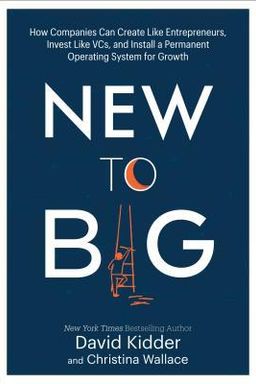
Why do some companies continue to grow with startup-like energy while others stall out into slow decline? In New to Big, David Kidder and Christina Wallace argue that even the largest organizations can reignite entrepreneurial growth—if they install a new operating system for discovery. The authors contend that growth doesn't depend on more money or ideas but on leadership that preserves a startup's hunger, adaptability, and customer obsession inside the machinery of an enterprise.
Their core claim is simple but revolutionary: established companies are excellent at taking what’s big and making it bigger, but terrible at taking what’s new and making it big. To solve this, every enterprise must build a parallel system—a “New to Big” machine—to coexist alongside the “Big to Bigger” engine that runs its existing business. By combining entrepreneurial discovery with the disciplined capital management of venture investing, leaders can continually uncover, validate, and scale new sources of growth.
From Startup Lessons to Corporate Renewal
Kidder draws heavily on experiences from his own startups and from his firm Bionic’s work with companies like GE, Nike, Citigroup, Microsoft, and P&G. He explains how entrepreneurs think and decide in uncertain terrain—what he calls the ‘Five Lenses of Growth.’ While MBAs are trained to optimize known systems, founders are trained to discover unknown opportunities. New to Big teaches enterprises how to integrate those startup mindsets and mechanics into their corporate DNA.
Through this lens, growth becomes a discoverable process rather than a plan. Instead of forecasting based on known markets, companies place a portfolio of small bets on unmet customer needs, testing and learning until new businesses emerge. Large firms can’t predict the future; they can only uncover it through experimentation.
Leadership, Culture, and the 'Day One' Mindset
The book insists that growth starts with the CEO’s mindset. Jeff Bezos’s idea of “Day One” versus “Day Two” frames this argument perfectly. Day One is hungry, fast, and adaptable; Day Two is complacent and bureaucratic. Big companies drift toward Day Two because their leaders reward efficiency over discovery. New to Big shows how to reverse that drift by embracing what Kidder calls 'refounder leadership'—leaders who preserve startup energy inside scaled enterprises. (Satya Nadella’s refounding of Microsoft serves as one of the book’s best examples.)
This transformation demands permission, ownership, and courage. CEOs must personally drive growth and empower teams to test ideas quickly, kill projects that fail, and celebrate learning rather than punish mistakes. Enterprises don’t have an idea problem—they have a leadership problem, the authors claim, because most executives are incentivized to avoid risk instead of create new business value.
Why This Book Matters Now
In a world of accelerating change, traditional business metrics like ROI and IRR can’t guide decisions for unknown markets. Startups have dominated the first wave of disruption by discovering and scaling new industries such as ride-sharing, cloud computing, and fintech, while big corporations largely outsourced innovation to Silicon Valley. Kidder and Wallace argue it’s time for enterprises to fight back. Their advantage lies in scale—customer trust, global distribution, manufacturing, and brand power—that startups lack. If those assets are paired with startup speed and entrepreneurial discovery, big can beat fast.
Throughout the book, readers will learn why traditional planning must give way to discovery, how to identify large unmet customer needs, validate ideas quickly, invest like venture capitalists, build ambidextrous leadership, and install a permanent growth operating system. It’s both a manual and a manifesto for corporate reinvention, arguing that your legacy organization doesn’t have to envy startups—it can become one.
“Big used to beat little; today, fast beats big. But if you can become both fast and big—if you learn to go from New to Big—you win.”
That is the promise of New to Big: transforming not just how organizations innovate, but how they lead. It’s a call for every executive, entrepreneur, and intrapreneur to play offense, rediscover their curiosity, and make growth a permanent capability.