
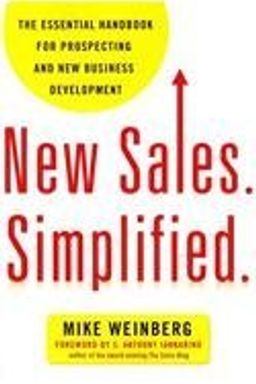
New Sales Simplified cover

New Sales Simplified

by Mike Weinberg

New Sales Simplified is a comprehensive guide for sales professionals seeking to excel in prospecting and new business development. Mike Weinberg shares practical strategies for targeting the right prospects, managing time effectively, and engaging clients with genuine communication, providing a clear path to sales success.

Sales Made Simple: Returning to the Lost Art of Selling

What if selling wasn’t as complicated as it seems? What if, beneath all the buzzwords, CRMs, and social media algorithms, the real secret to sales success was returning to the basics? That’s exactly the message Mike Weinberg drives home in New Sales. Simplified.: The Essential Handbook for Prospecting and New Business Development. Drawing from decades of frontline experience—as a top-performing salesperson, sales executive, and consultant—Weinberg argues that sales works best when it’s simple, structured, and relentlessly proactive.

Weinberg’s central claim is deceptively straightforward: sales is simple, but not easy. Salespeople and companies fail not because the profession has changed beyond recognition, but because they’ve forgotten—or abandoned—the fundamentals of prospecting and new business development. While trendy “Sales 2.0” gurus insist cold calling is dead and social media will save us, Weinberg insists otherwise. Buyers haven’t changed as much as our attitudes have. What’s really killing new business is confusion, laziness, and fear of rejection.

The book serves as both an inspirational manifesto and a tactical field guide. In his unmistakable blunt but humorous style, Weinberg strips away the fluff to show you precisely how to find, target, and win new customers. He breaks down what he calls the New Sales Driver—a three-part model that powers every successful new business campaign: Select Targets, Create and Deploy Weapons, and Plan and Execute the Attack.

The Crisis in Modern Sales

Weinberg opens by addressing a growing sales epidemic: far too many people in sales roles are not actually selling. Many are comfortable order takers or account managers who’ve never had to hunt for new business. Thanks to boom years in the 1990s and 2000s, plenty of salespeople prospered without doing proactive prospecting—they simply managed incoming demand. But as economic tides shifted, they found themselves unprepared and paralyzed. Instead of swinging back into action, they retreated into excuses: “We’re waiting for marketing leads,” or worse, claiming that buyers don’t respond to sales calls anymore.

And leadership hasn’t helped. Companies, Weinberg argues, set their people up for failure by dumping service responsibilities onto sales, devising absurd compensation plans that don’t reward new business, and assigning the same people to both farm and hunt. Add to that a lack of mentorship—those old-school Yoda-like sales managers who once rode shotgun with you, teaching by example have vanished. The result? A generation of salespeople allergic to picking up the phone.

The Return to Simplicity

Against this backdrop, Weinberg launches a counterrevolution. He contends that real success lies in mastering the basic yet powerful disciplines of classic salesmanship—identifying prime targets, communicating a compelling story, and executing disciplined activity. The heroes of Weinberg’s world are not tech-savvy Twitter wizards, but hunters who have a system and stick to it. He calls for a renewed respect for the job of selling, for the professionalism, preparation, and pride it demands. Sales, at its best, is not manipulation but service: helping people solve real problems by connecting them with meaningful solutions.

A Field Guide to Prospecting

From there, the book moves from philosophy to practical implementation. Weinberg deconstructs the entire process of new business development—from laying the groundwork to getting that first meeting, crafting your narrative, conducting winning calls, and following up to close the loop. He gives salespeople tools—such as the “Power Statement,” a refined version of the classic elevator pitch—and demonstrates how to tailor messages around customer pains rather than self-promotion. Most importantly, he teaches readers how to think like hunters: disciplined, strategic, and unafraid of the grind.

Along the way, he uses colorful metaphors—“never bring a water pistol to a gunfight,” “no one defaults to prospecting mode,” “stop babysitting existing accounts”—and real-life stories drawn from his own career. Whether describing his formative years mapping prospects on a foam-board map with colored pins or recounting a disastrous high-stakes presentation hijacked by ego, Weinberg’s anecdotes serve as cautionary tales and success blueprints in equal measure.

Why This Matters

This book matters because Weinberg captures a truth that’s often obscured in today’s loud, digital marketplace: selling is human again. As technology expands, so does the need for genuine connection, discipline, and courage. His approach doesn’t reject new tools—it integrates them without surrendering the timeless essence of selling: curiosity, empathy, and professionalism. Whether you’re a CEO frustrated with stagnant growth or a rookie rep afraid of picking up the phone, New Sales. Simplified. re-centers you on what actually matters: taking action, telling your story, and owning your pipeline.

By the time you finish the book, you’ll know the sixteen reasons most salespeople fail, the three-part model to reverse it, and how to transform your call reluctance into confidence. It’s a handbook, yes—but more than that, it’s a wake-up call to rediscover the craft of selling in its purest, most rewarding form.


The Not-So-Sweet 16 Reasons Salespeople Fail

Weinberg’s famous “Not-So-Sweet 16” list is both indictment and instruction manual—a mirror held up to the profession’s bad habits. Drawing from thousands of hours coaching teams, he identifies sixteen recurring reasons why salespeople underperform in new business development. Each one feels uncomfortably familiar, but that’s the point—they’re meant to force brutal self-honesty.

The Psychology of Failure

At the top of Weinberg’s list are psychological barriers. Many salespeople simply haven’t had to prospect or don’t know how, often because success came easy during economic booms. Others, he says, become “prisoners of hope,” clinging to a handful of deals in the pipeline instead of proactively pursuing new ones. Negativity and pessimism—what he calls “victim mentality”—also destroy momentum. Real hunters, Weinberg insists, take ownership of results instead of blaming the company, the market, or bad luck.

Behavioral Pitfalls

Some failures stem from pure behavior. Many reps are “late to the party,” reacting to opportunities only after competitors have already framed the game. Others waste time “waiting on the company” for new materials or clearer direction. The fake-activity syndrome—pretending to prospect while really surfing LinkedIn or “researching”—is rampant. And perhaps the biggest killer: they don’t use or protect their calendars. Weinberg’s unforgiving observation is that no one defaults to prospecting mode. If you don’t schedule it, it won’t happen.

Skill Deficiencies

Others fail due to missing skills. They can’t tell their company’s story convincingly, conduct effective calls, or adapt their communication style to match buyers’ personalities. Many fall back on account babysitting—spending 95% of their time servicing loyal customers while ignoring growth prospects. Weinberg warns that “being too nice” is not always an asset. The salesperson who loves committee meetings and company volunteer projects tends to underperform. Top producers, by contrast, are politely selfish with their time, focusing on revenue-driving activity.

Lack of Process and Growth

Weinberg reserves particular ire for those who “don’t own their sales process.” Too many sellers simply follow the buyer’s process, presenting and proposing on demand rather than guiding the sale. He also notes that many have stopped learning—an unforgivable offense in a knowledge-driven world. A true professional, he argues, reads sales books, follows gurus, and hones craft weekly (he cites Jill Konrath’s SNAP Selling as required reading). Finally, some people just aren’t built for hunting. Highly relational or analytical personalities who avoid conflict may excel in service roles but crumble under the pressure of prospecting. A company’s biggest mistake, he argues, is forcing such people into roles that don’t fit.

The value of this chapter isn’t just tough love—it’s clarity. By naming each failure pattern, Weinberg gives you a diagnostic checklist. If you want to win at new business, he says, your success begins with eliminating the behaviors that guarantee you won’t.


Why Companies Often Sabotage Sales Success

Weinberg doesn’t let executives or company structures off the hook. In Chapter 3, he flips the mirror toward leadership, exposing how organizations themselves cripple their sales teams. His message to CEOs: “Sales follows strategy—so do your job so I can do mine.”

Strategic Confusion and Mixed Signals

He begins with a fundamental truth: if there is no clear business direction, there can be no coherent sales effort. Many companies, he finds, cannot articulate why they exist, what they sell, whom they serve, or why they’re different. Without that clarity, sales reps improvise, chasing mismatched opportunities and wasting time on bad targets. Strategy isn’t a slogan—it’s the compass guiding every sales call. If the leadership team hasn’t defined it, no amount of coaching can compensate.

A Culture That Devalues Sales

A recurring corporate sin, Weinberg argues, is a low view of sales. He recounts stories of managers treating sales as the dumping ground for everyone’s problems: customer service errors, accounting issues, even warehouse mishaps. Too often, sales managers are overburdened with administrative garbage instead of coaching their teams. This cultural disrespect demoralizes reps and fractures company alignment. By contrast, in sales-driven organizations like Slim-Fast or his later direct-marketing company, Weinberg saw salespeople treated like royalty—and revenues soared as a result.

The Hybrid Hunter-Farmer Trap

Perhaps the biggest structural flaw is what he calls the “hybrid hunter-farmer role.” Companies expect one person to both land new business and service existing accounts—a recipe for mediocrity. With only 10–15% of most teams made up of true hunters, asking them to divide their time is self-sabotage. Through a vivid fishing analogy, Weinberg mocks leaders who make their best fisherman catch a marlin, then clean, cook, and serve it—barely leaving time to fish. The solution? Free hunters to hunt. Redesign teams and support functions so that top producers can spend 75% of their time fishing for new business.

Misaligned Compensation and a Culture of Mistrust

Two more systemic killers: illogical pay plans and micromanagement. Many organizations, he says, pay underperformers too much and top producers too little, discouraging excellence and new-client pursuit. If compensation doesn’t reward hunting, don’t expect hunters. Likewise, when companies mistrust and micromanage their salespeople—tracking every activity in CRM like a parole officer—they crush the independence and pride that drive results. Sales is a profession of the heart as much as the head, he reminds executives. Without belief, trust, and cultural respect, even great sales talent will wither.

Taken together, this chapter is both a scolding and a strategic blueprint for leaders. If your sales team isn’t selling, Weinberg insists, look in the mirror. Fixing sales starts not with software or slogans—but with structure, culture, and clarity.


The New Sales Driver Framework

After diagnosing the diseases plaguing sales, Weinberg delivers the cure: The New Sales Driver, his simple, battle-tested framework for developing new business. It’s an elegantly minimal system born out of experience and refined through hundreds of client engagements: Select targets. Create and deploy weapons. Plan and execute the attack. Three parts. No fluff. Just fundamentals executed with discipline.

1. Select Targets

Everything begins with focus. Weinberg insists you can’t hit a target you haven’t named. A winning target list must be finite, focused, written, and workable. Too many sellers are “wandering aimlessly,” spreading effort thin instead of saturating a defined list. Your targets should mirror your best customers—those who “look, smell, and feel” similar. The secret isn’t chasing random leads but strategically selecting accounts where you can deliver and win. It’s deliberately narrowing your world so you can dominate it.

2. Create and Deploy Weapons

Once targets are chosen, you need the right firepower. In Weinberg’s military metaphor, these weapons include your sales story, the proactive phone call, and the face-to-face sales call. Supporting tools—emails, case studies, proposals—are secondary. The key is proficiency. You should master your weapons so thoroughly that you can fire them confidently under pressure. The goal isn’t volume of tactics but the potency and precision of each strike.

3. Plan and Execute the Attack

Targets and weapons are useless without execution. This is where most salespeople fail. They talk a good game but fail to act. Weinberg challenges readers to “block time, work the math, and hold yourself accountable.” Schedule weekly prospecting blocks as sacred appointments. Track the ratio between outreach, meetings, and closed deals. Ensure that your pipeline stays full, moving, and balanced—divided equally between targeted, active, and hot opportunities. Above all, commit to consistency. “Sales is a verb,” he repeats. Nothing works unless you do.

The New Sales Driver is deceptively simple, which is precisely its power. It doesn’t promise tricks or hacks—just a framework that, when executed relentlessly, guarantees measurable results. Weinberg’s declaration is bold but backed by two decades of proof: if your new business effort fails, it’s because you missed one of these three steps.


Crafting a Powerful Sales Story

For Weinberg, storytelling isn’t a marketing luxury—it’s your most essential weapon. A weak story kills sales faster than a bad product. In Chapters 7 and 8, he shows how to build and deploy what he calls the Power Statement, a potent, client-focused narrative that centers not on what you do, but on what your customers achieve because of you.

Flipping the Script: From Self to Customer

Most salespeople, Weinberg laments, are self-absorbed in their messaging: “We’ve been in business 25 years,” “We’re the market leader,” “Our customer service is the best.” This puts buyers to sleep. The first rule of storytelling is simple: it’s not about you. Your story should begin with client pains, problems, and results. Prospects don’t care what you make; they care what you make happen. As Charles Revson of Revlon famously said, “We don’t sell cosmetics, we sell hope.” Weinberg revives that spirit—sales is about hope, outcomes, and improvement.

The Three Building Blocks

Weinberg’s Power Statement has three sections: (1) client issues addressed, (2) offerings, and (3) differentiators. The order matters: lead with customer issues, not your product catalog. They are the “sharp tip of your sales spear.” Then briefly mention what you provide, followed by why you’re better or different. He demonstrates the formula through real examples, such as “Allsafe Security,” a Canadian firm whose revamped story transformed demoralized guards into confident consultants. By shifting from features (“we offer CCTV monitoring”) to pains (“clients frustrated by untrained, unreliable security staff”), the team doubled sales velocity.

Sharpening Your Message

Weinberg guides readers through an exercise: brainstorm customer pains, consult raving fans about why they chose you, identify differentiators, then condense it into a tight two- to three-minute story. It becomes your master reference for calls, emails, presentations, and proposals. And because it’s grounded in customer reality—not corporate fluff—it builds confidence. When you believe your story, you sell with pride. As Weinberg quips, “A premium price requires a premium story.”

Ultimately, storytelling is the antidote to commoditization. When products look similar, stories aren’t a gimmick; they’re a differentiator. A great story turns you from vendor to value creator—from “one of many” to “the only one that matters.”


Winning with the Proactive Phone Call

If there’s a single skill Weinberg fights hardest to revive, it’s the lost art of the cold call—though he prefers a friendlier term: the proactive telephone call. To him, the phone remains the most powerful sales weapon ever invented—yet also the most feared. His coaching boils down to mindset, structure, and persistence.

Fixing Your Mindset

Weinberg first asks you to erase the mental “tapes” of telemarketing. You’re not a spam caller; you’re a professional offering value. Every call is a small act of service. The reason most people hate calling is they imagine themselves as intruders. Flip that script—believe your call helps, and your tone transforms. As he says, buyers can hear your confidence—or fear—within seconds.

The Structure That Works

A successful call, he explains, has one goal: to secure the meeting. Too many reps overqualify prospects, grilling them for fit before meeting. Stop doing that. If you’ve already chosen the account strategically, you want the meeting. Weinberg’s formula begins with a natural opener (“Let me steal a minute”), positions you as credible (“I head up our regional team”), and delivers a mini power statement highlighting two client issues. End every ask using his three magic words—visit, fit, and value: “I’d love to visit with you to see if there’s a fit and I promise you’ll get value from our conversation.”

Persistence Pays

Weinberg challenges you to ask three times for the meeting, calmly pushing past reflex rejections. Most prospects aren’t saying “no forever”—just “not now.” Be pleasantly persistent. And when it goes to voicemail (as it will 75% of the time), treat that as an opportunity, not a dead end. Leave short, confident messages that reveal bits of your story and end with a promise to follow up. Over time, these touches position you as professional and human—the opposite of the desperate telemarketer stereotype.

His mantra captures the spirit: “Sales is a verb.” The phone only works for those who pick it up. When you consistently do, you enter a rare club—the 10% of salespeople still brave enough to call. And that 10%, he reminds us, wins most of the deals.


Structuring the Winning Sales Call

Once you’ve secured that meeting, what do you do? Weinberg’s answer is laser-clear: conduct the sales call; don’t just go on it. Think of yourself as the pilot in command, not a passenger. He lays out a proven seven-step structure that ensures every meeting is purposeful, professional, and productive.

1. Build Rapport and Identify Style

Start by connecting personally, but follow the prospect’s lead—talk baseball with the chatty type, go straight to business with the analytical. Use this phase to read behavioral cues so you can adapt your own style and pace. Sales, he reminds, is emotional intelligence in action.

2. Share the Agenda

This is your chance to stand out. Almost no one explicitly sets an agenda. Do it, and you instantly appear competent and respectful of time. Outline what you’ll cover—including your two-minute story, questions to understand their situation, and potential next steps—and then ask, “What would you like to accomplish today?” It signals partnership, not pushiness.

3. Deliver the Power Statement

Weinberg asks you to use your full Power Statement early—three minutes max—to explain who turns to you, what you provide, and how you’re different. Then stop talking. Watch reactions. Note when they nod, flinch, or take notes; those cues reveal where to probe next.

4. Ask and Listen

Discovery is the heart of selling. Ask probing questions about goals, challenges, and consequences of inaction. Listen twice as much as you speak (“God gave you two ears and one mouth for a reason”). Turn pains into insights, not interrogations. Weinberg divides questions into personal, strategic, issue-seeking, and process categories—all designed to reveal both business needs and buying dynamics.

5–7. Sell, Seek Fit, and Define the Next Step

Only after understanding the customer’s reality do you present. Tailor your solutions precisely to the pain points uncovered. Then test the fit: “It seems we might be a good match—what do you think?” Finally, lock in next steps while you’re still in the room. A meeting without a defined follow-up is a failed meeting, he warns. Control the landing of your sales flight by scheduling the exact date and responsibility for the next action.

The beauty of this structure is its flexibility—it’s not a script, it’s choreography. Follow it faithfully, and you’ll never again leave a sales call saying, “That went pretty well, I think.” You’ll know exactly where you are and why.


Execution, Discipline, and the Long Game

The final act of New Sales. Simplified. is a rallying cry for execution. Weinberg insists that all the frameworks, tools, and tips mean nothing if you don’t do the work. Prospecting is a discipline, not an event. Excellence, he writes, comes from time blocking, working the math, and playing the long game.

Time Blocking and Focus

Weinberg’s simplest productivity tool is also his most powerful: schedule nonnegotiable “prospecting appointments” with yourself. Two-hour blocks, two to four times per week. During that time, no email, no social media, no colleagues. Treat this like a meeting with your biggest client—because it is. “No one defaults to prospecting mode,” he warns. Protect this time fiercely or it will disappear into distractions.

Work the Math

Sales isn’t guesswork—it’s a numbers game of predictable conversions. Weinberg urges you to reverse-engineer your goals: if it takes 3 meetings to land 1 proposal and 3 proposals to win 1 deal, then 144 calls yield 12 new clients. When you “work the math,” rejection becomes something measurable, not personal. It’s liberating.

Balance the Pipeline

He proposes a simple formula for time allocation: one-third of your energy on hot deals, one-third on active opportunities, one-third on prospecting new targets. Most reps overweight hot deals and end up dry later. A healthy pipeline, he says, is full, moving, and balanced—no prisoners of hope, no moldy opportunities.

Professional Habits

In the closing chapters, Weinberg shares “rants and reflections” on professionalism: be punctual, mind your image, attack the giant competitor without fear, stay off your phone during family vacations, and guard your optimism. Attitude, he writes, is contagious within a team; cynicism spreads faster than skill. Winners own their mornings, win the deal early, and never apologize for being in sales. It’s not just a job—it’s a craft.

Weinberg ends where he began: sales success is not complicated, but it is earned through disciplined execution of the basics. If you take nothing else from the book, take this—sales is simple, disciplined, and profoundly human. When done right, it’s one of the most honorable and fulfilling professions in business.

Dig Deeper

Get personalized prompts to apply these lessons to your life and deepen your understanding.

Go Deeper

Get the Full Experience

Download Insight Books for AI-powered reflections, quizzes, and more.